Flooring Calculator
Estimate flooring boxes, waste, material cost, and installed cost by flooring type.
Room Details
Room Length (ft)
Room Width (ft)
Flooring Type
Estimates only. Not professional advice.
On the hardwood carton
Ask what the board length mix in the carton is. A box of mostly short lengths costs you an extra row of offcuts.
Going deeper
This page prices every material against the same room. For the inputs that only matter to one of them, the hardwood flooring calculator goes further.
Plan to order
10boxes
Hardwood for a 180 sq ft room, ordered at 198 sq ft once the 10% cut allowance is in.
- Sold as
- 20 sq ft per box
- Whole units to buy
- 10 boxes
- Cut allowance
- 10%
- Installed, all in
- $1,584 to $3,960
- Hardwood material
- $1,188 – $2,376
Coverage assumed: 20 sq ft per box and 200 sq ft per underlayment roll. The installed figure adds $2 to $8 per sq ft of labour and excludes trim, transitions, adhesive and pad upgrades.
Material swap
Flooring cost comparison: one room, five materials
Your room, priced across every material this site covers, with the service life that decides what it costs to keep. Carpet is the odd one out: it is roll goods, so its order comes off a 12 ft width rather than a cut allowance. Nothing here changes the order above.
Head to head
Vinyl plank costs $792 less to buy than hardwood for this room, and $28 a year more to own. Hardwood lasts 25 years and up, and solid boards take two or three sandings after that.
Hardwood offcut
Board lengths come random in the carton, so you cut to fit rather than to a plan, and the short pieces left over rarely suit anywhere else in the room.
Vinyl plank offcut
Least wasteful of the five: the boards score with a knife rather than a saw, so a mis-measure is recoverable. Sheet vinyl drops nearer 5% again because it arrives as one piece.
In neither price
- Under the floor
- One 200 sq ft underlayment roll per 200 sq ft for plank and laminate. Tile takes thinset instead, and carpet takes a pad from about $0.50 per sq ft.
- Holding it down
- Click-lock plank and laminate float free. Nailed hardwood, glued vinyl and tiled floors each add a fastener, an adhesive or a bag of mortar.
- Around the edges
- T-mouldings, reducers, thresholds and shoe moulding, counted in lineal feet at $5 to $15 a strip and left off almost every estimate.
Written and reviewed by
Creator
Hawkin
Certified Cost & Estimating Professional
AACE-certified estimator working with 20+ insulation companies including the two largest franchises in America.
See full profileExpert Review
Ehsan Ghazanfari
Licensed Structural Engineer
FISE-certified structural engineer with 11+ years designing bridges, retaining walls, and foundations. MSc from Aalto University.
See full profileUpdated August 4, 2026
How we verify our calculatorsApplies to every row
- Room measured
- 180 sq ft
- Cut allowance
- 10%
- Carpet roll width
- 12 ft, 1 strip
- Roll-width overage
- 0 sq ft
- Labour, on top
- $2 to $8 per sq ft
Turning the room so its shorter side runs across the roll can drop a carpet strip and take the overage with it.
| Material | Order, sq ft | Material cost | Grade spread | Service life | Per year |
|---|---|---|---|---|---|
| Vinyl Plank (LVP) | 198 | $594–$1,386 | $0.75 to $7.50 | 10 to 25 yr | $99 |
| Laminate | 198 | $396–$990 | $1.00 to $8.00 | 10 to 25 yr | $69 |
| Hardwoodyours | 198 | $1,188–$2,376 | $6.00 to $18.00 | 25 yr and up | $71 |
| Ceramic/Porcelain Tile | 198 | $396–$2,970 | $1.00 to $25.00 | 50 yr and up | $34 |
| Carpet | 198 | $396–$1,584 | $2.00 to $8.00 | 8 to 10 yr | $124 |
Material cost uses the same dollars per square foot this calculator uses for its own order figures, so the table and the tool can never disagree. Grade spread is the full range in that material's own calculator, linked in the tips below. Per year divides the mid material cost by the SHORT end of the service life, which is why tile wins it here. Material only: no labour, underlayment, pad, adhesive or trim.
Room by room
Four rooms, four materials, and what each flooring order came to
Four jobs run through this calculator at its default 10% allowance. Every figure below is what the tool returns, and the material was picked for the room rather than the price.
Small bedroom
10 × 10 ft · 100 sq ft · laminate
5 cartons · $220 to $550
Straight click-lock, one doorway, 10% allowance. The cheapest floor in the house to buy and among the shortest lived, which matters less in a room nobody walks through in shoes.
Living room
15 × 12 ft · 180 sq ft · hardwood
10 boxes · $1,188 to $2,376
Six times the laminate money for the same footprint, and it will still be there in twenty five years after two sandings. Order the whole room in one go: board lengths and shade both drift between runs.
Open plan kitchen and diner
20 × 18 ft · 360 sq ft · vinyl plank
17 cartons · $1,188 to $2,772
Waterproof, warm underfoot, no thinset. The right call anywhere a dishwasher can leak. Two transitions to budget, one at the hall and one at the patio door.
Whole ground floor
40 × 25 ft · 1,000 sq ft · tile
74 boxes · $2,200 to $16,500
The widest price range on the page, because $2 ceramic and $15 porcelain both count as tile. At this area a cut strip runs the full length of two walls, so set the field out before the first bag of thinset is mixed.
Beyond the tape
Flooring waste, boxes and transitions: what the room area misses
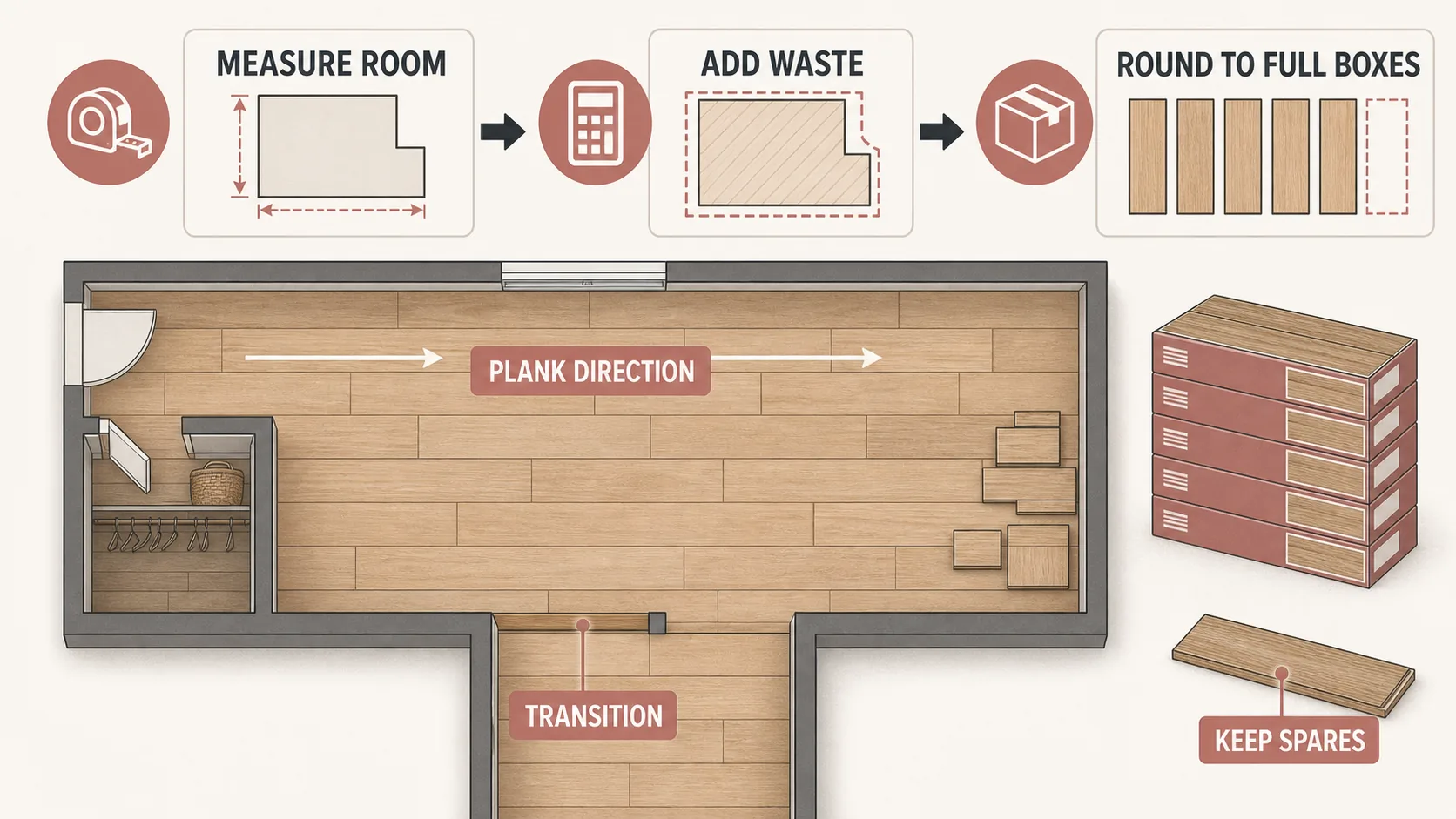
Length times width is the first of six numbers on a flooring order, and it is the only one the tape measure gives you. The other five are what people go back to the store for.
- Measured area
- Length times width, closets and hearth alcoves included, built-in cabinet runs excluded. An L-shaped room is two rectangles added together, not one average.
- Cut allowance
- 10% on a straight run in a plain rectangle. 15% once there are closets, returns or a diagonal, 20% for herringbone. The allowance covers offcuts too short to use anywhere else in the room, not breakage.
- Whole boxes
- Nobody sells you 3.4 boxes. The rounding up is often worth more than the allowance: a 198 sq ft order in 24 sq ft cartons buys 216 sq ft, so you are already 9% over before the slider moves.
- Underlayment
- One 200 sq ft roll per 200 sq ft of floor, for laminate, LVP and engineered hardwood. Tile takes thinset instead and carpet takes a pad, so neither uses a roll.
- Transitions and trim
- Counted in lineal feet and almost always forgotten. T-moulding between rooms at the same height, a reducer where the height changes, a threshold at every exterior door. Budget $5 to $15 a strip.
- Spare stock
- One box, unopened, in the garage. Shade and batch both drift between production runs, so a repair three years out cannot be bought to match, only replaced wall to wall.
Acclimation
Flooring install tips that change what you order
Numbered in the order they come up, from choosing the material to repainting the skirting once the floor is down. Several point at the sibling calculator that goes deeper on one material.
- 01
Always buy 10% extra for waste on rectangular rooms and 15% for diagonal layouts or rooms with many cuts. Returns are easier than re-orders from a different dye lot.
- 02
Acclimate hardwood and laminate planks in the room for 48 to 72 hours before installation. Wood expands and contracts with humidity changes.
- 03
For laminate-specific estimates including AC ratings and layout patterns, use our laminate flooring calculator.
- 04
Use our sq ft to linear ft calculator to convert room measurements when buying baseboards and trim for your new floor.
- 05
Run planks parallel to the longest wall for the best visual effect. Diagonal layouts look dramatic but waste 15 to 20% more material.
- 06
LVP (luxury vinyl plank) is the best value for moisture-prone areas. It handles kitchens, bathrooms, and basements where hardwood would warp.
- 07
Uneven subfloor? Our self-leveling concrete calculator estimates leveler bags and primer before your flooring install.
- 08
For vinyl-specific estimates with SPC, WPC, and wear layer guidance, use our vinyl flooring calculator.
- 09
For irregular rooms, use our square footage calculator to find the exact area before ordering flooring.
- 10
After installing new flooring, you may need to repaint baseboards and trim. Use our paint calculator for touch-up estimates.
- 11
After installing flooring, use our baseboard calculator to estimate trim pieces and shoe molding.
- 12
For tile-specific estimates with thinset, grout, and layout patterns, use our tile calculator.
Layout penalty
Flooring waste allowance by layout, for your room
The allowance is not a safety margin, it is the offcut you cannot reuse. The extra area column is your own 180 sq ft at each figure.
| Layout | Allowance | Extra sq ft | Where it goes |
|---|---|---|---|
| Straight, parallel to the long wall | 10% | 18 | Cuts land only at the perimeter, and most trimmed pieces are long enough to use again. |
| Straight, room with closets and a hall | 15% | 27 | Every doorway and return restarts the cutting, and the offcuts rarely fit the next opening. |
| Diagonal at 45 degrees | 15% | 27 | Every perimeter piece is cut at an angle, and an angled offcut fits nothing else. |
| Herringbone or chevron | 20% | 36 | Every piece is cut, and the pattern only closes on a full unit. |
Whole-box rounding sits on top of all four figures. A room that lands three quarters of the way into a carton pays for the whole carton either way.
A season later
Five flooring mistakes you only notice a season later
None of these show on the day the last plank goes down. They show when the heating comes on, or when the second box is opened, and by then the fix is the whole room.
Laying the planks the day they arrive
Wood and laminate arrive at the store's humidity, not the room's, and they move once they settle. Gaps in winter, buckling in summer.
Leave the boxes flat in the room for 48 to 72 hours, unopened, before a single cut. The wait costs nothing and it is not recoverable afterwards.
No transition budgeted at the doorways
Two floors meeting at a door need a T-moulding at equal height and a reducer where the height changes. The gap is what everyone stubs a toe on.
Count every opening before you leave the store and add $5 to $15 a strip. Match the strip to the floor at the same time, or the colour never quite lands.
Not checking the subfloor is flat
More than 3/16 in of dip over 10 ft makes a plank floor bounce and click, and it telegraphs straight through tile as lippage.
Drag an 8 ft straightedge across the room in both directions first. Fill the low spots with leveller, and let it cure fully before anything goes on top.
Skipping the moisture barrier on a slab
Concrete wicks moisture upward for years after it is poured, and it destroys flooring from underneath where nobody can see it.
Underlayment with an integral vapour barrier on every slab, taped at the seams and run up the wall behind the skirting.
Buying the floor in two trips
The second batch is a different production run. Shade and thickness both drift, and the change lands as a visible line across the room.
Order the whole job at once, check the batch number on every box, and keep one unopened box for repairs.
Cost to own
Flooring cost per square foot, and what a box covers
Two lookups worth having open in the aisle: the rate the material sells at, and the area one unit covers. Tile has the widest spread on the wall because $2 ceramic and $15 porcelain sit under the same word.
Bars share one axis running to $15/sq ft. Material only: installation adds $2 to $8 per sq ft on top, and tile sits at the high end of that because of the substrate prep.
Hardwood
Laminate
Vinyl Plank
Ceramic/Porcelain Tile
Carpet
Box coverage varies by maker, so check the carton before you count. Carpet is the exception on the row: it is sold by the square yard off a 12 ft roll, and nine square feet make one square yard.
Box arithmetic
The arithmetic behind your flooring box count
Area times the allowance gives the quantity to buy. Everything after that divides by a coverage rate and rounds up, because a carton is the smallest thing anyone will sell you. The rounding is where the real overage hides: it is invisible in the percentage and it can run higher than the allowance itself.
Rates come from NWFA, TCNA, NALFA and CRI installation guidance and from carton ratings. They assume a flat, dry subfloor and a plain rectangle. A wavy floor or a room full of returns takes more, and no formula predicts how much.
The formulas
buy = length × width × (1 + waste)boxes = buy ÷ sq ft per boxcarpet sq yd = buy ÷ 9underlayment = buy ÷ 200material = buy × $ per sq ftinstalled = material + buy × $2 to $8Every division rounds up. Metric input is converted at 3.28084 ft per metre before any of this runs, so the coverage rates stay in the units the cartons are printed in.
Before you order
Flooring questions people ask at the store counter
The eight that come up in front of the sample wall, answered against the same NWFA, TCNA, NALFA and CRI guidance this calculator is built on.
How many boxes of flooring for a 12x12 room?
About 8 boxes of laminate (24 sq ft/box) or 9 boxes of hardwood (20 sq ft/box) with 10% waste.
How much does flooring cost per square foot?
Laminate $2 to $5, LVP $3 to $7, hardwood $6 to $12, tile $2 to $15 depending on material quality.
How much extra flooring should I buy?
10% for rectangular rooms with straight layouts. 15% for diagonal, herringbone, or rooms with many doorways and closets.
Do I need underlayment?
Yes for laminate, LVP, and engineered hardwood on concrete subfloors. Not needed for tile (use thinset) or carpet (uses carpet pad instead).
What is the most durable flooring?
Porcelain tile is the most durable (50+ year lifespan). LVP is the best balance of durability and comfort. Carpet wears fastest (8 to 10 years).
Can I install flooring over existing flooring?
LVP and laminate can go over most flat, solid existing floors. Hardwood and tile need bare subfloor. Never layer carpet.
How do I calculate flooring for an L-shaped room?
Split it into two rectangles, calculate each separately, then add the areas together before applying waste factor.
What direction should I lay planks?
Parallel to the longest wall or toward the main light source. This makes the room appear larger and more cohesive.
Disclaimer
These estimates are for planning purposes only. Actual costs vary by location, material availability, and project complexity. Always get at least 3 local quotes. This calculator does not replace professional advice.
Sources
Related Calculators
Carpet Calculator
Square yards, roll length, and cost
Tile Calculator
Tiles, thinset, grout, and spacers
Grout Calculator
Pounds of grout by tile and joint
Vinyl Flooring Calculator
LVP, LVT, SPC, WPC
Baseboard Calculator
Trim and molding
Self-Leveling Concrete Calculator
Subfloor prep and leveler
Laminate Flooring Calculator
Laminate planks and boxes
Square Yard Calculator
Square yards for flooring & fabric