Self-Leveling Concrete Calculator
Count bags, primer and cost from the floor area and how far the slab is out of level.
Floor Details
Not the drop you measured. Open the options below to work it out from the fall.
Product type
Estimates only. Not professional advice.
Bags to buy
950 lb bags
Standard Self-Leveler over 180 sq ft at 1/4 in average, including the 15% allowance.
- Standard Self-Leveleryours
- 9 bags, $225 to $315
- High-Flow Premium
- 10 bags, $350 to $500
- Feather Edge (Thin Pour)
- 5 bags, $100 to $150
- Quick-Set (Walk in 2-4 hrs)
- 11 bags, $440 to $605
- Material cost per sq ft
- $1.25 to $1.75
Last updated August 11, 2026. Coverage and minimum-thickness figures checked against ARDEX, MAPEI and Henry product data by our expert review team.
The fall
Self-leveling concrete depth: what a floor that is out of level actually needs
The bag count follows the depth, and the depth is not the drop you measured. Compound has to cover the high point before it can level anything, so the pour runs from the product minimum at the top of the slab to that minimum plus the whole drop at the bottom.
Vertical is exaggerated 229 times; horizontal is true. At true scale the whole wedge would be thinner than the line drawn along the top of it.
The reading most estimates use
Half the drop on its own is 1/8 in and 5 bags. It draws as a wedge that tapers to nothing at the left-hand edge, which leaves the high point bare, and it is short by 4.
This floor, top to bottom
- Longest run
- 15 ft
- Drop across that run
- 1/4 in
- Quoted as
- 3/16 in per 10 ft
- Minimum over the high point
- 1/8 in
- Depth at the low point
- 3/8 in
- Average depth to enter
- 1/4 in
- Bags at that depth
- 9
Wasted bags
Where a self-leveling concrete pour goes wrong, and what each mistake costs
Four of these six change the number of bags on the pallet, and the other two decide whether the floor that comes out of them is worth having. None of them are visible on the day.
Pouring half the drop and calling it the average
A floor half an inch out of level is not a quarter-inch pour. Half the drop leaves nothing at all on the high point, and the compound has to bury that point before it can find a level surface.
Add the product minimum over the high point to half the drop. On a half-inch fall with a 1/8 in minimum that is 3/8 in average, and 3/8 in buys a third less floor per bag than 1/4 in does.
Reading the floor with a 4 ft level in one spot
A 4 ft level finds the fall in 4 ft. Rooms fall across their whole length, and the figure the estimate needs is the total high-to-low difference over the pour.
Stretch a laser line or a taut string across the longest run and measure down to the slab every 2 to 3 ft. The largest and smallest readings are the only two numbers the depth derivation wants.
Leaving the high point where it is
Every bag on the floor is priced off the high point, because the whole surface has to rise above it before it can be flat.
Grind the ridges down first, then measure again. Taking 1/8 in off one high spot takes 1/8 in off the average depth of the entire room, which is worth more bags than any change of product.
Leaving the perimeter and the penetrations open
Self-leveler is a liquid for its first ten minutes and it finds the gap under the drywall, the pipe collar, the floor register and the doorway.
Foam or caulk every edge and penetration and dam doorways with a screwed-down batten. A leak drains material out of the pour and drops the finished depth across the whole room.
Mixing one bag at a time on a large floor
Flow time is around ten minutes. A batch that arrives after the last one has skinned over leaves a lap line, and lap lines telegraph straight through sheet vinyl and LVP.
Two people, two buckets, two bags a batch, or hire a mixing pump. Keep a wet edge moving wall to wall and do not stop until the floor is covered.
Skipping the primer to save an hour
Unprimed concrete pulls water out of the mix from below and pushes air up into it, so the surface pinholes and the bond is a guess.
Prime, then let it go tacky before pouring. Porous slabs take a second coat. It is the cheapest hour on the job and the one that decides whether the floor is still bonded in five years.
Yield
Self-leveling compound coverage per bag by pour depth
Coverage is inversely proportional to thickness, so this is the table that decides the order. Every row runs through the same rule the calculator divides by, at your floor size, your product and your allowance.
Computed for Standard Self-Leveler at its 25 sq ft rating at 1/4 in, with the 15% allowance already in. Switch product in the calculator and the whole column moves.
What three makers publish at 1/4 in
sq ftHenry publishes its figure at 1/8 in, so its row is taken to 1/4 in with the same inverse rule. The 25 sq ft the standard setting uses sits in the middle of the three, which is why it works as a planning number and not as a substitute for the bag in front of you.
How flat the floor under it has to be
- Tile with every edge under 15 in
- 1/4 in per 10 ft
- Tile with an edge 15 in or longer
- 1/8 in per 10 ft
- Your floor
- 3/16 in per 10 ft
Inside the tolerance for tile under 15 in, outside the tighter one large format needs. Limits are ANSI A108.02 substrate flatness, measured from the high points with a 10 ft straightedge. Vinyl and LVP have no equivalent standard, but they show every ridge, so most installers work to the tighter of the two anyway.
Three floors
Self-leveling concrete for three real floors, measured and counted
Each one starts from a drop read off a string line, not from a depth somebody guessed. All three use a 1/8 in minimum over the high point, standard compound and a 15% allowance, through the same helper the readout uses.
Bathroom, tile next
3 bags
- Floor
- 8 × 6 ft
- Drop measured
- 1/4 in
- Low point depth
- 3/8 in
- Average depth
- 1/4 in
- Material
- $75 to $105
This fall clears the ANSI substrate tolerance for small tile and misses the tighter one large format needs. One batch, one pour, no seam.
Kitchen, LVP next
13 bags
- Floor
- 15 × 12 ft
- Drop measured
- 1/2 in
- Low point depth
- 5/8 in
- Average depth
- 3/8 in
- Material
- $325 to $455
Half the drop on its own reads a third short here. Watch the dishwasher gap and the door swing: the low end loses the full low-point depth in clearance.
Basement, slab correction
46 bags
- Floor
- 20 × 20 ft
- Drop measured
- 1 in
- Low point depth
- 1 1/8 in
- Average depth
- 5/8 in
- Material
- $1,150 to $1,610
A floor this size at this depth is a crew job with a mixing pump, not a drill and a bucket. Deal with moisture and cracks before an underlayment goes anywhere near it.
Pour day
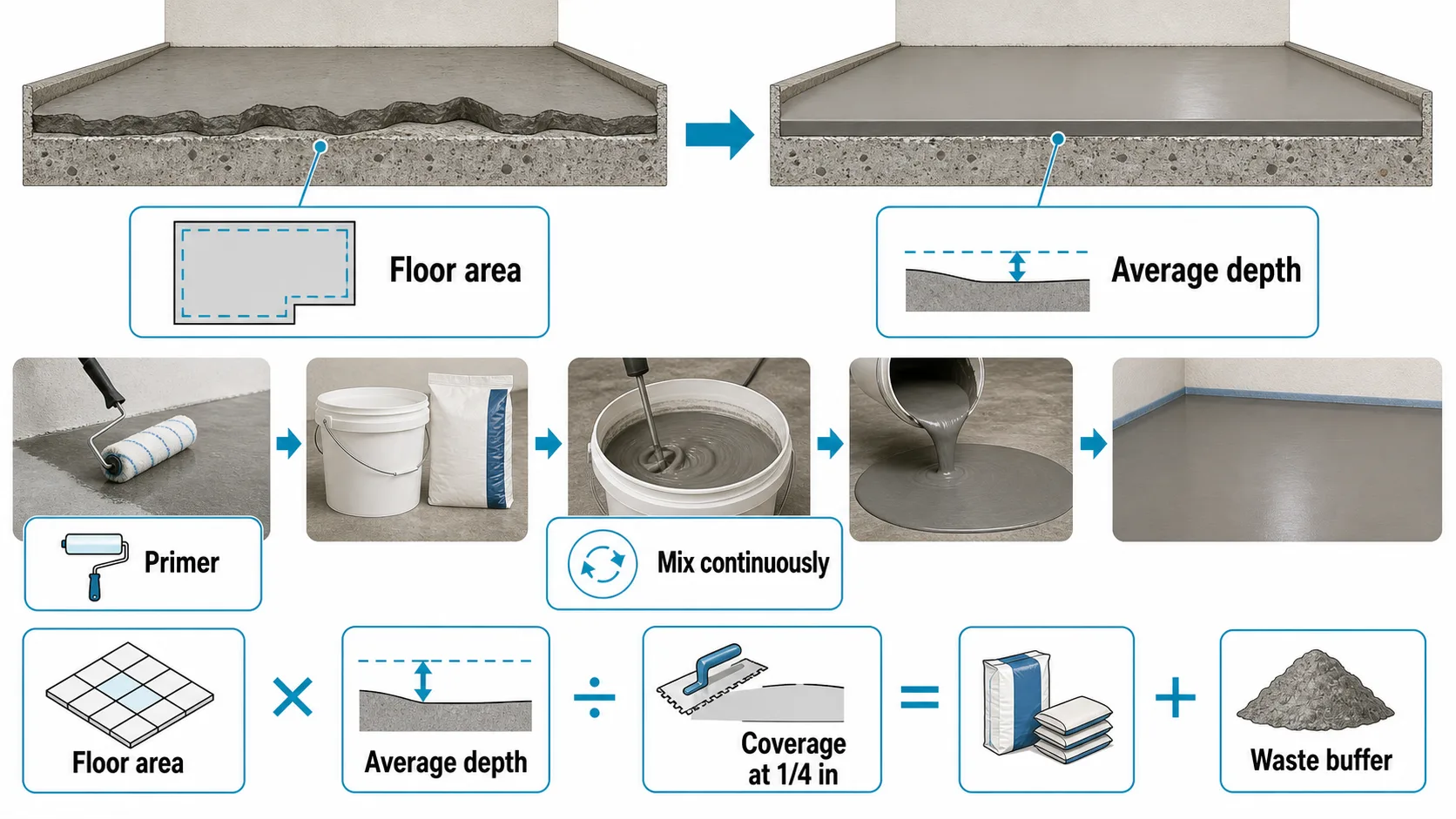
Pouring self-leveling concrete: the order the day has to run in
These ten steps are genuinely sequential. Flow time is about ten minutes once water meets powder, so everything that can be done wrong has to be done before the first bag opens.
- 01
Find the high point and the fall
String line or laser across the longest run, readings every 2 to 3 ft. Mark the high point on the slab in pencil, because everything after this is measured from it.
- 02
Grind the high spots down
A cup wheel and a vacuum shroud. Every 1/8 in you remove here comes off the average depth of the whole floor, so this is the step that pays.
- 03
Patch cracks, holes and hollow areas
Sound the slab with a hammer. Anything hollow gets removed and patched now; self-leveler bonded to a loose surface fails with the surface.
- 04
Dam the edges and the penetrations
Foam or caulk the wall line, collar the pipes, cover the registers, and screw a batten across every doorway you do not intend to pour through.
- 05
Vacuum, then prime
A shop vac with a fine filter, then primer rolled out thin and even. Let it go tacky. Porous slabs take a second coat, and the label tells you which yours is.
- 06
Stage everything before the first bag opens
Water measured out, buckets, half-inch drill, paddle, gauge rake, spiked roller, spiked shoes. The clock starts when water meets powder, not when you are ready.
- 07
Mix two bags at a time and start at the low end
Water into the bucket first, powder in while the paddle turns, two to three minutes to a lump-free mix. Do not add water past the label ratio to make it flow.
- 08
Spread, then spike-roll
Gauge rake to move it into the corners, spiked roller straight after to release the air the mixing put in. Both happen inside the flow window, not after it.
- 09
Keep the wet edge alive to the far wall
One continuous run. If a batch lands on a surface that has started to skin, the seam is permanent and it will show through the flooring.
- 10
Leave it alone, then check before flooring
Walkable in 2 to 3 hours. Moisture-insensitive tile can go down at 6 hours, everything else at 16, and a moisture test comes before any adhesive.
Depth arithmetic
How this self-leveling concrete calculator turns depth into bags
Two pieces of arithmetic sit behind the answer. One derives the average depth from a floor that is out of level; the other turns that depth into a bag count. The second is easy and the first is where most estimates go wrong.
Deriving the average depth
Take a floor that falls in one plane. Call the drop from the high point to the low point d, and the minimum the product needs over the high point m. The compound has to bury the high point, so its thickness there is m, and at the low point it is m plus the whole drop. In between, thickness rises in a straight line, which makes the mean thickness the mean of the two edges: m + d/2.
That is why halving the drop is wrong rather than merely rough. Half the drop is the mean of a wedge that starts at zero, and a wedge that starts at zero leaves the high point bare. On a 1/2 in fall, with the 1/8 in (3 mm) minimum that ARDEX and Henry both publish, the half-the-drop reading gives 1/4 in and the correct figure is 3/8 in: half again as much material, because coverage falls off in proportion to depth.
The low-point figure, m + d, is the one to check against the product limits rather than the average. It is what has to stay under the deepest neat pour the bag allows, and it is what comes off the door clearance, the stair nosing and the appliance gap at that end of the room.
One caveat, and it is a real one: this holds for a floor that tilts. A floor with one isolated dish in it is not a plane, and m + d/2 will overstate it. Split that room into zones, run each zone through the derivation on its own, and add the bag counts.
Turning that depth into an order
Bag coverage is published at one thickness, almost always 1/4 in. Scale it by the ratio of that rated depth to yours, divide the floor area by the result, add the allowance and round up, because half a bag is not something you can open.
- Floor area
- 180 sq ft
- Rated coverage at 1/4 in
- 25 sq ft
- Coverage at your depth
- 25 sq ft
- Allowance
- 15%
- Bags, rounded up
- 9
- Primer at 300 sq ft per gallon
- 1 gallon
Bag prices are national planning averages. Primer, patching compound, lath over wood, grinding, dams, the mixing drill and the spiked roller are all outside this figure, and on a small bathroom they can come to more than the compound does.
- Depth over the high point
- 1/8 in
- Drop across the run
- 1/4 in
- Depth at the low point
- 3/8 in
- Average depth, m + d/2
- 1/4 in
Staging
Self-leveling concrete tips for the ten minutes the mix stays liquid
Ordering is the part you can redo. Everything below is about the part you cannot, which starts the moment water goes into the first bucket.
Measure the fall before you price anything. The room dimensions set the area, but the drop sets the depth, and the depth is what moves the bag count.
Buy the whole order in one lot and check the date codes. Self-levelers are polymer-modified and they age in the bag, so a pallet that has been in a damp yard mixes and flows differently from a fresh one.
Pour a small room in one batch rather than pacing yourself. A bathroom is 3 or 4 bags and the flow window is ten minutes, so the whole job is one continuous pour or it is a floor with a seam in it.
Work out where the new surface leaves the door. A 5/8 in pour at the low end takes 5/8 in off the door clearance, and the toilet flange, the dishwasher gap and the stair nosing all move with it.
After leveling, the flooring calculator sizes the tile, hardwood, laminate or LVP that goes on top, and the tile calculator adds thinset, grout and spacers.
Self-leveler is an underlayment, not a slab. If the pour would be deeper than the product allows neat, the honest answer is a structural pour sized with the concrete slab calculator.
Over a wood subfloor, confirm the product is approved for it, then follow the lath, primer and deflection requirements exactly. Most cracked self-leveler jobs are wood floors that moved under a compound that was never rated for them.
Keep two bags back rather than returning them. Nobody delivers one bag at four in the afternoon with a half-poured floor going off in the room.
Floor prep
Self-leveling concrete questions: depth, primer and pouring over wood
Nine questions, answered against published manufacturer data rather than a rounded rule of thumb. The first three are the ones that change what you buy.
How deep should self-leveling concrete be?
Manufacturers ask for a minimum over the highest point on the floor, usually 1/8 inch. ARDEX and Henry both publish that figure, and ARDEX notes it typically works out at 1/4 inch average or more once the floor has any fall in it. Depth at the low point is that minimum plus however far the slab drops.
My floor is 1/2 inch out of level. How thick is the pour?
1/8 inch at the high point, 5/8 inch at the low point, and 3/8 inch on average if the fall is a straight tilt. The 3/8 inch is the figure the bag count uses. It is not the 1/2 inch you measured, and it is not half of it either.
How do I measure how far a floor is out of level?
Stretch a laser line or a taut string across the longest dimension of the room, then measure down to the slab every 2 to 3 feet. The difference between the largest and the smallest reading is the drop, and a 4 foot level in one spot will not find it.
How many square feet does a bag of self-leveling concrete cover?
About 25 sq ft per 50 lb bag at 1/4 inch is a fair planning figure. ARDEX K 15 publishes 30 sq ft from a 55 lb bag, MAPEI Novoplan 2 Plus 24 sq ft from a 50 lb bag, and Henry 555 LevelPro 43 sq ft at 1/8 inch, which is about 22 sq ft once you take it to 1/4 inch.
Why does the bag count climb so fast with depth?
Coverage is inversely proportional to thickness. A bag that covers 25 sq ft at 1/4 inch covers 12.5 sq ft at 1/2 inch and 6.25 sq ft at 1 inch, so every doubling of depth doubles the order.
Should I grind the high spots or just pour deeper?
Grind. Every bag is priced off the high point, because the whole surface has to rise above it. Taking 1/8 inch off one ridge takes 1/8 inch off the average depth of the entire room and off the height at every doorway.
Do I need primer before self-leveling compound?
Yes. Primer controls suction, improves the bond, and stops air rising out of the slab into the pour as pinholes. Porous concrete usually needs a second coat, and the product data sheet says which primer goes with which substrate.
Can I pour self-leveling concrete over plywood?
Only where the product is approved for wood and the floor is stiff enough. Those systems normally require a primer, metal or plastic lath, sealed seams, and a minimum thickness over the highest point that is greater than the one used on concrete.
How much waste should I add to a self-leveling estimate?
Use 10% on a smooth slab you have measured properly, 15% on a normal uneven room, and 20% or more where the low spots are hard to read, the substrate is rough, or nobody on the job has poured self-leveler before.
Disclaimer
These estimates are for planning purposes only. Actual costs vary by location, material availability, and project complexity. Always get at least 3 local quotes. This calculator does not replace professional advice.
Sources
- 01ARDEX K 15 Premium Self Leveling Underlayment, technical dataardexamericas.com
- 02HENRY 555 LevelPro Self-Leveling Underlaymentwwhenry.com
- 03MAPEI Novoplan 2 Plus product data, coverage by thicknessbuildsite.com
- 04ASTM C1708/C1708M Test Methods for Self-leveling Mortarsastm.org
- 05ASTM F710 Preparing Concrete Floors to Receive Resilient Flooringastm.org
- 06Ceramic Tile Education Foundation on ANSI A108.02 substrate flatnessceramictilefoundation.org