Baseboard Calculator
Calculate linear feet, stock pieces, corners and shoe molding for any room.
Room and trim
Room Length (ft)
Room Width (ft)
Number of Doors (3 ft off the run each)
Baseboard Height
Material Type
Estimates only. Not professional advice.
Trim to buy
53LF
MDF (Primed) at 3-1/4", 10% waste on a 48 LF wall run.
- Room perimeter
- 54 LF
- Door openings deducted
- 6 LF
- Outside corners to miter
- 0
- Brad nails, 18 gauge
- 1.1 lb
- MDF (Primed) rate
- $0.80 to $1.50/LF
- Material plus shoe
- $69 to $133
Material only. Casing, plinth blocks, caulk, paint and labour are not counted, and installation is usually quoted at $2 to $4 per LF on top.
Stick plan
Baseboard cut list: which stick covers which wall
Footage tells you what to buy. It does not tell you whether it goes on the wall, because every wall starts a fresh stick and ends at a corner. Below, the same room divided into four runs, with the joints put where they can actually be nailed. Nothing here changes the order above.
4 scarf joints at 8 ft stock, each one pulled back to the nearest stud so both halves have framing behind them. Cut wall by wall that is 8 sticks; feeding the drops back into the shorter runs brings it to 6, and nothing is wasted.
The order above buys 7 pieces, because 10% waste on footage is not the same question as how the walls divide. Here it covers the cut list with 1 to spare.
Written and reviewed by
Creator
Hawkin
Certified Cost & Estimating Professional
AACE-certified estimator working with 20+ insulation companies including the two largest franchises in America.
See full profileExpert Review
Ehsan Ghazanfari
Licensed Structural Engineer
FISE-certified structural engineer with 11+ years designing bridges, retaining walls, and foundations. MSc from Aalto University.
See full profileUpdated August 5, 2026
How we verify our calculatorsStick schedule
- Stock length
- 8 ft
- Corners to cope
- 4
- Corners to miter
- 0
- Profile height
- 3-1/4"
- Stud spacing assumed
- 16 in on centre
Each scarf is cut at 45 degrees on both ends so the pieces overlap instead of butting, which keeps the seam closed when the trim shrinks in a dry winter. Openings are drawn at the end of their wall; a door in the middle of a long wall splits that run in two and usually costs you a stick.
| Wall | Trim run | Sticks | Cut to | Joint from the corner |
|---|---|---|---|---|
| Wall A, along the lengthless 1 opening at 3 ft | 12 ft | 2 | 8 ft + 4 ft | 8 ft |
| Wall B, across the width | 12 ft | 2 | 8 ft + 4 ft | 8 ft |
| Wall C, along the lengthless 1 opening at 3 ft | 12 ft | 2 | 8 ft + 4 ft | 8 ft |
| Wall D, across the width | 12 ft | 2 | 8 ft + 4 ft | 8 ft |
The four runs add up to 48 LF, the net figure in the panel above. Studs are taken at 16 in on centre from each corner, which is the usual layout but worth checking with a magnet before you cut.
Punch list
Baseboard mistakes that leave you short on the last wall
Every one of these is decided before the saw comes out, and every one shows up at the end of the job when there is no material left to fix it with.
Buying to the footage instead of to the walls
A room with 48 net feet does not always come off six 8 ft boards. Each wall starts a fresh stick and the drop at its end may be too short for anywhere else.
Read the cut list above, count the sticks, then buy to that. Footage plus waste is a budget figure, not a shopping list.
Mitering the inside corners
Two 45 degree cuts only close in a square room. A wall that is out by a degree leaves a gap at the front of the joint that caulk cannot hide for long.
Cope them. Miter the second piece, follow the exposed profile with a coping saw, then back-cut so only the front edge touches.
Landing a scarf joint between studs
Neither half has anything behind it, so the joint opens as soon as the trim shrinks and no amount of filler brings it back.
Mark the studs first, then pull each joint back to the last stud before the stick runs out. That is what the joint positions above are doing.
Putting MDF in a wet room
MDF takes paint better than anything and swells permanently the first time it gets soaked. A mopped bathroom is enough.
PVC in bathrooms, laundries, basements and slab-on-grade entries. It costs more per foot and it survives.
Deducting every opening on the plan
The 3 ft per doorway assumes the trim actually stops there. Closets, alcoves and built-ins usually get trimmed and are not openings at all.
Walk the room and deduct only where the baseboard genuinely ends. Measure cased openings wider than 3 ft rather than taking the default.
Skipping shoe molding over hard flooring
Hardwood, laminate and plank floors need a gap at the wall to move into. Without shoe you either see the gap or you pin the floor down.
Run shoe on top of the finished floor and nail it into the baseboard, never down through the floor. Match PVC shoe to PVC base in wet rooms.
Trim sequence
Installing baseboard, in the order the trim goes on
Numbered because the order is the whole point. Each step closes off the one after it, and the last three cannot be revisited once the caulk is dry.
- 01
Get the floor in first. Baseboard sits on the finished floor, not on the subfloor, so trim is the last thing in the room. Our sq ft to linear ft calculator converts a flooring order into wall run if you are working from a floor quote.
- 02
Find and pencil every stud before a single cut. Studs decide where the scarf joints can go, and once the trim is up you cannot move them.
- 03
Plan the joints on the longest wall first, then work round. Keep them off the wall you see from the doorway, and never leave a short return piece stranded at a corner.
- 04
Cope the inside corners. Two 45-degree miters only meet cleanly in a room that is genuinely square, and almost none are. Scribe the profile onto the second piece with a coping saw instead.
- 05
Miter and glue the outside corners, then pin them with two brads from each face. Glue holds the point together long after the nails have loosened.
- 06
Fire 18 gauge brads, 2 inches long, two per stud, one high and one low. Hand nailing means pre-drilling or the ends of the boards split.
- 07
Nail shoe molding into the baseboard, not down into the floor. The gap it covers exists so the floor can move, and a nail through it defeats the point. Trim paint is roughly a quart per 100 linear feet, which the paint calculator will size alongside the walls.
- 08
Use PVC anywhere a mop, a leak or a slab can reach it: bathrooms, laundries, basements. MDF paints beautifully and swells permanently. If the room is getting new flooring at the same time the flooring calculator covers the other half of the order.
Stock prices
Baseboard cost per linear foot, by material
Material only, before anyone hangs it. The spread inside each bar is the difference between a builder profile at a big box and a milled profile at a lumberyard.
Shoe molding runs a further $0.50 to $1.00 per linear foot, and installation is quoted separately at $2 to $4 per LF. Both are the rates this calculator uses.
Takeoff
How much baseboard do I need for a room?
Six lines decide the order. Four of them are measurements and two of them are decisions you make at the trim rack.
- Wall run
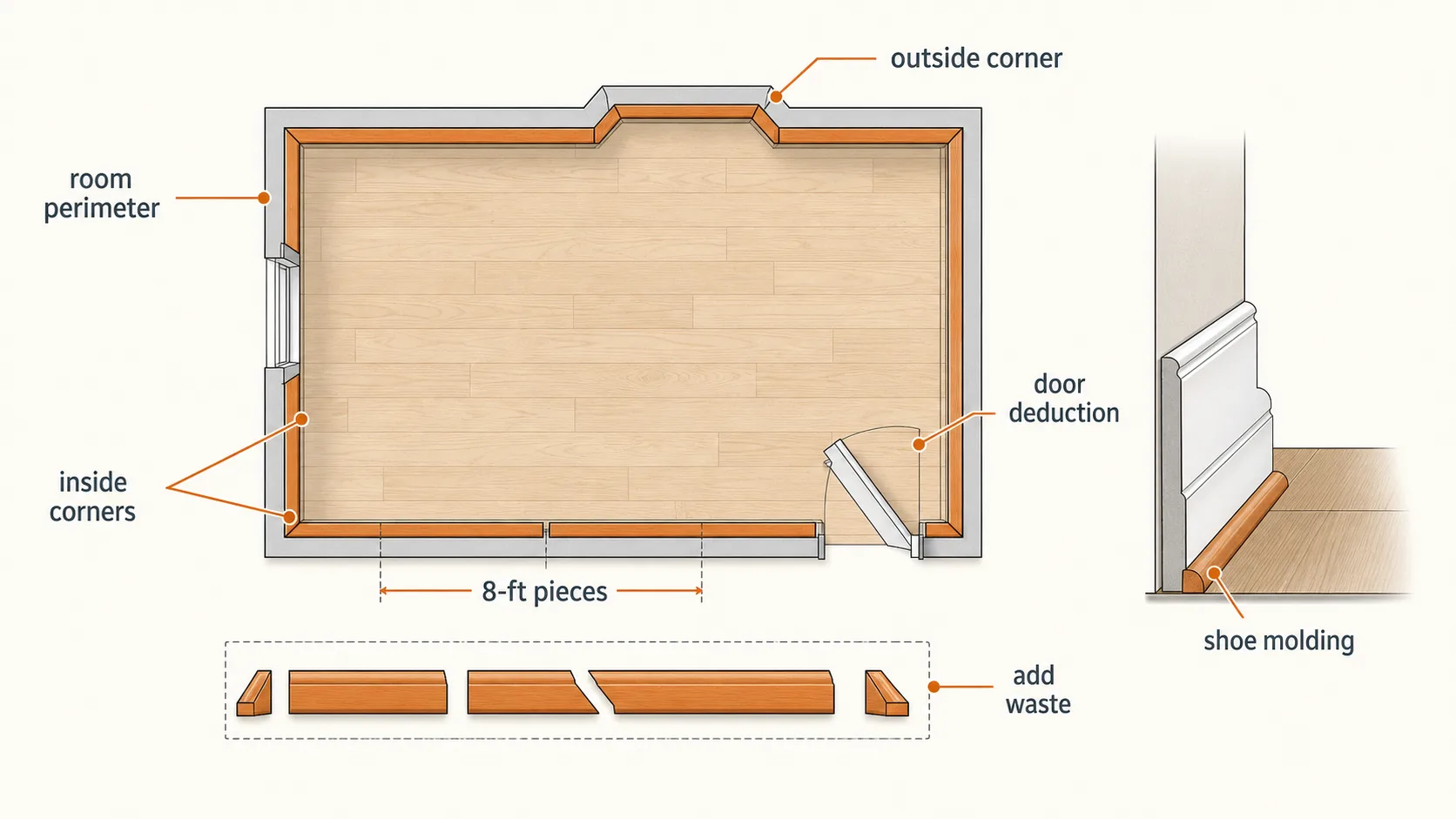
- Measure at floor level, all the way round, including alcoves and bump-outs that are getting trimmed. That is the perimeter: 2 × (length + width) in feet. Trim is racked in 8 ft lengths as standard, with 12 ft and 16 ft on order.
- Door openings
- Take 3 ft off the run for each doorway the baseboard stops at. That is a default, not a measurement: a cased opening wider than a standard door gets measured properly, and a closet you are trimming inside is not an opening at all.
- Corners
- A plain rectangle has four inside corners and no outside ones, which is why the panel shows 4 to cope and 0 to miter. A bay, a chimney breast or a bump-out adds two outside corners each, and those get mitered and glued.
- Waste
- 10% covers miters, coping practice and damaged ends on a plain room. Go to 15% for stain grade, tall profiles or a room with several long walls, because every scarf joint burns two ends rather than one.
- Shoe molding
- Counted as the same run again when you switch it on, because it follows the baseboard exactly. It exists to cover the expansion gap at hardwood, laminate and plank floors, and it is nailed into the baseboard so the floor underneath can still move.
- Profile height and fixings
- 3-1/4" is the standard builder height; 5-1/4" to 7-1/4" reads as traditional and shows every joint, so it wants the higher waste figure. Fixings are 18 gauge brads 2 in long, about 0.02 lb per foot of run. Casing, plinth blocks, returns, caulk, paint and labour are not counted anywhere on this page.
Four rooms
Baseboard linear feet for four real room sizes
Each row states its inputs; every figure beside it comes out of the same takeoff this page runs, at 10% waste. The last one is the awkward case.
Small painted bedroom
10 × 10 ft · 2 doors · MDF (Primed)
38 LF · 5 pieces
34 LF net · $30 to $57 in material
MDF is the sensible paint-grade choice in a dry bedroom. Check whether the closet is getting trimmed inside before you deduct its opening, because that decision is worth a whole stick here.
Open living room
15 × 12 ft · 2 doors · Pine (Finger-Joint)
53 LF · 7 pieces
48 LF net · $53 to $106 in material
Two 15 ft walls means two scarf joints at 8 ft stock and none at 16 ft. Finger-jointed pine takes a knock better than MDF and it is the cheapest material that will hold a coped edge cleanly.
Stain-grade dining room
20 × 15 ft · 3 doors · Oak (Stain Grade)
68 LF · 9 pieces
61 LF net · $170 to $340 in material
Oak shows every joint and every colour mismatch, so sort the boards for grain before cutting and put the joints on the wall behind you as you come in. Push the waste figure to 15% on stain grade.
Long hallway
24 × 4 ft · 3 doors · Poplar (Paint Grade)
52 LF · 7 pieces
47 LF net · $78 to $156 in material
A hallway is almost all long wall and almost all doorways, so the footage looks small and the stick count does not. This is the room where 16 ft stock earns its awkwardness.
Takeoff math
How this baseboard calculator counts feet, pieces and corners
It walks the perimeter, takes the doorways off, adds your waste percentage and then rounds up to whole pieces, because trim is sold by the stick. Shoe molding is counted as the same finished run again when it is switched on. Corner counts assume a plain rectangle, which is where the four coped corners and the zero mitered ones come from.
The piece figure divides footage by 8 ft and rounds up. That is the right answer for a budget and the wrong one for a shopping trip, which is why the cut list further up plans each wall separately instead. Where the two disagree, buy to the cut list and keep the difference as a spare.
The formulas
perimeter = 2 × (length + width)net run = perimeter − doors × 3 ftorder = ceil(net run × (1 + waste))pieces = ceil(order ÷ 8 ft)shoe = order, when selectedbrads lb = order × 0.02Metric entries are converted to feet before any of this runs, then converted back for display, so the two unit modes cannot disagree.
At the trim rack
Baseboard questions: pieces, joints, corners and shoe
The eleven things people ask standing in front of the moulding rack, answered against the same figures the calculator uses.
How many 8-foot pieces of baseboard for a 12 by 12 room?
6 pieces. The perimeter is 48 ft, two door openings take 6 ft off it, and 42 ft plus 10% waste rounds to 47 ft, which is 6 pieces. Cut wall by wall it can still be one more, because each wall starts a fresh stick.
How much does baseboard cost per linear foot?
MDF runs $0.80 to $1.50 per linear foot, pine $1.00 to $2.00, poplar $1.50 to $3.00, PVC $2.00 to $4.00, and oak $2.50 to $5.00. Shoe molding adds $0.50 to $1.00 per foot. Installation is charged separately, usually $2 to $4 per linear foot.
Where should a baseboard scarf joint go?
On a stud, cut at 45 degrees on both ends so the pieces overlap rather than butt. The overlap keeps the seam closed when the trim shrinks in a dry winter, and the stud gives you something solid to nail both halves into. Push the joint away from the wall you see first when you walk in.
Should I cope or miter inside corners?
Cope the inside corners and miter the outside ones. Rooms are rarely square, and a coped joint takes up that error because the second piece is scribed to the profile of the first. An outside corner has no back to hide, so it gets a mitered pair, glued and pinned.
Should I subtract closets and door openings?
Subtract door openings where baseboard stops. Do not subtract closet interiors if you plan to trim inside the closet. For cased openings wider than 3 ft, use the actual opening width.
How much waste should I add for baseboard?
Use 10% for simple rectangular rooms. Use 15% for tall profiles, stain-grade material, long walls with scarf joints, bay windows, or if you are learning to cope corners.
Do I need shoe molding or quarter round?
Use shoe molding to cover the expansion gap at hardwood, laminate, and some vinyl floors. Skip it at carpet. In bathrooms or slab areas, choose PVC shoe if moisture is likely.
What material should I use in each room?
MDF is fine for dry painted bedrooms. Finger-jointed pine or poplar handles dents and repairs better. Oak is for stain-grade work. PVC belongs in wet rooms and basements.
When should I use 12-foot or 16-foot pieces?
Longer pieces reduce scarf joints on big rooms and hallways, but they are harder to transport and may cost more. Use them when a long visible wall would otherwise need several joints. The cut list on this page will show you how many joints each stock length saves.
Why does the calculator round to full pieces?
Baseboard is bought in fixed lengths, usually 8 ft. A 9 ft wall needs a joint, not one 9 ft board, so the calculator rounds material length up to whole pieces after waste.
What is not included in the estimate?
The calculator does not include casing, plinth blocks, returns, caulk, paint, primer, adhesive, transition trim, or labor. Add those separately if the room is part of a larger finish package.
Disclaimer
These estimates are for planning purposes only. Actual costs vary by location, material availability, and project complexity. Always get at least 3 local quotes. This calculator does not replace professional advice.
Sources