Hardwood Flooring Calculator
Estimate hardwood boxes, board feet and cost by species, then check what your subfloor allows.
Room and species
Common rooms
Janka hardness under each name
Read off the carton
Coverage per box is printed on the end of the carton and varies by mill, so it is worth checking against the 20 and 24 sq ft this calculator assumes.
Estimates only. Not professional advice.
Boxes to buy
10boxes
Red/White Oak, solid, at 20 sq ft a box. That covers 198 sq ft once the 10% cut allowance is in.
- Room area, no allowance
- 180 sq ft
- Cut allowance
- 18 sq ft at 10%
- Board feet
- 198
- Board width
- 5 in
- Rate, red/white oak
- $6 – $12 per sq ft
- Material only
- $1,188 – $2,376
Board feet stay in imperial, because a board foot has no metric form. Installation, trim, transitions and moisture testing are all separate from the figure above.
Last updated August 4, 2026. Reviewed by our expert review team.
Grade and subfloor
Can hardwood go here: subfloor, grade and radiant heat
Hardwood is the one floor where the room decides the product. It is a wood fastened to a building, and it takes on and gives up moisture for as long as it is down. Solid boards are nailed into wood, so a slab or a below-grade room rules them out. Engineered is built in cross-grain layers that barely move, so it goes where solid cannot. None of this changes the box count above.
What can be fastened down
Solid or engineered
plywood or osb above grade with no loop in the floor is the one case where both builds are open to you, so pick on cost, board width and how many times you want to refinish it.
- Solid hardwood
- Goes down
- Engineered hardwood
- Goes down
Nailed or stapled through the tongue into the subfloor, 3/4 in of wood the whole way through, and sandable three to five times over its life.
Nail it, glue it or float it. On a wood subfloor above grade the choice is yours, and nail-down is the quietest of the three.
At 5 in wide, middle of the range, the common compromise. Leave 1/4 in clear at every wall, pipe and door frame either way, and hide it under the baseboard rather than filling it.
| Board | Cut allowance | Rows across | How it moves |
|---|---|---|---|
| 3 in | baseline | 48 | Moves least, so it gaps least in a dry winter |
| 5 inyour board | +5% | 29 | Middle of the range, the common compromise |
| 7 in | +5% | 21 | Moves most, and shows every seasonal gap |
Allowances are relative to a 3 in strip. Rows are counted across your 12 ft wall and include the last one, which almost always gets ripped narrower than the rest.
Dent resistance
Hardwood species by Janka hardness, hardest first
Janka measures the load it takes to push a steel ball halfway into a board. It is the number that decides whether a dropped pan leaves a mark, and it is unrelated to price: the softest wood on this list is also one of the dearest.
| Species | Janka | Against your pick | What that means |
|---|---|---|---|
| Hickory | 1820 | +530 | The hardest of the five. Fine for hallways and kitchens. |
| Hard Maple | 1450 | +160 | Harder than oak by 160 points, at a similar rate. |
| Red/White Oakyour species | 1290 | your pick | The reference species. Everything here is compared to it. |
| Black Walnut | 1010 | -280 | Dents under furniture legs. Best kept to bedrooms. |
| American Cherry | 950 | -340 | Softest here, and the same caution applies as walnut. |
Engineered boards carry the Janka rating of their veneer species, so an engineered hickory floor dents like hickory even though the layers under it are not.
Order sheet
What a hardwood flooring order needs beyond room area
Room area gets you a box count and nothing else. The rest of the order is time, clearance and a handful of items that live on a different line of the invoice.
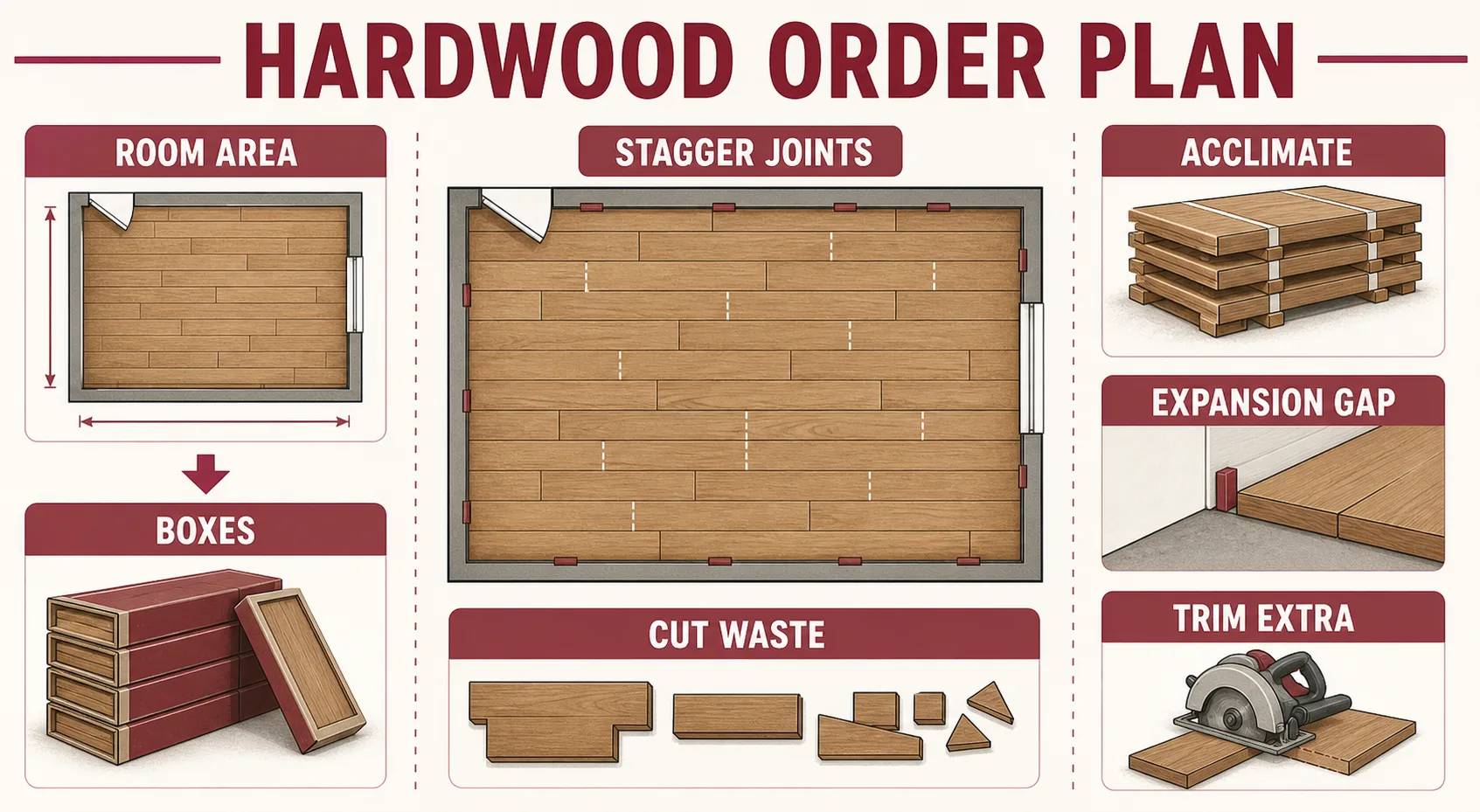
Boxes are the only part of this the calculator counts. Everything else on the sheet is either a day on the schedule or a separate line on the receipt.
On the order
- Boxes
- 10
- Coverage per box
- 20 sq ft
- Cut allowance
- 10%
- Board feet
- 198
On install day
- Acclimate in the room
- 3 to 5 days
- Gap at every wall
- 1/4 in
- Stagger end joints
- 6 in min
- Cleats
- 10 lbs
Quoted separately
- Installation
- $3 to $8 per sq ft
- Trim and transitions
- by the linear foot
- Shoe or quarter round
- covers the gap
- Moisture testing
- before delivery
Heating season
Hardwood flooring mistakes that show up in the first heating season
None of these are visible on the day the last board goes in. They appear in January, when the heating has been on for a month and the floor has finished giving up the moisture it arrived with.
Boards cut the day they are delivered
Wood arrives at the warehouse's moisture content and keeps moving until it reaches the room's.
Stack the boxes flat in the room for 3 to 5 days with spacers between them, so air gets to every face. This is the cheapest thing on the whole list and the one most often skipped.
Solid boards nailed over a slab
There is nothing for a cleat to bite into, and the slab gives off moisture for years.
Use engineered over the slab, or build a plywood subfloor system on top of it first and nail into that.
A soft species in a hallway
Cherry at 950 and walnut at 1010 take a mark from a furniture leg.
Keep them to bedrooms, and put oak at 1290 or hickory at 1820 where the traffic is.
No vapor retarder over concrete
Moisture wicks up through a slab and reaches an engineered floor from underneath, where nobody looks.
Moisture-test the slab first, then run a retarder or a moisture-rated underlayment under the whole floor, not just the middle.
The perimeter gap filled or forgotten
A floor with nowhere to expand pushes against the walls and lifts in the middle of the room instead.
Leave 1/4 in at every wall, pipe and door frame, and cover it with baseboard or shoe. Filling it with caulk is the same as not leaving it.
End joints landing in line
Aligned ends read as a stripe across the floor from the doorway and make a weak line under traffic.
Keep at least 6 inches between the end joints of neighboring rows, and work off the offcut rather than to a pattern.
Species pricing
Hardwood flooring cost per square foot by species
Material only, on one axis. Hardness and price barely track each other here: hickory is the hardest of the five and among the cheapest, and walnut is the dearest and nearly the softest.
Per sq ft of finished boards, prefinished or site-finished.
Reading these
Red/White Oak is highlighted because it is your current pick, at $6 to $12 per sq ft. The spread inside one species is mostly grade and board width, not quality.
Across your 198 sq ft order that band is worth $1,188, which is more than most people expect to hear after they have already chosen the species.
None of these are installed prices. Fitting adds $3 to $8 per sq ft on top, and it costs the same to lay a cheap species as a dear one.
Board feet
Where your hardwood box count comes from
Four lines of arithmetic, all of them auditable. The one that surprises people is the last: a board foot and a square foot are the same number at 3/4 in thick, which is why hardwood gets quoted both ways.
area = L × Worder = area × (1 + waste)boxes = order ÷ 20, rounded upboard feet = ordercleats = order × 0.05 lbRoom area comes straight off your two dimensions, then the cut allowance is added before anything is divided. Boxes are always rounded up, because half a box is not something a supplier sells, and the spare in the last one is what you keep back for repairs.
Coverage per box is the only figure here you should overwrite with what is printed on the carton. Everything else holds across mills.
Run through, your room
- Room area
- 180 sq ft
- Plus 10% allowance
- 198 sq ft
- Divided by 20, rounded up
- 10 boxes
- Spare in the last box
- 2 sq ft
Figures this calculator uses
- Solid box
- 20 sq ft
- Engineered box
- 24 sq ft
- Underlayment roll
- 200 sq ft
- Cleats
- 0.05 lbs per sq ft
- Solid thickness
- 3/4 in
- Default allowance
- 10%
The cleat rate is quoted per square foot by every fastener maker, so it stays imperial whichever unit you type in.
Four floors
Four hardwood jobs: species, boxes and what they cost
Every one at a 10% cut allowance, material only, so the only things moving are the room, the species and the build. Figures are in feet and dollars per square foot.
Bedroom · 12 × 10 ft
7 boxes
$792 to $1,584
Oak solid in 3 in strips, nailed to a plywood floor upstairs. The narrowest board on the list, so nothing extra goes on the allowance.
Living room · 15 × 20 ft
14 boxes
$1,980 to $3,960
Engineered oak, because this one sits on a slab. Same species, same rate, and the only reason for the change is what is underneath.
Primary suite · 18 × 14 ft
14 boxes
$2,772 to $4,990
Walnut solid in 5 in planks. At 1010 Janka it is soft, which a bedroom forgives and a hallway would not.
Whole floor · 40 × 25 ft
46 boxes
$6,600 to $12,100
Hickory engineered in 7 in boards. Hardest of the five at 1820, and the widest board here, so budget the extra 5% on offcuts.
Delivery day
Getting hardwood down without cupping, gaps or squeaks
In the order you meet them. The first two are decided before you have bought anything, and the last two are decided with the boxes already in the room.
- 01
Price hardwood against the alternatives first. Our flooring calculator puts all the materials on one order sheet, and it is a cheaper decision to change now than after delivery.
- 02
If you are pricing rough lumber rather than finished boards, our board foot calculator converts between the two ways hardwood gets sold.
- 03
Order every box from the same production run. Color varies between runs, and mixing them puts visible banding across a floor that is otherwise finished.
- 04
Wider boards cost you on the cut list as well as at the till: a 5 to 7 inch board loses about 5 points more to offcuts than a 3 inch strip.
- 05
Stack the boxes in the room they are going into for 3 to 5 days with spacers between them, so air reaches every face. Test the subfloor at the same time and only start once the two readings agree.
- 06
Solid boards are nailed or stapled to wood. Engineered can be floated, glued or nailed, which is the whole reason it goes places solid cannot.
Refinishing
Hardwood flooring questions: acclimation, concrete and refinishing
The eight things people ask at the counter, answered against the same figures this calculator runs on.
How many boxes for a 12x12 room?
About 8 boxes of solid (20 sq ft/box) or 7 boxes of engineered (24 sq ft/box) with 10% waste. Always round up to full boxes.
Solid vs engineered hardwood?
Solid is 3/4 inch thick real wood, nailed to plywood. Engineered is a thin real-wood veneer over plywood layers. Engineered handles moisture and concrete subfloors better.
What is Janka hardness?
The Janka scale measures how hard a wood species is. Higher numbers resist dents better. Hickory (1820) is the hardest common species. Cherry (950) is the softest.
How much does hardwood flooring cost per sq ft?
Oak runs $6 to $12, maple $7 to $13, hickory $6 to $11, walnut $10 to $18, and cherry $8 to $14 per sq ft for materials only. Installation adds $3 to $8 per sq ft.
Nail-down vs floating installation?
Nail-down is stronger and quieter, but requires a plywood subfloor. Floating (click-lock engineered) works over concrete, radiant heat, and existing floors.
How long should hardwood acclimate?
3 to 5 days minimum. Open the boxes and stack boards with spacers in the room where they will be installed. Maintain normal room temperature and humidity.
How often can hardwood be refinished?
Solid hardwood can be sanded and refinished 3 to 5 times over its lifetime. Engineered hardwood with a thick veneer (4mm+) can be refinished 1 to 2 times.
What is the best species for kitchens?
Hickory or white oak. Both score high on the Janka scale and resist dents from dropped items. Use engineered over concrete or with radiant heat.
Disclaimer
These estimates are for planning purposes only. Actual costs vary by location, material availability, and project complexity. Always get at least 3 local quotes. This calculator does not replace professional advice.
Sources