Vinyl Flooring Calculator
Estimate LVP, LVT, sheet vinyl, SPC, and WPC boxes, sheet runs, waste, and material cost.
Room Details
Before you pay
Three things off the carton: the wear layer in mils, the core type, and the coverage per box. A box that prints none of the three is a box to walk away from.
Estimates only. Not professional advice.
Cartons to order
9boxes
LVP (Luxury Vinyl Plank) at 24 sq ft a box, enough for 198 sq ft once the waste allowance is in.
- Vinyl material
- $495 to $990
- Wear layer on this pick
- 12-20 mil
- Transition strips
- 2
- LVP rate
- $2.50 to $5.00/sq ft
Material only. Fitting runs $1.50 to $4.00/sq ft for click-lock and $2.00 to $5.00/sq ft glued down, and adhesive, trim and thresholds are separate again.
Last updated August 4, 2026 by our expert review team.
Mil rating
Vinyl wear layer thickness by room: 6, 12, 20 or 28 mil
Two planks can look identical on the shelf and be built to survive completely different rooms. The wear layer is the clear film on top, measured in mils, and it decides that. Prices below come from the same table the estimate above uses, so the money is your room, not a national average.
Closets, spare bedrooms, a rental you expect to refloor again
A kitchen or a hallway walks through it in 3 to 5 years
Sheet Vinyl · $0.75 to $2.50/sq ft
$149 to $495
Bedrooms, home offices, dining rooms
Hallways and kitchens reach bare print by about year 10
LVT, LVP · $2.00 to $5.00/sq ft
$396 to $990
Hallways, entries, kitchens, rental turnovers
Nothing residential outruns it
SPC, WPC · $3.00 to $7.50/sq ft
$594 to $1,485
Shopfronts, waiting rooms, light commercial
Nothing, but no product in the price list above is built this thick
not priced here
Rates are material only, taken from the five product families this calculator prices. Nothing in that list is specced at 28 mil, so the commercial row carries no figure rather than a guess.
Creator
Hawkin
Certified Cost & Estimating Professional
AACE-certified estimator working with 20+ insulation companies including the two largest franchises in America.
See full profileExpert Review
Ehsan Ghazanfari
Licensed Structural Engineer
FISE-certified structural engineer with 11+ years designing bridges, retaining walls, and foundations. MSc from Aalto University.
See full profileUpdated August 4, 2026
How we verify our calculatorsWhere your pick lands
LVP carries a 12-20 mil wear layer, which is the middle residential tier in the table. It is right for bedrooms and thin for a kitchen or a hallway.
Stepping up to the 20 mil tier on your 198 sq ft costs $594 to $1,485, against $396 to $990 for what you have selected.
Core build
SPC vs WPC vs glue-down: what the vinyl core changes
The wear layer decides how long the floor lasts. The core decides how it feels, how loud it is, how thick it sits at the doorway and how flat the subfloor underneath has to be. Same room, same wear layer, three different floors.
SPC: Limestone powder and PVC, pressed into a board that barely moves
WPC: Wood flour and PVC, foamed, so the board is lighter and thicker
Glue-down LVP: Solid flexible PVC the whole way through, bonded to the subfloor
SPC: Rigid. Holds its length through a hot afternoon and a cold night
WPC: Rigid but softer. A fridge leg parked in one spot can dent it
Glue-down LVP: Flexible. It takes the shape of whatever is underneath it
SPC: Hard and cold. It reads more like tile than like wood
WPC: Warmer and softer. The closest vinyl gets to a padded floor
Glue-down LVP: Firm and quiet, because there is no air gap under the plank
SPC: The loudest of the three. A hollow tap follows you across the room
WPC: The quietest floating option. The thick core swallows the tap
Glue-down LVP: No hollow tap at all once the adhesive has grabbed
SPC: Thin for a rigid plank, so doors and thresholds usually still clear
WPC: The thickest of the three. Check door clearance before you buy
Glue-down LVP: The thinnest by a wide margin, which is why it suits low thresholds
SPC: Bridges small dips, so a decent subfloor is enough
WPC: Same tolerance as SPC, and the extra thickness helps
Glue-down LVP: The fussiest of the three. More than 3/16 in of dip over 10 ft telegraphs straight through
SPC: Waterproof, core and all
WPC: Waterproof, core and all
Glue-down LVP: Resists water. Standing water can still creep into the seams
SPC: 20+ mil
WPC: 20+ mil
Glue-down LVP: 12-20 mil
SPC: $3.00 to $7.00/sq ft
WPC: $3.50 to $7.50/sq ft
Glue-down LVP: $2.00 to $5.00/sq ft
SPC: $594 to $1,386
WPC: $693 to $1,485
Glue-down LVP: $396 to $990
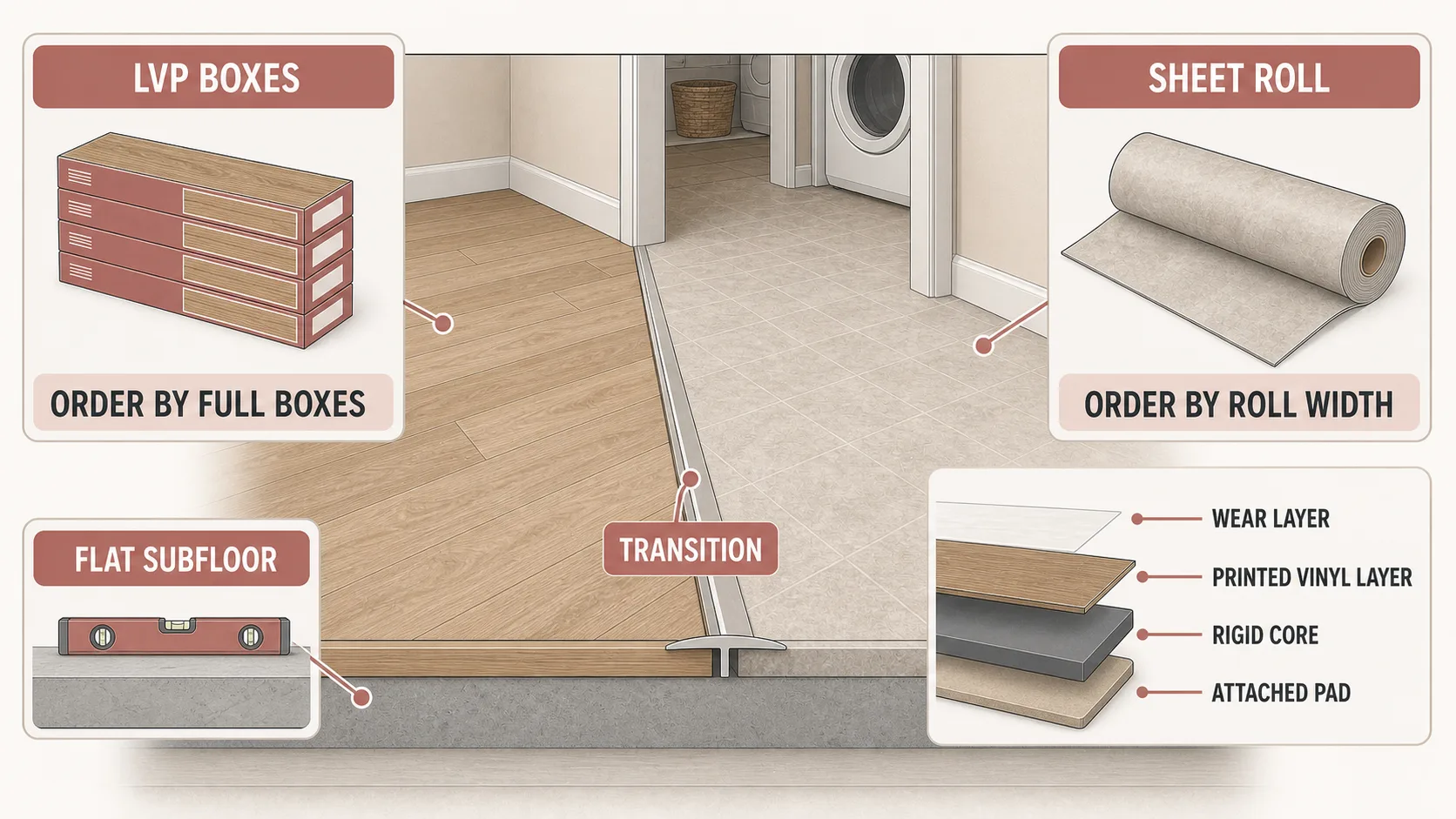
The pad drawn on the underside of the plank is the reason a second underlayment roll breaks click joints. Sheet vinyl, on the right, is the only form here with no core at all, which is why it is sold by the running length instead of by the box.
Spec traps
Five vinyl floors that failed inside three years
None of these were installation accidents. Every one was decided at the shelf or in the first hour, and every one of them cost the whole floor rather than a repair.
Buying on the price tag and ignoring the mils
Two boxes at the same money can be 6 mil and 20 mil. Only the wear layer number tells them apart.
Read the mils before the price. 12 for bedrooms, 20 once feet actually travel, 28 for a shopfront.
Rolling underlayment over a pre-attached pad
Two pads let the click joints flex on every step until they work themselves apart.
If there is foam bonded to the back of the plank, the box is the underlayment. Leave the roll at the store.
Butting the floor tight against the wall
Vinyl grows with heat and has nowhere to go, so it lifts somewhere out in the middle of the room.
Leave 1/4 in at every wall and every fixed object, then hide the gap under shoe moulding.
Gluing flexible plank onto a floor that is not flat
Glue-down plank is thin and reads every hump and dip underneath it. A rigid core would have bridged them.
Flat to 3/16 in over 10 ft before the adhesive goes down, or switch to SPC and let the core do the work.
Floating a floor behind full-height south glass
Sustained direct sun discolours some vinyl and cups the boards along the length of the run.
Ask for a UV-stabilised wear layer, keep the expansion gap honest, and put blinds on the worst elevation.
Four orders
Four rooms, four vinyl products, four order totals
Every line uses the same 24 sq ft carton and the same 10 percent allowance the calculator starts with, so the only things changing are the room and the product. Cost is material.
Small bathroom
8 × 6 ft
WPC
Boxes 3
53 sq ft
$185 to $396
A waterproof core that is warm on bare feet at seven in the morning. Ten percent of a room this small is only a few extra planks.
Kitchen
15 × 12 ft
SPC
Boxes 9
198 sq ft
$594 to $1,386
The rigid stone core takes a dropped pan and a dragged fridge better than a foamed one does.
Living room
20 × 15 ft
LVP
Boxes 14
330 sq ft
$825 to $1,650
Click-lock is a weekend for a room this size, and it is the cheapest honest route to a wood look.
Whole ground floor
40 × 25 ft
LVP
Boxes 46
1,100 sq ft
$2,750 to $5,500
One order means one production batch, which means one colour. Budget a transition strip at every doorway between rooms.
On the floor
Before the first LVP plank: what fitters check
Seven checks, none of them in any particular order, all of them cheaper to do now than to fix once the floor is down.
Read the carton, not the tag
The mil number printed on the side of the box decides whether this floor survives its room. Two planks at the same price can be 12 mil and 20 mil, and only one of them belongs in a kitchen.
Leave the attached pad alone
If there is foam bonded to the back of the plank, that foam is your underlayment. A second roll beneath it lets the click joints flex on every step until they let go.
Buy the whole floor in one order
Colour drifts between production runs, and it shows worst in daylight along a long wall. One order usually means one batch, which is why the box count above matters more than a running total.
Rack out three cartons first
Open three boxes and shuffle the planks before the first row goes down, so two dark boards do not end up side by side in the middle of the room.
Flatten the floor before you glue
Glue-down plank shows every dip. Our self-leveling concrete calculator sizes the leveler for the low spots, and a rigid core plank forgives more than a flexible one does.
Measure an odd room as rectangles
An L-shaped room is two rectangles, and the calculator above wants one. Our square footage calculator adds them up first.
Price the alternatives once
Vinyl is rarely the only candidate. Our flooring calculator puts the same room in laminate, tile, hardwood and carpet so the comparison is a number rather than a hunch.
Box or roll
Boxes or rolls: how vinyl flooring is sold and ordered
Plank and tile round up to a whole carton. Sheet vinyl comes off a roll and is planned from its width and where the seams land, which is why the calculator above swaps the headline figure when you choose it.
Off the shelf
- Standard carton
- 20 to 24 sq ft
- Sheet roll width
- 12 ft
- Underlayment roll
- 200 sq ft
- Fitting, click-lock
- $1.50 to $4.00/sq ft
At the perimeter
- Expansion gap
- 1/4 in at every wall
- Transition strips
- 2 for this room
- Offcut on this room
- 18 sq ft
- Fitting, glue-down
- $2.00 to $5.00/sq ft
On the spec sheet
- Residential wear layer
- 20 mil and up
- Commercial wear layer
- 28 mil and up
- Sheet vinyl wear layer
- 6-10 mil
- Service life, 20 mil
- 15 to 25 yr
Plank and tile
Order in whole cartons and keep the last one sealed. A damaged plank three years in is a swap rather than a patch, and the batch will no longer be on sale.
Sheet vinyl
Sold by the running length off a 12 ft wide roll. A room narrower than that takes one seamless run, which is the whole argument for sheet in a wet room.
Rate card
Vinyl flooring price per square foot, LVP to WPC
All five families on one shared axis, so the gap between sheet vinyl and a rigid core reads as a distance rather than as ten separate numbers.
Material only, on the ordered area rather than the bare floor. Fitting, adhesive, trim and thresholds sit on top, and the axis is capped at $8.00/sq ft because nothing in this list is priced above it.
Counting rule
Where your vinyl box count comes from
Three inputs and no hidden allowances. The order below is the order the calculator works in, so every figure it prints can be checked by hand.
- 01
Measure the room and enter length and width. The calculator works in the unit you have selected and converts internally, so a metric room is never rounded twice.
- 02
Read the coverage off the carton and put it in the advanced options. 24 sq ft is the common default, but it varies by plank width and nobody at the store will volunteer it.
- 03
Set the waste allowance. Ten percent covers a rectangular room in a straight layout. Sheet vinyl in a simple wet room often lands nearer five.
- 04
The result is cartons rounded up, plus the underlayment, transitions and offcut that come with them.
The arithmetic
- Ordered area
- room area × (1 + 10%)
- Cartons
- ordered area ÷ 24 sq ft, rounded up
- Sheet runs
- room width ÷ 12 ft, rounded up
- Sheet length
- room length × runs × (1 + waste)
- Underlayment
- ordered area ÷ 200 sq ft, rounded up
- Transitions
- √room area ÷ 10, rounded up
- Material cost
- ordered area × $2.50 to $5.00
Fitting labour, adhesive, levelling compound, skirting and door trimming are all outside this estimate. Sheet vinyl skips the carton line entirely.
At the checkout
The vinyl flooring questions that decide what you buy
Eight answers, each one about a spec you can read off the carton before you pay for it.
What is the difference between LVP and LVT?
LVP mimics wood planks (long, narrow). LVT mimics stone or tile (square). Both use the same vinyl core technology.
Is vinyl flooring waterproof?
SPC and WPC are fully waterproof. Standard LVP/LVT resists water but joints can allow seepage with standing water. Sheet vinyl is waterproof.
How much does vinyl flooring cost?
LVP $2.50 to $5/sq ft, SPC $3 to $7, WPC $3.50 to $7.50, sheet vinyl $0.75 to $2.50. Installation adds $1.50 to $5.
How long does vinyl flooring last?
15 to 25 years for SPC/WPC with 20+ mil wear layer. 10 to 15 for standard LVP. 5 to 10 for sheet vinyl.
Can vinyl go over concrete?
Yes. SPC and WPC handle concrete subfloors well. Use a moisture barrier if slab moisture exceeds 3 lbs/1000 sq ft in 24 hours.
Do I need underlayment for vinyl?
Only if the vinyl has no pre-attached pad. Never double up underlayment layers as it causes clicking and joint failure.
Click-lock vs glue-down vinyl?
Click-lock is DIY-friendly and removable. Glue-down is more stable in large rooms (over 40 ft in any direction) and in hot climates.
What is wear layer thickness?
The clear top coating that resists scratches. 12 mil for bedrooms, 20 mil for kitchens and living rooms, 28+ mil for commercial.
Disclaimer
These estimates are for planning purposes only. Actual costs vary by location, material availability, and project complexity. Always get at least 3 local quotes. This calculator does not replace professional advice.
Sources
Related Calculators
Carpet Calculator
Square yards, roll length, and cost
Flooring Calculator
All flooring types
Laminate Flooring Calculator
Laminate materials
Epoxy Flooring Cost Calculator
Garage floor coating
Square Footage Calculator
Room area
Self-Leveling Concrete Calculator
Subfloor prep and leveler
Grout Calculator
Grout by tile size & joint