Laminate Flooring Calculator
Estimate laminate cartons, planks and underlayment, then see where every row ends.
Room Details
Read off the carton
Coverage and plank size are printed on the end of the box and vary by product, so they are worth typing in rather than accepting. Take the AC rating off the same label while you are there.
Estimates only. Not professional advice.
Cartons to buy
9cartons
Mid-Range (AC4) laminate in a straight layout, covering 198 sq ft once the 10% cut allowance is in.
- Room area, no allowance
- 180 sq ft
- Offcut allowance
- 18 sq ft at 10%
- Planks per carton
- 10
- Plank size
- 7 × 48 in
- Mid-Range (AC4) material
- $396 – $693
Material only. Trim, transitions, moisture testing and labour are separate, and underlayment is counted at one 200 sq ft roll per room area.
First row
Laminate plank layout: where each row starts and ends
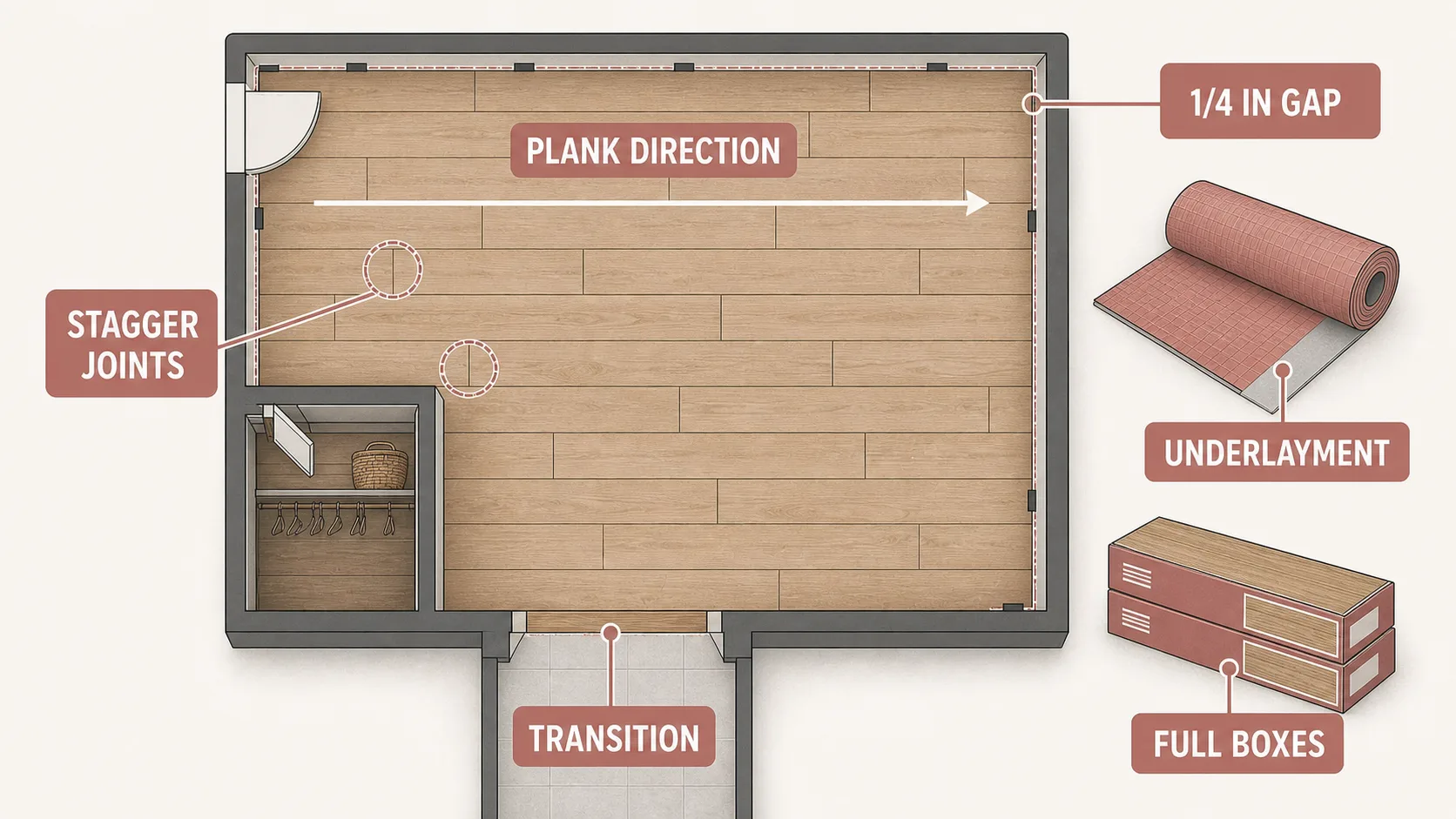
The carton count tells you what to buy. This tells you what the floor will look like. Laminate goes down in rows of planks butted end to end, and a room almost never divides into whole planks, so every row finishes on a cut and that cut sets where the next row begins. Nothing here changes your order above.
Row 1 takes 3 whole planks and finishes on 35.5 in, comfortably over the 12 in minimum, and the 12.5 in left on that plank is what opens row 2.
Across the whole field the closest two end joints come within 12.5 in of each other, and 10 of the 20 rows after the first open on a piece already cut.
Written and reviewed by
Creator
Hawkin
Certified Cost & Estimating Professional
AACE-certified estimator working with 20+ insulation companies including the two largest franchises in America.
See full profileExpert Review
Ehsan Ghazanfari
Licensed Structural Engineer
FISE-certified structural engineer with 11+ years designing bridges, retaining walls, and foundations. MSc from Aalto University.
See full profileUpdated August 4, 2026
How we verify our calculatorsCut schedule
- Field run, gaps out
- 179.5 in
- Whole planks, row 1
- 3
- Row 1 end cut
- 35.5 in
- Rows across
- 21
- Last row rips to
- 3.5 in
- Tightest stagger
- 12.5 in
- Rows opening on an offcut
- 10 of 20
Cut list
How the laminate stagger falls, row by row
Every row is planned so neither end piece drops under 12 in and no two end joints come within 12 in of each other. Those two rules are what turn a pile of planks into a sequence.
| Row | Opens with | Whole planks | End cut | Stagger |
|---|---|---|---|---|
| 1 | a full plank | 3 | 35.5 in | none |
| 2 | 12.5 in, off the offcut pile | 3 | 23 in | 12.5 in |
| 3 | a full plank | 3 | 35.5 in | 12.5 in |
| 4 | 12.5 in, off the offcut pile | 3 | 23 in | 12.5 in |
| 5 | a full plank | 3 | 35.5 in | 12.5 in |
| 6 | 12.5 in, off the offcut pile | 3 | 23 in | 12.5 in |
From row 1 the opening lengths repeat every 2 rows, so once you have marked 2 planks you have marked the rest of the floor.
Cuts are rounded to the half inch, which is as fine as a pencil mark on a plank end is worth. Doorways, closets and hearths break the sequence, and every break starts the count again from a full plank.
Acclimation
Eight laminate install tips worth knowing before the first row
Laid out in the order you meet them. The first three are decided before a carton is opened, and the last three are decided with a plank already in your hand.
- 01
Settle the direction before a carton is opened. Rows along the longest wall mean fewer end cuts and a calmer floor, and the flooring calculator is where laminate gets compared against the other materials.
- 02
Acclimate planks 48 hours in the room before install. Laminate expands with humidity.
- 03
Underlayment is required on concrete subfloors. Use one with a built-in moisture barrier rated for your slab's moisture level.
- 04
Leave 1/4 inch expansion gap at all walls. Cover with baseboards. Never butt planks against walls.
- 05
Rip the first row narrower when the last row would land as a sliver. Splitting the difference between the two outside rows is invisible under baseboard and much easier to click together.
- 06
Stagger end joints at least 12 inches between rows. Random stagger looks best and is structurally stronger.
- 07
Keep every offcut and start the next row with the longest one that fits. That single habit is most of the difference between 8% waste and 20%.
- 08
Waterproof instead? The vinyl flooring calculator covers LVP, SPC and WPC, the hardwood flooring calculator covers real wood, and the paint calculator sizes the trim paint afterwards.
AC rating
Laminate cost per square foot by AC grade
Every range sits on one shared scale, so you can see what the jump from a bedroom grade to a kitchen grade actually costs before anyone installs it.
Material only, per square foot. Professional install adds $2 to $4 per sq ft on top.
The rating is a wear class, not a quality ladder. Paying up from AC4 to AC5 in a bedroom buys nothing you will ever notice; paying down to AC3 in a kitchen shows inside two years.
Carton math
The math behind your laminate carton count
Room area times the allowance gives the area to buy. Everything after that divides that one figure by a coverage rate and rounds up, because a carton is the smallest thing anyone will sell you. The pattern penalty is added to your waste slider rather than replacing it, so a herringbone floor set at 10% is ordered at 20%.
Coverage per carton is the one input worth taking off the label rather than accepting: products ship anywhere from 18 to 30 square feet in a box, and that single number moves the carton count more than the grade or the pattern does. Transition strips are estimated from the room's size rather than counted, so count your own doorways if the room has more than a couple.
The formulas
buy = area × (1 + waste + pattern)cartons = buy ÷ sq ft per cartonplanks = buy ÷ (w × l ÷ 144)underlay = buy ÷ 200transitions = √area ÷ 10Every division rounds up. Diagonal adds 5 points of waste, herringbone 10. Cost covers laminate and nothing else: no underlayment, trim, transitions, moisture testing or labour.
Room by room
Laminate flooring by room: four jobs and their carton counts
Four rooms run through this calculator on 24 sq ft cartons and 7 by 48 inch planks, with the pattern penalty added where there is one. The row note on each is the plan you would draw before opening the first box.
Small bedroom
10 × 10 ft · mid-range AC4 · straight
5 cartons · $220 to $385
100 sq ft plus 10%. Rows along either wall come out the same in a square room, and the run takes 2 whole planks and a 23.5 in end cut. Watch the other axis: 18 rows leaves the last one ripped to half an inch, so take three inches off row 1 and finish both outside rows near 3.5 in.
Living room
15 × 20 ft · premium AC5 · straight
14 cartons · $1,155 to $1,815
300 sq ft plus 10%. Run the rows down the 20 ft wall and each one takes 4 whole planks and a 47.5 in end cut, which is nearly a whole plank and the easiest possible row to finish. AC5 is the grade that survives a room this busy.
Open plan
25 × 18 ft · mid-range AC4 · diagonal
22 cartons · $1,035 to $1,811
450 sq ft plus 10% plus the 5% diagonal penalty. Straight down the 25 ft run the end cut lands at 11.5 in, just under the minimum, so row 1's opening plank wants cutting to 29.75 in to even both ends up. A diagonal field turns every one of those ends into an angle instead.
Commercial office
30 × 20 ft · commercial AC6 · straight
28 cartons · $3,300 to $5,280
600 sq ft plus 10%. AC6 handles rolling chairs, and 7 whole planks plus a 23.5 in end cut per row makes for a fast install. A 30 ft run is long enough that the expansion gap alone may not be sized for it, so ask about a mid-floor transition before you start.
Floating floor
What goes into a laminate order beyond room area
Laminate floats. It is not fixed to anything, it moves with the season, and it is sold by the carton rather than the square foot. All three facts put something on the order that measuring the room does not.
- Expansion gap
- 1/4 inch at every wall, pipe and door frame, hidden afterwards by baseboard or quarter round. It comes off the field, not off your order: the planks fill a room slightly smaller than the one you measured.
- Cut allowance
- 10% on a straight floor, and the pattern penalty on top of that: 5% for diagonal, 10% for herringbone. Both numbers exist because an angled cut leaves an offcut with no straight edge to reuse.
- Underlayment
- One 200 sq ft roll per that much floor. Required on concrete, and it needs a moisture barrier there. Optional over plywood if the planks already carry a pad, and never doubled up: two layers is too soft and the joints work loose.
- Transition strips
- Counted in doorways, not square feet. Every threshold where the floor meets another material needs one, and a run long enough to need a mid-floor expansion joint needs one there too.
- Carton rounding
- The last carton is always partly spare, because cartons do not split. On a small room that rounding alone can be worth more than your whole waste allowance.
- A spare carton
- Kept sealed, in the same batch, for the plank a fridge gouges in year four. Laminate patterns are discontinued faster than anything else on this list, and a floating floor cannot be patched from the middle without lifting back to a wall.
Cartons to buy when the label does not say 24 sq ft
Coverage per carton is the number people assume and should read. Against your 198 sq ft with waste, here is what each coverage costs you in cartons.
| Sq ft per carton | Cartons | Spare in the last one | Against 24 sq ft |
|---|---|---|---|
| 18 | 11 | 0 sq ft | +2 cartons |
| 20 | 10 | 2 sq ft | +1 carton |
| 22 | 9 | 0 sq ft | same |
| 24assumed | 9 | 18 sq ft | same |
| 26 | 8 | 10 sq ft | -1 carton |
| 30 | 7 | 12 sq ft | -2 cartons |
Worked from the area with waste already in it, in square feet, which is how cartons are labelled even where the room is measured in metres. Change the coverage in the calculator's advanced options and the order above follows it.
Buckling
Laminate floor failures, and what to do instead
None of these show on the day you finish. They show up a season later, when the floor has taken on humidity and found out whether it has anywhere to move.
Laying planks straight off the delivery truck
Laminate arrives at the warehouse's humidity and swells or shrinks as it reaches the room's.
Leave the cartons flat in the room they are going into for 48 hours, unopened, before a single plank is cut.
No expansion gap at the walls
A floating floor with nowhere to grow pushes against the walls and lifts in the middle instead.
1/4 inch at every wall and every fixed object, pipes and door frames included, then hide it under baseboard rather than filling it.
Laying over a subfloor that is not flat
More than 3/16 inch of dip over 10 feet and the click joints flex every time somebody walks the floor.
Check with a straightedge before underlayment goes down, and level anything worse with compound. This is the one thing you cannot fix afterwards.
Standard foam underlayment over concrete
Concrete gives off moisture for years, and plain foam lets all of it reach the plank cores.
Use an underlayment with a built-in moisture barrier, and test the slab first. Over 3 lbs per 1000 sq ft wants a separate vapour barrier as well.
End joints lining up between rows
Joints close together make a continuous weak line that opens under traffic, and the stair-step pattern is visible from the doorway.
Keep at least 12 inches between the end joints of neighbouring rows. The offcut from the row before usually lands you there on its own.
Starting a row with a short offcut
A piece under a foot long has almost no locking edge and works itself loose at the wall.
Put anything shorter than 12 inches aside for closets and thresholds, and open the row with a fresh plank cut to length.
Discovering the last row on the last day
Whatever is left over is what the last row rips down to, and a one-inch strip has no tongue left to click into.
Divide the room across the plank width before you start. If the remainder is thin, take half of it off row 1 so both outside rows come out the same.
Plank questions
Eight things people ask before buying laminate
The questions that come up at the counter, answered against the same NALFA and manufacturer guidance this calculator is built on.
How many boxes for a 12x12 room?
About 7 to 8 boxes (24 sq ft/box) with 10% waste for straight layout. Diagonal adds 1 to 2 more boxes.
What AC rating do I need?
AC3 for bedrooms, AC4 for living rooms and kitchens, AC5 for commercial or heavy traffic. AC6 is for retail stores.
Can I install laminate over concrete?
Yes, with a moisture barrier underlayment. Test the slab moisture first. Readings over 3 lbs/1000 sq ft need a separate vapor barrier.
How thick should laminate flooring be?
8mm minimum for residential. 10 to 12mm for better feel underfoot and noise reduction. Thicker planks also hide minor subfloor imperfections.
What is the best layout pattern?
Straight (parallel to longest wall) wastes the least at 10%. Diagonal uses 15% waste but adds visual interest. Herringbone uses 20% waste.
Do I need underlayment?
Yes on concrete. Optional on plywood if the laminate has pre-attached padding. Never double up underlayment layers.
How long does laminate last?
15 to 25 years for AC4+. Budget AC3 lasts 10 to 15 years. Waterproof WPC variants can last 25+ years in kitchens and bathrooms.
Can laminate get wet?
Standard laminate swells when wet. Waterproof/WPC laminate handles splashes and spills. Neither should be submerged or installed in shower areas.
Disclaimer
These estimates are for planning purposes only. Actual costs vary by location, material availability, and project complexity. Always get at least 3 local quotes. This calculator does not replace professional advice.
Sources
Related Calculators
Carpet Calculator
Square yards, roll length, and cost
Flooring Calculator
All flooring types
Hardwood Flooring Calculator
Solid and engineered wood
Paint Calculator
Baseboards and trim
Sq Ft to Linear Ft Calculator
Trim conversions
Vinyl Flooring Calculator
LVP and LVT estimates
Grout Calculator
Grout by tile size & joint