Linear Feet Calculator
Convert square feet to linear feet for lumber, flooring, siding and rolled goods.
Area and width
10% for straight cuts, 15 to 20% for angles and patterns
Estimates only. Not professional advice.
Length to order
1200.00
linear feet of lumber/boards at 5.5" wide, with 10% waste already in it.
- sq ft you entered
- 500 sq ft
- Divided by coverage width
- 0.458 ft
- LF before waste
- 1090.91 ft
- Waste allowance at 10%
- 109.09 ft
- Buy this length
- 1200.00 LF
Coverage width is what the material actually covers once any overlap, tongue or groove is taken off. The board count assumes one stock length; the optimizer below ranks all four.
Last updated August 10, 2026 by our expert review team.
Cut list
Your linear feet, cut from the stock lengths your yard racks
A converter hands you a number with a decimal point in it. A yard sells boards in fixed lengths, and the rack you have ticked holds 8, 10, 12 and 16 ft. Every board in a run gets used whole except the last one, so the whole of your offcut sits on that final piece, and which stock length you pick decides how long it is.
Only length is drawn to scale here, since board width and thickness play no part in this decision. Nothing before the final board is cut at all, which is why one piece carries the whole leftover.
This run, on paper
- Length needed
- 1,200.00 ft
- Coverage width
- 5.5"
- Best stock length
- 8 ft
- Boards at that length
- 150
- You actually buy
- 1,200 ft
- Left over
- 0.00 ft
Every length you have ticked divides into 1,200 ft exactly, so nothing is left over and the choice comes down to handling and price.
Stock lengths and price live in the calculator's options panel.
Every stock length ranked on what it leaves behind
nothing to cut at this length
100.0% USED · 150 PIECES
100.0% USED · 120 PIECES
100.0% USED · 100 PIECES
100.0% USED · 75 PIECES
A round total like 1,200 ft divides into all of these, so no row wastes anything and the only thing left to choose is how many pieces you carry: 150 against 75. Nudge the area or the waste factor and the offcuts appear. Price, when it is switched on, buys the whole purchased length, offcut included.
Coverage width
Why linear feet depends on actual width, not the board's name
Square feet is a surface. Linear feet is a length you can buy. The only thing standing between them is the width the material really covers, and that number is almost never the one printed on the sticker.
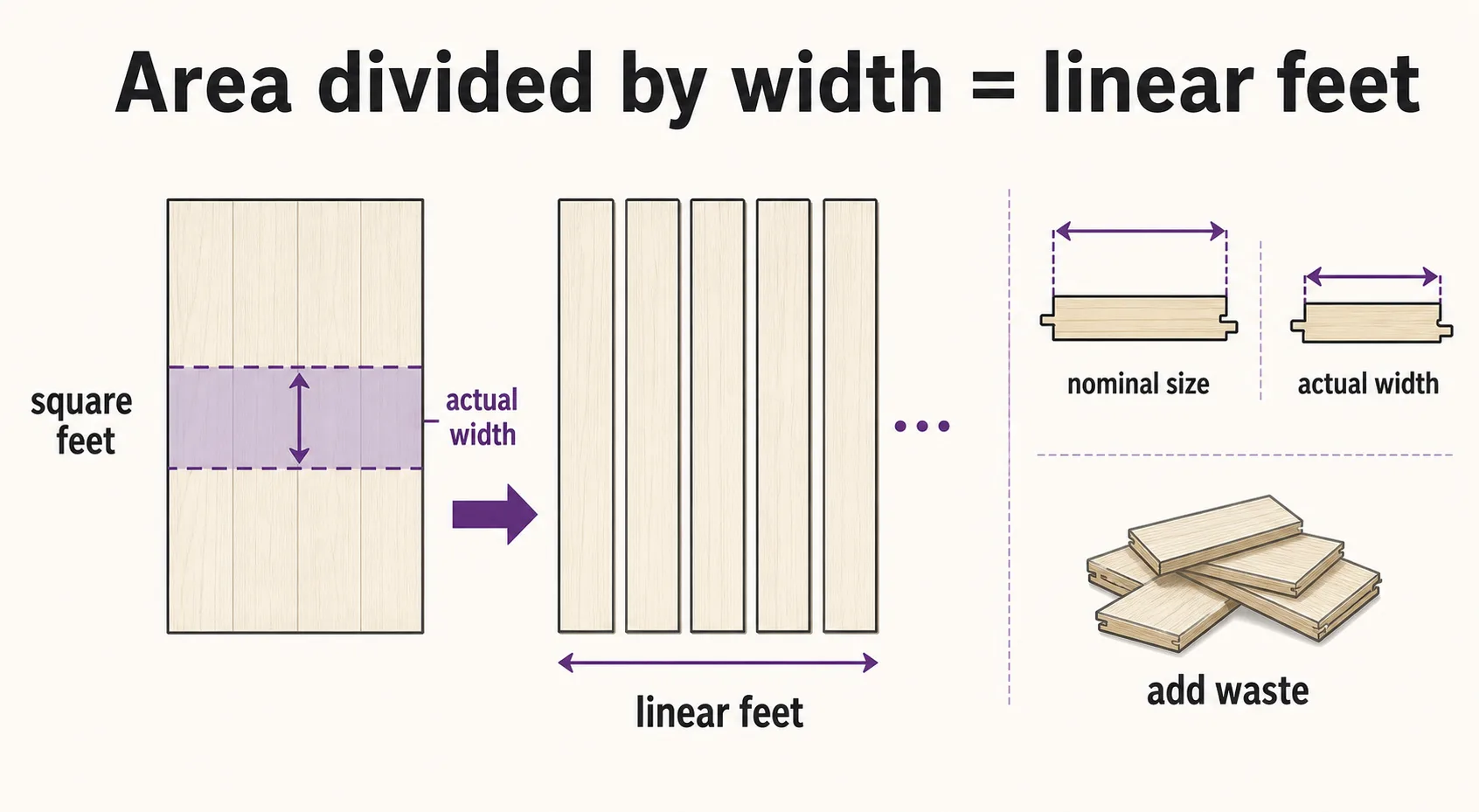
The same floor as an area and as a run of boards, with the name a board is sold under set against the width that actually covers. Waste goes on after the divide.
Dressed width: what a board measures
Softwood is milled green and then planed on all four sides, and the name it was cut under sticks. That is why a 1x6 hands you 5.5 inches and a 2x12 hands you 11.25. For decking, framing and square-edge boards, dressed width is the number to type.
Coverage width: what it hides in the joint
Tongue-and-groove flooring loses its tongue under the next board. Lap siding loses whatever you overlap. Shiplap loses the rabbet. Manufacturers publish this as coverage or exposure, and it can run an inch narrower than the plank in your hand.
Roll width: what comes off the roll
Carpet, sheet vinyl and upholstery fabric have no boards at all. Their width is fixed by the loom or the line, so the answer is a running length rather than a piece count, and the width to enter is simply the roll width in feet.
What the name costs you
| Called | Measures | Short by |
|---|---|---|
| 1×4 | 3.5" | 12.5% |
| 1×6 | 5.5" | 8.3% |
| 1×8 | 7.25" | 9.4% |
| 1×10 | 9.25" | 7.5% |
| 1×12 | 11.25" | 6.3% |
Dressed sizes for surfaced dry softwood under the American Softwood Lumber Standard. The last column is how far short your order lands if you type the name instead.
Takeoff table
Linear feet per 100 square feet, by material width
One patch of floor, five widths, and the length each one buys. Every figure below comes from the same division the calculator runs, so the table can never drift away from the number in the readout.
100 sq ft of coverage
PS 20 sizes
| Board | Width | LF exact | +10% waste | At 8 ft |
|---|---|---|---|---|
| 1×4 | 3.5" | 343 | 377 | 48 |
| 1×6 | 5.5" | 218 | 240 | 31 |
| 1×8 | 7.25" | 166 | 182 | 23 |
| 1×10 | 9.25" | 130 | 143 | 18 |
| 1×12 | 11.25" | 107 | 117 | 15 |
Board counts round up to whole pieces. Halve the width and the length doubles, which is the fastest sanity check there is on a supplier's takeoff.
Waste allowance by cut pattern
0 to 25%
The vertical rule is the waste factor set in the calculator. Ranges are working allowances for a competent install, not a guarantee, and a room full of closets and jogs can push any of them higher.
The divide
How this linear feet calculator divides area by width
Two lines of arithmetic, run in a fixed order so the unit mismatch that ruins hand calculations never gets a chance to happen.
The width goes to feet first. A 5.5 inch board is 0.458 ft, and that single step is where hand takeoffs come apart, because dividing square feet by 5.5 gives an answer twelve times too small that still looks like a real number. Area then divides by that width, which is the whole conversion: a surface becomes a length.
Waste is applied afterwards, as a straight multiplier on the length. Reverse mode runs the same two lines backwards, multiplying a length you already own by its width to see what it will cover. The metric toggle converts your entry to square feet, does the identical division, and converts the answer back, so both unit systems produce the same physical result.
Length measurement follows NIST unit definitions, and the dressed widths quoted throughout come from the American Softwood Lumber Standard published through AWC.
width (ft) = inches ÷ 12LF = sq ft ÷ width (ft)order = LF × (1 + waste)sq ft = LF × width (ft)boards = ceil(order ÷ stock length)offcut = boards × stock length − orderWhat it leaves out
- Seam layout and pattern matching
- Bad boards you cull at the rack
- Stair nosings, thresholds and transitions
- Splicing offcuts back into hidden runs
- Delivery minimums and cut charges
Each of those belongs to the trade rather than to the arithmetic, so the waste factor is where you account for them.
At the yard
Seven checks before you order the linear feet
Not a sequence, just the seven things that decide whether the number you carry to the counter is the number you needed.
Enter the dressed width, never the call-out. A 1x6 is 5.5 inches across, so typing 6 makes the order look 8.3% smaller than the floor really is and you finish the last row on a Sunday afternoon.
Use the exposed face, not the whole board, on anything that overlaps. Lap siding, shiplap and tongue-and-groove all hide part of their width in the joint, and the label calls that number coverage width.
Roll goods divide by roll width in feet. Carpet racks at 12 and 15 ft, sheet vinyl at 6 and 12, upholstery fabric at 54 inches. Pick the width closest to your longest room dimension and you buy fewer seams.
Wider planks buy less length and cost more per square foot. A 7 inch plank needs roughly 2 to 3% less running length than a 5 inch one, and usually lists 15 to 25% dearer. Price the floor with the flooring calculator once you have the linear feet.
Add the waste after the divide, not before. Adding 10% to the area and then dividing gives the same figure, but it hides which number you are checking when the yard quotes something different.
Measure the area first if you are working off a sketch. The square footage calculator handles rectangles, circles, triangles and L-shapes, and this page takes it from there.
Convert once more if the yard prices by volume. Hardwood and rough stock are often sold by the board foot, so run the length through the board foot calculator before you compare two quotes.
Over the counter
Square feet to linear feet questions: widths, rolls and reverse mode
The things people ask between getting a figure and handing it to a supplier. Nothing here is behind a toggle.
What width should I enter for lumber?
Enter actual dressed width. A nominal 1x6 is usually 5.5 inches wide. If the board has a profile, use the exposed coverage width from the label or manufacturer data.
How does this work for carpet or sheet vinyl?
Use the roll width in feet. A 180 sq ft room with 12 ft carpet needs 15 linear feet before waste because 180 divided by 12 equals 15.
How do I use reverse mode?
Use linear feet to square feet when you already know how much material you have. Enter the length, actual width, and waste to see the area it can cover.
Why does nominal size make the order short?
Nominal size is a name, not the covered width. Using 6 inches for a 5.5 inch board overstates coverage by about 9%, so the calculator uses the actual width you enter.
Should I round to board count or exact feet?
Buy in the lengths your supplier sells. If you need 120 linear feet and boards are 8 ft long, order at least 15 boards before allowing for bad boards or layout waste.
What waste factor should I use?
Use 5 to 10% for straight runs, 10 to 15% for trim with miters, and 15 to 20% for diagonal flooring, herringbone, closets, or heavy pattern matching.
Can I use this for fencing?
Yes. Calculate the fence face area, enter the actual picket width, and use the result as linear feet of pickets. For posts and rails, use the fence calculator.
When do I need board feet instead?
Use linear feet for length orders. Use board feet when buying hardwood or rough lumber by volume. Convert with the board foot calculator.
Three takeoffs
Square feet to linear feet for a floor, a fence and a carpet
Three jobs whose areas are nothing alike and whose widths are further apart still. The width is doing almost all the work in every one of them.
Living room hardwood
300 sq ft at 3.25"
1,218 LF
- LF before waste
- 1,108
- waste at 10%
- 111 ft
- boards at 8 ft
- 153
Narrow planks buy the most length. Drop to a 5 inch plank and the same floor needs roughly a third less, which is why plank width moves a quote more than grade does.
Cedar privacy fence
720 sq ft at 5.5"
1,728 LF
- LF before waste
- 1,571
- waste at 10%
- 157 ft
- boards at 8 ft
- 217
Fence face area is run times height, so a 6 ft fence buys twice the pickets a 3 ft one does. Posts and rails are counted separately.
Bedroom carpet
180 sq ft at 12 ft roll
17 LF
- LF before waste
- 15
- waste at 10%
- 2 ft
- off the roll
- one piece
Roll goods divide by the roll width, so the answer is a running length off the roll rather than a board count. Seam direction can push it up.
Every figure comes from this converter at a 10% allowance. Change the width in the calculator to any of the three and the readout reproduces the column.
Short courses
Where a linear feet order goes wrong
Four of these five send you back to the yard. The fifth sends you back with material you cannot use, which is the more expensive of the two.
Typing the call-out instead of the width
A 1x6 measures 5.5 inches, a 2x8 measures 7.25. The name has been a name since the lumber standard settled on dressed sizes.
Read the width off the end of a board with a tape. Every nominal size and its dressed width is in the takeaway table above.
Using full board width on an overlapping profile
Lap siding, shiplap and tongue-and-groove all bury part of their width in the joint, so the face you can see is narrower than the board you bought.
Use the coverage width from the product sheet. On 8 inch lap siding with a 1 inch lap, that is 7 inches, and the difference is a 14% shortfall.
Mixing inches and feet in the divide
Area is in square feet, so dividing by 5.5 rather than 0.458 gives an answer twelve times too small and it still looks like a plausible number.
Convert the width to feet first. The calculator does it from whichever unit you pick, and the method section shows the division on its own line.
Ordering the exact linear feet
Nobody sells 1,090.91 ft of anything. Boards come in 8, 10, 12 and 16 ft, carpet comes off a roll in whole feet.
Round up to the stock length your yard racks. The optimizer at the top of this page does it for all four lengths at once and shows the offcut each one leaves.
Treating roll goods like boards
Carpet and sheet vinyl are planned around roll width, room direction and where the seams fall, none of which a division can see.
Take the linear feet as an order length and let the installer set the seam layout. Expect the final figure to come back a little higher.
Disclaimer
These estimates are for planning purposes only. Actual costs vary by location, material availability, and project complexity. Always get at least 3 local quotes. This calculator does not replace professional advice.