Grout Calculator
Calculate grout weight and bag count from tile size, joint width and area.
Tile, joints and area
Tile shapes
Joint width
Decimal inches. Currently 1/8 in.
Grout type
Dye lots
Buy the whole job in one dye lot. Colour shifts between batches, and a top-up bag bought a week later shows as a stripe across the floor.
Estimates only. Not professional advice.
Grout to buy
23.2lb
Sanded grout for 120 sq ft of 12×12 in tile at 1/8 in joints, including 10% waste.
- Tile & joint · 12×12 in tile, 0.125 in joints, sanded
- Grout rate · joint volume per sq ft × density
- 0.19 lb / sq ft
- Total grout · 0.19 lb / sq ft × 120 sq ft + 10% waste
- 23.2 lb
- Bags to buy
- 1 × 25 lb
Joint check
Sanded is right at 1/8 in: the sand is what keeps a joint this wide from shrinking and cracking.
Bought separately
Tile, thinset and sealer are separate buys, and epoxy is sold as a kit rather than by the bag. The tile calculator covers the first two.
Last updated August 6, 2026. Checked against the TCNA Handbook by our expert review team.
Joint plan
Your grout joints, drawn at tile scale
Grout is the only tile material whose quantity is set by a gap. Below is the patch you are grouting, drawn at one scale on both axes: your tile, your joint width, and the share of the surface the grout actually covers.
Joint detail at 8x
The share is set by the joint width against the tile size, so smaller tile and wider joints push it the same way. Two floors of identical area can differ by several bags.
The plan is one scale on both axes, so a joint you can barely see there is a joint you will barely see on the floor. That is the whole argument for large-format tile.
Three jobs, bagged up
How much grout a floor, a backsplash and a shower each take
Three real jobs, each with the grout the tile actually calls for. The shower is barely a third of the floor’s area and still takes more than twice the grout.
Kitchen floor
23.2 lb
120 sq ft · 12×12 in · 1/8 in
1 bag at 25 lb · 0.19 lb / sq ft
Sanded grout suits a floor joint this wide, and it resists cracking underfoot.
Subway backsplash
6.1 lb
30 sq ft · 3×6 in · 1/16 in
1 bag at 10 lb · 0.20 lb / sq ft
A tight subway joint wants unsanded, which is the only one that packs a narrow gap cleanly.
Mosaic shower
49.9 lb
45 sq ft · 2×2 in · 1/8 in
5 bags at 10 lb · 1.11 lb / sq ft
A mosaic puts joint around every square, so the figure runs high. Epoxy adds the water resistance a shower wants.
Haze and hollow joints
Where grout estimates go wrong, and what to do instead
Four of these five are settled before you open a bag, and the fifth is settled at the till. None of them can be fixed once the joints are struck.
Sizing grout from the square footage alone
Area sets the tile count, not the grout. The joint does that.
A 2 in mosaic takes six times the grout of a 12 in tile over the same floor, at the same joint. Enter the tile size, not just the area.
Sanded grout in a 1/16 in joint
The sand will not pass into a joint that narrow, so it packs hollow.
Unsanded up to 1/8 in, sanded from 1/8 in up. Epoxy covers the whole range if you want one product.
Sanded grout on polished marble or glass
The sand scratches the face on the first float pass, and it does not polish out.
Use unsanded or epoxy on anything polished, and test a spare tile before you commit to the room.
Forgetting the joint is as deep as the tile is thick
Depth is half the volume. A thick porcelain plank holds far more grout than a thin wall tile.
Set the tile thickness under advanced options. A 3/8 in plank at 1/8 in joints needs about half again what a 1/4 in wall tile does.
Buying the exact bag count
Mixing loss, repacking and a partial bag all come out of the same number.
Add about 10%, and buy every bag in one dye lot. A top-up bag from a later batch reads as a stripe.
Bag maths
Pounds of grout per 100 sq ft, by tile size and joint
Every figure here comes back out of the same calculation above, so the table and your answer can never disagree. The right-hand column is the share of the surface the grout covers, which is the number the tile trade actually reasons with.
| Tile size | 1/8 in joint | 1/4 in joint | Joint share at 1/8 in |
|---|---|---|---|
| 2×2 in | 105.5 lb | 210.9 lb | 11% |
| 3×6 in | 52.7 lb | 105.5 lb | 6.0% |
| 12×12 inyour tile | 17.6 lb | 35.2 lb | 2.1% |
| 6×24 in | 22 lb | 44 lb | 2.5% |
| 24×24 in | 8.8 lb | 17.6 lb | 1.0% |
Sanded grout, joint depth 5/16 in, no waste allowance, per 100 sq ft. Your own thickness, grout type and waste move these, and the calculator uses your figures rather than these.
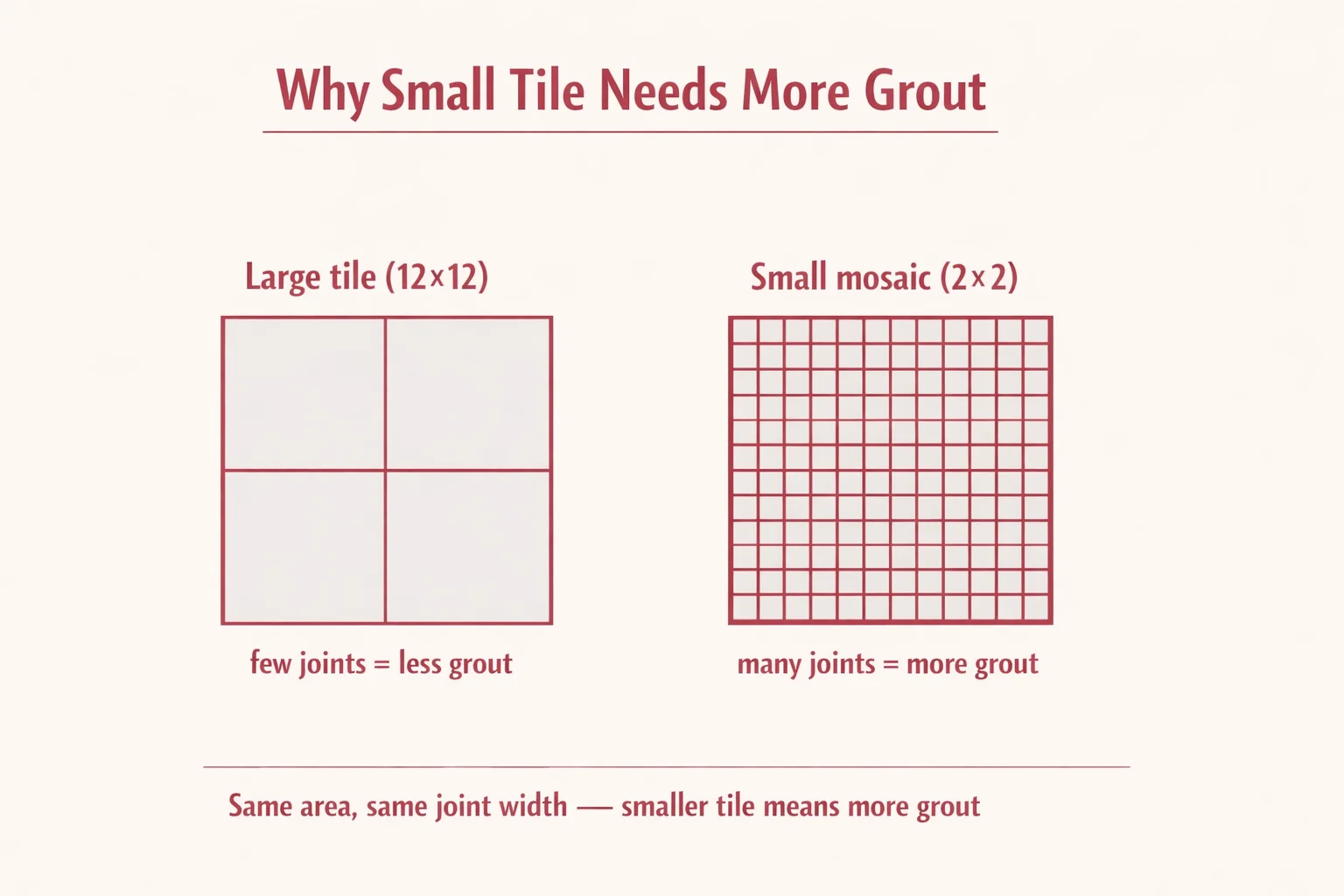
Both panels cover the same wall at the same joint width. The bag count is set by how much joint that tile choice puts into the wall.
Sanded or unsanded
Sanded, unsanded or epoxy grout: which one your joints take
Joint width decides this, and the room decides the tie-breaks. Pick the wrong one and the joint either packs hollow, cracks out over a winter, or scratches the tile you just laid.
Unsanded
≤ 1/8 in (3 mm)
Joints are 1/8 in or narrower, or the tile is polished/scratch-prone (glass, marble).
Smooth; can scratch soft tile if sanded
Sandedyours
1/8–1/2 in (3–12 mm)
Joints are 1/8 in or wider, where sand resists shrinking and cracking in the wider gap.
Most floor tile; the default for wider joints
Epoxy
1/16–1/2 in (1.5–12 mm)
It's a wet, high-stain, or chemical area (showers, kitchens, commercial) and you want maximum durability.
Stain- and water-resistant; pricier and harder to work
Cementitious grout, sanded or not, wants a penetrating sealer once it has cured. Epoxy does not, which is most of what you are paying the extra for.
Float and strike
Mixing, floating and cleaning grout without wasting a bag
In the order you actually do them. Most of the grout people throw away is lost to a bucket mixed too big or a joint struck too early.
- 01
Vacuum the joints before you mix anything. Thinset ridges and dust stop grout reaching full depth, and depth is half the volume this calculator works from.
- 02
Let the thinset cure first, a full 24 hours. Grouting over a wet bed traps water under the tile and shows up weeks later as pale, blotchy joints.
- 03
Mix one bag at a time, let it slake five to ten minutes, then remix without adding water. Skipping the slake is what makes a joint crumble a month later.
- 04
Hold the float at about 45 degrees and work across the joints, never along them. Pulling along a joint drags the grout straight back out.
- 05
Strike the joints when the surface goes matte, usually 15 to 30 minutes. Too early and you pull them hollow, too late and the haze has bonded.
- 06
Change the rinse water often. One bucket of grout-heavy water is the usual cause of the film people blame on cheap grout.
- 07
Need the tile and thinset as well? The tile calculator does those. Not sure of the area yet? Start with the square footage calculator.
Slake to sealer
From bag to back in service
- Slake after mixing
- 5–10 min
- Epoxy pot life
- 45–60 min
- Strike the joints
- 15–30 min
- Second haze wipe
- 2–3 hr
- Light foot traffic
- 24 hr
- Shower back in use
- 72 hr
- Seal cementitious grout
- 72 hr
Times are for a room at about 70°F. Cold slows every line down, and a fan or a heat gun speeds the top of the joint only.
At the tile counter
Grout questions: bags, joint width, waste and coverage
The seven that come up every time somebody buys grout, answered against the same coverage data the calculator uses.
How much grout do I need for 100 square feet?
It depends most on tile size and joint width. For 12×12 in tile with 1/8 in joints, about 15–18 lb per 100 sq ft. Small mosaic at the same joint can need six times as much, because there is far more joint per square foot.
How much grout for a 12×12 tile floor?
A 120 sq ft floor of 12×12 in tile with 1/8 in joints needs about 23.2 lb of sanded grout (with 10% waste), roughly 1 bag.
Should I use sanded or unsanded grout?
Use unsanded grout for joints 1/8 in and narrower, or for polished/scratch-prone tile like glass and marble. Use sanded grout for joints 1/8 in and wider, where the sand keeps the grout from shrinking and cracking.
Why does small tile need so much more grout?
Smaller tile means more linear feet of joint per square foot. A mosaic install can use several times the grout of a large-format floor at the same joint width: the 45 sq ft mosaic example needs about 49.9 lb.
Does joint width really matter that much?
Yes. It is the biggest lever after tile size. A 1/4 in joint uses roughly twice the grout of a 1/8 in joint on identical tile, because the joint cross-section doubles.
How many pounds is a bag of grout?
Sanded and unsanded grout commonly come in 10 lb and 25 lb bags; epoxy grout comes in smaller kits (often by the unit). Set your bag size in the calculator to get the bag count.
Should I add extra grout for waste?
Yes. Add about 10% for mixing loss, partial bags, and repacking joints. Tight mosaics and rough, porous tile can justify a bit more.
Behind the number
The joint-volume method this grout calculator runs
No coverage chart is consulted. The calculator measures the joint as a solid, then weighs it, which is why an odd tile size or a 3/16 in joint still gets a real answer.
Tile size gives the length of joint in a square foot. Multiply that run by the joint width and the tile thickness and you have the volume of grout in a square foot as a solid. Multiply by the grout factor for your product, then by your area, then add waste.
joint run = (L + W) ÷ (L × W)joint volume = run × width × depthgrout = volume × factor × areabags = grout ÷ bag size, rounded upThat joint run term treats the joint as running the full length of the tile in both directions, so it counts each crossing twice. On a 12 in tile at 1/8 in joints the over-count is about 1%, which is a rounding error next to how full you actually pack the joints, and it errs high rather than leaving you short.
Metric entries are converted to inches before any of this runs, so both modes return the same job. Full installation guidance is in the TCNA Handbook.
Grout factor
Pounds per cubic inch of joint, from manufacturer coverage data. The same in both unit modes.
- Sanded
- 0.1875
- Unsanded
- 0.165
- Epoxy
- 0.22
Epoxy is the densest and the most expensive per pound, so a shower priced on bags alone always looks worse than it is.
Disclaimer
These estimates are for planning purposes only. Actual costs vary by location, material availability, and project complexity. Always get at least 3 local quotes. This calculator does not replace professional advice.
Sources