Square Yard Calculator
Convert room or fabric dimensions to square yards, plus square feet and square meters.
Area to convert
Length
Width
Estimates only. Not professional advice.
Area in square yards
20
square yards of floor or cloth, exact area, before any waste or roll width is added.
- One square yard
- 9 ft² and 0.8361 m²
- Price per square yard
- not set
- The same price per square foot
- not set
- Put a price per square yard in advanced options to cost this area and to see it per square foot.
Roll width, seams and offcuts are decided by the material, not by the arithmetic. Take this area into the carpet calculator for the ordering figure.
Last updated August 13, 2026 by our expert review team.
The three-foot square
Your floor drawn in square yards, one 3-foot square at a time
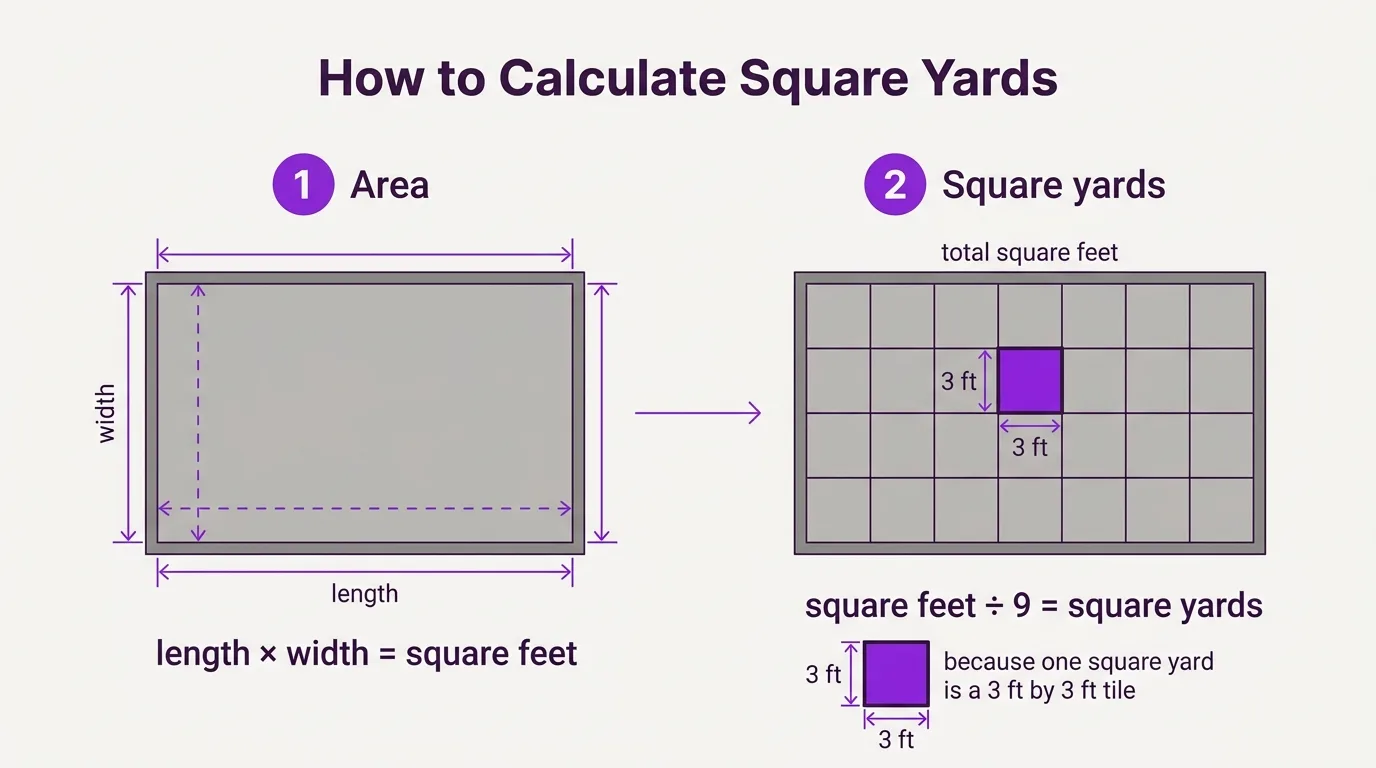
A square yard is a square three feet on a side, which is why the conversion is nine and not three. The plan below is your own length and width at one scale with the grid drawn at one yard, so the whole squares are countable and the strip that is left over is visible. Change either dimension in the calculator and it redraws.
- Whole squares that fit inside the room
- 20 yd²
- Left over, as part of a yard
- 0 yd²
- Total area
- 20 yd²
- The same area in square feet
- 180 ft²
Grid pitch is one yard, which is 3 ft or 0.9144 m exactly. A room whose sides are both multiples of three leaves nothing over, and every other room lands on a fraction.
Why the counter uses yards
Broadloom carpet, carpet pad and sheet vinyl are cut off a roll and priced by the square yard, so the price sheet is in yd² while your tape reads feet. That gap is the only reason this conversion matters, and it is why it matters at the counter rather than in the abstract.
A partial square is still floor
The strip outside the grid is not a rounding artefact, it is carpet you still have to buy. Add a foot to each wall of a 12 by 15 ft room and it still holds only 20 whole squares while the area climbs to 23.11 yd². All of the difference sits in strips too narrow to take another square.
At the price sheet
Buying by the square yard without ordering nine times too much
Not a sequence, so not numbered. Every line is a place where the unit on the quote and the unit on your tape are not the same one.
Ask which unit a price is in before you compare two of them. A shelf tag or a written quote often gives a figure and not the unit behind it, and on carpet that omission is worth a factor of nine.
Add the rooms up in square feet and divide by nine once, at the end. Converting room by room and rounding each one puts a fraction of a yard into every room instead of into the total.
Keep the rooms apart anyway. Carpet is priced per square yard and installed room by room, so four 5 yd² bedrooms and one 20 yd² floor are the same yardage and a completely different cut list.
When a supplier says "yards" and the material has a depth, they mean cubic yards. Topsoil, mulch and ready-mix all work that way, and an area on its own cannot answer them. Add a depth in the cubic yard calculator.
Exact area is not an order. Broadloom comes off a roll a fixed width, commonly 12 ft, so a room 13 ft across takes the full width plus a seamed strip and the invoice runs ahead of your floor. Carry this figure into the carpet calculator for that part.
Who quotes what
Who quotes square yards, and who quotes square feet
Square yards survive in a handful of trades and nowhere else. Knowing which list a material is on settles the nine-times mistake before the tape comes out.
The bottom two rows are the ones that catch people. A linear yard is a length of roll, and a cubic yard is a volume. Neither is nine square feet of anything.
Divide by nine
Square feet to square yards: the divide-by-nine this calculator runs
Four steps, and only the third one changes the number. The other three exist so that the division happens once, on one figure, at the end.
- 01Every dimension to feetInches divide by 12, yards multiply by 3, meters multiply by 3.280839895. Each box carries its own unit, so a room measured in feet and a panel measured in inches can sit side by side.
- 02Multiply for square feetLength times width, in feet, before any conversion happens. In known-area mode this step is the figure you typed.
- 03Divide by nineA yard is three feet, and area squares the three. That is the whole conversion, and it is the only step that changes the number.
- 04Convert to metric off that one figureSquare yards times 0.83612736, which is 0.9144 squared. Deriving every unit from one value keeps rounding from compounding.
Area (ft²) = length(ft) × width(ft)
Square yards = ft² ÷ 9
Square meters = yd² × 0.83612736
1 yd = 3 ft = 0.9144 m, exactly
The yard has been 0.9144 m by definition since 1959, so both of those factors are exact rather than rounded. The general tables in NIST Handbook 44 Appendix C carry the same equivalents.
Nothing here needs a waste factor or a coverage rate, which is what separates this page from a flooring calculator. It converts an area and stops, so the figure it gives you is the floor itself and not an order quantity.
Nine times out
Square yard mistakes that land at nine times the order
Every one of these is the same slip in different clothes: two units that share a word, used as though they were the same unit.
Reading a square-foot figure as square yards
A 12 by 15 room is 180 square feet and 20 square yards. Ordering 180 square yards buys 1,620 square feet of carpet, nine times the floor, and it is the single most expensive typo on this page.
Comparing $4 per square foot against $30 per square yard
Multiply the per-foot price by nine before you compare. $4 per square foot is $36 per square yard, so the $30 quote is the cheaper carpet, not the dearer one.
Using square yards on a job that has a depth
Topsoil, gravel and concrete are quoted in cubic yards, and an area cannot become a volume on its own. Add the depth in the cubic yard calculator instead of converting twice.
Rounding each room up to a whole yard, then adding the rooms
Keep every room in square feet, add them, and divide once. Rounding four rooms up separately carries four separate part yards into a total that only ever needed one.
Buying a yard of fabric and expecting a square yard
A linear yard is 36 in of roll length. On 36 in goods that is exactly one square yard, on 54 in goods it is 1.5, and on 60 in goods it is 1.67. The width is what decides.
Three orders
Square yards for a carpet room, a fabric cut and a floor you already measured
Each one is a preset in the calculator above and lands on the same figure there. The third line of each column is the one people get wrong: the nine-times read, the linear yard, and the metric equivalent.
12 x 15 ft carpet room
Broadloom for a bedroom
20 yd²
- Area in square feet
- 180 ft²
- Divided by 9
- 20 yd²
- Read as square yards instead
- 180 yd²
12 and 15 both divide by 3, so this floor is exactly 20 whole squares with nothing left over. It is the reason this room turns up in every worked example of the conversion.
96 x 54 in fabric panel
A cut of 54 in goods
4 yd²
- Inches to feet
- 8 x 4.5 ft
- Area, divided by 9
- 4 yd²
- The same cloth in linear yards
- 2.67 lin yd
A linear yard is 36 in off the roll, so on 54 in goods it is 13.5 ft², or 1.5 yd². The panel is four square yards and two and two thirds linear yards of the same cloth.
360 sq ft already measured
A quote to compare
40 yd²
- Area as given
- 360 ft²
- Divided by 9
- 40 yd²
- Metric equivalent
- 33.45 m²
Nothing to measure here, only a unit to change. This is the mode to use when the quote is per square yard and the takeoff you were handed is per square foot.
Room by room
Square yards by room size, and what your own price makes of them
The first three columns are exact area. The last one fills in once you put a price per square yard in advanced options, which is how a quote you were handed lines up against a room you have not measured yet.
Every row is length times width divided by the same nine square feet per square yard the readout uses. Exact area, so none of these figures carries waste.
Ordering questions
Ordering by the square yard: the questions that come up first
Eight answers, opening with the conversion itself and closing with what it deliberately leaves out.
How many square feet are in a square yard?
There are 9 square feet in 1 square yard. Divide square feet by 9 to get square yards.
How many square yards are in 100 square feet?
About 11.11 square yards. The math is 100 / 9 = 11.11 yd².
How many square yards is a 12x15 room?
A 12x15 room is 180 sq ft, or 20 square yards before waste.
Should flooring be estimated in square feet or square yards?
Use whichever unit your supplier quotes. Carpet and some sheet goods are often discussed in square yards, while tile, laminate, and plank flooring are usually quoted in square feet or boxes.
Square yard or cubic yard: which one do I need?
Use square yards for area and cubic yards for volume. If the project has depth, such as gravel or concrete, use cubic yards instead.
How much does carpet cost per square yard?
Fiber, backing, pad, roll width, and installation all move the price, so the unit is the only part you can pin down yourself. Convert the area to square yards first, then compare every quote in the same unit: a price per square foot times 9 is the price per square yard.
Why is confusing square feet and square yards a 9x mistake?
One square yard is 9 square feet. Treating 100 sq ft as 100 sq yd would order nine times too much material.
Does this include flooring waste?
No. This converter gives the exact area. Flooring, carpet, and tile jobs usually add waste for seams, pattern direction, cuts, and damaged pieces.
Disclaimer
These estimates are for planning purposes only. Actual costs vary by location, material availability, and project complexity. Always get at least 3 local quotes. This calculator does not replace professional advice.
Sources