Carpet Calculator
Calculate square yards, roll length, seams, cushion and installed cost for a room.
Room and roll
Common rooms
The run direction
Across the roll
Roll width
Carpet grade
Estimates only. Not professional advice.
Carpet to order
22.1sq yd
17 ft off a 12 ft roll, cut into 1 strip, with the 10% trim allowance included.
- Carpet
- $594-$990
- Cushion
- $158-$238
- Install labor
- $149-$297
- Installed total
- $901-$1,525
- Installed, per sq ft
- $4.55-$7.7
Uses mid-grade carpet and memory foam pad. Removal, furniture moving and job minimums sit outside this.
Last updated August 13, 2026. Roll widths, seam placement and cushion limits checked against CRI guidance by our expert review team.
Seam plan
Carpet roll layout for your room, and where the seam falls
Carpet is roll goods. It arrives in a fixed width, commonly 12 ft with 15 ft available in some ranges, and the room is covered by strips of that width laid side by side. The plan below is your room at the dimensions above, with the strips drawn on it, so you can see the seam before anyone cuts anything.
1
Strips
0
Field seams
17 ft
Roll run
22.1 sq yd
Off the roll
Nothing is exaggerated. This room fits inside a single strip, so there is no field seam to place, and the hatched band is the roll width you still pay for.
This room, off each roll width
No field seam, 17 ft of roll, about $1,213 installed
No field seam, 17 ft of roll, about $1,516 installed
The 12 ft roll is about $303 cheaper installed on this room, at the same grade and cushion. A wider roll is not automatically dearer: it is dearer per square foot and can still win by removing a strip.
Roll goods
Why carpet is ordered by roll width and not by room area
A plank floor is sold in boxes, so the room area rounds up to the next box and the arithmetic ends there. Carpet is sold off a roll, so the room rounds up to the next full-width strip, and a room one foot over the roll width can add a whole second cut the length of the room. That gap is where the money goes, and it is the reason this page is not another area calculator.
Tape, sketch, seam
Measuring a room for carpet, in the order the installer does it
These are not parallel suggestions. Each one narrows the next: the run direction decides the strip count, the strip count decides the seam, and the seam decides how much carpet you are buying. Steps three, four and five are the ones people reach in the wrong order.
- 01
Measure wall to wall at the widest point in each direction, then measure every closet, alcove and landing as its own rectangle. The square footage calculator adds up an odd-shaped room, and the total comes back here for the roll-width arithmetic.
- 02
Sketch the room before you think about carpet. CRI treats the diagram as part of the estimate: it wants accurate measurements, marked seam placement, and a note on anything unusual such as a bay, a border or a stepped closet.
- 03
Decide the run direction next, because it fixes everything after it. Strips are cut as long as the room and as wide as the roll, so the run direction decides how many strips the room takes and therefore how much carpet falls past the wall.
- 04
Set the pile lay once, for every piece. CRI 105 requires adjacent pieces of the same broadloom to run the same direction, ideally with the pile leaning toward the entrance, so a fill strip cannot be turned to save material.
- 05
Place the seam where traffic runs along it rather than across it, away from pivot points, not perpendicular to a doorway, and out of the line where daylight rakes across the floor. A seam that breaks every one of those rules is the seam you will see from the door.
- 06
Leave 3 in spare along each wall for trimming, and more again if the carpet has a pattern that has to match across the seam. This is why the allowance is a percentage of the cut, not of the finished floor.
- 07
Pick the cushion from the carpet style, not from how it feels underfoot in the showroom. Too thick is a real failure mode: the carpet flexes at the seam and the backing gives out.
- 08
Count stairs separately from the field. Twelve square feet a step is enough to price the job, but tread depth, nosing profile, winders and landings change the cuts, so use the stair calculator for the geometry and let the installer take the final measurements.
- 09
Ask for the seam diagram on the quote, in writing, before you pay a deposit. Two installers can price the same room differently purely on where they intend to put the seam.
- 10
Compare quotes as installed totals. Carpet, cushion, labor, old floor removal, furniture moving, stair charges and a job minimum all sit outside the advertised square-foot price, and any one of them can outweigh the difference between two carpets.
Rooms off the roll
Carpet by the room: four jobs and four roll layouts
Four rooms run through this calculator, each with the roll width an installer would actually choose for it. Two of them fit inside one strip and two do not, and that single fact moves the order more than the difference between a builder carpet and a premium one.
Guest bedroom
17.6 sq yd
- Room
- 12 x 10 ft
- Roll
- 12 ft, no field seam
- Roll length
- 14 LF
- Installed
- $721-$1,220
This room fits across a 12 ft roll with no field seam, but you still buy the full roll width.
Wide family room
58.7 sq yd
- Room
- 20 x 13 ft
- Roll
- 12 ft, 1 seam
- Roll length
- 44 LF
- Installed
- $2,402-$4,066
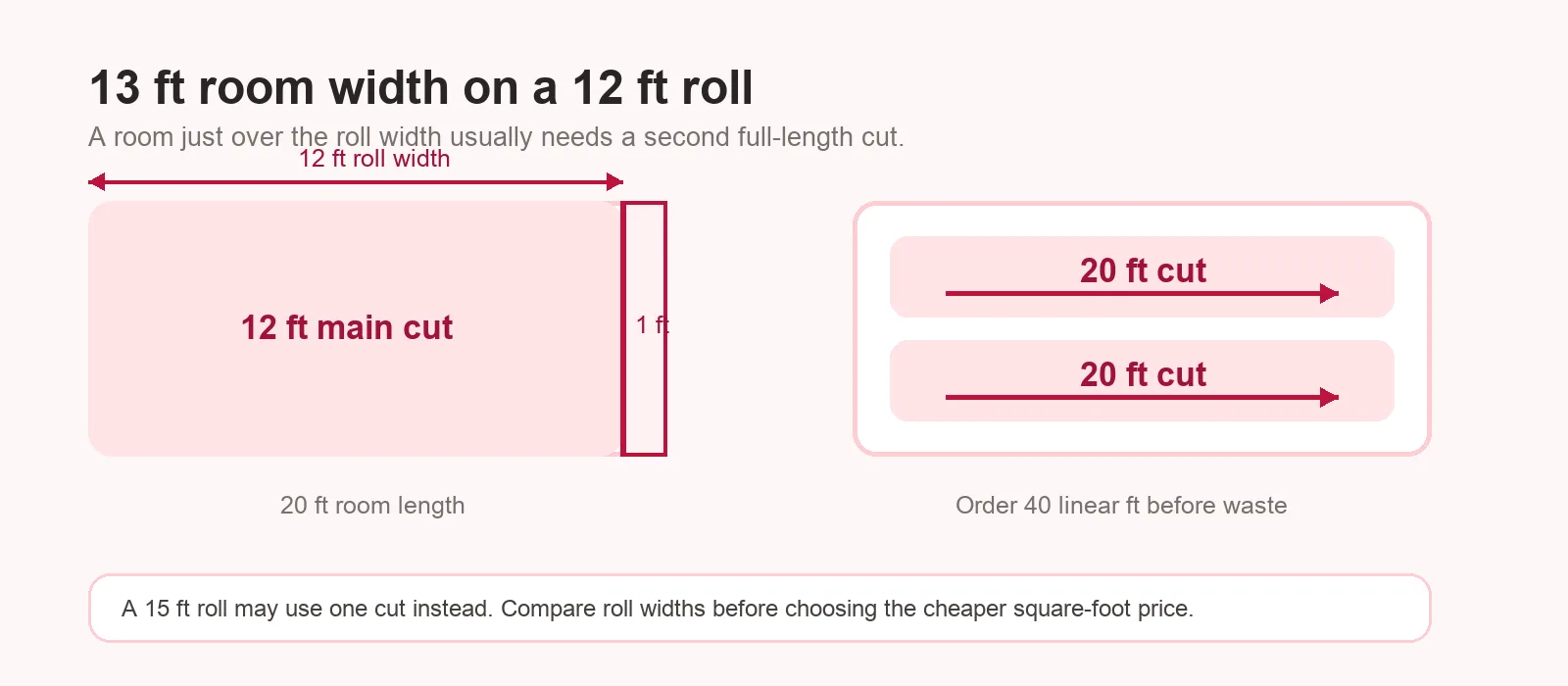
A 13 ft width needs two 20 ft cuts from a 12 ft roll unless a 15 ft broadloom option is available.
Bedroom plus stairs
35.9 sq yd
- Room
- 12 x 12 ft
- Roll
- 12 ft, no field seam
- Roll length
- 27 LF
- Installed
- $2,242-$3,645
Stairs add material and labor. Use the stair count here for carpet, then check rise and run separately.
Premium primary suite
36.7 sq yd
- Room
- 20 x 15 ft
- Roll
- 15 ft, no field seam
- Roll length
- 22 LF
- Installed
- $2,294-$3,729
A 15 ft roll can remove the seam that a 12 ft roll would create in the same room.
All four use a 10% trim allowance and the grade and cushion named in each row. Figures are in feet, square yards and dollars, because that is how a carpet quote arrives.
Strips and yardage
How this carpet calculator turns a room into square yards
Five steps, and only the last carries any judgement. The one worth reading is the second, because it is where this parts company with every calculator that multiplies length by width and adds ten percent.
Room length times room width gives the finished floor area, and each stair adds a flat twelve square feet on top of it. Room width divided by roll width, rounded up, gives the number of strips, and one less than that is the number of field seams. Each strip is charged at the full roll width for the whole length of the room, so the area bought is strips times room length times roll width. The trim allowance goes on last, and the result divides by nine for square yards or by the roll width again for the linear feet the store will actually cut.
So the waste on this page is not one flat percentage. The roll-width overage is derived from the real roll width first, and it can be far larger than any percentage anyone would type in: on a 13 ft wide room off a 12 ft roll it is roughly 85% of the floor area, because the second strip is as long as the room and almost none of it gets laid. The percentage you set sits on top of that, and it covers the 3 in along each wall CRI 105 asks for, the doorways and the closet fills. A patterned carpet needs more again, because every strip has to start at the same point in the repeat.
- Square yard
- 9 sq ft
- Roll widths offered
- 12 ft and 15 ft
- Stair allowance
- 12 sq ft
- Trim allowance in use
- 10%
This is an estimating layout, not a seaming diagram. The final cuts come from the installer after checking pile direction, closets, doorways, stairs and the light in the room.
Pile lay
Carpet seams and pile direction: what goes wrong on the day
Broadloom is one continuous piece of fabric with a direction to it, stretched over a floor it is not glued to. That makes its failure modes different from a plank floor: nothing here is a cutting accident, and every row either changes the order above or shows up as a line across the room the first time the sun comes round.
Ordering by square footage alone
Area is what a tape measure gives you and it is not what the store sells. Carpet comes off a roll of fixed width, so the order is a number of full-width strips.
Enter the room width and the roll width, not just the area. On the room above the two differ by 0 sq ft, which is carpet you pay for and never walk on.
Turning a fill strip to save material
It looks like free carpet. Broadloom has a pile that leans one way, so a rotated piece takes light differently and the seam reads as a stripe across the room.
Keep the pile lay identical on every adjacent piece, as CRI 105 requires. If the layout only works with a rotated strip, the room needs a wider roll or a different run direction.
A seam through the doorway or across the light
Doorways concentrate traffic into a pivot, and raking daylight across a seam throws a shadow line down its whole length. Both make the one seam you have the most visible thing in the room.
Run seams the length of the area, parallel to the main traffic, away from pivot points and never perpendicular to an opening. Mark them on the plan before the carpet is cut.
Leaving the seam edges unsealed
A cut edge of broadloom ravels. Once the yarn starts pulling out of the backing at the seam there is no repair that does not involve replacing the piece.
Carpet manufacturers specify that all seams are sealed, on cut pile as much as on loop. If an installer tells you a cut pile seam does not need sealing, that is the wrong installer.
Buying cushion by feel in the showroom
The thickest sample feels best under a hand and is often the wrong product. An over-thick cushion lets the carpet flex at the seam and at the tack strip, which is how a new floor develops ripples.
Match the cushion to the carpet style. Cut pile takes a firm cushion no thicker than 7/16 in, and berber or commercial carpet takes a very firm one no thicker than 3/8 in.
Leaving closets, returns and landings off the sketch
They are small, so they get skipped, and then the fill they need comes out of the offcut that was going to cover the last two feet of the room.
Draw them and measure them. A closet floor is a separate small piece, and on a room already at the roll width it can be the thing that forces a second full-length cut.
Per square foot
Carpet cost per square foot, and the cushion each style takes
Three numbers make an installed carpet price: the carpet, the cushion under it and the labor to stretch it in. The first table is the band each grade sits in, the second is the cushion the carpet you picked is actually allowed, which is the line most quotes leave to the salesperson.
Maximum cushion thickness by carpet style
Published by the Carpet and Rug Institute. Over the limit, the carpet flexes at the seam and at the tack strip, which is what turns a new floor into a rippled one inside a year.
Carpet bands are 2025 to 2026 US planning figures and sit close to the $3-$11/sq ft installed range published for a whole job. Removal of the old floor, subfloor repair, furniture moving, stair charges and a job minimum sit outside all of them.
At the sample rack
Carpet questions: square yards, seams, stairs and cushion
The eight things people ask between measuring the room and signing the order, answered against the same CRI guidance and the same roll-width arithmetic used above.
How much carpet do I need for a 12 x 12 room?
A 12 x 12 room needs about 17.6 square yards of carpet when ordered from a 12 ft roll with 10% waste. That is 14 linear feet of 12 ft roll.
How many square feet are in a square yard of carpet?
One square yard of carpet is 9 square feet. Carpet is often priced by square foot in retail ads, but installers and older quotes may still use square yards.
How much does carpet installation cost?
A mid-grade carpet job often lands around $901-$1,525 for a 12 x 15 ft room in this calculator, including carpet, pad, and basic installation. Your quote can change with furniture moving, removal, stairs, subfloor repair, and minimum labor charges.
Should I choose 12 ft or 15 ft carpet?
Use the width that creates the cleanest layout, not just the cheapest square-foot price. A 15 ft roll can remove seams in 13 to 15 ft rooms, while a 12 ft roll may still be cheaper if the seam is acceptable and the pile direction works.
Can carpet seams be invisible?
No seam is guaranteed invisible. CRI guidance says seams should be minimized, run with the length of the area when possible, and avoid traffic pivots, doorway openings, and cross-light.
How much carpet do stairs need?
Plan about 12 square feet per stair for a rough takeoff, or 3 ft by 4 ft per step. Stairs need installer review because tread depth, riser height, nosing, landings, pattern, and pile direction change the cuts.
Do I need carpet pad?
Yes for most stretch-in residential carpet. The Carpet and Rug Institute describes cushion as important to carpet life, except for direct glue-down systems where the manufacturer says otherwise.
Should I buy carpet by square feet or square yards?
Both describe area, but square yards are common for carpet because 1 square yard equals 9 square feet. This calculator leads with square yards and also shows roll linear feet because roll width controls the cut plan.
Planning a hard floor in the next room instead? The flooring calculator covers boxes of laminate, vinyl, hardwood and tile, none of which are ordered by roll width.
Disclaimer
These estimates are for planning purposes only. Actual costs vary by location, material availability, and project complexity. Always get at least 3 local quotes. This calculator does not replace professional advice.
Sources