Paint Calculator
Calculate how much paint a room needs, by surface, coats and number of rooms.
Room Dimensions
Smooth (previously painted)
375 sq ft/gal
Standard coverage on previously painted walls.
Estimates only. Not professional advice.
Paint to buy
2.0
gallons total
320 sq ft of wall across 1 same-size room, 2 coats at 375 sq ft/gal.
- Walls
- 2.0 gallons
- Estimate at $45 a 1 gal can
- $90
- Total to buy
- 2.0 gallons
Quantities include the 10% buffer for touch-ups and what stays in the tray and roller. Each product is rounded up to a whole can, which is why the can plan below can sometimes close the same gap for less.
Last updated August 5, 2026 by our expert review team.
Surface and sheen
Every surface takes a different paint, and a different number of cans
Pick the product by where it lives first. The spread rate follows from that choice, and the spread rate is what decides how many cans you carry out of the store.
Interior walls
Latex eggshell or satin
Bedrooms, halls and living spaces. Texture pulls the spread rate down.
350-400
Trim and doors
Acrylic enamel or alkyd hybrid
Harder film, better cleaning, less coverage per can than wall paint.
300-350
New drywall and patches
PVA or stain-blocking primer
Evens out porous paper, joint compound and repair spots before paint.
300-350
Cabinets and tough surfaces
Bonding primer plus enamel
Plan extra sanding, dry time and thin coats so doors do not stay tacky.
300-400
Your surface setting picks one of four rates: 375 sq ft/gal on smooth walls, 325 sq ft/gal on new drywall, 300 sq ft/gal on texture or bare wood. Nothing else in the estimate moves as much as that number does.
Same wall, four settings
Your wall area with each of the four spread rates the calculator carries. Guess the surface wrong and the order moves by whole cans.
Smooth (previously painted)yours
375
1.9 gal
2 × 1 gal
Textured walls
300
2.3 gal
2 × 1 gal + 2 × 1 qt
New drywall
325
2.2 gal
2 × 1 gal + 1 × 1 qt
Bare wood
300
2.3 gal
2 × 1 gal + 2 × 1 qt
At the mixing counter
Your paint order in cans, not in decimal gallons
Nobody sells you 1.9 gallons. Paint comes in cans, so the useful question is which containers to pick up and what the leftover is worth. This reads your own numbers above: change the coats or the room count and the order below changes with it.
What to carry to the till
Wall paint
smooth walls at 375 sq ft/gal
1.9 gal
2 × 1 gal2.0 gal for $90
0.1 gal
Whole order
1.9 gal
2.0 gal of containers for $90
0.1 gal
Leftover is not waste. 0.1 gal of wall paint is about 46 sq ft of touch-ups at your spread rate, and a sealed can of a color you already own is the only reliable way to match it in two years. Wall, ceiling, trim and primer are four different products, so they are ordered separately and never pooled together.
Coat by coat
A second coat is not a second order. Each coat adds 0.9 gallons of wall paint, and only one of them usually pushes you onto another container. This calculator spreads every coat at the same rate.
- Through coat 1
- 0.9 gal
- 1 × 1 gal
- Through coat 2new container
- 1.9 gal
- 2 × 1 gal
Closing the last part-can
The wall paint is where the remainder sits. Two honest ways to close it, priced from the $45 can and the roughly $20 1 qt tin.
1 qt tins allowedyour setting
2 × 1 gal
$90
0.1 gal spare
Full 1 gal cans only
2 × 1 gal
$90
0.1 gal spare
Your remainder is 0.9 gal past the last full can, which is too much for tins to close cheaply: it would take 4 of them at $80 against $45 for the can. Tins win when the remainder is a quarter or a half can, no further.
Rooms pooled, not rounded twice
Rooms of the same color pool into one order. Priced one at a time, every room rounds its own part-can up; pooled, the rounding happens once. Same paint, fewer containers.
| Rooms this size | It drinks | One pooled order | Bought room by room | Saving |
|---|---|---|---|---|
| 1your order | 1.9 gal | 2 × 1 gal$90 | 2.0 gal$90 | none |
| 2 | 3.8 gal | 4 × 1 gal$180 | 4.0 gal$180 | none |
| 3 | 5.6 gal | 1 × 5 gal + 1 × 1 gal$225 | 6.0 gal$270 | $45 |
| 4 | 7.5 gal | 1 × 5 gal + 3 × 1 gal$315 | 8.0 gal$360 | $45 |
With one room there is nothing to pool. At three rooms this size, one order saves $45 against three orders rounded separately.
Container prices are the ones this page uses for its estimate: $180 a 5 gal pail, $45 a 1 gal can, about $20 a 1 qt tin, $35 a 1 gal can of primer. Your store will differ, and a mixed color is rarely returnable. For a full budget with labor and supplies, use the paint cost calculator.
Spread rate
Paint coverage by finish, from flat to high-gloss
Sheen and spread rate move together. Flat lays down thin and goes furthest; gloss is the thickest film and covers the least ground per can. The bars share one axis, so the gap between the top and bottom row is the real gap.
Flat / matte
ceiling rate here: 400
Ceilings, low-traffic walls where glare shows every roller mark.
375-400
Eggshell
Bedrooms and living rooms. Hides flaws, takes a touch-up cleanly.
350-375
Satin
Kitchens and hallways. Wipes clean from grease and hands.
325-350
Semi-gloss
trim rate here: 300
Bathrooms, trim and doors. Resists moisture and scrubbing.
300-325
High-gloss
Rarely walls. Doors, cabinets and furniture that take real wear.
250-300
Bars run on a shared 0 to 420 sq ft/gal axis and show the low-to-high span, on smooth previously painted walls. Texture, new drywall and bare wood pull every row down 15 to 25%.
Inside the estimate
What this paint calculator counts, and what it leaves to you
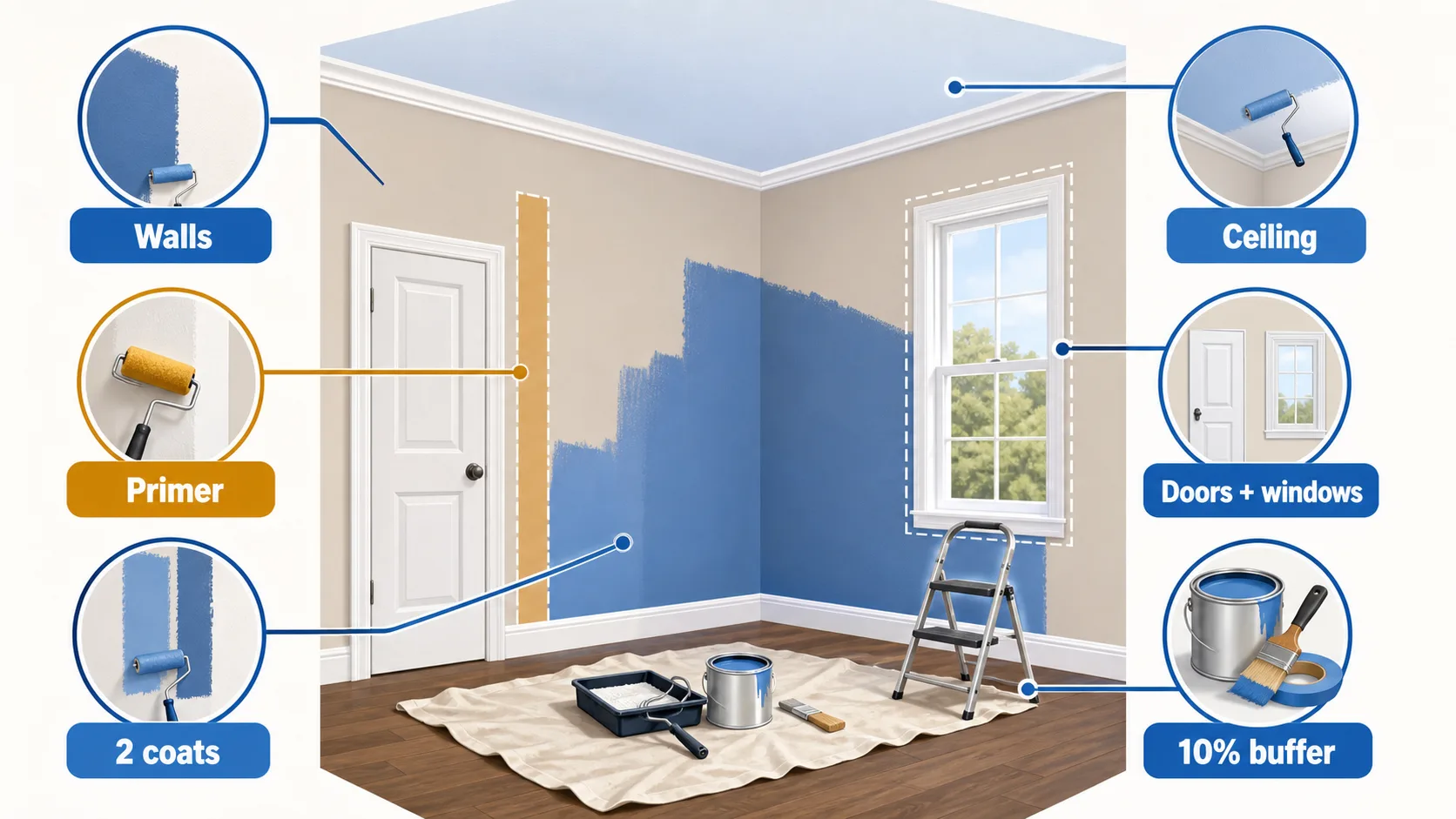
Height times perimeter is the whole of it. Everything after that is subtraction for the openings, a buffer for the tray and the touch-ups, and a division by the spread rate your surface setting picked.
wall area = (height × perimeter − doors × 20 sq ft − windows × 15 sq ft) × roomswall cans = ⌈wall area × 1.10 × coats ÷ spread rate⌉ceiling cans = ⌈ceiling area × 1.10 × coats ÷ 400⌉trim cans = ⌈perimeter × trim height × rooms × 1.10 × coats ÷ 300⌉primer cans = ⌈(wall + ceiling area) × 1.10 ÷ 300⌉estimate = paint cans × $45 + primer cans × $35Counted
- Wall area for every same-size room, with 20 sq ft out per door and 15 sq ft per window, per room.
- A 10% buffer on every product, for cut-in overlap and paint left in the tray and roller.
- Coats as a straight multiplier, at one spread rate per surface.
- Ceiling, trim and primer as separate products with their own rates, when you turn them on.
- Rounding up to a whole can, once per product rather than once per room.
Left to you
- A first coat on a raw or patched wall drinking more than the ones after it.
- Colour strength. A saturated red over white can need a coat nobody planned for.
- Sprayer overspray, which no roller-based buffer covers.
- Brushes, rollers, tape, filler and drop cloths, none of which are in the estimate.
Labor, supplies and paint tiers live in the paint cost calculator; exterior wood in the stain calculator.
Cutting in
Eight habits that make two coats of paint look like two coats
The can count is the easy half. These are the eight things that decide whether the finish reads as one even film or as a wall somebody painted in a hurry.
Box the batch
Buy the whole order at once and have the store shake the cans together. The same color code can shift slightly between batches.
Cut in first
Cut in edges with a 2.5" angled brush before rolling. Rolling first leaves visible lap marks at corners.
Prime what shines
Use a bonding primer (Zinsser or Kilz) on glossy surfaces, dark colors, or fresh drywall. Without it, your topcoat peels within a year.
Roll in a W
Roll a W pattern across 3 to 4 foot sections, then fill it in. Straight parallel strokes leave streaky lines.
Watch the humidity
Aim for 50% relative humidity when you can. Many paint specs use 77°F and 50% RH for dry times; above 85% RH, wait for drier air because cure time and adhesion get unpredictable.
New walls first
Painting new construction or fresh walls? Our drywall calculator estimates sheets before any of this matters.
Paper instead of paint
Considering wallpaper? The wallpaper calculator estimates rolls, strips, and paste for any room.
Outside wood
Finishing a deck or fence too? The stain calculator works out how much stain exterior wood needs.
Flashing and peeling
Six ways a paint order goes wrong before the lid comes off
Every one of these produces a wall that looked fine while it was wet. Five are prep, one is arithmetic, and the arithmetic one is the cheapest to fix.
Skipping primer on new drywall
Mudded joints and paper-faced areas absorb paint differently, so the wall dries in light and dark patches. One coat of PVA primer fixes it.
Painting in bad weather
Dry-time specs are usually based on about 77°F and 50% RH. Above 85% RH or below 50°F, wait or expect slow curing and adhesion trouble.
Rolling before cutting in
Cut in one wall with a brush, then roll it while the edges are still wet. Roll first and the dried roller texture shows through the brush work.
Cheap roller covers
A $2 roller sheds fibers and leaves stipple marks. Spend $8 on a Purdy or Wooster microfiber. 3/8" nap for smooth walls, 1/2" for textured.
Leaving tape on too long
Pull tape within 1 to 2 hours of the final coat while it is still slightly tacky. After 24 hours the adhesive bonds and tears paint off in strips.
Ordering the exact amount
Round the last part-can up rather than down. Mid-project color matching is unreliable, and the extra covers touch-ups for years.
The last one is why the readout rounds each product up rather than down. Going back for a second batch of a mixed color is the one mistake on this list you cannot sand out.
Room by room
Three rooms of paint, ordered can by can
Three sets of dimensions run through the same arithmetic as the calculator, at 375 sq ft/gal on smooth walls with two coats. The middle one is the pooling case: three bedrooms, one order.
12 × 12 ft, 8 ft ceiling
2.0gal
drinks 2.0 gal · 1 room
Standard bedroom
- Wall area
- 334 sq ft
- Cans to pick up
- 2 × 1 gal
- Paint only
- $70-$130
One door and two windows come out of the wall area. Two cans cover two coats with touch-up paint left over.
12 × 12 ft, 8 ft ceiling
6.0gal
drinks 5.9 gal · 3 same-size rooms
Three matching bedrooms
- Wall area
- 1,002 sq ft
- Cans to pick up
- 1 × 5 gal + 1 × 1 gal
- Paint only
- $210-$390
Same room, three times. Doors and windows come out per room, then the order is rounded once instead of three times.
20 × 25 ft, 9 ft ceiling
5.0gal
drinks 4.2 gal · 1 room
Open living and dining
- Wall area
- 710 sq ft
- Cans to pick up
- 4 × 1 gal + 1 × 1 qt
- Paint only
- $175-$325
Tall open rooms show roller marks, so box the cans together before you start cutting in.
The headline figure is the rounded order the calculator returns. Paint-only ranges use the $35 to $65 a can span this page has always quoted, which is wider than the $45 the estimate assumes.
From the paint desk
Paint questions people ask at the mixing counter
Eight answers, all of them against the same spread rates this calculator divides by.
How much paint do I need?
Multiply wall perimeter by ceiling height, subtract 20 sq ft per door and 15 per window, then divide by 350-400. A 12x12 room needs about 2 gallons for two coats.
How many gallons for a room?
10x12 bedroom: 2 gallons. 15x20 living room: 3-4 gallons. Bathroom: 1-2 gallons. All assume two coats at 350-400 sq ft per gallon.
How many sq ft does a gallon cover?
350-400 on smooth walls. Drops to 250-300 on textured, new drywall, or bare wood. Semi-gloss covers slightly less (300-350).
One coat or two?
Almost always two. One coat leaves thin spots visible in side lighting. Only skip on exact same-color recoats.
When do I need primer?
New drywall, raw wood, patched spots, dark-to-light changes, and glossy surfaces. Zinsser and Kilz are the go-to brands.
How does the room multiplier work?
Enter one room's perimeter, doors, and windows, then set Same-size Rooms to the count. Three identical 12x12 bedrooms with one door and two windows each need about 6 gallons for two coats.
Should I use this or the cost calculator?
Use this page when the main question is gallons. Use the paint cost calculator when labor, supplies, primer, and paint tier are part of the budget.
Is premium paint worth it?
For high-traffic areas, often yes. Benjamin Moore Regal Select is best budgeted around $55-65/gal and usually covers better than economy paint, so you may buy fewer gallons on strong color changes.
Disclaimer
These estimates are for planning purposes only. Actual costs vary by location, material availability, and project complexity. Always get at least 3 local quotes. This calculator does not replace professional advice.
Sources