Sand Calculator
Estimate cubic yards, tons, 50 lb bags and cost for paver bedding, sandboxes and levelling sand.
Project Dimensions
Project preset
Paver Base
1" typical
Under pavers. That is the finished depth, so the calculator adds the compaction allowance on top of it.
Paver/Leveling Sand · For paver bedding layers · $42/ton
Loose sand to order
0.41
cubic yards of paver/leveling sand, loose, with the 20% compaction allowance and 10% waste already in it.
- In place at 1 in
- 8.33 cu ft
- Loose volume to buy
- 0.41 yd³
- Weight on the ticket
- 0.57 tons
- Estimated material cost
- $24
0.57 tons at $42 per ton. Material only. Delivery, base course, edge restraint and labour are all extra.
Estimates only. Not professional advice.
Last updated August 5, 2026 by our expert review team.
Short loads
Sand orders that arrive short, and what caused it
Sand is the one material on a paver job that is deliberately compacted, and almost every expensive mistake here comes from confusing the depth you specify with the depth you spread.
Ordering to the finished depth instead of the loose depth
Sand compresses 15 to 25% under a plate compactor. A finished 1-inch layer needs 1.2 to 1.25 inches of loose sand spread over it, so an order taken off the spec depth arrives short.
Screeding the bedding course deeper to be safe
The error runs both ways. A bedding course thicker than the spec compacts unevenly under the pavers and leaves waves you can feel underfoot, which is why bedding sand has a thin spec rather than a generous one.
Regular sand in the paver joints
Washed sand walks out of the joints within months. Polymeric sand carries binders that harden once you water them in, and it holds the joint through freeze and thaw.
Ordering by volume when the supplier sells by weight
Wet sand weighs up to 30% more than dry. Confirm the moisture condition against the tonnage or the yard delivers fewer cubic yards than the ticket suggests.
Spreading the fill in one thick lift
A plate compactor only reaches about 2 inches down. A 6-inch fill is three lifts and three passes, or you get voids that settle out over the first wet season.
Skipping the crushed stone base under the pavers
Sand alone shifts under load. Pavers want 4 to 6 inches of compacted crushed stone beneath the bedding course (ICPI standard), and the bedding sand is never the structural layer.
Watering polymeric sand in on a damp surface
Even light dew starts the binders early and leaves a white haze that is close to impossible to lift. Install on a dry day, and not after October in a cold climate.
Depth this page assumes
- Sandbox
- 12 in
- Paver Base
- 1 in
- Leveling/Grading
- 2 in
- Concrete Mix
- 4 in
- Joint Sand
- 0.5 in
Bedding sand is the one that surprises people: it is a thin screeded course, not a generous one, because depth here turns into settlement under the pavers.
The one that costs money
A bed specified at 1 in only finishes at that depth if you spread 1.2 in of loose sand and compact it down. Order to the spec depth and you are 20% short before the first pass.
On this job that gap is 0.07 yd³, which is 0.10 tons of sand.
Screed line
Loose sand or compacted sand: which depth to order to
A paver bed is specified at its compacted depth. Sand arrives loose and loses that depth the moment the plate goes over it, so the volume you buy and the volume you end up with are two different numbers.
Both columns are the same sand at one scale, and the drawn grain count is identical because the weight never changes. Compaction takes out depth, not tonnage, which is why the loose spread has to start deeper than the bed you want.
- Finished depth you specified
- 1 inThe depth the bed has to end up at
- Loose depth to screed
- 1.2 in20% deeper, so it settles onto the spec
- In place at the finished depth
- 0.31 yd³Length × width × depth, nothing added
- Loose volume that fills it
- 0.37 yd³The same sand, before the plate goes over it
- Plus 10% handling waste
- 0.41 yd³This is the figure the calculator returns above
- On the delivery ticket
- 0.57 tonsPaver/Leveling Sand at 2,800 lb/yd³ as delivered
Joint Sand
Between pavers
Paver Base
Under pavers · your preset
Leveling/Grading
Surface prep
Concrete Mix
Mixing component
Sandbox
Safe play area
Finished depths are the presets in the calculator. Screed depths apply your 20% allowance to them, and the weight column uses the Paver/Leveling Sand density, so both follow whatever you change above. The allowance rides on every preset, so wind it back towards the 5% floor for a layer you are not going to compact.
At the pit
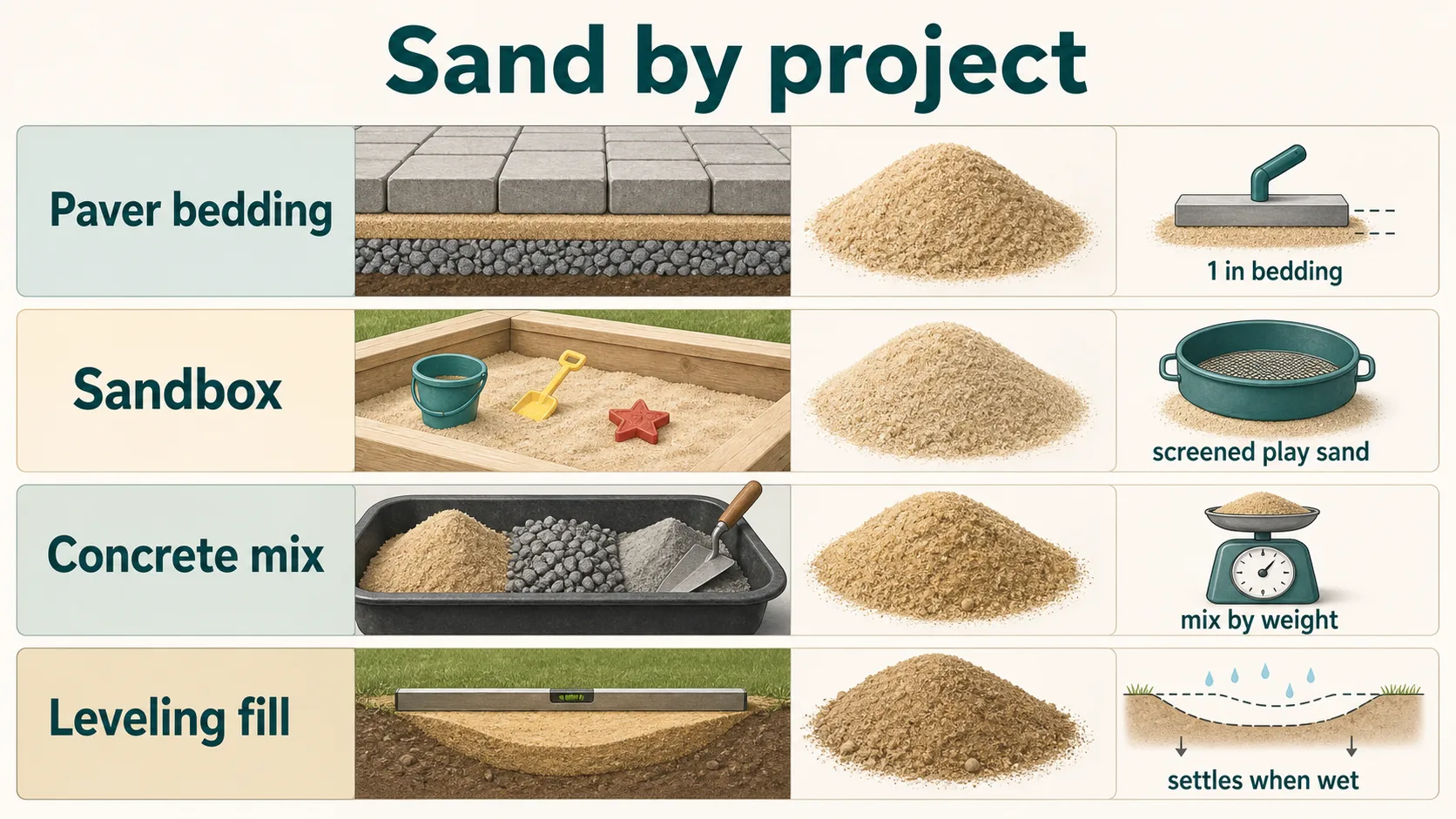
Which sand for the job: bedding, joint, mix and play sand
They are sold by the same yard out of bays that look alike, and they behave nothing alike once they are wet or compacted. Grade first, quantity second.
Play Sand
Fine grain, sandbox safe. Weighs about 2,600 lb per yd³ as delivered.
$32 / ton
Masonry Sand
For mortar and concrete mixes. Weighs about 2,700 lb per yd³ as delivered.
$38 / ton
Paver/Leveling Sand
your sandFor paver bedding layers. Weighs about 2,800 lb per yd³ as delivered.
$42 / ton
Fill Sand
General fill and grading. Weighs about 2,700 lb per yd³ as delivered.
$20 / ton
Polymeric Sand
For paver joints (50lb bag). Weighs about 2,900 lb per yd³ as delivered.
$25 / bag
Yard rates for bulk material, before delivery. Polymeric sand is sold by the bag because it is watered in rather than spread, so it is priced per bag throughout this page.
Plate and screed
Spreading sand so the compacted bed comes out flat
Not a sequence, so not numbered. Each of these is a habit that decides whether the surface above the sand still reads flat in two years.
Screed the bedding course on two lengths of 1 inch steel conduit laid as rails, then pull a straight 2x4 across them. The rails hold the depth for you, which is the whole reason the trade uses them.
Compact in lifts of 2 inches at most. One thick pour never compacts through, and what looks flat on the day settles into hollows within weeks.
Wash and screen matters for a sandbox. Keep construction sand, polymeric sand and stone dust out of a play area entirely.
Dampen the sand lightly before compacting a deep fill. Bone-dry sand flows away from the plate instead of packing down under it.
Sand is one layer of a paver build, not the base. Size the crushed stone underneath with our paver base calculator, and the joints separately with the paver sand calculator.
Polymeric sand needs 24 hours above freezing to cure. In a cold climate that rules out the back end of the season, and an uncured joint washes out with the first spring rain.
Buying gravel rather than sand for a path or a drainage layer? Our pea gravel calculator and stone calculator cover those.
Volume to weight
How this sand calculator turns a depth into tons
Area times depth gives the volume in place. The compaction allowance and the waste allowance both scale that up to the loose volume you buy, and the grade you picked converts it to weight.
area = length × widthcu ft = area × depth ÷ 12cu yd = cu ft ÷ 27loose cu yd = cu yd × (1 + waste) × (1 + compaction)tons = loose cu yd × densitybags = ceil(loose cu ft ÷ 0.5)The densities are as-delivered figures, which is what makes the compaction allowance honest rather than double counted: it scales the volume you buy, and loose volume times loose density is the real weight on the ticket. Reverse mode runs the same density the other way, from tons you already have back to the area they cover, and it applies no compaction allowance at all.
Not included: delivery, the crushed stone base below the sand, edge restraint, geotextile, joint sand, tool hire and labour.
Priced beds
Sand cost by project: four priced jobs
Each one runs through the same arithmetic as the calculator above at a 10% waste and 20% compaction allowance, so you can type any of them in and get the identical answer.
Backyard sandbox
3.13
yd³ loose
$130
- Area
- 8 × 8 ft
- Finished depth
- 12 in
- Screed at
- 14.4 in
- Grade
- Play Sand
- Weight
- 4.07 tons
- Bags instead
- 169
A full-depth fill gets heavy fast. Price bulk delivery against bagged play sand before committing to move it by hand.
Paver patio bedding
0.98
yd³ loose
$57
- Area
- 12 × 20 ft
- Finished depth
- 1 in
- Screed at
- 1.2 in
- Grade
- Paver/Leveling Sand
- Weight
- 1.37 tons
- Bags instead
- 53
The thinnest layer on the page and the least forgiving. Screed to the rails, compact once the pavers are down, and order joint sand separately.
Driveway paver bed
2.44
yd³ loose
$125
- Area
- 10 × 40 ft
- Finished depth
- 1.5 in
- Screed at
- 1.8 in
- Grade
- Masonry Sand
- Weight
- 3.30 tons
- Bags instead
- 132
Bedding sand only. The compacted aggregate below it and the polymeric joints above it are both separate orders.
Levelling a lawn strip
1.47
yd³ loose
$40
- Area
- 30 × 6 ft
- Finished depth
- 2 in
- Screed at
- 2.4 in
- Grade
- Fill Sand
- Weight
- 1.98 tons
- Bags instead
- 80
Fill sand is the cheapest grade here, so the delivery charge tends to outweigh the material on a job this size.
Coverage table
How far a cubic yard of sand goes, and what it weighs
The first table is the one to check against a supplier quote, because a yard of sand is sold by volume and delivered by weight. The second is the coverage a single cubic yard buys at each finished depth.
Play Sand
2,600 lb0.77$32Masonry Sand
2,700 lb0.74$38Paver/Leveling Sand
2,800 lb0.71$42Fill Sand
2,700 lb0.74$20Polymeric Sand
2,900 lb0.69$25 / bagDry weights, as delivered. Wet sand runs 20 to 30% heavier, which moves the truck payload without changing the volume you get. One yd³ is about 54 50 lb bags at 0.5 cu ft a bag.
Coverage at the finished depth. Add the compaction allowance on top before you order, which at 20% means one yd³ covers about 83% of the area listed here.
Order desk
Sand questions that come up before the load arrives
Nine answers in the order they tend to be asked, starting with the one the ledger above exists to settle.
Do I order sand to the compacted depth or the loose depth?
Order the loose volume. The depth you enter above is the finished, compacted depth, and the compaction allowance scales it up to the loose sand you have to buy to end up there. That is why the cubic yards in the results panel are larger than length x width x depth on its own.
How much sand do I need?
Multiply length x width x depth in feet for cubic feet, then divide by 27 for cubic yards. A 10x10 patio at 1-inch depth needs about 0.37 cubic yards before waste and compaction.
How much does a yard of sand weigh?
One cubic yard weighs about 2,600 to 3,000 lbs dry. The Engineering ToolBox material density table shows why moisture and compaction can change truck payload planning.
How deep should sand be under pavers?
1 inch screeded over compacted gravel for patios (ICPI standard). For driveways, use 1 to 1.5 inches over a 6-inch aggregate base.
Play sand vs masonry sand?
Play sand is washed and screened for play areas. Masonry sand is meant for mortar and concrete work, so it can be coarser and dustier.
How deep should a sandbox be?
For playground equipment, CPSC loose-fill guidance uses deeper maintained surfacing. For a simple ground-level sandbox, many homeowners plan 8 to 12 inches.
Polymeric sand for all paver joints?
It works best in joints 1/16" to 1.5" wide. Narrower joints won't fill properly; wider joints may crack. Use gator dust for joints over 1.5".
Bagged or bulk sand?
Bulk costs $20 to $45/ton. Bags run $160 to $240/ton equivalent. Bulk saves 60 to 75% for anything over 0.5 cubic yards.
What about gravel for drainage?
For drainage layers under sand beds, our Stone Calculator estimates crushed stone quantities, and the French Drain Calculator covers full drainage system materials.
Disclaimer
These estimates are for planning purposes only. Actual costs vary by location, material availability, and project complexity. Always get at least 3 local quotes. This calculator does not replace professional advice.
Sources
Related Calculators
Gravel Calculator
Any-project tons, yards, and bags
Paver Base Calculator
Base material for pavers
Fill Dirt Calculator
Grading and leveling
Pea Gravel Calculator
Landscaping gravel
Paver Sand Calculator
Sand for paver joints
Stone Calculator
Landscaping stone
Tons to Cubic Yards Calculator
Convert tons to yd³ by material