Paver Sand Calculator
Estimate bedding sand and joint sand for patios, walkways, and paver borders.
Project Dimensions
Project preset
Before you call the yard
Ask for concrete sand by its standard, ask what the minimum bulk load is, and ask whether the jointing sand on the shelf is plain or polymeric. Those are three different answers, and only one of them changes this page.
Estimates only. Not professional advice.
Bedding sand to screed
9.2cu ft
Enough bedding sand to screed 100 sq ft at 1.0 in, with the 10% allowance already in it. The joints are a separate order below.
- Bedding sand, 0.46 tons
- $16
- Joint sand, 3 bags of 50 lb, 6 x 9" paver
- $105
- Material total
- $121
- Sand per sq ft
- $1.21
Material only, at your own prices. The 10% allowance is 0.80 cubic feet of the bedding figure. It covers screed loss and refilling joints, not low spots: those belong in the compacted base.
Last updated August 13, 2026. Checked against CMHA interlocking pavement guidance and jointing sand data sheets by our expert review team.
Screed and sweep
Paver sand in section: the bedding course and the joint fill
Two sands, drawn at one scale. The bedding course runs the whole width at the depth you chose. The joint fill occupies only the gaps, and the paver size decides how many gaps there are.
Nothing here is exaggerated. Both axes share one scale, which is why a joint reads as a hairline and still swallows bags of sand once you add up how much joint a 6 x 9" paver field creates.
The dashed edges mean the section is cut, and the base below it is cut too. Change the paver size in the calculator and the joint spacing here changes with it. That spacing is the only thing that moves the joint order, and it does not touch the bedding order at all.
Two products, two orders
- Bedding sand
- 0.46 tons19 bags of 50 lb, or 0.34 yd³ bulk. ASTM C33 concrete sand, area times depth.
- Joint sand
- 3 bagsBagged only, plain to ASTM C144 or polymeric. Joint width times the joint a 6 x 9" paver creates.
On the rails
Paver sand habits that keep the bed flat and the joints full
Five things that decide whether the sand you ordered ends up where it was meant to go. None of them cost anything on the day.
Screed to a nominal inch, and no more
CMHA's guide specification screeds bedding sand to a nominal 1 in (25 mm) thickness. That is a setting bed, not a levelling compound, and the calculator's default depth is the one the spec names.
Buy the two sands as two orders
Bedding sand is coarse ASTM C33 concrete sand and comes bulk or bagged. Jointing sand comes bagged only and is a different product on the ticket. One phone call, two line items.
Screed only what you can lay today
Loose bedding sand takes a footprint, a rain shower and a wheelbarrow track. Pull the rails forward as the field advances rather than screeding the whole patio at once.
Sweep the joints diagonally, then vibrate
Sweeping across the pattern drops sand into the gaps instead of running it along the joint lines. CMHA then has the field compacted again until the joints are full, which is what settles the sand rather than bridging it.
Get the faces clean before any water touches them
Unilock's guide is blunt about it: the surface has to be swept clean before wetting, or the polymer hazes and stains the paver. Alliance Gator's data sheet also wants the pavers dry going in and above 32°F (0°C).
After the pavers are down
Five ways paver sand fails once the field is laid
A paver field that rocks, hazes or washes out almost never failed at the paver. Four of these five are decided in the hour before the sand goes down.
Screeding a thick bed to hide a low spot
Sand deep enough to bury a dip behaves like a cushion, and the pavers sitting over it drop first.
Rake more compacted aggregate into the hollow instead. Size that layer with the paver base calculator and leave the bedding course at the depth you screeded everywhere.
Ordering bedding sand and calling it done
The joints are a second product and often the larger bill, because jointing sand is sold by the bag rather than the ton.
Order both at once. The readout at the top of this page splits them, and the joint figure moves with paver size while the bedding figure does not.
Mason sand or stone dust in the bedding course
CMHA rules out limestone screenings, stone dust and mason sand: the particles are weaker, they absorb water, and they keep moving under repeated load.
Ask the yard for washed concrete sand to ASTM C33. If they cannot name the standard, that is the answer to your question.
Joint sand that never reached the bottom of the joint
A joint filled halfway lets the pavers rock, and the first heavy rain takes the rest of the sand with it.
Fill to the full depth of the paver, top up after the compactor, and stop about 1/8 in (3 mm) below the surface, which is what Alliance Gator's data sheet specifies.
Misting polymeric sand onto damp pavers
Damp faces activate the polymer where it is not wanted, and a light film turns into a haze that does not brush off.
Wait for dry units. Gator's traditional installation wants no rain for at least an hour afterwards, not the full day people quote from overlay instructions.
The first and third have the same root: asking bedding sand to do a job that belongs to the layer under it. Sand levels a paver. Stone carries it.
Order of work
How to lay paver sand: screed the bed, then fill the joints
Seven steps, numbered because each one closes off the one before it. The two sands go in at opposite ends of this list, which is why they are two separate orders.
- 01
Finish the compacted base first and check it with a straightedge. Everything below the bedding course belongs to the paver base calculator, not here.
- 02
Set screed rails and pull the bedding sand to a nominal 1.0 in. Do not compact it and do not walk on it.
- 03
Lay the field off a string line, keeping the joints inside the 1/16 to 3/16 in (2 to 5 mm) CMHA calls for. Consistent joints are what makes the bag count predictable.
- 04
Cut the perimeter, then set the edge restraint on the base while the sand is still exposed.
- 05
Compact the pavers into the bedding sand. This is the pass that seats the units and closes the bed.
- 06
Sweep dry jointing sand across the field diagonally, working it down the full depth of the joint.
- 07
Compact again, refill the joints that dropped, and brush every face clean. If you are using polymeric sand, mist it only once the pavers are dry and the surface is spotless.
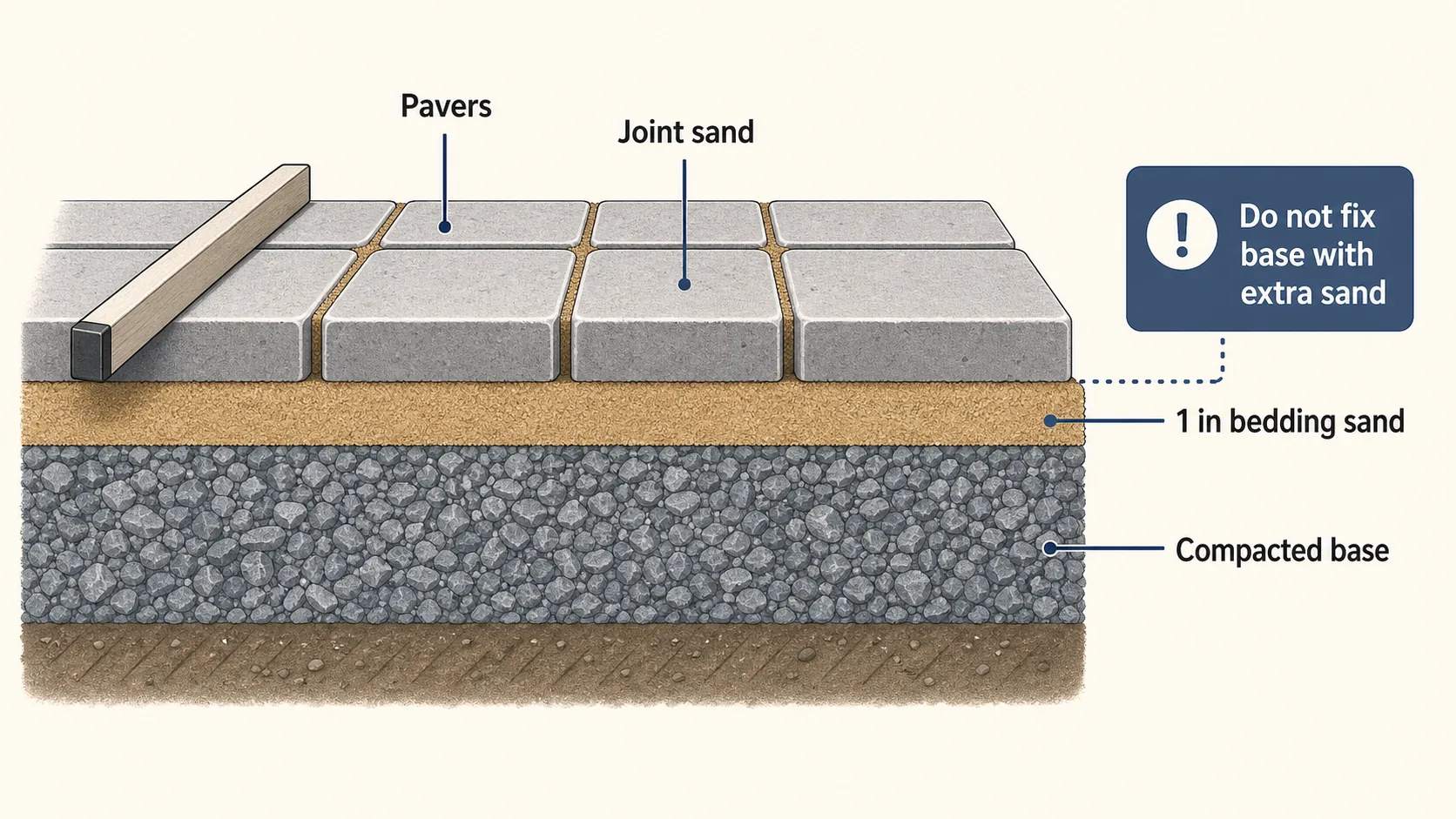
The screed rail at the left is step two, and the sand in the joints is step six. Both sands are visible in one view here, which is the only place on the job they ever are.
Gaps per unit
Joint sand by paver size and joint width
Area alone cannot tell you how much joint sand a job takes. A 6 x 9" paver field packs a measurable length of joint into every 100 sq ft, and the width of that joint then multiplies it.
4 x 8" brick
434 ft of joint
0.86
1.70
2.50
6 x 6" square
388 ft of joint
0.77
1.51
2.24
6 x 9" paver
your paver
325 ft of joint
0.64
1.27
1.88
12 x 12" slab
197 ft of joint
0.39
0.77
1.14
16 x 16" slab
148 ft of joint
0.29
0.58
0.86
The three bag columns are per 100 sq ft too. A 50 lb bag holds 0.5 cu ft at the density this calculator already uses for bedding sand.
What the columns are
Bags of jointing sand per 100 sq ft, from the geometry: joint width times 2.25 in of fill depth times the joint run in that row. Fill depth is a 2 3/8 in pedestrian paver less the 1/8 in Alliance Gator asks you to leave below the surface. The three widths are the range CMHA specifies, so the whole table is inside spec.
Why the calculator asks for more
The bag figure in the readout uses manufacturer-style coverage, from 30 to 75 sq ft per bag by paver size. That runs 1.7 to 2.3 times the bare geometry above, which is the allowance for chamfered and tumbled edges opening the joint at the top, joints that drift wider than spec, and the sand that ends up on the paver faces. A spare bag is cheaper than a second trip.
Three tickets
Paver sand for a patio, a walkway and a border, priced out
Every figure comes out of the calculator above at its default 1.0 in bedding and 10% allowance. The first two cover the same area on purpose.
Seating patio · 10 × 10 ft
$121
both sands, material only
- Bedding sand
- 19 bags · 0.46 tons
- Joint sand
- 3 bags · 6 x 9" paver
- Area
- 100 sq ft
Ten by ten, laid in a 6 by 9 in paver. This is the reference job: whatever the bedding sand costs here, the joint sand costs more, because bulk sand is priced by the ton and jointing sand is priced by the bag.
Front walkway · 25 × 4 ft
$156
both sands, material only
- Bedding sand
- 19 bags · 0.46 tons
- Joint sand
- 4 bags · 4 x 8" brick
- Area
- 100 sq ft
Exactly the same area as the patio, so the bedding order does not move by a single bag. The brick creates far more joint per square foot, and that is the whole difference in the total.
Garden border · 30 × 2 ft
$80
both sands, material only
- Bedding sand
- 11 bags · 0.28 tons
- Joint sand
- 2 bags · 6 x 6" square
- Area
- 60 sq ft
A narrow strip where the bedding sand is under a quarter of a ton. Bagged sand wins here: a bulk delivery would arrive as a minimum load several times the size of the job.
At the counter
Paver sand questions: bedding depth, joint width, polymeric
Eight answers in the order they come up, from what to screed to why the bag count moves when the paver does.
How much bedding sand goes under pavers?
CMHA's guide specification screeds bedding sand to a nominal 1 in (25 mm) uncompacted thickness, which is the depth this calculator defaults to. A 10 by 10 ft patio at that depth works out to 9.2 cubic feet, or 19 fifty-pound bags once the 10% allowance is in.
Is bedding sand the same as joint sand?
No, and most jobs need both. Bedding sand is a screeded course under the pavers, sized from area and depth. Joint sand fills the gaps between them, and its volume comes from joint width, joint depth and how much joint the paver size creates, so a brick walkway takes more of it than a slab patio of the same size.
What sand should I use for paver bedding?
Washed, angular concrete sand meeting ASTM C33. CMHA rules out limestone screenings, stone dust and mason sand for the bedding course, because those particles are weaker, hold water, and keep moving under repeated load.
How wide should paver joints be?
CMHA specifies 1/16 to 3/16 in, or 2 to 5 mm, with no more than 5% of joints wider than 1/4 in. Joint width is what the bag count is most sensitive to: at 3/16 in a joint holds close to three times the sand it holds at 1/16 in.
How deep does joint sand go?
The full depth of the paver. Sakrete's application guide says polymeric sand works best when it fills the entire depth, and Alliance Gator's data sheet asks for the finished sand level to sit at least 1/8 in below the paver surface, so on a standard 2 3/8 in pedestrian unit that is about 2 1/4 in of fill.
Can extra bedding sand level a bad base?
No. A thick sand layer behaves like a cushion and the pavers over it settle first. Low spots get more compacted aggregate, and the bedding course stays at the depth you screeded everywhere.
Do I need polymeric sand or will plain joint sand do?
Plain jointing sand to ASTM C144 meets the spec, and CMHA describes it being swept in and vibrated until the joints are full. Polymeric sand costs more per bag and binds after misting, so it resists washout and weeds better. Either way the joint holds the same volume, so the bag count does not change.
Why does the joint sand bag count change with paver size?
Because smaller pavers put more joint into the same area. Per 100 sq ft a 4 by 8 in brick creates roughly 430 linear feet of joint against about 148 feet for a 16 by 16 in slab, so the brick field takes close to three times the joint sand.
Two sums
How this paver sand calculator reaches two separate numbers
The bedding figure is a volume: area times depth, plus your allowance, converted to bags and tons. The joint figure never touches depth. It divides your area by a bag coverage that belongs to the paver size, which is the only place paver size enters the arithmetic at all.
bedding ft³ = A × d ÷ 12 × (1 + waste)yd³ = ft³ ÷ 27tons = yd³ × 1.35bedding bags = ⌈tons × 2000 ÷ 50⌉joint bags = ⌈A ÷ coverage × (1 + waste)⌉Both bag counts round up, because a yard sells whole bags. The joint estimate can be switched off in the calculator when you are only topping up a bed, and the bedding figure does not change when you do.
In neither number
Delivery and minimum load
A bulk sand order under about a yard is usually billed as a minimum load, which is why the border job above is cheaper bagged.
The base and the edge restraint
Both sit outside the two sands. The base is the larger order on almost every job.
The price gap between jointing sands
Plain and polymeric fill the same volume at very different prices, so the joint line moves with the product, not the quantity.
Constants
- Bedding sand density
- 1.35 tons / yd³
- Bag weight
- 50 lb
- Bag volume at that density
- 0.5 cu ft
- Bedding depth, spec
- 1.0 in
- Joint width, spec
- 1/16 in to 3/16 in
- Pedestrian paver
- 2 3/8 in
- Joint fill depth
- 2.25 in
- Default allowance
- 10%
The first three rows and the allowance are the calculator's own. The four spec figures between them come from CMHA and from Alliance Gator's data sheet, and they drive the drawing and the joint table rather than the result.
Disclaimer
These estimates are for planning purposes only. Actual costs vary by location, material availability, and project complexity. Always get at least 3 local quotes. This calculator does not replace professional advice.
Sources
- 01Guide Specification for the Construction of Interlocking Concrete Pavementcmha.org
- 02Construction of Interlocking Concrete Pavementscmha.org
- 03Interlocking Concrete Pavement Crosswalks, bedding and joint sand materialscmha.org
- 04Gator Maxx Sand technical data sheetalliancegator.com
- 05Applying Polymeric Sand to an Existing Patio or Walkwaysakrete.com
- 06Polymeric Sand Guide: Installation, Benefits and Pro Tipsunilock.com