French Drain Calculator
Estimate washed drain stone, perforated pipe, filter fabric, and the drop your run needs.
Trench Dimensions
Drain length (ft)
Trench width (in)
Trench depth (in)
Estimates only. Not professional advice.
Washed drain stone to order
2.88
cubic yards of clean open-graded stone, which is the trench less the 4 in pipe bore, plus 10% for ordering.
- Washed drain stone
- $130
- Perforated pipe, 4 in
- $38
- Filter fabric
- $63
- Materials for the run
- $231
Materials only, at the prices in the advanced options. Confirm the pipe, the fabric grade, the outlet location and local requirements before excavation.
Last updated August 13, 2026 by our expert review team.
Fall to daylight
Will your French drain actually fall to the outlet?
Every other material on this site is a volume problem. A French drain is an elevation problem wearing a volume problem's clothes: a trench that does not drop is a trench full of water, and the outlet elevation is fixed by the site before you own the decision. The section and the profile below are drawn from your own numbers.
Panel A shares one scale on both axes, so the bedding, the bore and the cover can be read against each other. Panel B keeps the run at true length and stretches the vertical 6 times, because a drain that falls correctly looks flat at true scale.
Your fall check
- Run length
- 50 ft
- Grade entered
- 1%
- Drop the run needs
- 6.0 in
- Drop you have
- 12.0 in
- Spare drop
- 6.0 in
- Grade your drop allows
- 2.00%
- Furthest run at 1%
- 100 ft
- Trench depth at the outlet
- 24.0 in
This run drops to daylight. 12.0 in of fall carries 50 ft at 1% with 6.0 in to spare.
By the linear foot
French drain cost per linear foot by trench size
The stone is most of the bill and stone volume is width times depth, so the trench section decides the rate far more than the pipe does. Six common sections priced at your own stone, pipe and fabric prices, with your trench dropped in beside them.
Materials only, at $45 a cubic yard for stone, $0.75 a ft for pipe and $0.25 a sq ft for fabric, with your 10% allowance in the stone. Change any of them in the advanced options and every bar moves. Labour is not here: it is usually the larger half of an installed price and it depends on access, soil and whether a machine can reach the line.
Inside the wrap
What goes in a French drain trench, and what each layer is for
Six decisions, and only one of them is about how much to buy. Not a sequence, so not numbered: the install order is further down in the method section.
An outlet that is lower than the trench, found before anything is dug
USDA NRCS puts it in one line for gravity systems: the conduit must hold a positive grade the whole way to the outlet. There is no material, no pipe size and no fabric that substitutes for that, which is why the fall check sits above every other section on this page.
Washed, open-graded stone, not base material
The stone is the drain. Crusher run and stone dust pack tight and fill the voids the water has to move through, so they turn an expensive trench into a buried curb. Order clean washed drainage stone by the cubic yard with the crushed stone calculator, and keep the pea gravel for the surface where it belongs.
Stone under the pipe, not just over it
NRCS Subsurface Drain 606 asks for a sand-gravel envelope at least 3 inches thick for support, and for filter material to cover every perforation by at least 3 inches. A pipe dropped straight onto the trench floor has bedding on one side only, and the section drawing above shows how much you actually have.
Fabric up the walls and lapped over the top
Washington State University Extension describes the wrap the way it has to be built: the cloth lines the trench, the stone and pipe go inside it, and the cloth folds over the stone before the soil goes back. Fabric on the floor alone leaves both walls open to the fines that clog the drain.
Pipe diameter chosen after the catchment, not before
NRCS sets 4 inches as the minimum conduit for an underground outlet, which is where most residential runs start. Going to 6 inches is a decision about how much water arrives and how far it travels, and a wider pipe in a trench with no fall still holds standing water.
Utility marking, then the spoil plan
Call before the first cut. The dirt coming out has to go somewhere too, and on a long perimeter run it is more than a wheelbarrow of it: the excavation calculator sizes the spoil, and the fill dirt calculator covers what you bring back.
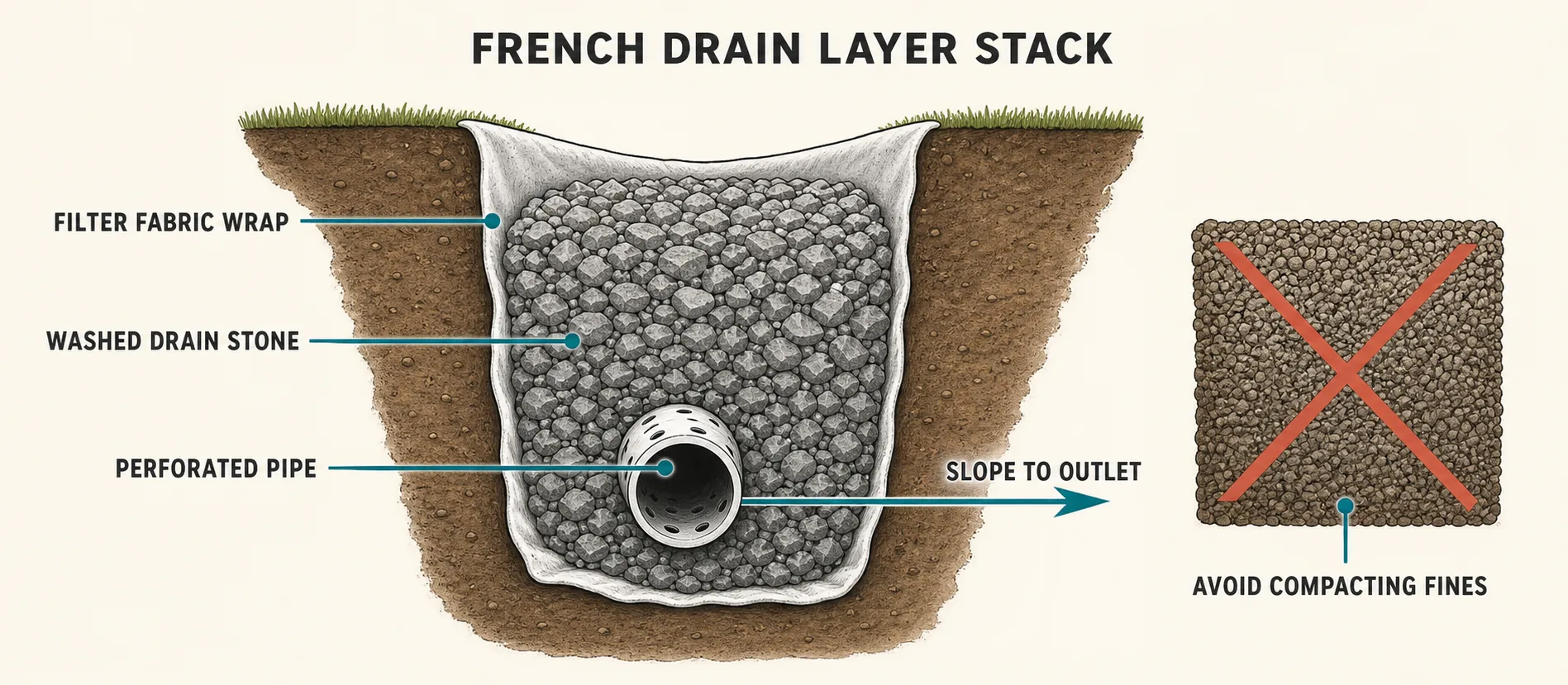
The same six decisions in the order they get made on site. The drawing above the fold is your trench; this one is the general case.
Your French drain against the published minimums
Every figure on the right comes from what you entered. Every figure in the middle comes from an agency standard, cited at the foot of this page.
At the trench edge
French drain questions asked before the first spade goes in
Twelve answers, opening with the grade, because every other question on this list changes its answer depending on whether the run can fall.
What slope does a French drain need?
Washington State University Extension puts a French drain trench at 0.5% to 1%. One percent is a foot of drop in 100 feet, which works out at one inch of drop every 8 feet 4 inches. The rule of thumb people quote, an inch every 8 to 10 feet, is 1.0% down to 0.83%, so it sits at the top of that band.
How much drop do I need over my run?
Multiply the run length by the grade. A 50 foot run at 1% needs 6 inches of drop between the high end and the outlet. Measure the drop you actually have first, because a run with a fixed outlet elevation can only hold the grade that drop allows.
How deep should I dig a French drain?
Depth depends on the water source, the outlet, frost, nearby structures and local requirements. Eighteen inches is a common planning default. Remember the trench gets deeper as it falls: an 18 inch trench running 50 feet at 1% is 24 inches deep by the time it reaches the outlet.
How much stone does a French drain need?
Take the trench volume, subtract the volume the pipe occupies, and add an ordering allowance. This calculator leads with cubic yards of washed drainage stone and does the pipe subtraction with the real circular bore rather than ignoring it.
What size pipe do I need?
NRCS sets 4 inches as the minimum conduit for an underground outlet, and 4 inch perforated pipe is where most residential runs start. Capacity depends on the catchment, the run length, the grade and the outlet, so treat 4 inches as a starting point rather than an answer.
How much stone goes under the pipe?
NRCS Subsurface Drain 606 asks for a sand-gravel envelope at least 3 inches thick for support and for filter material to cover every perforation by at least 3 inches. The section drawing on this page shows the bedding and the cover your entered depth actually leaves.
Can I use a French drain in clay soil?
Clay makes the filter fabric and the outlet plan matter more, not less, because clay fines are what close the voids in the stone. Choose fabric suited to the soil, keep the wrap continuous up both walls, and get site-specific advice when the water is persistent or near a structure.
Should the pipe holes face up or down?
Follow the pipe manufacturer's installation instructions. Orientation depends on the product and on whether the drain is collecting groundwater rising into the trench or surface water percolating down through the stone.
Do I need a sump pump?
Only when gravity cannot do the job. If there is no point lower than the trench that water can safely discharge to, a gravity outlet is not available and the design changes. Work out the drop you have before assuming either answer.
Do I need filter fabric around a French drain?
Yes in almost every residential case. Its job is to keep soil fines out of the stone so the voids stay open, and it has to line the floor and both walls and then lap over the stone. Fabric laid flat on the trench floor leaves the walls doing nothing.
How much does a French drain cost per linear foot?
Material cost per foot follows the trench section more than anything else, because the stone is the expensive part and stone volume is width times depth. The chart on this page prices six common trench sections at your own stone, pipe and fabric prices.
How do I maintain a French drain?
Keep the outlet clear and check it after heavy rain, because a blocked outlet backs the whole run up. Add cleanouts when the installation plan calls for access, and keep vehicles and livestock off the trench line so the pipe is not crushed.
Silted and stalled
How a French drain stops draining, and what it costs to put right
Six of these, and what they share is that none of them announces itself. A drain built wrong works for one wet season, then holds water against the thing it was dug to protect. By then the evidence is under a lawn.
Digging before the drop is measured
The outlet elevation is fixed by the site, so the grade is decided for you before you touch a spade. At 1% your 50 ft run needs 6.0 in of drop. If the site does not have it, the answer is a shorter run, a different outlet or a pump, and none of those gets cheaper after the trench is open.
Backfilling with crusher run or stone dust
Compacting base material is engineered to lock together and shed water, which is the exact opposite of what a drain needs. The voids between clean washed stone are the drain, and dense-graded material closes them.
Laying fabric on the trench floor only
Fines arrive through the walls, not just from below. WSU Extension describes the cloth lining the trench and folding over the top of the stone, so the stone envelope is fully wrapped before the soil goes back over it.
Resting the pipe straight on the trench bottom
NRCS 606 wants at least 3 inches of envelope under the conduit for support and the same over the perforations. Your entered depth leaves 3.0 in of bedding and 11.0 in of cover, both drawn to scale in the section above.
Running the trench level and hoping
A trench with no fall is a linear soakaway, not a drain. It fills, it holds water against whatever it was dug to protect, and in a freeze it holds it there. Pull a string line to the outlet grade and dig to the line, not to a uniform depth below the lawn.
Treating a foundation drain as a bigger yard trench
Water moved badly beside a structure can undermine it or push the problem onto a neighbouring property. Perimeter drainage deserves a designed outlet, a verified discharge point and, in most cases, someone who will stand behind the design.
Rows one and four move with your own inputs, because both are judgments about the trench you entered rather than general advice. Change the grade, the depth or the pipe and read them again.
Drainage beside a foundation or a retaining wall is a different job from a wet lawn, and a bad one can move water onto someone else's property. Price the trench here, then get the design from somebody who will put their name on it.
Four runs, dug
French drain materials and cost for four trench runs
Four real jobs, priced at your stone, pipe and fabric rates. The last row of each is the one that catches people out: how deep the trench has to be by the time it reaches the outlet.
Backyard soggy spot
30 ft run, 10 × 18 in trench, 3 in pipe
- Washed stone
- 1.47 yd³
- Perforated pipe
- 30 ft
- Filter fabric
- 145 sq ft
- Materials
- $125
- Grade
- 1%
- Drop needed
- 3.6 in
- Depth at the outlet
- 21.6 in
Driveway edge drain
50 ft run, 8 × 14 in trench, 3 in pipe
- Washed stone
- 1.48 yd³
- Perforated pipe
- 50 ft
- Filter fabric
- 200 sq ft
- Materials
- $154
- Grade
- 1%
- Drop needed
- 6.0 in
- Depth at the outlet
- 20.0 in
Long run to daylight
80 ft run, 12 × 18 in trench, 4 in pipe
- Washed stone
- 4.60 yd³
- Perforated pipe
- 80 ft
- Filter fabric
- 400 sq ft
- Materials
- $367
- Grade
- 0.5%
- Drop needed
- 4.8 in
- Depth at the outlet
- 22.8 in
Foundation perimeter
120 ft run, 12 × 24 in trench, 4 in pipe
- Washed stone
- 9.35 yd³
- Perforated pipe
- 120 ft
- Filter fabric
- 720 sq ft
- Materials
- $691
- Grade
- 1%
- Drop needed
- 14.4 in
- Depth at the outlet
- 38.4 in
The long run to daylight is deliberately at 0.5%, the bottom of the published band, because 80 feet at 1% would need 9.6 inches of fall and most yards do not have it. That trade, grade against run length, is the whole design.
Spade and string line
Digging a French drain: what the outlet end teaches you
Seven of these, and six are decided before the trench is open. The one that is not is the string line, and it is the one that saves the job.
Set the outlet elevation first and work backwards up the run. Everything else on this page follows from that one number, and it is the only one you cannot change later.
Pull a string line at the finished grade of the pipe before you dig, then measure down from the string rather than from the lawn. Ground surface wanders, string does not.
Order clean washed drainage stone and nothing else. Our crushed stone calculator prices number 57 stone by the ton if your supplier sells by weight rather than by the yard.
Buy the fabric in one roll wide enough to line both walls and lap over the top in a single piece. Seams inside the trench are where fines find their way in.
Keep the last few feet to daylight solid rather than perforated, and put a grate on the outlet. A perforated outlet discharges into the soil it just crossed, and an open pipe end becomes a rodent door.
Plan where the spoil goes before the trench is open. A long perimeter run makes more dirt than people expect, and the excavation calculator sizes it.
Call for utility marking, and adjust the route rather than the depth when something is in the way. Losing grade to dodge a service line is how a run ends up flat in the middle.
Behind the estimate
How this French drain calculator turns a trench into stone, pipe and fabric
Four lines of arithmetic and one derivation. The derivation is the interesting one, because it turns a percentage nobody can visualise into a number you can pull a string to.
- Stone
- (Trench volume less the pipe bore) × (1 + allowance) ÷ 27
- 2.88 cubic yards
- Pipe bore removed
- π × (diameter ÷ 24)² × run, so a 4 in pipe takes real space
- 4.36 cu ft
- Fabric
- Run × (width + 2 × depth + 1 ft of lap)
- 250 sq ft
- Drop over the run
- Run × grade % × 12, in inches
- 6.0 in
Where the one percent comes from, and what it is in inches
Washington State University Clark County Extension publishes the band a French drain trench should sit in: 0.5% to 1%, with the worked example that a one foot drop over 100 feet is 1%. Nobody can dig to a percentage, so convert it. One percent of 100 feet is 1 foot, which is 12 inches over 100 feet, which is one inch of drop every 8 feet 4 inches.
That is where the rule of thumb comes from. An inch every 8 feet is 1.04%, an inch every 10 feet is 0.83%, and both sit inside the published band, near the top of it. At the 0.5% floor you get one inch every 16 feet 8 inches, which is the setting for a long run where the outlet is barely below the high end. Below that the pipe is not moving water, it is storing it.
At the 1% you entered, that is one inch of drop every 8.3 ft, and 6.0 in across the whole 50 ft run. USDA NRCS states the rule the band exists to satisfy: a gravity system must hold a positive grade the whole way to its outlet.
Grade in inches per run
- 0.5%
- 1 in every 16 ft 8 in
- 0.75%
- 1 in every 11 ft 1 in
- 0.83%
- 1 in every 10 ft
- 1.0%
- 1 in every 8 ft 4 in
- 1.5%
- 1 in every 5 ft 7 in
- 2.0%
- 1 in every 4 ft 2 in
The order a French drain gets built in, which is a real sequence
Seven steps, numbered because each one closes a door on the one before it. Nothing here can be reordered once stone is in the trench.
- 01Find the outlet and shoot the dropThe elevation you can discharge to is fixed. Everything else is designed against it.
- 02Mark the route and call for utilitiesAdjust the line around services rather than the depth, so no part of the run goes flat.
- 03Set a string line to the finished pipe gradeMeasure down from the string, not from the lawn. Ground surface wanders and string does not.
- 04Dig to the string, deepening toward the outletThe trench is deeper at the outlet end by exactly the drop. That is the point, not an error.
- 05Line the trench with fabric, floor and both wallsLeave enough on each side to fold over the stone later. One piece beats a seam.
- 06Bed the pipe on stone, then bury itEnvelope under the pipe for support, stone over the crown to cover the perforations.
- 07Fold the fabric over and finish the surfaceLap it across the stone before any soil goes back, then cap and restore the grade.
Disclaimer
These estimates are for planning purposes only. Actual costs vary by location, material availability, and project complexity. Always get at least 3 local quotes. This calculator does not replace professional advice.
Sources