Pea Gravel Calculator
Calculate pea gravel tons, cubic yards, bags, edging and cost for paths, patios and drains.
Area and depth
What it carries
Pathways. Comfortable walking paths and patios, typically 2.5" finished. Adjust the depth for your own site.
Before you call the yard
Ask for washed 3/8 in, ask whether it is sold by the ton or the yard, and ask what the minimum load is. Those three answers move the delivery cost far more than the stone does.
Estimates only. Not professional advice.
Pea gravel to order
1.14tons
Enough washed 3/8 in stone to finish 100 sq ft at 2 in, with the 10% waste and 20% settling allowance already in it.
- Bulk delivered, 1.14 tons at $45 / ton
- $51
- Same volume in 44 bags at $5.50
- $242
- Total volume, 22.00 cubic feet
- 0.81 yd³
- Bulk gravel per sq ft
- $0.51
Material only. Delivery, edging, fabric and pins are not in the total, and most yards bill a small order as a minimum load.
Last updated August 10, 2026. Checked against USGS aggregate data and landscape trade practice by our expert review team.
Subgrade to surface
Pea gravel path section, from subgrade to finished surface
Drawn to the depth you entered, with the base course your use calls for and the edging that has to hold it. The two things people get wrong on this page are both visible here: how far down the dig goes, and how far up the edging has to stand.
Every vertical dimension shares one scale, so the gravel, the base and the edging can be read against each other. The path width is broken at the centre rather than shrunk: a path is tens of times wider than it is deep, and on one shared scale the layers would vanish.
- Base course under it
- 2 inAngular stone, compacted, carrying whatever the gravel cannot
- Dig below finished grade
- 4 inGravel and base together, measured from the top
- Edging that holds it
- 3.5 in1 in buried, 0.5 in of lip, the rest is gravel
What to put on the order
ASTM D448 SIZE 8 · WASHED 3/8 IN
- Washed pea gravel
- 1.14 tons0.81 yd³ loose in the truck
- Landscape edging
- 40 ftWhole perimeter, 3.5 in tall minimum
- Woven fabric
- 110 sq ftArea plus 10% for the seam overlaps
- Bagged instead
- 44 bags50 lb each, worth it only for a small repair
Retention
Will pea gravel stay put on your slope?
This is the question the tonnage does not answer. Pea gravel is rounded, so nothing keys into anything, and whether it stays where you rake it comes down to two numbers: how far the edging stands above the surface, and how steeply the ground falls away.
2 in of gravel, 4 in edging, 2% grade
SET IN THE OPTIONS PANEL ABOVE
Lip above the gravel
1 in
Needs 0.5 in or more. A 3.5 in edging gets you there at this depth.
Fall over the run
2.4 in
That is 2% grade, measured every 10 ft of run. Rounded stone starts moving above 5%.
Cross borders
Not needed
Under 2% the run is flat enough that edging on its own does the job.
It stays put
1 in of lip over 2 in of gravel at 2% grade. That drains and it does not travel. Top up half an inch a year along the edges and it stays that way.
What each grade does to a pea gravel surface
Flat to 2%
your grade
Stays where you rake it
Enough fall to drain, not enough to move a 3/8 in stone.
2 to 5%
Holds, with cross borders
Break the run into short level steps and keep the edging proud of the surface.
Above 5%
Collects at the bottom
Rounded stone rolls. Switch to angular crushed stone or terrace the run.
Dig, fabric, edge, spread
Laying pea gravel: the order that keeps it in place
Seven steps, numbered because each one closes off the one before it. Step three is the only item on the list you cannot go back and add later without lifting everything above it.
- 01
Cut the whole depth out in one go, 4 in below where the finished surface needs to sit. Gravel raked over turf sinks into it, and topping it up later never fixes the softness underneath.
- 02
Roll commercial woven fabric across the excavation and overlap the seams by 6 inches. The Landscaping Network puts woven polypropylene at 5 to 7 years under gravel, against 1 to 2 for the cheap non-woven rolls.
- 03
Set the edging next, while the trench is still open and there is something solid to spike into. It has to stand 3.5 in at your depth, and it is the one item on this list you cannot retrofit without lifting the gravel.
- 04
Spread and compact 2 in of angular base. Rounded stone does not lock, so the load-carrying job belongs to the layer underneath. Size that layer with the crushed stone calculator or, under pavers, the paver base calculator.
- 05
Order washed pea gravel rather than pit-run. It is 5 to 10 dollars a ton dearer and it arrives without the dust film that grey-coats every stone after the first rain.
- 06
Spread the gravel in two passes and rake the second one level rather than dumping the whole load and pushing it around. The last half inch is what decides whether the surface feels firm or loose.
- 07
Plan on half an inch of top-up a year, worst along the edges and wherever a car turns. A driveway loses it faster than a patio, which is what the gravel driveway calculator is sized for.
Delivered tonnage
What a pea gravel patio, path and drainage bed come to
Three real jobs through the same chain as the calculator above, at its own defaults: 10% waste, 20% settling, 1.4 tons to the cubic yard and $45 a ton. Type any of them in and the figures match.
Patio · 12 × 18 ft · 2.5 in
3.08 tons
2.20 yd³ · $139 of stone
216 sq ft · 60 ft of edging · 119 bags if bagged
The size most people are actually building. Chairs are the reason it goes deeper than a path: at 2 in a chair leg finds the fabric, at 2.5 in it does not.
Garden path · 30 × 3 ft · 2.5 in
1.28 tons
0.92 yd³ · $58 of stone
90 sq ft · 66 ft of edging · 50 bags if bagged
A tenth of the area of the patio and more than half its edging, because a narrow run is nearly all perimeter. Edging, not gravel, is what this job costs.
Drainage bed · 20 × 10 ft · 5 in
5.70 tons
4.07 yd³ · $257 of stone
200 sq ft · 60 ft of edging · 221 bags if bagged
Twice the depth of the patio on a smaller footprint, and the only one of the three that needs washed stone. Fines in an unwashed load silt up a drain in a season.
Depth and coverage
How deep pea gravel goes and what a yard covers
Coverage is one load divided by the depth, so it halves every time the depth doubles: a cubic yard that covers a walking path goes barely half as far in a drainage trench. The last column is what to actually order, with the calculator's own waste and settling allowances already in it.
Walking path
2 in
162
1.14
Garden paths, side yards and light foot traffic.
Patio or sitting area
2.5 in
130
1.43
Deep enough that a chair leg does not find the fabric.
Driveway top course
3.5 in
93
2.00
Over a compacted angular base, never straight onto soil.
Drainage trench bed
5 in
65
2.85
Washed stone only, so fines cannot silt up the pipe.
Rounded against angular
Pea gravel or crushed stone for this job
One property decides most of it. Pea gravel is rounded, which is why it feels good underfoot, drains fast and refuses to stay on a slope. Everything below follows from that.
Pea gravel, 3/8 in
$30 to $60 / ton
Rounded, drains fast, comfortable underfoot, will not lock
Patios, paths, play areas and drainage beds on flat ground
Crushed stone, #57
$25 to $50 / ton
Fractured faces that key into each other under a compactor
Bases, driveways and anything on a grade. Crushed stone calculator
River rock, 1 to 3 in
$50 to $120 / ton
Larger rounded stone, decorative, awkward to walk on
Dry creek beds and borders, not walking surfaces. River rock calculator
Decomposed granite
$35 to $70 / ton
Fine and firm once rolled, sheds a dust that tracks indoors
Formal paths and xeriscaping where a hard surface is wanted
Coarse bedding sand
$25 to $45 / ton
Levels units, carries nothing, washes out of an open surface
Under pavers only, never as a gravel base. Sand calculator
Yard answers
Pea gravel questions: depth, weight, bags and bulk
Eight answers in the order they come up, from the first sketch on the back of an envelope to the phone call that books the truck.
How much pea gravel do I need?
Multiply length by width by depth in inches, divide by 12 for cubic feet, then by 27 for cubic yards. A 10 by 10 ft patio at 2 inches deep works out to 0.62 cubic yards of bare volume, or 0.81 once the calculator adds 10 percent waste and 20 percent compaction.
How deep should pea gravel be?
About 2 inches on a walking path, 2.5 inches on a patio where chairs sit, 3.5 inches as a driveway top course over a compacted base, and 4 to 6 inches in a drainage trench. Past 4 inches it stops feeling firmer and starts feeling loose underfoot.
How much does pea gravel weigh?
About 1.4 tons, or 2,800 lb, per cubic yard, in line with USGS aggregate figures. A 50 lb bag holds roughly 0.5 cubic feet, so one cubic yard is about 54 bags and will overload a half ton pickup.
Does pea gravel need edging?
Yes. The stone is rounded, so nothing locks it in place and it travels into the lawn within weeks. Steel or aluminum edging needs to stand about 1.5 inches taller than the gravel is deep, which leaves an inch buried and a half inch of lip proud of the surface.
Can you put pea gravel on a slope?
Up to about a 5 percent grade, if the edging is right and a cross border breaks the run every 5 ft. Above 5 percent the stones roll and pile up at the bottom after the first heavy rain, and angular crushed stone is the honest answer instead.
Is bulk or bagged pea gravel cheaper?
Bulk wins above about half a cubic yard. Delivered bulk runs 30 to 60 dollars per ton, while bags work out near 220 dollars per ton once you count 54 bags to the yard at about 5.50 each. Bags only make sense for a small repair or where a truck cannot reach.
Pea gravel or crushed stone?
Pea gravel is rounded, drains fast and is comfortable to walk on, so it suits patios, paths and play areas. Crushed stone has fractured faces that lock together, so it belongs under pavers, on slopes and anywhere a base has to carry load.
Do I need landscape fabric under pea gravel?
Use it. Woven polypropylene keeps the stone out of the soil and blocks weeds for 5 to 7 years, against 1 to 2 years for cheap non woven rolls. Overlap the seams by 6 inches and pin every 12 inches or the fabric creeps as you rake.
One season later
Where a pea gravel path goes wrong after one winter
None of these show up on delivery day. Every one of them is decided in the two hours before the first stone comes off the truck.
Gravel raked straight onto turf
The stone works down into soft ground for two seasons, so the surface thins from the bottom while the order looked right on paper.
Cut the full depth, compact the subgrade, then fabric. The dig is the cheapest part of the job and the only part you cannot redo.
Edging chosen by price, not by depth
A 4 in edging buries an inch and holds three, which is fine at 2 in of gravel and useless at 3.5 in on a driveway.
Match the edging to the depth you entered. The check higher up this page prints the minimum height for your own number.
Spreading it thinner to make it stretch
Under about 2 in the fabric shows through in the traffic lane and weeds find the gaps, so you buy the shortfall twice.
Hold the depth and shrink the area instead. A smaller patio finished properly beats a large one that needs redoing next spring.
Pea gravel on a real slope
Rounded stone has nothing to key into. Above 5 percent it migrates to the low end and leaves the top of the run bare.
Terrace the run into level steps, or use angular crushed stone where the grade is genuinely steep.
Unwashed stone in a drain
The fines that come with pit-run gravel migrate into the pipe and blind it, so the drain works for one season and then does not.
Specify washed. It is a few dollars a ton and it is the difference between a drain and a trench full of stone.
No allowance for settling
Loose gravel loses 15 to 25 percent of its depth in the first months, which is exactly the thin patch people blame on a short delivery.
Leave the compaction allowance in. It is the reason the calculator asks for it, and it is already in the tonnage above.
The first two are the same mistake wearing different clothes: treating pea gravel as a surface you pour on rather than a layer you build under. The section at the top of this page separates the two.
Volume to tonnage
From area and depth to delivered tons of pea gravel
Eight steps, each one applied to your own numbers. Two of them are allowances rather than geometry, and they are the two that make a calculated order match a delivered one.
Area
100 sq ft
10 by 10 ft, as entered
Depth in feet
0.17 ft
2 in divided by 12
Bare volume
16.67 cubic feet
Area multiplied by the depth in feet
Waste allowance
× 1.1
10% for spillage, edges and an uneven subgrade
Settling allowance
× 1.2
20% for the depth loose gravel loses as it beds in
Loose volume
22.00 cubic feet
Divided by 27 that is 0.81 yd³
Weight
1.14 tons
Cubic yards multiplied by 1.4 tons, the density a yard quotes
Money
$51
Tons multiplied by the $45 per ton you entered
Why pea gravel carries two allowances and not one
Waste, 10% by default
Spillage off the barrow, the corner you overfill, and the extra depth an uneven subgrade swallows. It is proportional to how rough the excavation is, not to what the material is.
Settling, 20% by default
Rounded stone arrives loose and beds down 15 to 25% over the first months of use. Leave this out and the surface is genuinely thin by the second season, which is the complaint people usually blame on a short load.
Rounding, at the end
Volumes round to two decimals, bags round up to whole bags, and the cost rounds to the dollar. A yard will not sell a partial ton anyway, so treat the tonnage as a floor and expect to be billed to the next increment.
Disclaimer
These estimates are for planning purposes only. Actual costs vary by location, material availability, and project complexity. Always get at least 3 local quotes. This calculator does not replace professional advice.
Sources
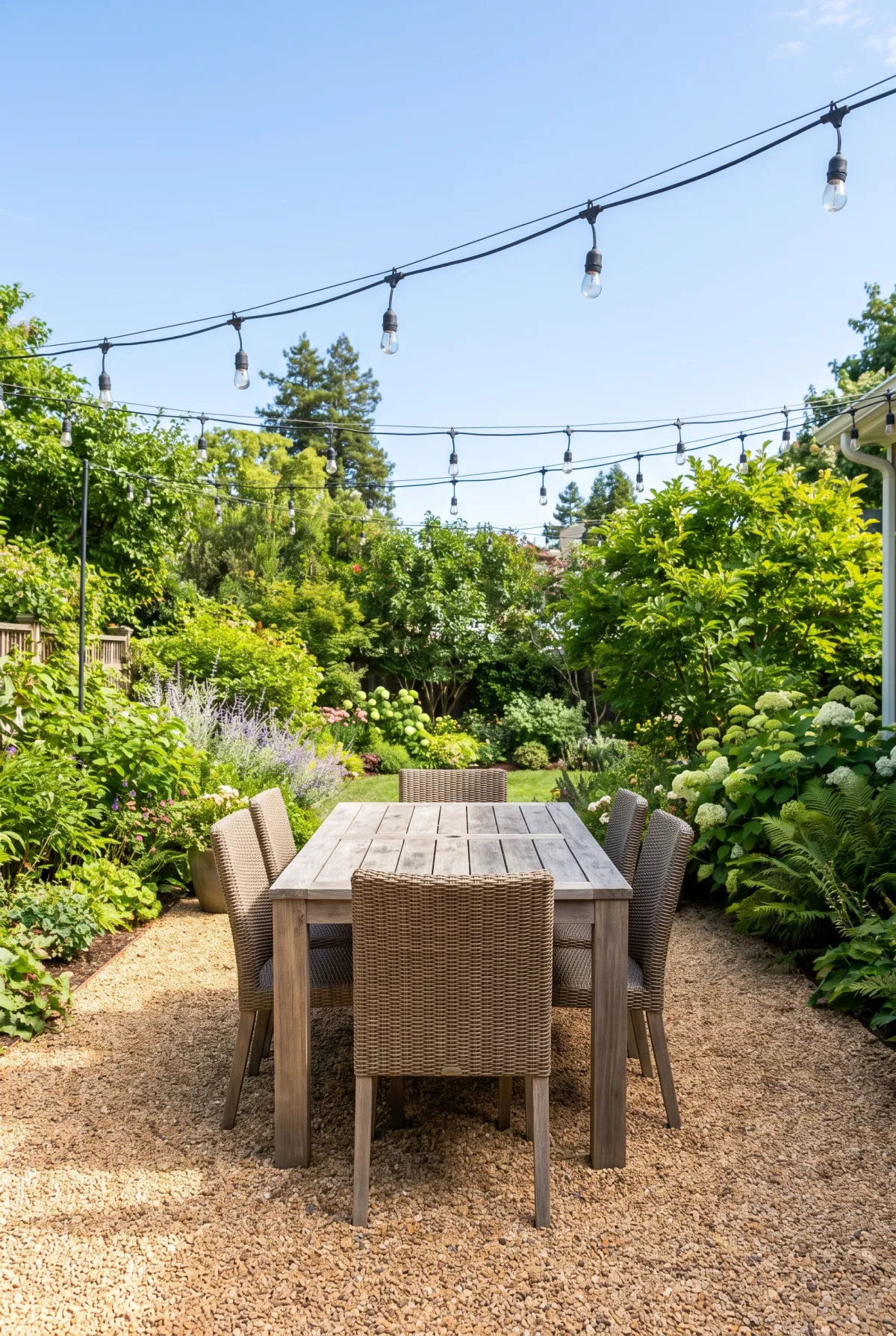
See 20 pea gravel patio ideas
Browse the looks, then price yours here.