Paver Base Calculator
Calculate compacted aggregate base tons, cubic yards, bedding sand, and edge restraint.
Base Dimensions
What it carries
Most patios and outdoor living areas. That is 6 in after compaction, so 7.2 in of loose stone gets spread to reach it.
Before you call the yard
Ask for the gradation, ask whether it is sold by the ton or the yard, and ask what the minimum load is. Those three answers move the delivery, not the base.
Estimates only. Not professional advice.
Aggregate base to order
6.57tons
Enough dense-grade stone to finish 192 sq ft at 6 in compacted, with the 10% waste and 20% compaction allowance already in it.
- Dense-grade aggregate, 6.57 tons
- $211
- Bedding sand, 0.88 tons
- $33
- Material total
- $244
- Material per sq ft
- $1.27
Material only. Delivery, geotextile, edge restraint, spikes and compactor rental are not in the total, and a small load is often billed as a minimum load.
Last updated August 6, 2026. Checked against CMHA and ICPI interlocking pavement guidance by our expert review team.
Subgrade to surface
Paver base cross section, from subgrade to finished paver
Four layers, drawn to the depths you entered. The column on the right is the same stone before the plate compactor has been over it, which is the depth the quarry actually delivers.
Order against the loose column, not the finished one. Nothing here is exaggerated: both sides share one scale and one subgrade line, so the difference between them is the whole compaction allowance.
Paver thickness varies by unit, and the dig moves with whatever you buy.
- Loose stone to spread
- 7.2 inWhat the truck tips out, before any passes
- Compacted base
- 6 inThe depth your patio spec calls for
- Lifts to compact
- 2About 3.6 in loose per pass, 3 in once rolled
- Dig below finished surface
- 9.4 inPaver, bedding course and base together
What to put on the order
ASTM D2940 base · ASTM C-33 bedding
- Dense-grade aggregate
- 6.57 tons4.69 yd³ loose in the truck
- Coarse concrete sand
- 0.88 tonsScreeded 1 in on rails
- Edge restraint
- 56 ftWhole perimeter, spiked into base
- Geotextile on soft soil
- 211 sq ftArea plus 10% for the overlaps
Lifts and passes
Paver base prep, in the order it happens
Seven steps, numbered because each one closes off the one before it. The excavation width in step one is the only thing on this list you cannot go back and fix.
- 01
Cut the subgrade to the full dig depth and take it 6 in past where the last paver lands. The edge restraint has to sit on stone, not on the crumbling lip of the excavation.
- 02
Compact the subgrade itself before any aggregate goes in. Stone laid on soft soil settles with the soil, and no number of passes on top will fix it.
- 03
Roll geotextile over clay, silt, or anything that holds water. It keeps the base out of the soil and the soil out of the base.
- 04
Spread the aggregate in lifts of about 3 in and run the plate compactor over each one before the next. This job takes 2 lifts at your depth.
- 05
Check the compacted surface with a screed board and a level, not by eye. Low spots get more stone, not more sand.
- 06
Set the edge restraint on the compacted base while it is still exposed. Spiking it through bedding sand gives it nothing to hold.
- 07
Screed the bedding course on rails and do not walk on it. Need only the setting bed or the joint sand? Size those separately.
Your lift schedule at 6 in compacted
7.2 in loose · 20% allowance · 95% Modified Proctor
Lift 1 of 2
3.6 in
spread loose, then rolled to 3 in. Base stands at 3 in of 6 when this pass is done.
Lift 2 of 2
3.6 in
spread loose, then rolled to 3 in. Base stands at 6 in of 6 when this pass is done.
Traffic classes
How deep a paver base goes: walkway, patio, driveway
Compacted depth is what the spec names. Loose depth is what you buy. The last column is the tonnage that follows, so you can sanity-check a quote before it arrives.
Walkway
Foot traffic, garden paths, narrow walks
4 in
4.7 in at 18%
2.24 tons
Foot traffic, garden paths, narrow walks
Patio
your base
Most patios and outdoor living areas
6 in
7.2 in at 20%
3.42 tons
Most patios and outdoor living areas
Driveway
Vehicle traffic needs a thicker compacted base
8 in
9.8 in at 22%
4.64 tons
Vehicle traffic needs a thicker compacted base
Weak soil
Clay, silt, or wet subgrade with geotextile
8 in
9.8 in at 22%
4.64 tons
Clay, silt, or wet subgrade with geotextile
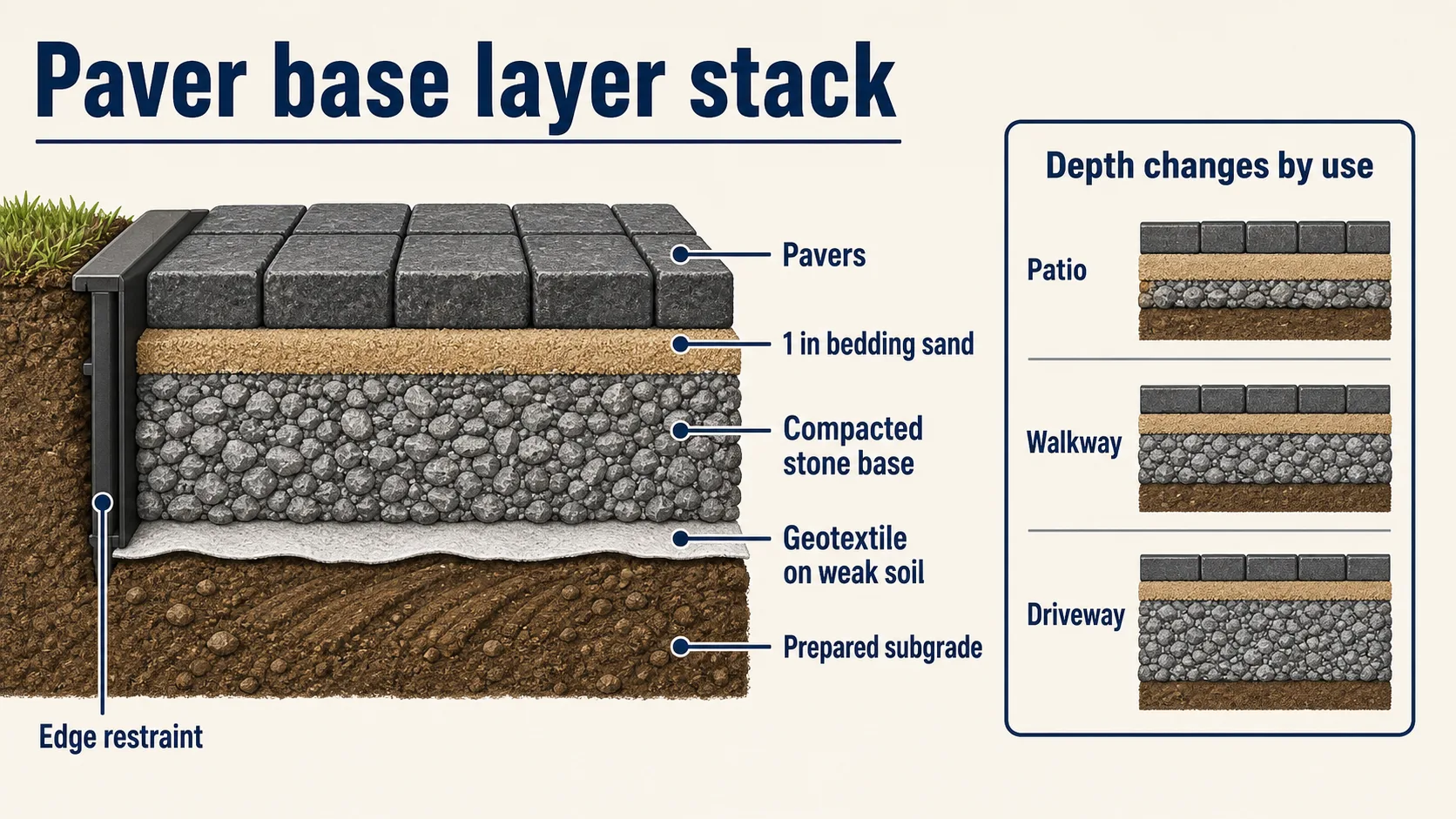
The same three depths as a built assembly, with the pieces the table cannot show: where the restraint sits, where the fabric goes, and how far the base runs past the last paver.
Spec answers
Paver base questions: gravel, fabric and compaction checks
Eight answers in the order they come up, from what to ask for at the quarry to how you know a lift is done.
What gravel for a paver base?
Angular crushed stone, 3/4 in minus, sold as dense-grade, road base, or #21A. ICPI points at ASTM D2940 gradation with 10 to 15% fines, because the fines are what let a lift lock up under the plate compactor. Rounded pea gravel never compacts.
Can I use regular sand for bedding?
No. Only ASTM C-33 coarse concrete sand works. Mason sand and play sand are too fine and too rounded, so they keep moving under traffic and the pavers show lippage within 6 to 12 months.
Do I need geotextile fabric?
Yes on clay, silt, or any soil that holds water. Fabric separates the two layers so base stone cannot punch down into soft subgrade and soil cannot pump up into the stone. On free-draining sand it is optional.
How deep should the gravel base be?
4 in compacted for walkways, 6 in for patios, 8 to 10 in for driveways, and 12 in or more for commercial traffic. Add about 2 in on clay soils.
How much does base material cost?
Dense-grade aggregate runs about $0.50 to $1.00 per sq ft at 6 in deep, and the bedding course adds $0.15 to $0.25. A 200 sq ft patio comes to roughly $130 to $250 in material.
Can I skip the sand layer?
No. The 1 in bedding course is what levels individual pavers and takes up the small variation left in the base. ICPI Tech Spec 2 calls for a setting bed, and it is not the place to make up missing base depth.
How do I check compaction?
Walk the surface in hard-soled shoes. Anything deeper than a 1/8 in footprint means another pass. The specified target is 95% Modified Proctor density, which a rented plate compactor reaches in about 3 in lifts.
What is the compaction factor?
Dense-grade aggregate loses 20 to 25% of its loose depth once it is compacted, so a 6 in finished base needs roughly 7.2 to 7.5 in of loose stone spread over it. This calculator adds that allowance before it converts to tons.
Base, bedding, joint
Paver base, bedding sand and crusher run are not interchangeable
Five materials get called sand or gravel on a delivery ticket and only one of them carries load. Swapping any two is the most expensive mistake on this page.
Dense-grade paver base
Carries the load and spreads it into the subgrade
Bottom layer, compacted in lifts. This is the layer this page sizes, at 6 in.
Bedding sand
Sets each paver level. Nothing structural at all
1 in screeded over the compacted base. Paver sand calculator
Joint sand
Locks the field so neighbouring pavers share a wheel load
Swept and vibrated into the joints once the field is laid
Crusher run
The same dense-grade aggregate, sold generically by the ton
Works as a base when it meets local gradation. Crusher run calculator
Open-graded clear stone
Drains instead of compacting, and needs a chip bedding course
Permeable installs only. The allowances on this page do not apply
Settlement
Why a paver base settles after the first winter
A paver field that has dropped, dished or spread almost never failed at the pavers. Every one of these is decided in the two days before the first unit is laid.
Ordering to the compacted depth
Quarries sell loose stone. A base specified at one depth arrives measuring less once it is rolled.
Order the loose figure the section above gives you, and keep the delivery ticket so a second load is a phone call rather than a re-measure.
Using bedding sand to level a bad base
Sand thick enough to hide a low spot behaves like a cushion, and the pavers over it sink first.
Rake more aggregate into the hollow and compact it again. The setting bed stays at the depth you screeded everywhere.
One deep dump instead of lifts
A plate compactor only reaches a few inches down, so the stone under that depth stays loose and settles later.
Spread and compact in passes. At your depth that is a handful of lifts, and each one takes minutes.
Stopping the base at the paver edge
Edge restraint spiked into unsupported ground moves outward and the whole field follows it.
Run the base past the finished edge and compact that margin as hard as the middle.
Ignoring a wet or clay subgrade
Angular stone works its way down into soft soil, so the base thins out from the bottom over a few seasons.
Lay geotextile, add depth, and give the water somewhere to go before the first lift goes in.
The first two share one root cause: treating depth after compaction and depth on delivery as the same number. The section at the top of this page separates them.
Delivered tonnage
Paver base tonnage for a walkway, a patio and a driveway
Three jobs through the same arithmetic as the calculator above, at its default 10% waste and $32 per ton aggregate. Type any of them in and the figures match.
Walkway · 20 × 4 ft · 4 in
1.79 tons
plus 0.37 bedding · $71
80 sq ft · 4.7 in loose
Foot traffic over soil that already drains. The narrow run is the reason edge restraint matters more here than on a patio: there is no field of pavers inboard to hold the outside course in place.
Patio · 16 × 12 ft · 6 in
6.57 tons
plus 0.88 bedding · $244
192 sq ft · 7.2 in loose
The size most people are actually building. Two lifts of stone, one screeded bedding course, and roughly a ton of the order exists only to be compacted away.
Driveway · 24 × 12 ft · 8 in
13.36 tons
plus 1.32 bedding · $478
288 sq ft · 9.8 in loose
Car and light truck loads. The base is a third deeper than the patio and the allowance is bigger, so the delivered tonnage more than doubles for less than twice the area.
Shrink allowance
From depth to delivered tons: the paver base math
Two allowances stack on the base and only one of them touches the bedding course. Waste covers spillage and the corner you overfill. Compaction covers the depth the stone loses under the plate, which is the one people leave out.
loose ft³ = A × d ÷ 12 × (1 + waste) × (1 + compaction)yd³ = ft³ ÷ 27tons = yd³ × 1.4sand tons = A × bed ÷ 12 ÷ 27 × (1 + waste) × 1.35loose depth = d × (1 + compaction)edge restraint = perimeterConstants
- Dense-grade density
- 1.4 tons / yd³
- Coarse concrete sand
- 1.35 tons / yd³
- Compaction loss
- 18 to 22%
- Lift depth
- 3 in
- Base past the paver edge
- 6 in
- Geotextile overlap
- 10% of area
Reverse mode runs the same chain backwards: it divides the tonnage you already have by the density and both allowances to get the area it finishes.
Disclaimer
These estimates are for planning purposes only. Actual costs vary by location, material availability, and project complexity. Always get at least 3 local quotes. This calculator does not replace professional advice.
Sources