Tons to Cubic Yards Calculator
Convert tons to cubic yards, or cubic yards to tons, using material density.
Weight, volume, and the material between them
Common quantities
The only assumption
2,700LB PER YD³
Washed angular drainage stone. This matches the Gravel Calculator #57 density. Change the material and every figure on the right moves. Nothing else on this page does.
Estimates only. Not professional advice.
Volume it fills
1.48
cubic yards of crushed stone #57, loose. That is the space 2.00 tons of it takes up once it is off the scale.
- Total weight
- 4,000 lb
- The same weight in metric tonnes
- 1.81 t
- The same volume in cubic feet
- 40.0 ft³
- One ton of #57 stone
- 0.74 yd³
Density comes from this site's own #57 stone figure. Swap in the number your supplier bills at if they will give it to you, because that is the one on the invoice.
Still need the volume? Size the job in the gravel calculator or the stone calculator first, then convert the yardage here.
Last updated August 13, 2026 by our expert review team.
Loose measure
One ton of stone, sand or soil, in cubic yards
A ton is a weight and a cubic yard is a volume, so neither converts to the other until you say what the pile is made of. Across the seven materials this site keeps densities for, one ton is anywhere from 0.49 to 0.91 cubic yards. That spread is the whole reason this page exists.
What one ton becomes, by material
Loose, as deliveredOne axis, no exaggeration: each bar is the material's own 2,000 lb divided by its density. Where two bars match, the two materials weigh the same per yard and convert identically.
Your tonnage, three ways
- Density used
- 2,700 lb/yd³
- Rock, not air
- 60% by volume
- As it stands
- 1.48 yd³
- As screened topsoil
- 1.82 yd³
- As standard concrete
- 0.99 yd³
The same 2.00 tons on the scale, and the volume moves by a factor of 1.86 depending on nothing but the material.
Weigh bridge
Tons to cubic yards on four real orders
Four quantities that arrive at a yard in the wrong unit, each run through this converter. Two started as a measured volume and two started as a weight.
Order crushed stone by the ton
5 yd³ of #57 stone
6.75 tons
- density
- 2,700 lb
- one ton is
- 0.74 yd³
- on the scale
- 13,500 lb
Useful when you measured a drainage bed in yards but the quarry quotes #57 stone by the ton.
Topsoil delivery check
3 tons of screened topsoil
2.73 yd³
- density
- 2,200 lb
- one ton is
- 0.91 yd³
- on the scale
- 6,000 lb
Topsoil is lighter than crushed stone at the same volume, but wet loads can still be heavy.
Crusher-run base
4 yd³ of crusher run
5.60 tons
- density
- 2,800 lb
- one ton is
- 0.71 yd³
- on the scale
- 11,200 lb
Crusher run includes fines, so it uses a denser assumption than washed decorative gravel.
Concrete debris or mix weight
2 yd³ of standard concrete
4.05 tons
- density
- 4,050 lb
- one ton is
- 0.49 yd³
- on the scale
- 8,100 lb
Concrete is much heavier than landscape aggregate. Confirm hauling limits before loading.
Stockpile
Ordering by the ton when you measured in cubic yards
Five things worth settling before the conversion, because none of them are arithmetic and all of them change the number you end up paying for.
Get the volume first, then convert. This page has no depth field on purpose: measure the bed with the cubic yard calculator or the gravel calculator, then bring the yardage here to find what the scale will say.
Ask the yard for the density they bill at, and use theirs over ours. Density is the only variable in this conversion, so one supplier figure beats any published average.
Convert after the allowance, not before. Compaction and settling are volume allowances: the crushed stone calculator and the sand calculator add them in cubic yards, and only that final yardage is worth turning into tons.
Ask whether the price is on dry or as-delivered weight. Water sits in the same voids this conversion treats as air, so a stockpile that has been rained on bills heavier per yard than the same stone dry.
Round to what the counter actually sells. Bulk aggregate is usually loaded to the nearest half ton, so a request for 4.37 tons gets rounded at the scale house whatever you ask for. Decide which way you want it rounded before you call.
Overbuy
Where a tons to cubic yards conversion goes wrong
Four errors, and none of them are in the arithmetic. Every one is a wrong density, a wrong unit of weight, or the right conversion done at the wrong point in the job.
One density for every material
A cubic yard of concrete outweighs a cubic yard of screened topsoil by 1,850 lb.
Pick the material before you read the answer. The same tonnage is 0.49 yd³ as standard concrete and 0.91 yd³ as screened topsoil, nearly double the volume for identical weight.
Typing a metric tonne into a short-ton field
A tonne is 2,204.6 lb, so a tonne figure read as a short ton is 10% light.
This page works in U.S. short tons of 2,000 lb. Multiply tonnes by 1.1023 first, and the readout prints the tonne equivalent back so you can check it.
Converting before the waste is added
Compaction and settling are volume allowances, so applying them to a tonnage applies them to the wrong quantity.
Add the allowance in cubic yards in the material's own calculator, then convert the finished yardage once.
Using a dry density on a wet stockpile
Water fills the voids the density assumes are air, and the weighbridge charges for the water.
Ask for the density behind the ticket and whether it is a dry or an as-delivered figure. On fines and topsoil the gap is large enough to matter.
Bulk density
Tons per cubic yard for seven materials
Density is the bridge, and it runs both ways. Read down the third column to turn a yardage into a weight, and down the fourth to turn a weight into a yardage.
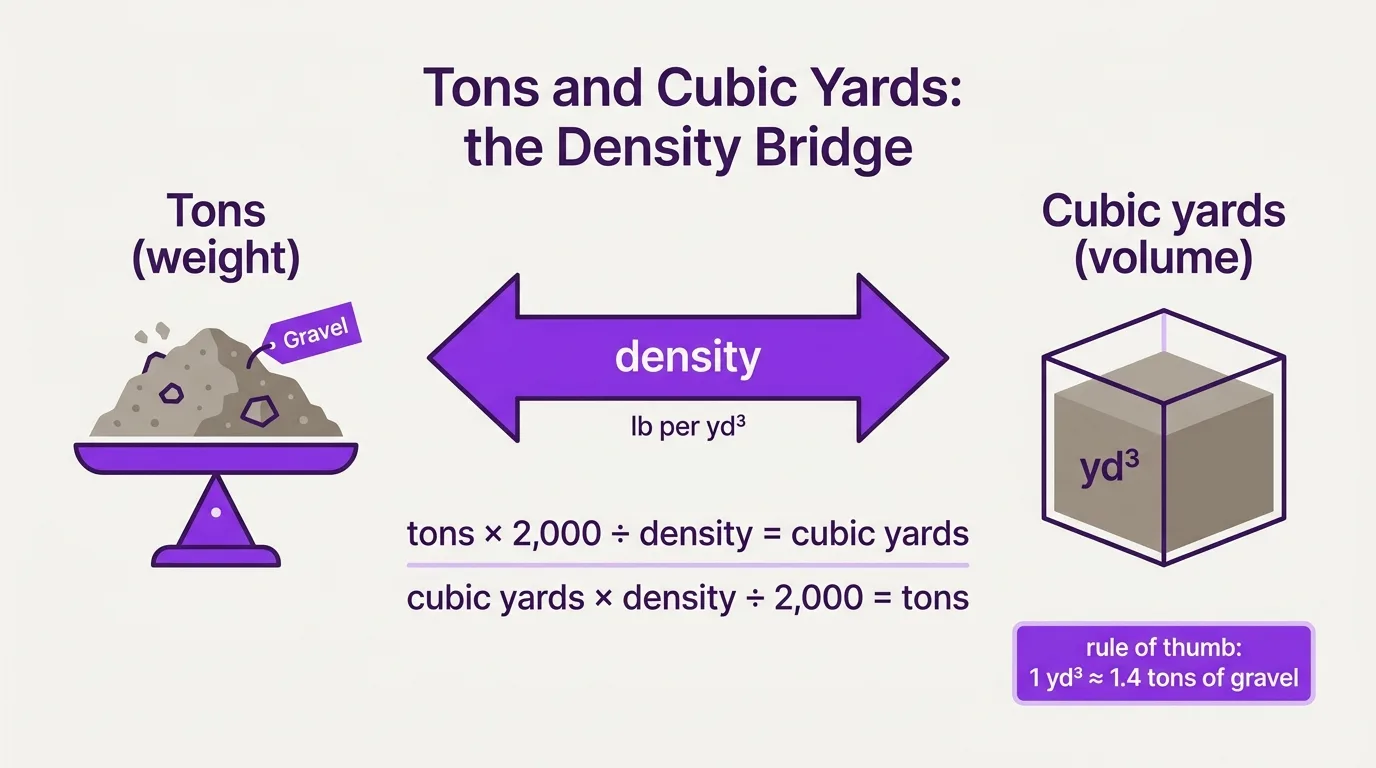
Both arrows use the same density, so an error in it pushes the answer the same way in either direction. The 1.4 rule of thumb only holds for the two materials below that really are 2,800 lb per cubic yard.
Density, both conversion factors, and how much of a yard is air
USDA NRCS| Material | Density | Tons / yd³ | Yd³ / ton | Rock, not air |
|---|---|---|---|---|
| Crushed Stone #57selected | 2,700 lb | 1.35 | 0.74 | 60% |
| Crusher Run | 2,800 lb | 1.40 | 0.71 | 63% |
| Pea Gravel | 2,700 lb | 1.35 | 0.74 | 60% |
| Paver / Fill Sand | 2,800 lb | 1.40 | 0.71 | 63% |
| Screened Topsoil | 2,200 lb | 1.10 | 0.91 | n/a |
| River Rock | 2,600 lb | 1.30 | 0.77 | 58% |
| Standard Concrete | 4,050 lb | 2.03 | 0.49 | n/a |
The last column is each density divided by 4,467 lb/yd³, what a cubic yard would weigh with no voids in it: the USDA NRCS bulk density guide puts most rock at 2.65 g/cm³. The remainder of every loose yard is air, which is why a stockpile weighs so much less than the rock in it, and why moisture and gradation move a published density at all. It reads n/a for topsoil, which is part organic matter, and for concrete, which is a set solid rather than a pile. Densities match this site's own material calculators.
Short ton
Why a ton of gravel is not a fixed number of cubic yards
Which unit you are quoted in is a commercial choice, not a property of the stone. Two things decide it: what the seller's equipment measures, and which word for "ton" the paperwork means.
Quarries run weighbridges, so they sell by weight. The USGS crushed stone summary counts the whole U.S. industry that way, at about 1.5 billion tons produced in 2025. A landscape yard loading with a bucket sells by volume instead, because a bucket is a known number of cubic yards and a scale is expensive. The same pile can therefore be quoted either way depending on who owns it.
On public work the unit is written into the contract. The Caltrans aggregate base manual notes that the bid item list and plans specify the class of aggregate base and the unit of measurement, so a job may be paid by the ton on one item and by the cubic yard on the next. Neither is more correct. They just need converting before you compare two prices.
So there is no single answer to "how many yards is a ton". There is one answer per material, which is what the table above gives, and a supplier's own density beats all of them. If you only know the area you want covered, start with the cubic feet calculator or the pea gravel calculator and come back with a volume.
Three units all spelled "ton"
| Unit | Pounds | Where it turns up |
|---|---|---|
| U.S. short ton | 2,000 | Every U.S. quarry and landscape-yard ticket |
| Metric tonne | 2,204.6 | Imported stone, lab reports, spec sheets |
| Long ton | 2,240 | Older UK documents and some shipping paperwork |
This calculator works in short tons throughout, and prints the metric tonne equivalent in the readout. A tonne read as a short ton is 10% light, which on a full truck is a load you have paid for and not received.
Quarry office
Tons and cubic yards questions, answered plainly
The questions that come up between reading a quote and placing the order. Nothing here is behind a toggle.
How many tons are in a cubic yard of gravel?
For #57 crushed stone, 1 cubic yard is about 1.35 tons using the 2,700 lb/yd³ density from our gravel calculator. Crusher run is about 1.4 tons per cubic yard.
How many cubic yards are in 1 ton of gravel?
One ton of #57 stone is about 0.74 cubic yards. One ton of crusher run is about 0.71 cubic yards because it is denser.
What is the formula for tons to cubic yards?
Cubic yards = tons × 2,000 ÷ density in lb per cubic yard. The density is the material assumption, so changing from topsoil to concrete changes the answer.
What is the formula for cubic yards to tons?
Tons = cubic yards x density in lb per cubic yard / 2,000. This calculator shows the density used under the result so the supplier can confirm it.
Why do gravel yards quote by tons instead of cubic yards?
Many aggregate suppliers load by scale weight because truck payload and inventory are tracked in tons. Homeowners often measure volume, so this converter bridges the two units.
Should I use tons or cubic yards when ordering?
Use the unit your supplier sells. Measure the project in cubic yards with a material calculator, then convert to tons only after choosing the closest density.
How much does delivery change the cost?
Delivery fees often matter more than the conversion on small orders. Local gravel and soil yards commonly set minimum loads or charge separate delivery, fuel, and spreading fees.
Is a ton the same as a tonne?
No. This calculator uses U.S. short tons of 2,000 lb. A metric tonne is about 2,204.6 lb, so confirm the unit if your supplier writes tonnes.
Conversion factor
Inside the tons to cubic yards conversion
Two steps and one assumption. Both steps are exact and the assumption is the density, which is why the readout prints it next to the answer.
A short ton is 2,000 lb by definition, so a tonnage becomes a weight in pounds with one multiplication. Dividing those pounds by the material's density in pounds per cubic yard gives the volume. Typing into the cubic yards field runs the same two steps backwards. Whichever side you type on, the other side updates from the density showing in the dropdown, and the readout repeats that density so a supplier can check it against theirs.
Nothing is rounded until the display, and nothing is added. There is no waste factor, no compaction allowance and no delivery minimum in these numbers, because all three are properties of a job rather than of a conversion.
lb = tons × 2,000yd³ = lb ÷ density (lb/yd³)tons = yd³ × density ÷ 2,000tons per yd³ = density ÷ 2,000yd³ per ton = 2,000 ÷ densityWhat it leaves out
- Waste, spillage and over-excavation
- Compaction, which base gravel needs
- Settling, which soil and mulch do
- Moisture in the stockpile on the day
- Delivery minimums and short-load fees
Each one belongs to a material, not to a unit, so it lives in that material's own calculator and this page stays a clean weight-to-volume conversion.
Disclaimer
These estimates are for planning purposes only. Actual costs vary by location, material availability, and project complexity. Always get at least 3 local quotes. This calculator does not replace professional advice.
Sources
Related Calculators
Gravel Calculator
Area, depth, tons, and bags
Crushed Stone Calculator
Stone volume and weight
Stone Calculator
Landscape rock quantities
Sand Calculator
Sand tons, yards, and bags
Pea Gravel Calculator
Pea gravel patios and paths
Cubic Feet Calculator
Boxes, cylinders, and volume
Cubic Yard Calculator
Area plus depth to yards