Stone Calculator
Get tons, cubic yards and cost by stone grade, with the grade sizes drawn to scale.
Stone Order
Application
Driveway
4" TYPICAL
Angular stone for vehicle traffic. Use 12-15% for compaction and grading.
Angular stone for bases, drainage, driveways, and general utility work. Size in our data: 3/4" (#57). 1.4 t/yd³ at $40/ton.
Estimates only. Not professional advice.
Stone to order
3.80
tons of crushed stone/gravel at 4 in deep, with the 10% allowance already in it.
- Crushed Stone/Gravel at $40/ton
- $152
- Coverage at 4 in
- 58 sq ft/ton
- Fabric and edging
- 220 sq ft · 60 ft edging
- Stone per sq ft covered
- $0.76
Bulk delivery recommended. Keep the dump spot close to the work area. Plan on local dump delivery unless you have a rated trailer.
Ask for both tons and cubic yards so the yard can match its local billing unit. Stone only, at a planning price. Delivery, fabric, edging and labour are separate, and local quarry prices move. Estimates, not professional advice.
Last updated August 5, 2026 by our expert review team.
Grade ladder
Stone size, drawn: what a grade name actually looks like
Aggregate is sold under names and sieve numbers that tell a homeowner nothing, and ordering the wrong size costs more than ordering the wrong amount. The grades our own data measures are drawn below against a single one inch grid, so you can see the difference between something that packs into a path and something you cannot walk on.
- Grade selected
- Crushed Stone/Gravel
- Size in our data
- 3/4" (#57)
- Shape
- angular
- Compacts
- 10-15%
- Application
- Driveway
- Depth entered
- 4 in
- Covers at that depth
- 58 sq ft/ton
Workable for a driveway
Crushed Stone/Gravel compacts 10-15% and locks, and this application wants angular stone for vehicle traffic.
Crown or slope for drainage before spreading stone.
Coverage per ton is 324 divided by depth in inches times density, the same line the readout above uses, so it moves with the depth you enter. Suitability reads the compaction band each grade already carries against what this application asks of it.
At the weighbridge
The wrong grade of stone costs more than the wrong quantity
An over-order is a nuisance you can spread somewhere else. Stone of the wrong size or the wrong shape has to be dug out and hauled away before the right load can go down, and that is two deliveries plus the labour.
Shape and fines
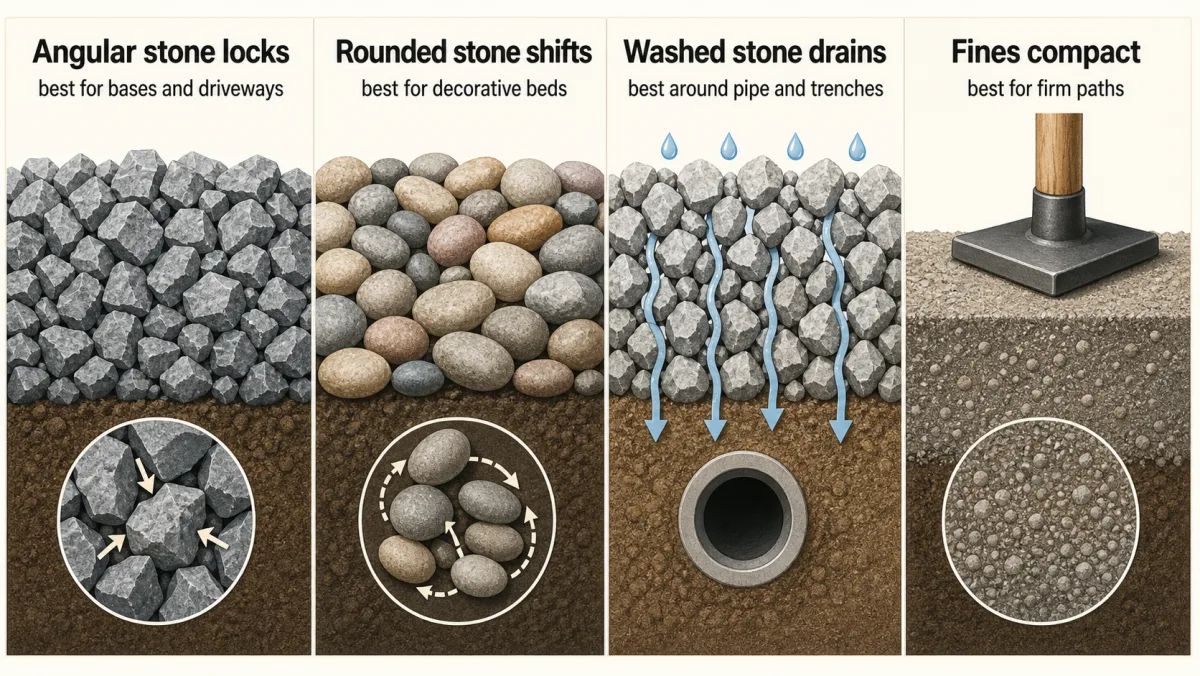
Angular locks, rounded rolls, washed drains: reading a stone description
Size is half the decision. The other half is whether the stone is angular or rounded and whether it carries fines, because those two facts decide whether a layer stays where you put it, drains, or packs into a surface.
By job
Decorative beds
2"- Pick
- River rock, lava rock, marble chips
- Avoid
- Dense base stone against plant crowns
Fabric plus edging keeps the bed clean.
Paths and patios
2.5-3"- Pick
- Pea gravel or decomposed granite
- Avoid
- Large river rock under chairs
Use edging on both sides before stone.
Driveway/top layer
4"- Pick
- Crushed stone or limestone
- Avoid
- Round river rock under tires
Compact in shallow lifts over a stable base.
Drainage trench
8-12"- Pick
- Washed clean stone with no fines
- Avoid
- Stone dust or compacted fines
Wrap the trench with non-woven fabric.
Bottom up
A stone layer is built in one order and only one, because each layer has to be finished before the next can be levelled on it. The calculator prices the last of the four.
- 1Prepared gradeCompacted base or open drain bed, shaped to fall before any stone lands on it.
- 2Separation layerFabric wherever weeds or soil migration would otherwise foul the stone.
- 3Control layerEdging or trench walls, because loose stone goes wherever nothing stops it.
- 4Finish layerThe grade and the depth, which is the only part this calculator prices.
The short version: angular stone locks, rounded stone decorates, clean washed stone drains, and fines compact.
Yard notes
Spreading landscape stone so it stays where you put it
Six habits that separate a stone job which still looks placed after a winter from one that has migrated into the lawn.
Match the shape to the load, not the colour
Angular crushed stone and limestone lock together, which is why they hold a driveway. Rounded stone rolls under a tyre and under a chair leg, so it belongs where movement does not matter.
Spread base stone in shallow lifts
Compacting one deep pour leaves the bottom loose. For dense-grade base work our crusher run calculator gives a tighter estimate than a generic grade does.
Buy fabric that outlives the stone
For decorative paths and patios the University of Maine Extension recommends commercial-grade woven polypropylene under the stone, plus edging to keep it contained.
Dump on a tarp, not on grass
Book bulk delivery for a dry day and drop the load on plywood or a tarp. Stone tipped onto bare grass picks up soil that shows on anything pale.
Keep drain stone clean
Washed stone with no fines is the whole point of a trench. Our French drain calculator sizes the stone and the pipe together.
Go to the single-material page for a firm quote
This page covers eight grades at once. For one material in detail, try the pea gravel calculator, the river rock calculator or the crushed stone calculator.
Volume to weight
Depth in inches, weight in tons: the stone arithmetic
Every figure on this page comes out of four lines. They are worth reading once, because three of the four are where a stone order goes wrong.
- Cubic yards
- length × width × depth in inches ÷ 324
- Tons
- cubic yards × grade density × (1 + waste)
- Coverage per ton
- 324 ÷ (depth in inches × density)
- Bags
- cubic feet with waste ÷ 0.5, rounded up
The 324 is 27 cubic feet in a cubic yard times 12 inches in a foot, folded together so depth can stay in inches. In metric mode the depth you type is converted to inches first and the answers come back in tonnes and cubic metres.
This page is deliberately the broad one: eight grades, six applications, decorative through to structural. That breadth is why it carries a size ladder rather than one material's spec sheet, and why a single-material page will give you a firmer number.
Density is the line that surprises people. A cubic yard of lava rock weighs about 0.55 tons and a cubic yard of limestone about 1.50, so the same hole costs a very different amount of money depending only on which grade goes in it.
Waste is not spillage. It covers uneven excavation, edge loss, and the fact that a compacted base finishes thinner than the loose pile delivered. Decorative stone often needs 5 to 10%. Driveway and paver bases need 15% or more.
Priced orders
Four stone orders and what each one weighed
Each of these runs through the same arithmetic and the same grade prices as the calculator above, at a 10% allowance, so you can type any one in and get the identical answer. Depth moves the weight more than area does.
Foundation bed
0.99
tons
$79 of stone
- Job
- 18 × 6 ft, 2" deep
- Grade
- River Rock (1-3")
- Size here
- 1 to 3"
- Volume
- 0.73 yd³
- Area
- 108 sq ft
Pin the woven fabric at the edge and keep the stone below the siding and the weep holes. If the yard rounds to the nearest half ton, take the full ton.
Side yard path
1.71
tons
$94 of stone
- Job
- 30 × 4 ft, 3" deep
- Grade
- Decomposed Granite
- Size here
- not stated here
- Volume
- 1.22 yd³
- Area
- 120 sq ft
Decomposed granite only holds a surface if it is edged on both sides and compacted in two shallow passes, misted between them.
Driveway top layer
7.60
tons
$304 of stone
- Job
- 20 × 20 ft, 4" deep
- Grade
- Crushed Stone/Gravel
- Size here
- 3/4" (#57)
- Volume
- 5.43 yd³
- Area
- 400 sq ft
This is the top layer only. A new drive normally wants a thicker compacted base underneath it as well, so ask whether the yard quotes by ton or by cubic yard.
Foundation drain
3.42
tons
$137 of stone
- Job
- 40 × 1.5 ft, 12" deep
- Grade
- Crushed Stone/Gravel
- Size here
- 3/4" (#57)
- Volume
- 2.44 yd³
- Area
- 60 sq ft
Washed stone with no fines, non-woven geotextile lining the trench, and the fabric folded back over the stone pack before backfill.
Job dimensions are stated imperial because that is how these four were measured. The tonnage, volume, area and cost recompute in whichever unit the calculator is set to.
Depth and yield
One ton of stone covers how much? Depth decides
Coverage halves when depth doubles, and it shifts again with the grade, because a ton of lava rock is nearly three times the volume of a ton of limestone.
All figures in sq ft. The first column is volume, the rest are per ton at each grade's own density. Plan the hole in cubic yards and buy in tons, because that is the unit the yard bills in.
- Densest grade here
- Limestone, 1.50 t/yd³
- Lightest grade here
- Lava rock, 0.55 t/yd³
- Small delivery minimum
- 1 to 3 tons typical
- Full dump truck
- 10 to 15 tons
At the counter
What people ask the yard before buying stone
How many tons for a 2-car driveway?
A 20x20 ft driveway at 4 inches deep works out at 6.9 tons of crushed stone before waste, and about 7.6 tons once a 10% allowance is in it. Both figures come straight from this calculator, so change the area or the depth above and they move.
What size stone should I order?
Size is the decision a grade name hides. Where our own data states one, it is 1/8 to 3/8 inch for pea gravel, 3/4 inch for #57 crushed stone, and 1 to 3 inch and 3 to 6 inch for the two river rock grades. Angular stone locks under load at any of those sizes and rounded stone rolls at all of them.
What depth of stone do I need?
Driveways: 4 inches over a 4 to 6 inch sub-base. Walkways: 2 to 3 inches over fabric. French drains: 8 to 12 inches around the pipe.
How much does a ton cover?
At 2 inches deep, one ton of crushed stone covers about 116 sq ft, and at 4 inches about 58 sq ft. Lava rock reaches about 295 sq ft at 2 inches because a cubic yard of it weighs far less.
Crushed stone or river rock?
Crushed stone interlocks and compacts for driveways and bases. River rock shifts under load but excels in drainage swales and decorative beds. Use our River Rock Calculator for decorative projects.
Why do suppliers quote by weight?
Weight is consistent regardless of moisture or how loosely stone is loaded. Volume can vary 10 to 20%. Our calculator converts volume to tons to match supplier quotes.
Do I need a permit?
Usually not for decorative stone. You may need one for grading over 50 cubic yards or driveway modifications. A quick call to your building department can save a $500+ fine.
What is the cheapest stone?
Of the eight grades priced here, crushed stone is the cheapest at about $40 per ton, then pea gravel at $50 and decomposed granite at $55. Marble chips are the dearest at about $150 per ton, so a decorative bed can cost three times a utility one for the same volume.
What sand goes under pavers?
For paver bedding, you need leveling sand over your stone base. Our Sand Calculator estimates the right amount for paver, masonry, and play sand projects.
Disclaimer
These estimates are for planning purposes only. Actual costs vary by location, material availability, and project complexity. Always get at least 3 local quotes. This calculator does not replace professional advice.