Fill Dirt Calculator
Calculate cubic yards of fill dirt for low spots, grade raises, and compacted backfill.
Fill Dirt Estimate
What you are filling
That is the compacted shape. At 20% shrink the yard has to load 7.2 in of loose dirt to leave you 6 in of finished grade.
Before you call the yard
Ask where the dirt came from, whether it is screened, and what the minimum load is. Those three answers move the price and the schedule more than the volume does.
Estimates only. Not professional advice.
Loose fill dirt to order
5.87cu yd
Enough clean fill dirt to leave 240 sq ft sitting 6 in higher once it is compacted, with the 20% shrink and 10% cushion already in the figure.
- Clean fill dirt, 5.87 cu yd
- $106
- Delivery, 1 load
- $90
- Planning total
- $196
- Delivered per cu yd
- $33.39
Material and haulage only. Machine hire, compactor rental, topsoil cap and any permit sit outside this, and a load under the yard's minimum is usually billed as the minimum.
Last updated August 10, 2026. Checked against USDA NRCS soil classification and FHWA compaction guidance by our expert review team.
Shrink in section
Fill dirt in section: loose delivered depth against compacted grade
The same dirt, drawn twice at the depth you entered. On the left it is finished. On the right it is the pile the truck tips out, standing proud of the grade it will end up at.
Vertical dimensions are to scale from the depth and shrink percentage in the calculator. Column widths are schematic, and the ordering cushion is not drawn because it buys extra volume rather than extra depth.
- Loose depth to spread
- 7.2 inWhat the truck tips out, before a single pass of the plate
- Compacted target
- 6 inThe depth the finished grade has to stand at
- Rolled away
- 1.2 inThe 20% this material loses when it is watered and compacted
- Lifts to compact
- 2Spread in 6 in passes, because a plate reaches no deeper
Free-delivery line
Delivered fill dirt price per yard, once the haul is in it
A flat delivery fee punishes small loads harder than any material price does. This reads your order, your material rate and the supplier minimum from the calculator and prices the two options side by side.
Your 5.87 yd³ of clean fill dirt
$18.00/yd³ material · $90 delivery · free over 10.00 yd³
- Ordered at 5.87 yd³
- $196$33.33/yd³ delivered, with $90 of that the delivery fee
- Topped off at 10.00 yd³
- $180$18.00/yd³ delivered, nothing paid for the truck
- The truck's share of your ticket
- 46%Every extra yd³ added spreads that one fee thinner, which is the whole reason the bars fall
Delivered rate by order size
The full 10.00 yd³ load costs $16 less than your order does, because the waived fee more than pays for the extra material. Order the larger load and stockpile the rest.
The estimate in the calculator bills one delivery fee per truck load, which is how most yards quote a haul. This compares that against the other common policy, one flat fee waived above a minimum order.
Building the grade
Placing fill dirt so the grade you build is the grade that stays
Six things that decide whether the surface is still where you left it in two years. None of them are about the volume, which is the part everybody gets right.
Fill builds the shape, topsoil only caps it
Fill dirt is subsoil with the organics screened out, which is why it holds a grade instead of rotting down into one. Build the whole profile in fill, then finish the last few inches with topsoil wherever something has to grow.
Order the loose number, plan to the compacted one
The hole is measured compacted and the truck is loaded loose, and those are two different volumes. Everything on this page carries both so you never read one as the other at the yard gate.
Spread in lifts, not one deep dump
A plate compactor reaches roughly six inches down. Fill placed deeper than that stays loose underneath however many passes go over the top, and it finds its own level over the first two winters.
Keep the finished grade below the siding
Around a house the surface has to fall away from the wall, but not by burying siding, weep holes or vents to get there. If the fall cannot be had in the space available, the answer is a swale, not more dirt against the wall.
Moisten each lift before you compact it
Bone-dry fill will not knit and saturated fill pumps under the plate. Damp enough to hold a shape when squeezed is the field test, and it is worth a hose run between passes.
Removing soil is a different sum
Excavated ground swells as it comes out rather than shrinking as it goes in, so hauling away uses the excavation calculator instead. Finishing the new grade in sod or mulch gets sized separately again.
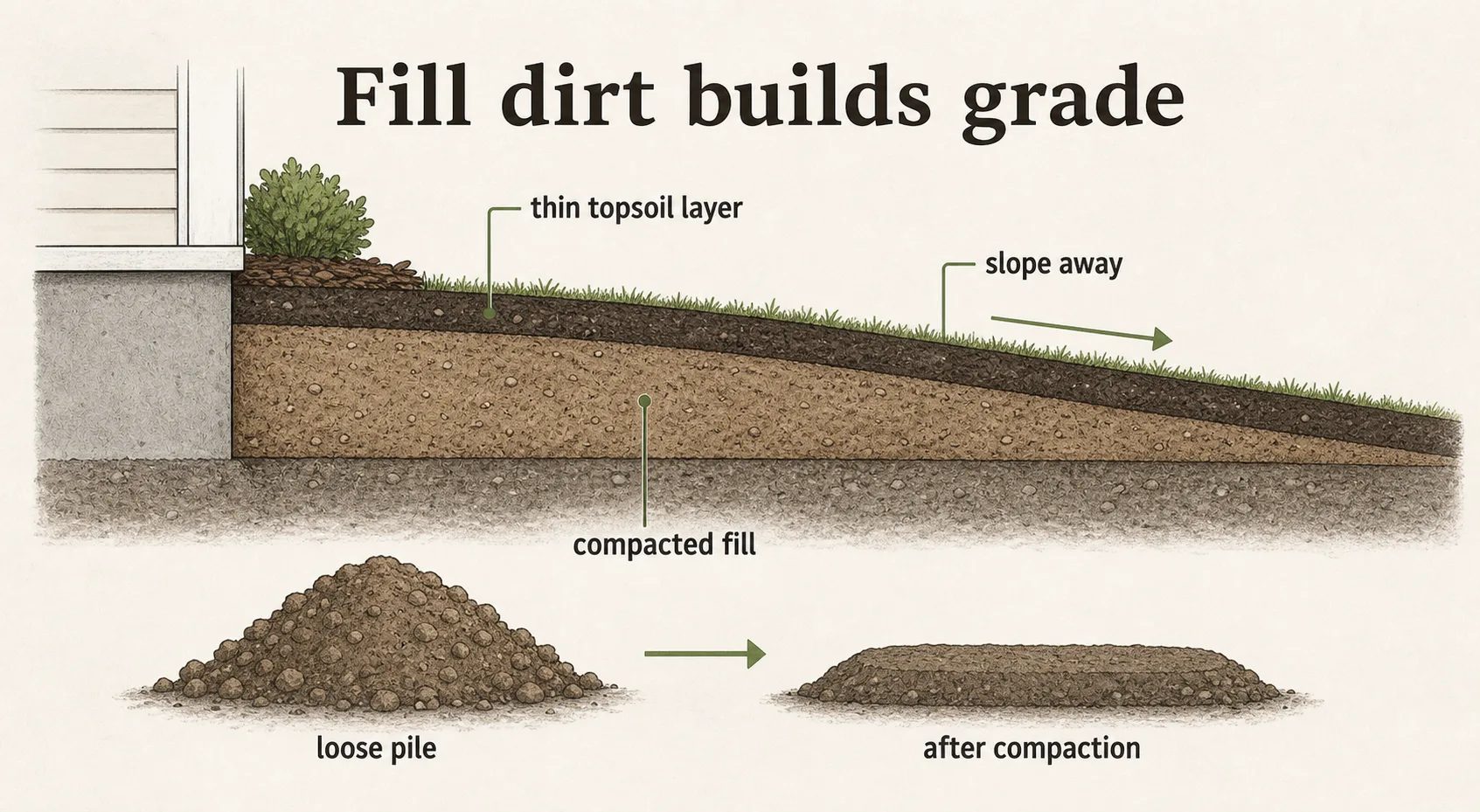
The same three ideas as a built assembly: where the topsoil cap stops, how far the surface has to fall away from a wall, and how much the delivered pile loses on the way to that surface.
Yards per job
Fill dirt by job size: a low spot, a grading strip and a deep fill
Three of the presets above, run through the same chain the calculator uses at each one's own material and shrink allowance. Load any of them into the tool and the figures match.
Low spot
1.87cu yd
1.48 cu yd compacted, plus 15% shrink and 10% cushion
- Area and depth
- 12 x 10 ft at 4 in
- Material
- Screened fill
- Weight
- 2.16 tons
- Loads and cost
- 1 at $142
A dip in a lawn, the job most people arrive here for. It is under two yards, which is below almost every yard's minimum load, so the delivery fee is the biggest single line on the ticket and the material is nearly free by comparison.
Grading strip
5.87cu yd
4.44 cu yd compacted, plus 20% shrink and 10% cushion
- Area and depth
- 40 x 6 ft at 6 in
- Material
- Clean fill dirt
- Weight
- 6.45 tons
- Loads and cost
- 1 at $196
Six feet of yard edge regraded away from a wall. One standard dump truck covers it with room to spare, and the twenty percent shrink allowance is the difference between finishing the run and stopping four feet short.
Deep fill
21.26cu yd
14.22 cu yd compacted, plus 30% shrink and 15% cushion
- Area and depth
- 16 x 12 ft at 24 in
- Material
- Structural fill
- Weight
- 28.70 tons
- Loads and cost
- 2 at $903
A void being brought back up to grade under something that will carry weight. The thirty percent shrink on structural fill and the deeper cushion together add more than seven yards over the hole's own measurement.
Permits and settling
Fill dirt questions: settling, permits and what clean fill means
Eight answers in the order they come up, from what separates fill from topsoil to what you are taking on when somebody offers you a free load.
Fill dirt vs. topsoil?
Fill dirt has no organics, won't decompose, ideal for structural support. Topsoil is nutrient-rich for planting only. UGA Extension has a detailed comparison guide.
How much does fill dirt settle?
Compacted fill settles 1-3% in year one. Uncompacted fill can settle 15-25%. Always compact to 95% Proctor density.
How much does fill dirt cost?
Clean fill: $5-15/yard. Screened: $20-30. Topsoil: $30-50. Delivery adds $50-150 per truckload.
How many yards fit in a dump truck?
Single-axle: 10-12 yards. Tandem: 14-18 yards. Semi: 20-25 yards. Weight limits may reduce capacity for heavy clay.
Do I need a permit?
Usually yes for fills over 12-18 inches deep or exceeding 50 cubic yards. Check with your local building department first.
What is 'clean fill'?
Dirt free of debris, chemicals, and organics. Accepting contaminated fill can make you liable for $10,000+ remediation costs.
How do I compact properly?
Use a plate compactor for granular fills, sheepsfoot for clay. Spread in 6-inch lifts, moisten to 12-15%, make 3-4 passes per lift.
Fill dirt or gravel behind retaining walls?
Use crushed gravel or sandy fill for the first 12 inches behind the wall. Clay traps water and creates pressure that can push walls over.
How fills fail
Where a fill dirt order goes wrong
A grade that has sunk, slumped or pushed water at a wall almost never failed for want of volume. Each of these is decided before the truck is booked or in the hour after it tips.
Ordering the volume the hole measures
That figure is the compacted target. Loose dirt in a truck occupies a fifth to a third more space than the same dirt once it has been rolled, so the load arrives short of the grade it was bought for.
Order the loose figure the readout gives you, shrink allowance already in it, and keep the ticket so a second load is one phone call rather than a fresh measure.
Using topsoil because it was on the truck already
Topsoil is roughly five percent organic matter by design, and that fraction breaks down over a few seasons. A grade built on it drops long after the job looks finished.
Build the profile in fill and cap it with topsoil only where planting happens, typically the top four to six inches.
One deep dump, compacted once from the top
A plate compactor works about six inches down. Everything below that stays at its delivered density and settles on its own schedule, usually unevenly.
Spread in lifts of six inches or so and compact each one before the next goes down. A two-foot fill is four passes, not one.
Raising the grade against the siding to get a slope
Burying siding, weep holes or a vent puts soil moisture against materials that were never detailed for it, and it voids most siding warranties outright.
Hold the finished grade six inches or more below the siding line and take the water away in a shallow swale where the fall runs out.
Taking free fill sight unseen
Free fill is somebody else's disposal problem. Construction debris, asphalt millings or contaminated soil become the receiving property's liability the moment they are spread.
Ask what the source site was, look at a load before it tips, and get clean fill in writing on anything going near a foundation or a well.
The first and third share one root: treating the volume the hole measures and the volume the truck carries as the same number. The section at the top of this page separates them, in the depths you entered.
What the ticket says
Fill dirt, structural fill and topsoil are three different deliveries
Six things a yard will sell you as dirt, and only five of them build a grade. Ordering the wrong one is the mistake on this page that cannot be fixed by adding another load.
Clean fill dirt
Screened subsoil, no organics and no debris. The cheapest thing that will hold a grade.
Bulk raises, low spots and anywhere the finished surface is going to be capped by something else.
Screened fill
The same subsoil put over a screen, so the rocks and clods are gone.
Grading that is going straight to lawn, where a rake has to leave a surface a mower can cross.
Sandy fill
Higher sand fraction, drains freely and shrinks the least of the five.
Backfill that has to shed water, including the first foot behind a retaining wall.
Clay fill
Holds a shape once compacted and holds water just as well.
Sealing a pond edge or building a berm. Keep it away from foundations and from anything that has to drain.
Structural fill
Engineered material placed to a specified density and usually tested.
Under slabs, footings and pavement, where the spec names a Proctor number rather than a depth.
Topsoil
Not a fill material. Organic-rich growing medium that decomposes and settles.
The last few inches only, sized with the soil calculator or the raised bed calculator.
Swell by soil
How much fill dirt shrinks, by material
The shrink column is what to type into the calculator if you are not sure. The rate and the weight are the same figures the estimate above is built from, so a quote can be checked against them before it is accepted.
Clean fill dirt
your fill
+25%
1.1 tons
$18
The default where nothing on top has to grow or carry weight. Screened of debris, not of stones.
Screened fill
+25%
1.15 tons
$28
Rock and clod free, so a rake leaves a surface a mower can cross on the first pass.
Sandy fill
+20%
1.2 tons
$24
Drains freely, which is why it shrinks least of the five and why it goes behind anything holding water back.
Clay fill
+30%
1.3 tons
$16
Holds its shape and holds water in equal measure. Berms and pond edges, never against a foundation.
Structural fill
+30%
1.35 tons
$34
Placed and tested to a density rather than a depth, which is what puts it at the top of the rate column.
Rates are a planning midpoint and move fifteen to twenty-five percent with region and season. Skip compaction entirely, as you would under a decorative bed, and the shrink allowance falls toward zero.
Average depth in
From average depth to delivered fill dirt yards
Two allowances stack on the compacted volume and they do different jobs. Shrink covers the depth the dirt loses under the plate. The cushion covers the corner you overfill and the wheelbarrow that tips. Coverage mode runs the same chain backwards from material you already have, which is why it carries no cushion at all.
compacted yd³ = L × W × d ÷ 12 ÷ 27loose yd³ = compacted × (1 + shrink) × (1 + cushion)tons = loose yd³ × densityloads = ceil(loose yd³ ÷ truck size)total = loose yd³ × rate + loads × $90area = compacted yd³ × 27 ÷ (d ÷ 12)Average depth is the input that carries the most error. On a slope, measure the deepest point and the shallowest and halve the sum. On a dished low spot, measure the middle and take about two thirds of it, because the hole is not a box.
Constants
- Clean fill dirt
- 1.1 tons / yd³
- Screened fill
- 1.15 tons / yd³
- Sandy fill
- 1.2 tons / yd³
- Clay fill
- 1.3 tons / yd³
- Structural fill
- 1.35 tons / yd³
- Delivery per load
- $90
- Truck capacity
- 8 to 16 cu yd
Densities are for damp in-place material. A dried-out clay weighs less per yard and a saturated one weighs considerably more, which is what puts a tandem load under its rated volume.
Disclaimer
These estimates are for planning purposes only. Actual costs vary by location, material availability, and project complexity. Always get at least 3 local quotes. This calculator does not replace professional advice.
Sources