Gravel Driveway Calculator
Calculate tons, cubic yards, truckloads, and delivery cost for a gravel driveway build or top-up.
Driveway Details
Project Type
Driveway Length (ft)
Driveway Width (ft)
Total Depth (in)
Gravel Type
Gravel to order
13.7 tons
of crusher run (#57) for a 40 × 12 ft driveway at 6 in, with the 10% waste allowance already in it. Short tons, the way bulk aggregate is priced.
- Material
- $342 to $684
- Delivery, 1 load at $75
- $75
- Stone on the ground
- $417 to $759
Stone and delivery only. Excavation, fabric, edging, grading, compactor hire and labour are all separate. Estimates only, not professional advice.
Last updated August 5, 2026 by our expert review team.
Quarry prices
Gravel driveway cost per ton by stone type
Five stones on one axis, so the step from recycled millings to river rock is the real step and not a chart trick. The right-hand figure applies each rate to the driveway you just measured, at that stone's own density.
Crusher Run (#57)
your stone$25 to $50 · 1.4 tons/yd³
$342 to $684
Crushed Stone (#3/#4)
$30 to $55 · 1.35 tons/yd³
$396 to $726
Pea Gravel
$35 to $60 · 1.35 tons/yd³
$462 to $792
River Rock
$40 to $80 · 1.3 tons/yd³
$508 to $1,017
Recycled Asphalt/Concrete
$15 to $30 · 1.4 tons/yd³
$205 to $411
Stone at the yard only. Delivery adds $50 to $100 per truckload, and a load is about 15 tons, so a small job pays a bigger share of it.
- Truck payload
- 15 tonsWhat the calculator counts a load as
- Delivery per load
- $75The mid point of the $50 to $100 range
- Loads for your order
- 113.7 tons, rounded up to whole loads
Gravel comes in $681 to $2,943 under asphalt on this driveway, before you count the grading either surface needs. Compare asphalt against concrete in detail.
Lift schedule
Gravel driveway depth, placed in lifts you can compact
A driveway is a structure, not one depth of one stone. The coarse course under the surface spreads the load and drains; the finer course on top is what tyres run on. And neither goes down in a single pass, because a plate or roller only densifies so far below the surface. A build dumped in one lift is loose underneath however long you run the machine over it, and that is the failure people blame on the stone.
Drawn to scale, so a base twice the depth of the course above it looks it. The dashed rules are where the machine goes over the build, not where the stone changes.
Change the assumed lift depth in the build options and watch the pass count move without the tonnage moving. The stone is the same either way.
Single course, lift 1 of 2
3 in of Crusher Run, then compact
Single course, lift 2 of 2
3 in of Crusher Run, then compact
- Passes over the build
- 2At the assumed 4 in maximum lift
- Courses in the build
- 1One stone doing both jobs
- The surface course
- 6 inCrusher Run, base and surface in one material
Subgrade up
What a gravel driveway is made of, from the subgrade up
Spread the stone slightly deeper than the depth you want left after compaction, and order by tons because that is how the yard sells it and how the truck is loaded.
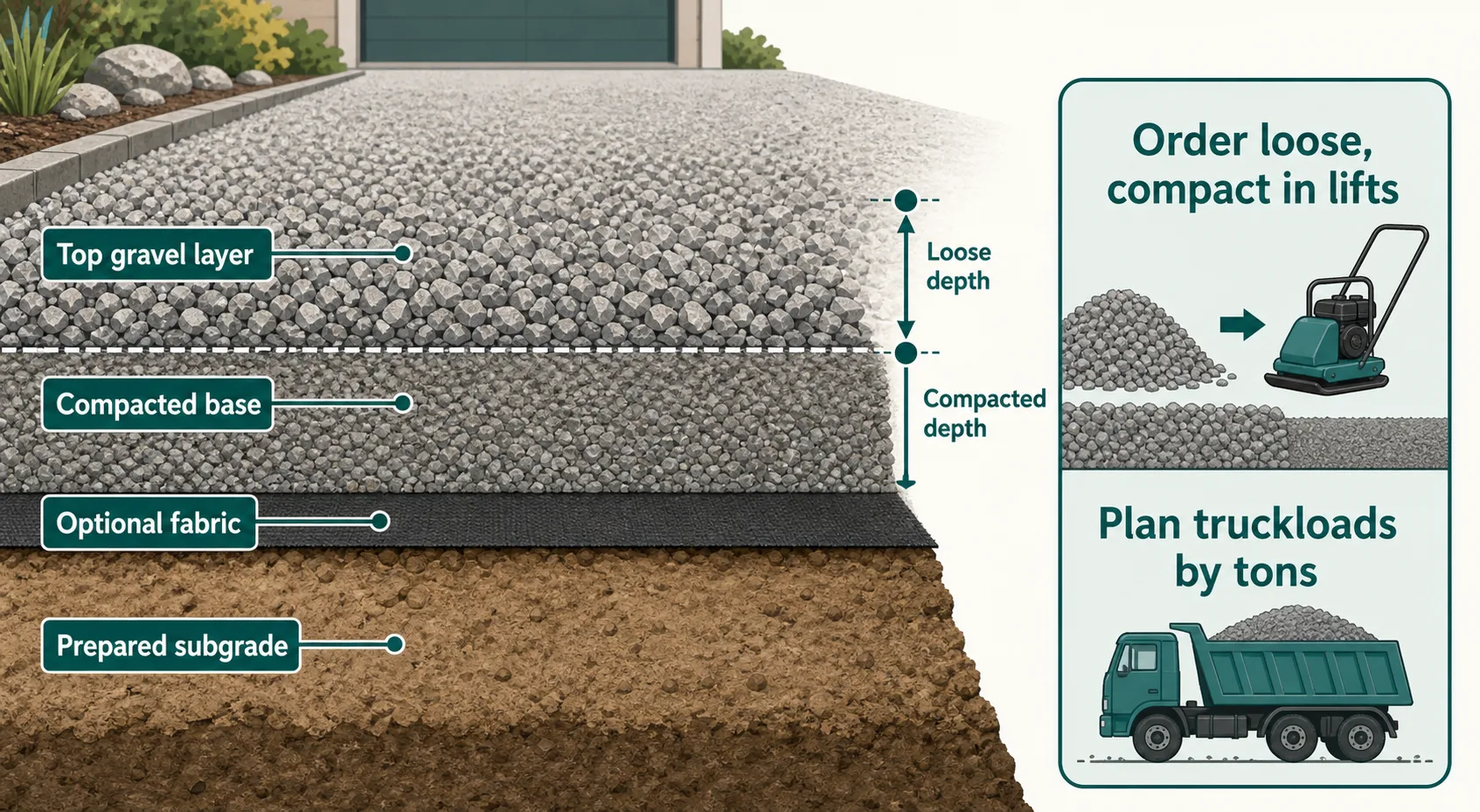
Fabric is optional and belongs over weak soil, where it stops fine subgrade from pumping up into the stone.
How deep, and what that costs you in stone
A 40 × 12 ft driveway at the 6 in minimum takes about 13.7 tons of crusher run, and going to the top of the heavy-use band roughly doubles it.
Tons at 10% waste in Crusher Run (#57), at 1.4 tons per cubic yard. Change the stone in the calculator and the column follows it.
Tons and loads
How this gravel driveway calculator turns depth into tons
Area times depth gives a volume, the stone's own density turns that into tons, and the truck payload turns tons into loads. In three-layer mode each course runs through the same arithmetic with its own stone before the three are added.
volume = length × width × (depth ÷ 12) × (1 + waste)yd³ = volume ÷ 27tons = yd³ × densityloads = ceil(tons ÷ 15)delivery = loads × $75lifts = ceil(course depth ÷ max lift)Waste is applied to the volume, before the density, so it carries through to tons and to cost. Nothing here applies a compaction factor: the calculator prices the depth you entered, and the last formula only splits that same depth into passes. Refresh mode overrides the depth to a fixed top-up and drops the waste allowance to 5%, because a thin course over an existing base wastes far less than a full build.
Not included: excavation, subgrade repair, landscape fabric, edging, culverts, grading, compactor hire and labour. Tons are short tons throughout, because the rates above are dollars per short ton.
The last row is the only assumed figure on this page. Everything above it is a constant the calculator itself uses.
Priced driveways
Gravel driveway cost by size: four worked orders
All four at 6 in of crusher run with a 10% allowance, run through the same function as the calculator above, so you can type any of them in and get the identical answer.
Short parking pad
5.7
tons
$218 to $360
- Drive
- 20 × 10 ft
- Area
- 200 sq ft
- Stone
- $143 to $285
- Loads
- 1 at $75
An entry pad or a spur off the drive. One load covers it, so the delivery charge is most of what you pay.
Single-car driveway
13.7
tons
$417 to $759
- Drive
- 40 × 12 ft
- Area
- 480 sq ft
- Stone
- $342 to $684
- Loads
- 1 at $75
The most common residential size, and the one the FAQ figure of 13.7 tons refers to.
Rural driveway
34.2
tons
$1,081 to $1,936
- Drive
- 100 × 12 ft
- Area
- 1,200 sq ft
- Stone
- $856 to $1,711
- Loads
- 3 at $75
Long runs are where crowning and drainage matter more than stone choice. Stage the loads so you compact as you go.
Double-wide driveway
22.8
tons
$720 to $1,291
- Drive
- 40 × 20 ft
- Area
- 800 sq ft
- Stone
- $570 to $1,141
- Loads
- 2 at $75
Side by side parking. Twice the width is twice the tonnage, and it crosses into a second truckload.
At the yard gate
Gravel driveway questions that come up before you order
Eight answers in the order they tend to arrive, starting with the tonnage the calculator above exists to settle.
How many tons of gravel do I need for a driveway?
A standard single-car driveway (40x12 ft, 6 inches deep, 10% waste) needs about 13.7 tons. A double-wide driveway (40x20 ft) needs about 22.8 tons. Use the calculator above for your exact dimensions.
How deep should a gravel driveway be?
6 inches minimum for light vehicle traffic. 8 to 12 inches for heavy use or soft soil. The depth should be split across 3 layers: 4 inches of base, 2 inches of middle stone, and 2 inches of top layer.
What is the best gravel for a driveway?
Crusher run (#57) is the most popular choice. It compacts well, locks together, and provides a stable driving surface. Use larger crushed stone (#3 or #4) for the base layer and crusher run on top.
How much does gravel cost per ton?
Crusher run costs $25 to $50 per ton. Crushed stone runs $30 to $55. Pea gravel is $35 to $60. River rock is the most expensive at $40 to $80 per ton. Recycled asphalt is cheapest at $15 to $30.
What is the difference between crusher run and pea gravel?
Crusher run is angular, compacts tightly, and stays in place. Pea gravel is round and smooth, which looks nicer but shifts under tires. Use crusher run for the driving surface and pea gravel only for borders or decorative areas.
How often do I need to add more gravel?
Plan to add a 1 to 2 inch top-up every 2 to 3 years. Driveways with proper base layers and drainage last longer between refills. High-traffic areas and slopes lose gravel faster.
Do I need edging for a gravel driveway?
Yes. Without edging, gravel migrates into the lawn and garden beds. Use treated timber, steel landscape edging, or large stones along both sides to contain the gravel.
How do I prevent ruts in a gravel driveway?
Crown the center so it sits 1/4 inch higher per foot of width. Compact each layer. Use angular stone (not round pea gravel). Grade and re-compact annually. Fix low spots before they become puddles.
Ruts and washouts
Gravel driveway failures that start on delivery day
Every one of these is decided while the stone is going down. None of them is fixable from the surface once traffic has been over it.
Not using a fabric barrier
Without landscape fabric, soil pushes up into the gravel within 2 years. You lose stone and end up with a muddy, uneven surface that needs a full rebuild.
Only one layer of gravel
A single dump of stone sits on bare soil and sinks. Proper driveways need 3 layers: large base stone, medium middle layer, and fine top layer, each compacted separately.
Using pea gravel as the only layer
Pea gravel is round and smooth. It shifts and ruts under tires without a compacted angular base underneath. Save pea gravel for the top layer or decorative borders only.
Not crowning the center
A flat driveway puddles and erodes. Slope the surface 1/4 inch per foot from the center to each edge so water sheets off to the sides.
Skipping compaction
Loose gravel scatters, creates tire ruts after the first rain, and washes downhill on any slope. Rent a plate compactor and pack each layer before adding the next.
Grade and crown
Gravel driveway habits that keep the surface flat
Not a sequence, so not numbered. Each one is a habit that separates a driveway still shedding water in five years from one that holds puddles by the second spring.
A new gravel driveway usually needs compactable base material first, then a smaller top layer. Order by tons, but keep cubic yards handy when talking to landscape yards.
Use our crusher run calculator to estimate sub-base material separately if you are ordering different stone sizes for each layer.
For a decorative top layer, check the pea gravel calculator to price out finishing stone options.
Compact in shallow lifts. A thick loose dump looks finished for a week, then ruts as soon as rain and tires hit it.
Use landscape fabric over weak soil when you need separation. It helps keep fine subgrade soil from pumping up into the stone.
Recycled asphalt millings cost 40 to 60% less than virgin gravel and pack down into a semi-solid surface that resists ruts.
Disclaimer
These estimates are for planning purposes only. Actual costs vary by location, material availability, and project complexity. Always get at least 3 local quotes. This calculator does not replace professional advice.
Sources
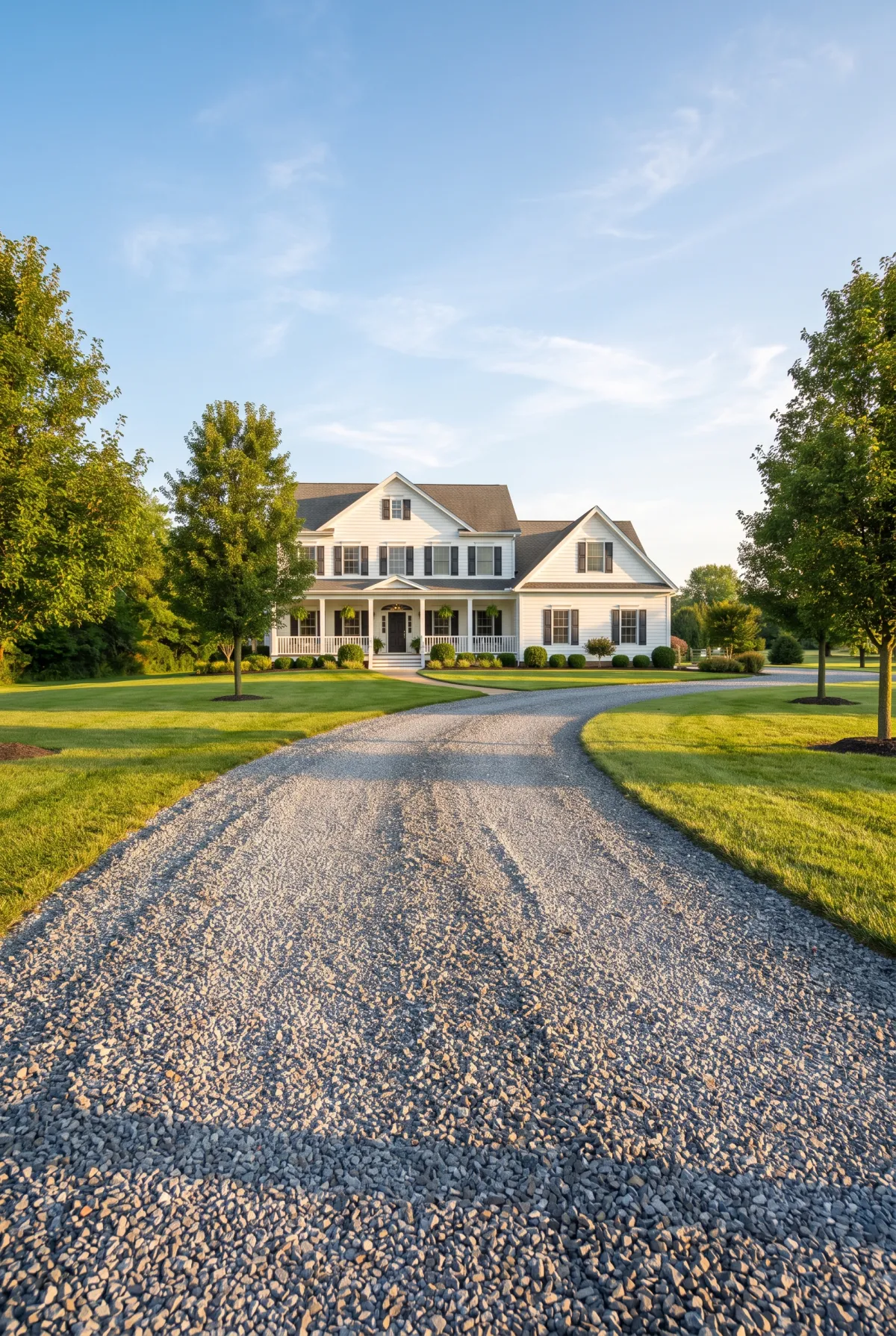
See 14 gravel driveway ideas
Browse the looks, then price yours here.
Related Calculators
Gravel Calculator
Any-project tons, yards, and bags
Crusher Run Calculator
Sub-base material
Pea Gravel Calculator
Decorative stone
Asphalt vs Concrete Calculator
Paving comparison
Fill Dirt Calculator
Grading and fill
Crushed Concrete Calculator
Recycled aggregate
Tons to Cubic Yards Calculator
Convert tons to yd³ by material