River Rock Calculator
Get tons, cubic yards and coverage by stone size, plus the depth that actually hides the ground.
Bed Dimensions
Application
Garden Bed
3 IN TYPICAL
Around plants. Adjust the depth for your stone size and site.
River rock to order
1.59
tons of medium (2-4") at 3 in deep, with the 10% allowance already in it.
- Medium (2-4") rock
- $159
- Landscape fabric
- $20 to $46
- Delivery
- $75-$150 local dump delivery
- Stone per sq ft of bed
- $1.32
1.59 tons is about 3,180 lb. A standard pickup should not carry much over 0.5 tons, so this is a delivery.
Medium (2-4") at $100 per ton, stone only. Fabric, edging, delivery and labour are separate. Estimates only, not professional advice.
Last updated August 5, 2026 by our expert review team.
Priced beds
River rock cost by bed size: four worked jobs
Each of these runs through the same arithmetic and the same yard prices as the calculator above, so you can type any one of them in and get the identical answer. Notice that depth and grade move the tonnage far more than area does.
Dry creek channel
1.96
tons
$293 of stone
- Bed
- 40 × 3 ft
- Depth
- 4 in
- Grade
- Cobble (6-12")
- Courses at that depth
- under one
- Waste
- 10%
Cobble at the centre of the channel and a smaller grade at the banks. Fabric earns its keep here because runoff pushes soil into the stone.
Front garden beds
4.81
tons
$385 of stone
- Bed
- 25 × 14 ft
- Depth
- 3 in
- Grade
- Small (1-2")
- Courses at that depth
- 2
- Waste
- 10%
A delivery job, not a pickup job. Order the fabric and the edging so they land before the truck does.
Side yard path
1.06
tons
$106 of stone
- Bed
- 20 × 4 ft
- Depth
- 3 in
- Grade
- Medium (2-4")
- Courses at that depth
- 1
- Waste
- 10%
Fine for a low traffic route. Set stepping stones in if it becomes the way everyone walks to the bins.
Pond edge band
1.06
tons
$128 of stone
- Bed
- 30 × 2 ft
- Depth
- 4 in
- Grade
- Large (4-8")
- Courses at that depth
- under one
- Waste
- 15%
Narrow and seen from the side, so 15% waste rather than 10% covers the sorting you will do by hand at the waterline.
- Your application
- Garden Bed
- Grade selected
- Medium (2-4")
- Depth entered
- 3 in
- Depth this page uses
- 3 in
- Courses that depth gives
- 1
The drawing below redraws from those last three rows. Change the depth or the grade in the calculator and watch the courses appear and disappear.
When it becomes a delivery
Depth check
Will the ground show through your river rock?
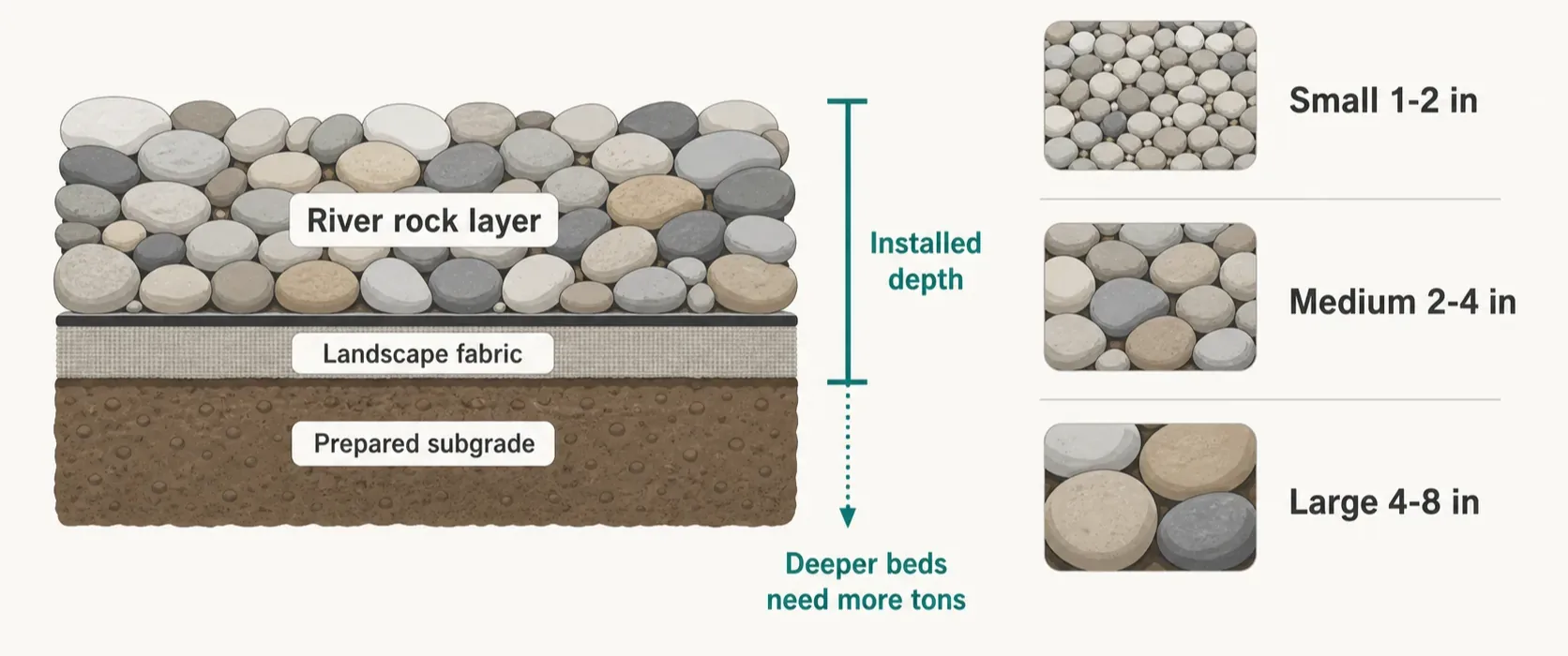
A decorative layer has one job the tonnage cannot tell you about: hiding the soil and the fabric underneath it. Because river rock is graded by diameter, the depth that covers a small grade leaves cobble looking sparse. Both views below are drawn to the same scale from the depth and the grade you entered.
Round stone is drawn as equal spheres in the tightest single layer it can form, which is the best case rather than a real delivery. A graded load has fines that fill some of what you see open here, and shapes that open up more.
Watch this
One course, so the fabric shows
3 in holds one course of 3 in stone. Packed as tightly as round stone will pack, a single course still leaves about 9% of the plan area open, and every one of those gaps looks straight down at the fabric. Go deeper, or drop to a smaller grade at the same depth.
A garden bed sits at 3 in here. Plants push stone aside all season and hands go in to weed, so the depth has to survive being disturbed rather than just look right on day one.
- Depth this page uses
- 3 inMatches the 3 in this calculator uses for a garden bed. That preset is a depth for planning material, and whether it covers is a question about the grade.
- Depth for two courses
- 6 inTwo typical stone diameters. An assumption drawn from the packing geometry, not a figure from a standard or a supplier.
- Largest stone in the grade
- 4 inDeeper than your bed, so the big end of Medium (2-4") will stand proud however carefully it is raked.
Yield per ton
River rock coverage per ton by grade
Bigger stone leaves bigger voids, so a ton of cobble reaches nowhere near as far as a ton of the small grade. The stone that needs the most depth is also the stone that covers the least, which is why the right hand column moves so much faster than the price list does.
Small (1-2")
Pathways, borders
60 sq ft/ton
$1.33
Medium (2-4")
Garden beds, mulch alternative
your grade50 sq ft/ton
$2.00
Large (4-8")
Water features, focal points
40 sq ft/ton
$3.00
Cobble (6-12")
Dry creek beds, edging
33 sq ft/ton
$4.50
Polished (1-3")
Premium decorative
57 sq ft/ton
$3.18
Bars redraw at the 3 in depth in the calculator. The per-ton coverage figures on this page are rated at 2 in and scale inversely with depth, so doubling the depth halves the reach of a ton. Cost per unit of ground is that coverage against the yard price for the grade, stone only.
Yard questions
River rock questions that come up before the truck
Nine answers in the order they tend to arrive, starting with the one the drawing above exists to settle.
How deep should river rock be?
Deep enough that a second course of stone sits over the gaps in the first, which means the bigger the grade the deeper the bed. This calculator uses 2 inches for ground cover and borders, 3 inches for garden beds and paths, and 4 inches for dry creek beds and pond edging. Set the depth against the stone size rather than picking one number for the whole property.
How much river rock per square foot?
At 2 inches deep, plan on about 25 to 30 lb per square foot. Add 10% for edges and uneven beds.
How much does a cubic yard weigh?
Most river rock weighs 2,500 to 2,700 lb per cubic yard. Smaller stone packs tighter than large cobble.
How deep for a dry creek bed?
Use 4 to 6 inches of larger cobble over fabric. Add a compacted gravel base if the channel will carry runoff.
Do I need edging?
Usually, yes. Edging keeps rounded stone from creeping into lawn, mulch, or pavement edges.
River rock vs pea gravel?
Use river rock for decorative beds and creek features. Use pea gravel when the surface needs to be smoother underfoot.
Can I put it directly on soil?
Avoid it. River rock settles into soil and weeds fill the gaps. Use woven landscape fabric first.
How is river rock delivered?
Small jobs can use bags or pickup. Once you pass 1 to 2 tons, dump delivery is usually safer and cheaper.
Need other stone types?
Use our Stone Calculator for crushed stone, lava rock, and other aggregates.
In the bed
River rock habits that keep a bed looking placed
Not a sequence, so not numbered. Each of these is a habit that separates a bed somebody laid from a bed somebody tipped.
Check the payload before you take a pickup to the yard. One cubic yard of river rock can weigh more than a half ton truck should carry, and the yard will load exactly what you ask for.
Put the edging in before the rock arrives. Rounded stone travels in a way angular stone does not, and retrofitting edging around a finished bed means lifting the stone twice.
For rock lined swales and dry creek beds, the NRCS home drainage guide recommends washed rock, a safe outlet, and non woven geotextile beneath the rock.
Hose the bed down after spreading. Quarry dust sits on every stone and hides the colour you paid for until it washes off.
Mix two grades deliberately rather than by accident. A coarse centre with a finer edge reads as placed; the same two grades stirred together reads as a delivery that went wrong.
If you already know the tonnage and want the area it covers, the Rock Coverage Calculator works that direction, and the Pea Gravel Calculator handles the small walkable grades.
Reorders
Six ways a river rock bed goes wrong
Every one of these is settled at the ordering stage or in the first hour of spreading. None of them is cheap to fix with the stone already down.
Spreading one stone thick to make the tonnage stretch
A single course of round stone leaves roughly a tenth of the ground in open sight lines no matter how carefully it is raked. Order for the depth or shrink the bed.
Using the same depth for every grade
Two inches that covers a 1 to 2 in grade leaves 6 to 12 in cobble looking sparse, because depth has to scale with the stone. Set the depth against the size, one bed at a time.
Laying stone straight onto soil
Round stone works its way down into bare soil and weeds come up through the gaps. Woven fabric first, seams overlapped, and pinned before any stone lands on it.
Leaving the bed flush with the lawn
Round stone rolls. Recess the bed below the surrounding grade or edge it, otherwise the first mow throws stone and the bed thins at every margin.
Ordering the exact figure with no allowance
A short order means a second delivery fee that can rival the stone. The waste allowance on this calculator exists for the low spots and the edges you cannot see from a tape measure.
Booking a truck before checking access
A dump truck needs room to turn and headroom to tip. No access means the whole load lands on the drive and moves by wheelbarrow, which is a different job entirely.
Bed build-up
Laying a river rock bed, in the order it happens
Numbered because the order is real. Each step is far cheaper to do in sequence than to come back to with stone already spread over it.
- 01
Cut the bed edge first, with a hose laid out on the ground for the curves. Everything after this step is easier to do than to redo.
- 02
Strip the sod and grade the base so it falls away from the house. The finished stone follows whatever shape you leave here.
- 03
Set the edging now, and recess the bed below the surrounding grade wherever stone could roll out onto a lawn or a path.
- 04
Roll the woven fabric with the seams overlapped and pinned. The calculator adds 10% to the bed area for that overlap.
- 05
Tip the stone in piles across the bed rather than in one heap, then rake out to depth. Check the depth with a stick, not by eye.
- 06
Hose the finished bed down to wash the quarry dust off, and walk the margins once more to pull any stone that ended up on the wrong side of the edging.
Bed to tons
How this river rock calculator gets from a bed to tons
Area times depth gives a volume, the waste allowance is added to that volume, and the bulk density for the grade turns it into weight. Cover area mode runs the same chain backwards from the tonnage you already have.
sq ft = length × widthcu ft = sq ft × depth ÷ 12cu yd = cu ft ÷ 27order = cu yd × (1 + waste)tons = order × densitycost = tons × price per tonfabric = sq ft × 1.10bags = ceil(cu ft × (1 + waste) ÷ 0.5)area = (tons ÷ density) × 27 ÷ (depth ÷ 12)Waste is applied to the volume, before the density, so it is a real allowance of stone rather than a rounding. The fabric figure adds 10% to the bed area for the seam overlap. Bag counts assume the 0.5 cu ft bags decorative stone usually comes in, and they are there to tell you when bagging stops making sense, not to recommend it. Cover area mode ignores the waste allowance, because the question it answers is what the stone already on the drive will reach.
Not included: edging, pins, base gravel under a channel, sod removal, disposal, delivery, or labour.
Bulk densities and yard prices vary by quarry, haul distance and how wet the pile is when it is loaded. Confirm both with your supplier before you commit an order.
Disclaimer
These estimates are for planning purposes only. Actual costs vary by location, material availability, and project complexity. Always get at least 3 local quotes. This calculator does not replace professional advice.
Sources
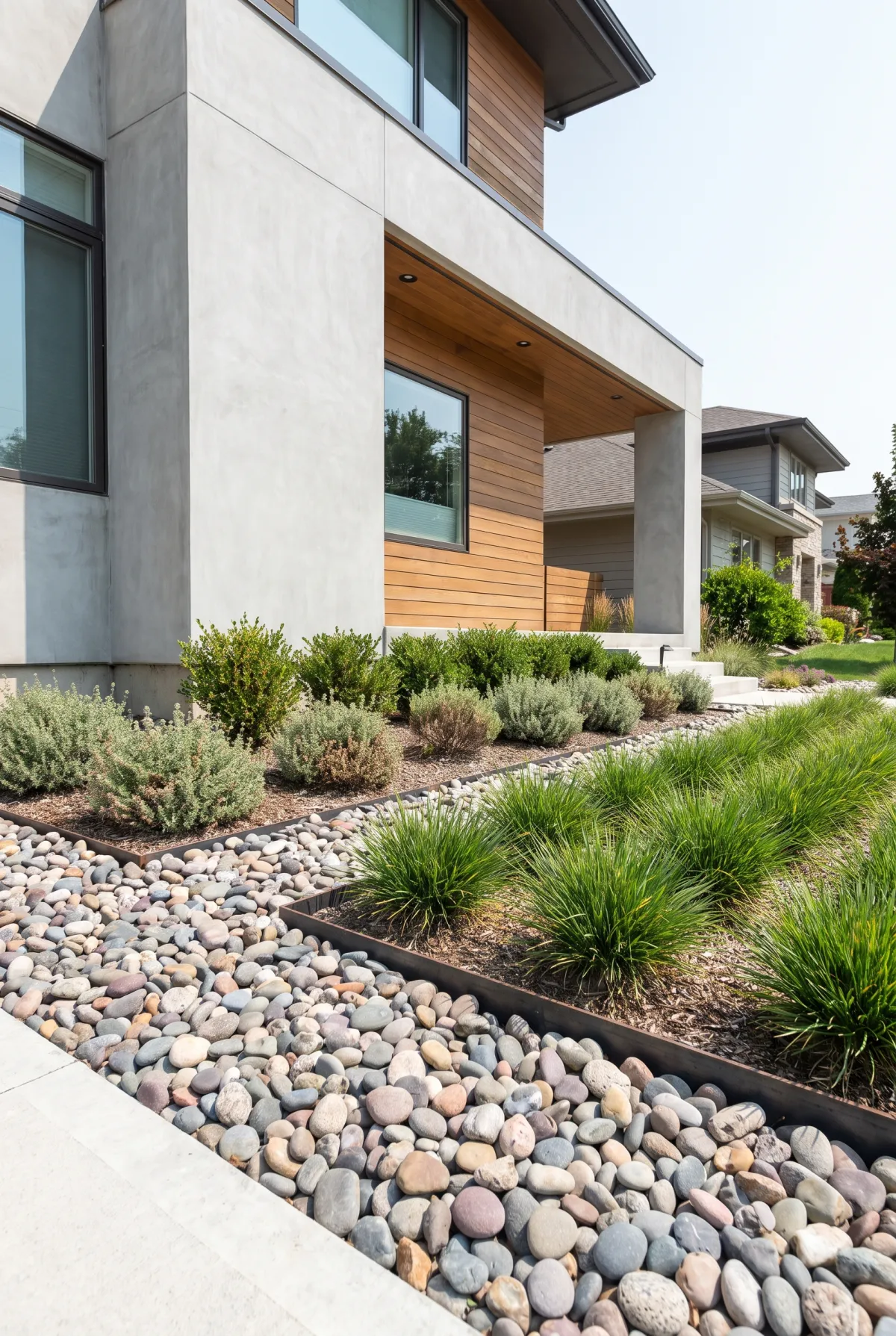
See 20 river rock landscaping ideas
Browse the looks, then price yours here.