Crushed Stone Calculator: #57, #411, 3/4", Stone Dust
Calculate tons, yards and cost by grade, and see which grade drains and which one compacts.
Stone bed
Common jobs
Length (ft)
Width (ft)
Depth (inches)
Grade
3/4" with fines
1.5 tons/yd³
Fines lock the stone into a tighter surface.
Estimates only. Not professional advice.
Crushed stone to order
4.9 tons
#411 dense grade over 480 sq ft at 2 in, with the 10% waste already in it.
- Loose volume
- 3.3 yd³
- Density used
- 1.5 tons/yd³
- Waste applied
- +10%
- Typical yard range
- $122 to $220
- Delivery
- 1 load at 15 tons
- Material at $36 per ton
- $176
Material only. Excavation, geotextile, compactor hire, delivery and labour are all separate, and yards set their own minimum load. Estimates, not professional advice.
Last updated August 11, 2026 by our expert review team.
Passing the No. 200
Which crushed stone grade drains, which one compacts, and why no grade does both
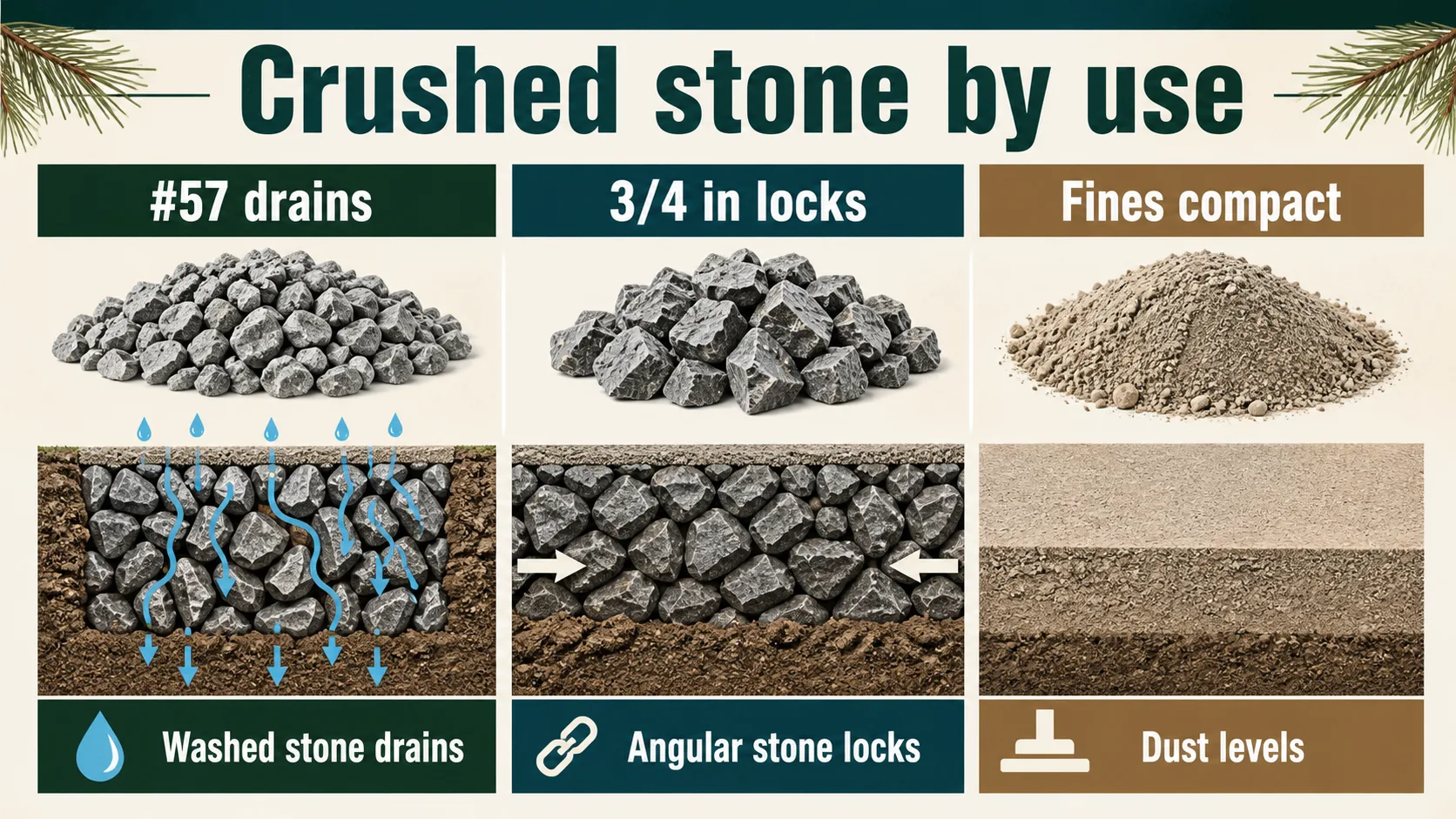
One number decides it, and it is not the nominal size. It is how much of the pile passes the No. 200 sieve. Under about 3 percent and the voids between the pieces stay open, so water leaves and nothing binds. Between 3 and 15 percent and those fines wedge into the voids under a compactor, so the surface locks and the water stays. Change the grade in the calculator and the section below moves with it.
Size numbers come from AASHTO M 43, which Ohio DOT's own aggregate section defers to. The 3 to 15 percent figure is the No. 200 limit that specification sets for item 411. Where nobody publishes a figure, this sheet says so.
What 411 is not
It is not an AASHTO size number, which is why you will never find it beside #57 and #2 on a gradation table. It is an Ohio DOT construction item number for stabilized crushed aggregate that the trade adopted as a product name, and yards outside that region sell the same material as crusher run, dense grade or #21A. The practical consequence is that a #57 pile is the same stone in every state and a "411" pile is not, so the number to confirm is the fines, not the name.
Your grade, read out
3 to 15%
passes the No. 200 sieve in #411 dense grade, which is what makes it a compacting stone that will not drain.
A dense-graded blend that runs from 1 1/2 in right down through the No. 200 sieve. The fines wedge into the voids under a plate compactor, which is what makes the surface lock and what makes it hold water.
What the ticket may say
The same pile is sold under all of these. Any of them should get you #411 dense grade.
- crusher run
- dense grade
- #21A
- ABC stone
If the yard is out
Crusher run or #21A. Same class of material under a different item number, so it compacts the same way.
At the scale house
Getting the crushed stone you meant to order
Not a sequence, so not numbered. Each one is a place where the grade on the ticket and the grade in the pile quietly stop being the same thing.
Order clean stone by asking for it washed, not by asking for a number. A yard that screens but does not wash still leaves enough dust on the stone to blind a drain in a season.
Where the surface has to carry tires, the fines are the point. A dense grade with 3 to 15 percent passing the No. 200 sieve locks up under a plate compactor; a washed stone of the identical nominal size never will.
Compact base stone in lifts of a few inches with the material damp. A thick single lift bridges in the middle and settles into ruts once traffic finds the soft spots.
Never let screenings into a trench drain. They are the finest thing the crusher makes, and they migrate into the voids of the stone around them.
Building a dense driveway base rather than picking a surface grade? The crusher run calculator covers depth by traffic and subgrade instead.
For rounded decorative gravel on a walked surface, the pea gravel calculator is the closer match.
Read the yard's own name back to them before the ticket is written. #57, 3/4 clean, washed stone and drainage stone overlap by region, and so do #411, crusher run and dense grade.
Grade by job
Every crushed stone grade in the dropdown, and the job it belongs to
Five grades, five different answers to the same question. Read the right-hand column first: once you know how much of the pile is fines, the job it suits follows on its own.
Nominal sizes are AASHTO M 43 bands, not single diameters: a #57 pile holds everything from a 1 in piece down to a No. 4 piece, which is why it interlocks at all.
Yards into tons
How this crushed stone calculator turns a bed into a weight
Length by width by depth gives a loose volume in cubic yards. The waste factor is applied to that volume, before the density, so it carries through to both the tonnage and the price. The grade only enters at the last step, as its density.
- 01AreaLength times width, in square feet. Metric entries are converted to feet first and converted back for display.
- 02Loose volumeArea times depth in feet, times one plus the waste factor. Divided by 27 for cubic yards.
- 03WeightCubic yards times the grade's density in tons per cubic yard. Tonnes are that figure times 0.907185.
- 04Cost and loadsWeight times your price per unit, and weight divided by the truck payload, rounded up to whole loads.
The one step worth arguing with is the density. A ton of stone is a ton whatever it is made of, but a cubic yard of it is not: the tighter a grade packs, the more weight sits in the same hole. That is why swapping #2 for screenings on the identical bed moves the order by roughly a quarter without a single dimension changing.
Every row is a constant this calculator uses. Nothing on this page assumes a density that is not one of them.
Coverage per ton
How far one ton of crushed stone goes, by grade and depth
Each cell is the area one ton covers, at the 10% waste factor currently set in the calculator. Change the waste and every figure here moves with it. Depth swamps the grade: going from 2 in to 12 in costs six times the stone, while the widest gap between grades is under a quarter.
Figures are sq ft per ton, from the same expression the readout uses: 27 divided by the density, divided by the depth in feet, divided by the waste multiplier. A denser grade covers less ground per unit of weight, which is why the screenings column is always the shortest.
Wrong pile, wrong job
What goes wrong with crushed stone, and it is almost always the grade
A drain that stopped draining and a surface that will not hold are the same mistake seen from two ends: a grade chosen by size when it should have been chosen by fines. None of these is fixable from the top once the stone is down.
Ordering by nominal size and ignoring the fines
Two piles both labelled 3/4 inch behave in opposite ways depending on whether they were washed. Ask "washed or minus" before the ticket is written.
Putting a clean stone where the surface has to hold
#57 will not bind. Use a dense grade for anything tires drive on, and save the clean stone for the layers water has to leave through.
Letting screenings near a drain
Fines migrate into the voids of the stone around them and the drain stops draining. Keep dust and dense grades out of the trench entirely.
Dumping the full depth in one lift
Spread and compact in lifts of a few inches with the material damp, or the middle of the layer never reaches density.
Stone straight onto soil with no separator
Without geotextile between them, soil pumps up into the stone and the stone sinks into the soil. Both layers stop doing their job.
Ordering the exact calculated figure
Edges, low spots, moisture and the material left in the truck bed all eat the margin. Ten percent is the practical floor.
Four tickets
Crushed stone by the job: driveway, drain, paver base, shed pad
The four quick jobs from the calculator, each at its own grade, depth, waste and price. Every figure comes out of the same arithmetic the readout runs, so any of them can be typed in for the identical answer.
Driveway top
4.9
tons
$176
- Bed
- 40 x 12 ft
- Depth
- 2 in
- Grade
- #411
- Area
- 480 sq ft
- Waste
- +10%
A dense grade, because the layer has to take tires. A washed stone of the same nominal size would shove sideways under the first turn.
Drain trench
5.7
tons
$217
- Bed
- 50 x 2 ft
- Depth
- 12 in
- Grade
- #57
- Area
- 100 sq ft
- Waste
- +10%
Clean #57 around the pipe. This is the one job on the list where the fines are the failure, not the fix.
Paver base
3.9
tons
$141
- Bed
- 16 x 12 ft
- Depth
- 4 in
- Grade
- #411
- Area
- 192 sq ft
- Waste
- +10%
Dense grade again, compacted in lifts, with the bedding sand kept as a separate layer above it.
Shed pad
2.4
tons
$91
- Bed
- 12 x 10 ft
- Depth
- 4 in
- Grade
- 3/4"
- Area
- 120 sq ft
- Waste
- +12%
3/4 inch angular, which is the grade you have to ask about: washed or minus changes what this pad does in the rain.
Yard questions
Crushed stone grades, answered: #57, #411, dust, tons, depth
Eight answers in the order the questions arrive at the scale house, starting with the one that sends people home with the wrong pile.
What do the crushed stone numbers actually mean?
The numbers with a standard behind them, like #57 and #2, are AASHTO M 43 size numbers: each one is a band of sieve sizes, not a single diameter. #411 is different. It is an Ohio DOT construction item number that the trade turned into a product name for dense-graded base.
Should I use #57 or #411?
Use #57 where water has to move, because it is washed and under 3 percent of it passes the No. 200 sieve. Use #411 where the surface has to hold under tires, because 3 to 15 percent of it passes that sieve and those fines are what lock it together.
What crushed stone is best for drainage?
A clean washed stone, usually #57 around a perforated pipe and #2 where a deeper, coarser bed is wanted. The point is the missing fines: the voids between the pieces stay open, so water moves through instead of sitting.
Does clean stone compact?
It settles and tightens slightly, then stops. There are no fines to wedge into the voids, so the pieces keep shifting past each other under load. That is why a clean stone driveway surface ruts and a dense-grade one does not.
Is stone dust the same as #411?
No. Stone dust is screenings, the fine material the crusher sieves out, with nothing larger in it. #411 is a graded blend that runs from about 1 1/2 inches all the way down through those fines, so it has the coarse skeleton screenings lack.
How many tons are in a cubic yard of crushed stone?
Roughly 1.3 to 1.6 tons per cubic yard. This calculator uses 1.4 for #57, 1.5 for #411, 1.45 for 3/4 inch angular, 1.6 for screenings and 1.3 for #2, and the denser the grade the fewer square feet a ton covers.
How deep should crushed stone be?
About 2 to 3 inches to refresh a driveway surface, 4 to 6 inches under pavers or a shed pad, and 6 to 12 inches for a trench drain or a base over soft ground. Depth drives the tonnage far harder than the grade does.
Can I order crushed stone by the cubic yard?
Some yards quote yards, but nearly all bulk deliveries are weighed and billed by the ton. This calculator shows both, so the volume you measured and the weight on the ticket can be checked against each other.
Disclaimer
These estimates are for planning purposes only. Actual costs vary by location, material availability, and project complexity. Always get at least 3 local quotes. This calculator does not replace professional advice.
Sources
- 01ODOT Item 703 Aggregate, gradation for item 411dot.state.oh.us
- 02ODOT Item 411 Stabilized Crushed Aggregatedot.state.oh.us
- 03FHWA Strength Characterization of Open-Graded Aggregatesfhwa.dot.gov
- 04FHWA Granular Base User Guidelinesfhwa.dot.gov
- 05Unilock Paver Base Installationunilock.com
- 06USGS Crushed Stone Mineral Commodity Summarypubs.usgs.gov
Related Calculators
Gravel Calculator
Any-project tons, yards, and bags
Crusher Run Calculator
Compacted base with fines
Pea Gravel Calculator
Round decorative gravel
Stone Calculator
Mixed landscape stone uses
Gravel Driveway Calculator
Layered driveway builds
Rip Rap Calculator
Large erosion-control stone
Tons to Cubic Yards Calculator
Convert tons to yd³ by material