Crusher Run Calculator
Estimate crusher run tons, cubic yards, and delivery loads for compacted base projects.
Base project
Quick presets
Cars, pickups, and delivery traffic
Crusher run to order
7.16 tons
Loose material for a 240 sq ft driveway base at 6 in compacted, with the 15% allowance already in it.
- Compacted base in place
- 4.44 cubic yards
- Weight before the allowance
- 6.22 tons
- Allowance applied
- +15%
- Spread depth before compaction
- 6.9 in
- Delivery
- 1 load at 15 tons
- Material at $35 per ton
- $250
Stone at 1.4 tons/yd³, material only. Excavation, subgrade repair, separator fabric, compactor hire, delivery charges and labour are all separate. Ask the quarry about payload limits and minimum delivery. Estimates only, not professional advice.
Last updated August 5, 2026 by our expert review team.
Fines and binding
Where crusher run belongs in a base, and what will not do its job
Crusher run is crushed stone that still has its fines in it. The fines fill the voids between the larger pieces, which is why it locks up under a compactor and why a washed stone of the same size never will. That single property decides every row below.
Because the fines are the point, crusher run has to go down damp and be compacted in shallow passes rather than dumped and driven over. It also has to sit on something firm: it cannot bridge soft organic soil, so topsoil comes off before any stone goes on.
Ask for it by name
The same material is sold under several names. Any of these will get you a compactable dense-grade aggregate.
- Crusher run
- ABC stone
- #21A
- #411
- Dense-grade base
Depth requirement
How deep a crusher run base has to be, and who decides that
Not you. The base has to spread a wheel load wide enough that the subgrade under it never sees more than it can carry, so the depth follows from two things: what will drive over it, and what is underneath. Set both in the calculator's options and your cell is marked below.
Every depth here is one of the nine figures this calculator's own traffic and subgrade option lists carry. It publishes no CBR value and no agency base table, because this repo holds neither.
Your base against it
6 in
required for cars & pickups on average ground. The depth you have set meets it exactly.
- Traffic
- Cars & pickups
- Subgrade
- Average
- Depth required
- 6 in
- Depth in the calculator
- 6 in
Separator fabric: optional. Firm, well-drained soil usually does not need a separator under the stone.
Why depth follows the ground
A wheel presses on a small patch of surface. By the time that pressure reaches the subgrade it has fanned out through the stone, and the deeper the base the wider the patch it lands on. Firm ground can take a narrow patch. Soft clay cannot, so it needs more stone above it to spread the same load further before it arrives.
Yard tickets
Four crusher run orders, from a walkway pad to a parking pad
The four quick presets, each at its own depth and allowance, priced at $35 per ton and at 1.4 tons/yd³. Every figure comes out of the same arithmetic the calculator runs, so you can type any of them in and get the identical answer.
Driveway section
7.16
tons
$250
- Pad
- 20 × 12 ft
- Area
- 240 sq ft
- Spec
- 6 in compacted, 15% allowance
- Loose
- 5.11 cubic yards
A small delivery is often priced as a minimum load, so call the quarry before ordering just 7.16 tons.
Paver base
8.94
tons
$313
- Pad
- 20 × 15 ft
- Area
- 300 sq ft
- Spec
- 6 in compacted, 15% allowance
- Loose
- 6.39 cubic yards
Aggregate base only. Bedding sand and the pavers themselves are separate layers on top.
Shed pad
2.32
tons
$81
- Pad
- 12 × 10 ft
- Area
- 120 sq ft
- Spec
- 4 in compacted, 12% allowance
- Loose
- 1.66 cubic yards
Extend the base past the shed footprint so roof runoff does not erode the edge.
Parking pad
16.59
tons
$581
- Pad
- 20 × 20 ft
- Area
- 400 sq ft
- Spec
- 8 in compacted, 20% allowance
- Loose
- 11.85 cubic yards
The 20% allowance here is the heavy-pad setting, because a thicker base over soft ground loses more to compaction.
Moisture and edges
Getting crusher run to lock up instead of staying loose
Not a sequence, so not numbered. Each one is the difference between a base that holds grade and a pile of stone that happens to be the right size.
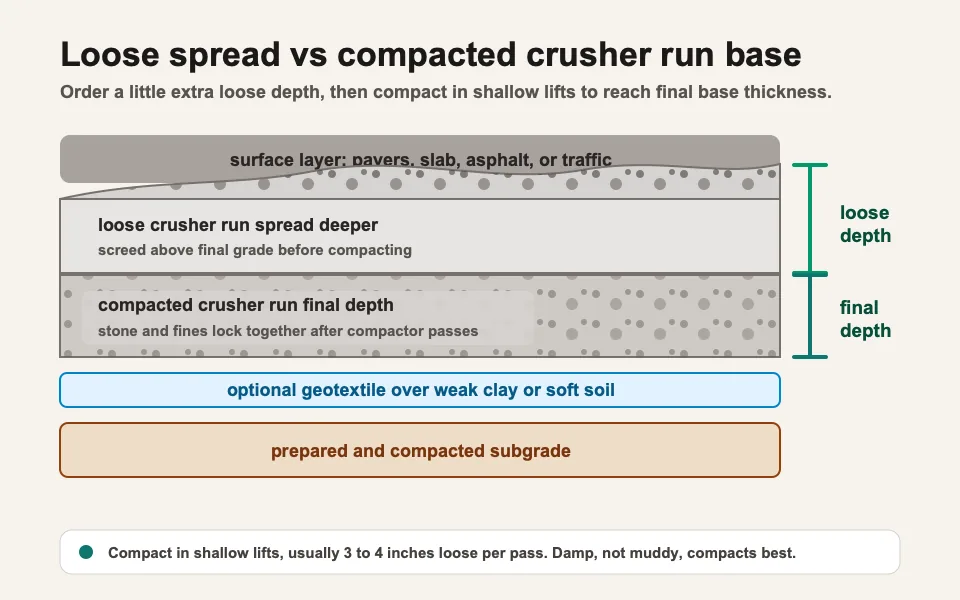
Order for the loose material you need delivered, not only the compacted volume. Crusher run with fines tightens up under a plate compactor.
Build driveway and paver bases in lifts. Spread 3 in to 4 in loose, mist it damp, compact it, then place the next lift.
Strip topsoil before placing base material. Crusher run cannot bridge soft organic soil, and the finished surface will settle.
For pavers, crusher run is the structural base. Keep the bedding sand separate and hold it to about 1 in after screeding.
For full driveway builds with surface stone, compare this base estimate with the gravel driveway calculator.
If your supplier quotes recycled concrete instead, use the crushed concrete calculator to compare weight and cost.
Tons per yard
Crusher run tonnage, one step at a time
Area times compacted depth gives the finished volume. The allowance turns that into the loose volume a truck has to bring, and the density turns loose volume into the weight the quarry actually bills you for.
compacted yd³ = length × width × (depth ÷ 12) ÷ 27loose yd³ = compacted yd³ × (1 + allowance)order tons = loose yd³ × densityloads = ceil(order tons ÷ truck payload)cost = order tons × price per tonThe allowance is applied to the volume, before the density, so it carries through to both tons and cost. In reverse mode the same chain runs backwards: the weight you already have becomes a loose volume, the allowance comes back out of it, and the compacted volume is divided by your depth to give an area.
Every row is a constant the calculator itself uses. Nothing on this page assumes a figure that is not one of them.
Pumping and rutting
What a crusher run base fails from, and it is rarely the stone
A rutted base almost never means the wrong material arrived. It means the order, the ground under it, or the compaction was wrong, and none of those is fixable from the surface afterwards.
Ordering finished volume only
Add 10 to 20% so loose material reaches the planned depth after compaction.
Skipping compaction
Driving over the pile is not enough. Use a plate compactor or roller in thin lifts.
Confusing clean stone with crusher run
Clean #57 drains well but does not bind like dense-grade crusher run with fines.
Ignoring the delivery load
Small orders may trigger minimum fees, and large loads may exceed driveway or street limits.
Placing it on topsoil
Remove soft organic material and compact the subgrade before the base goes down.
Using it as bedding sand
For pavers, keep crusher run below the bedding layer. Screed sand or fine chip on top.
Common mix-ups
Crusher run, answered: gravel, tons, pavers, allowance
Six answers in the order the questions tend to arrive, starting with the one that sends people home with the wrong stone.
Is crusher run the same as decorative gravel?
No. Crusher run is a compactable base mix with crushed stone and fines. Decorative gravel is usually washed or rounded, so it does not lock together the same way.
How deep should crusher run be for a driveway?
Use 4 inches compacted for light car traffic on firm soil, 6 inches for normal residential driveways, and 8 inches or more for trailers, RVs, or weak subgrade.
How many tons are in a cubic yard of crusher run?
A practical planning value is 1.35 to 1.45 tons per cubic yard. This calculator defaults to 1.4 tons per cubic yard and lets you change it in advanced options.
Should I order tons or cubic yards?
Most quarries sell crusher run by the ton. Cubic yards help you visualize volume, but the final order is usually tons plus a compaction allowance.
Can crusher run go under pavers?
Yes for a traditional dense-grade paver base. Compact it in lifts, then add a separate 1 inch bedding layer of sand or fine chip before laying pavers.
Why add a compaction allowance?
The loose load settles as fines fill voids between larger stone. If you order only the finished compacted volume, you can come up short before reaching grade.
Coverage per ton
How far a ton of crusher run goes at each base depth
Every cell is the area one ton covers, at the four depth presets and the three stock densities, using the 15% allowance currently set in the calculator. Change the allowance and the whole table moves with it.
Figures are sq ft per ton. A denser stone covers less ground per unit of weight, which is why the recycled column reaches furthest and the limestone column least.
Disclaimer
These estimates are for planning purposes only. Actual costs vary by location, material availability, and project complexity. Always get at least 3 local quotes. This calculator does not replace professional advice.
Sources