Concrete Slab Calculator
Calculate cubic yards, bags, and cost for patios, driveways, garage floors, and sidewalks.
Slab Details
What are you pouring?
Order check
Measure inside the form boards, not the outside. Confirm screed depth, waste allowance and whether your supplier charges a short-load fee before you book.
Estimates only. Not professional advice.
Concrete to order
2.72yd³
73.33 cu ft of standard mix, including your 10% waste allowance.
- Rebar on a 12 in grid
- 430 linear ft
- Wire mesh, 5 × 10 ft sheets
- 4
- Slab weight
- 11,000 lbs (5.5 tons)
Installed cost
- Material (Standard Mix)
- $340 – $407
- Delivery (ready-mix)
- $75 – $150
- Sub-base prep ($1–$2/sq ft)
- $200 – $400
- Total (DIY)
- $3.08 – $4.79 per sq ft
- $615 – $957
Last updated June 2026. Reviewed against ACI 318 and ASTM C94 by our expert review team.
Volume · form boards to yards
Concrete slab volume: from form boards to cubic yards
A slab is ordered by volume, not by area. The inside dimensions of your form boards and the finished screed depth are the only three numbers that matter, and this is what happens to them.
20 × 10 ft at 4 in is 73.33 cu ft, ordered as 2.72 yd³ once your 10% allowance is added. The section is drawn exaggerated so the thickness can carry a label.
Slab spec sheet
ACI 318 · ASTM C94 · IRC R402
- Patio, walkway, shed
- 4 in
- Driveway, garage
- 6 in
- Equipment pad
- 8 in
- Control joints
- 8–10 ft
- One cubic yard
- 27 cu ft
- 80 lb bag yields
- 0.6 cu ft
- 60 lb bag yields
- 0.45 cu ft
- Ready-mix drum
- 10 yd³
What the yardage leaves out
What the cubic yards figure leaves out
Volume tells you what to order. It does not tell you how much steel to buy, how much the finished slab weighs on your subgrade, or how long you are kept off it. These are the rest of the figures for your pour.
Order sheet
- Slab area
- 200 sq ft
- Screed depth
- 4 in
- Waste allowance
- 10%
- Volume to order
- 2.72 yd³
- Ready-mix loads
- 1
Steel and weight
- Rebar, 12 in grid
- 430 linear ft
- Wire mesh sheets
- 4
- Slab weight
- 11,000 lbs
- In tons
- 5.5 tons
After the pour
- Keep it moist
- 7 days
- Foot traffic
- 24–48 hr
- Vehicle traffic
- 7 days
- Full design strength
- 28 days
Before the truck
Habits that keep a concrete slab flat and crack-free
These are settled before the truck arrives, not after. Nothing on this list is optional on a slab you expect to still be flat in ten years.
Order 10% extra concrete. You can't stop a pour to get more, and a short load means a cold joint that weakens the slab permanently.
For slabs over 2 cubic yards, order ready-mix instead of bags. A 10x10x4" slab takes about 50 bags (80lb) vs. one quick pour from a truck. Use our concrete bags calculator for small pours.
Need to know the weight? Our concrete weight calculator converts volume to lbs, tons, and kg for transport and structural planning.
Place control joints every 8 to 10 feet in each direction. Without them, the slab will crack randomly. Cut joints to one-quarter the slab thickness.
Cure concrete for at least 7 days by keeping it moist. Cover with plastic sheeting or spray with curing compound. Proper curing adds 50% to final strength.
For driveways, use 4,000 PSI concrete minimum with 6-inch thickness. Standard 3,000 PSI at 4 inches is fine for patios and walkways.
Need exact rebar quantities? Our concrete rebar calculator estimates sticks, linear feet, and weight by bar size and spacing.
For patio-specific estimates with finish options, use our concrete patio calculator.
Use our concrete cost calculator for a detailed breakdown of material, labor, and finishing costs.
Building a pool? Use our pool volume calculator to estimate water volume, fill time, and chemical needs.
Grade the sub-base with compacted gravel before pouring. 4 inches of crushed stone provides drainage and prevents frost heave. Our crusher run calculator estimates base material.
Method
How we calculate slab volume, bags, and steel
Thickness converts to feet, then volume is area times depth with your waste allowance applied before anything else. Bag counts and cost are both taken from that waste-inclusive volume, so the number you see is the number to order.
cu ft = L × W × (t ÷ 12) × (1 + waste)yd³ = cu ft ÷ 2780 lb bags = cu ft ÷ 0.660 lb bags = cu ft ÷ 0.45rebar = rows × L + cols × Wweight = yd³ × 4,050 lbRebar assumes a 12 in grid both ways and wire mesh assumes 5 by 10 sheets. Forming lumber, vapor barrier, sealer, permits and pumping are not included. Confirm quantities with your supplier before ordering.
Under the slab
Base prep, vapor barrier, and control joints under a slab
Plan the slab, base, joints, and delivery method before concrete arrives. These choices decide cracking, drainage, and whether bags are still practical.
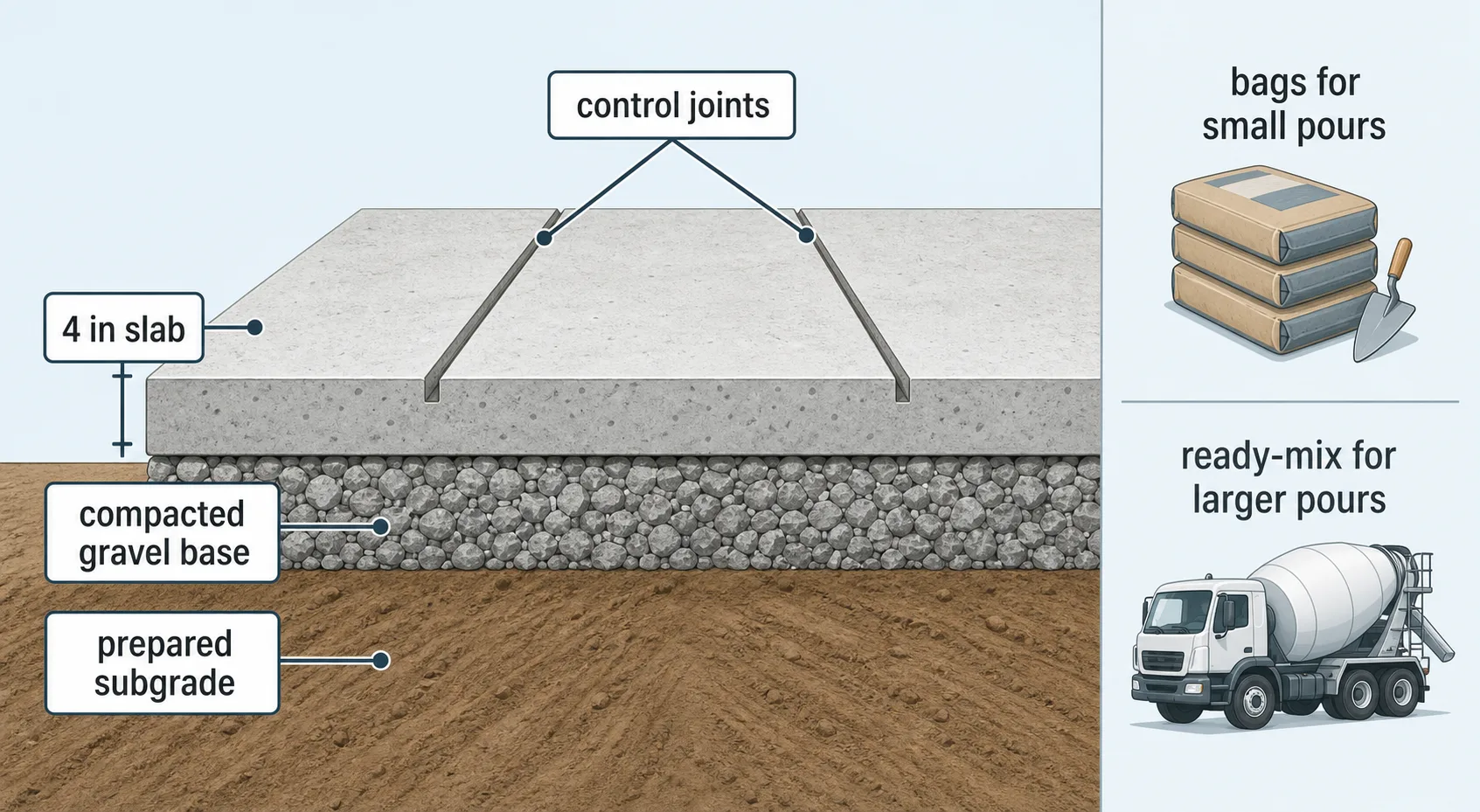
A compacted base and planned control joints matter as much as the cubic yards. Use bags for small pours and schedule ready-mix once volume or working time gets too large.
Asked on site
Answers on concrete slab thickness, curing, and ordering
The nine questions people actually ask before a pour, answered against the same standards this calculator uses.
How many bags of concrete for a 10x10 slab?
A 10x10 slab at 4 inches thick needs about 1.23 cu yd or 56 bags of 80lb concrete. With 10% waste, order 62 bags.
How thick should a concrete slab be?
4 inches for patios, walkways, and shed floors. 6 inches for driveways and garage floors. 8 inches for heavy equipment pads.
Do I need gravel under a concrete slab?
Yes for most exterior slabs. A compacted 4 inch gravel base helps drainage, reduces frost heave risk, and gives the slab a stable surface.
Do I need rebar or wire mesh?
Wire mesh (6x6 W1.4) is standard for 4-inch slabs. Use #4 rebar on 12-inch centers for driveways, garage floors, and any slab over 5 inches thick.
How much does a concrete slab cost?
$125 to $250 per cubic yard for ready-mix depending on mix type. A 20x10 patio at 4 inches takes 2.72 cubic yards with 10% waste, so about $340 to $410 in concrete alone.
When should I use ready-mix vs. bags?
Use bags for pours under 1 cubic yard (about 45 bags of 80lb). Above that, ready-mix is faster, cheaper per yard, and gives a more consistent mix.
How long does concrete take to cure?
24 to 48 hours for foot traffic, 7 days for vehicle traffic, 28 days for full strength. Keep the surface moist during curing.
Can I pour concrete in cold weather?
Not below 40 degrees F without precautions. Use hot water in the mix, insulating blankets, and avoid freezing for 48 hours. Cold pours below 25 degrees F will fail.
What is a cold joint and how do I avoid it?
A cold joint forms when fresh concrete meets partially cured concrete. Avoid by pouring continuously, having enough help, and ordering enough material to finish without stopping.
Four pours, measured
Four common slab pours and the yardage each takes
Each one is this calculator run at 10% waste, so the volume shown is already the volume to order. Only size, depth, and mix change between them.
Patio · 12 × 10 ft, 4 in
1.63 yd³
74 bags of 80 lb
A standard backyard patio on standard mix. Budget $204 to $244 for the concrete alone.
Driveway · 20 × 12 ft, 6 in
4.89 yd³
1 ready-mix load
Two-car driveway section on 4,000 PSI high-strength mix. Budget $684 to $831.
Garage · 24 × 24 ft, 6 in
11.73 yd³
2 ready-mix loads
Full two-car garage floor. Needs rebar on 12 in centers, about 1,200 linear ft. Budget $1,643 to $1,995.
Sidewalk · 40 × 4 ft, 4 in
2.17 yd³
98 bags of 80 lb
Front walkway on standard mix. Control joints every 4 ft for a clean look. Budget $272 to $326.
How slabs fail
Five ways a concrete slab fails after the truck leaves
Every one of these is decided on pour day or the week after it, and every one of them shows up as a crack, a dusting surface, or a slab that has moved.
Pouring on bare dirt
Water collects under the slab, freezes, and heaves it until it cracks.
Lay 4 inches of compacted gravel base for drainage and a stable bearing surface, more on clay.
Ordering the exact amount
Running short mid-pour creates a cold joint that permanently weakens the slab.
Add 10% for waste, uneven ground, and spillage. On a bagged pour, buy the extra bags and return them.
Using the wrong thickness for the application
A 4-inch driveway cracks under vehicle weight within a year.
4 inches for patios and walkways, 6 inches with reinforcement for driveways and garage floors.
Skipping control joints
Concrete will crack. Without joints it cracks randomly across the surface.
Cut joints every 8 to 10 feet in each direction, one quarter of the slab thickness deep.
Not curing properly
Drying too fast leaves a weak surface that dusts and flakes off.
Keep it moist for 7 days with plastic sheeting or curing compound. Curing adds about 50% to final strength.
Mix pricing
Concrete slab cost per cubic yard by mix type
Every range sits on one shared scale, so you can see how far a stronger or decorative mix moves the number instead of reading four separate figures.
Ready-mix delivery prices per yd³, before the $75 to $150 delivery charge. Bags cost more per yd³ but stay practical under about one yd³.
Reading these
Standard Mix is highlighted because it is your current selection. High-strength mix costs about 12% more than standard and is the one upgrade worth taking on anything that carries a vehicle.
Stamped mix costs roughly 50% more per yd³ than standard. On your 2.72 yd³ that is $150 to $272 more, before the stamping labour and the resealing it wants every two to three years.
Cutaway · the real decision
Ready-mix or bags for a concrete slab
Under about 1.5 cubic yards, bags stay practical and you skip the delivery fee. Above that, a delivered truck places faster, mixes more consistently, and usually costs less per yard. This is your pour on both routes.
Bagged, mixed on site
- 80 lb bags
- 123
- Bag cost
- $800
- Mixing time
- 10h 15m
- Delivery
- none
Ready-mix, delivered
your pour- Truck loads
- 1
- With delivery
- $415 – $557
- Placing time
- one pour
- Delivery
- $75 – $150
Your pour is over 1.5 cu yd at 2.72 cu yd, so book the truck. Have the forms, base and screed crew ready before it arrives.
Disclaimer
These estimates are for planning purposes only. Actual costs vary by location, material availability, and project complexity. Always get at least 3 local quotes. This calculator does not replace professional advice.
Sources