Asphalt Calculator
Calculate hot mix tons, lifts, truckloads and installed cost for a driveway or parking pad.
Paving Area
Standard Hot Mix to order
6.38tons
Enough hot mix for 2 in compacted, laid in 1 lift. Your 10% allowance is already in it.
- Hot mix at $100 to $150 per ton
- $638 – $957
- Paving labour at $2 to $5 per sq ft
- $960 – $2,400
- Installed, material and labour
- $1,598 – $3,357
Estimates only. Not professional advice.
Last updated August 2026. Reviewed against Asphalt Institute and NAPA laydown guidance by our expert review team.
Lift stack
Asphalt lifts: why a 6 inch driveway is two passes
Asphalt is bought by weight and laid by depth, and a roller can only reach so far down. Past about 3 in the bottom of the mat never gets compacted, so the depth you entered is split into courses and each one is rolled before the next goes on.
Every labelled depth is drawn to the one vertical scale marked at the left; the width of the section is not a dimension. Rolling changes the depth, not the weight, so the tonnage above is bought against the compacted figure and the screed is set to the loose one.
Lift schedule
Standard Hot Mix · 145 lb/cu ft
| Course | Compactedin | Loose screedin | Weighttons | Loads20 tons each |
|---|---|---|---|---|
| Lift 1 | 2 | 2.5 | 6.38 | 1 |
2 in divides into 1 legal course of 2 in, which carries a mix up to 1/2 in stone. One course means one continuous mat, so nothing has to wait between passes.
What bounds a lift
- Thickest, compacted
- 3 in
- Loose over compacted
- × 1.25
- 3/8 in mix, thinnest lift
- 1.13 in
- 1/2 in mix, thinnest lift
- 1.5 in
- 3/4 in mix, thinnest lift
- 2.25 in
The thinnest lift is 3 times the mix’s largest stone, which is why a thin course cannot simply be feathered out.
Pavement distress
Where asphalt driveways fail, and what the fix costs
None of these show up on pave day. They show up the following spring, and every one of them was decided in the hour the mat went down.
Asking for the whole depth in one pass
Past about 3 in the roller cannot reach the bottom of the mat, so the lower half stays loose under a hard skin.
Split the depth into courses of 3 in or less and roll each one before the next goes on. The lift schedule above shows how yours divides.
Feathering a thin edge into old asphalt
A course under 1.13 in is thinner than three stones deep, so it ravels away from the edge inside a season.
Saw a clean vertical butt joint, mill out to full lift depth and pave up to it. Tack the cut face before the mix touches it.
Paving straight onto graded dirt
Asphalt is flexible. It carries load by spreading it, and it needs something stiff underneath to spread it into.
Lay 6 to 8 inches of compacted gravel first, in lifts of its own. Tick the sub-base option in the calculator to price it.
Paving below 50 degrees F, or on a falling thermometer
Cold ground pulls heat out of the bottom of the mat, so it stiffens before the roller has finished with it.
Pave when the air is above 50 degrees and rising. A thicker lift holds heat longer, which is one reason 2 inch overlays are the fussiest work of the year.
Ordering the exact tonnage
Running out mid-lift means the mat stops, cools and gets a cold joint through the middle of the driveway.
Keep the 10% allowance the calculator applies by default, and have the last load on site before the crew starts the final course.
Mix and tonnage
What asphalt costs per ton, and how density changes the bill
A mix is quoted by weight but bought to fill a depth, so the lighter mix needs fewer tons to cover the same driveway. The last column prices the same patch of paving in each mix, which is the only comparison that settles it.
| Mix | lb/cu ft | $ / ton | tons / 100 sq ft | $ / 100 sq ft |
|---|---|---|---|---|
| Standard Hot Mixyour mix | 145 | $100 – $150 | 1.21 | $121 – $181 |
| Polymer Modified | 145 | $130 – $200 | 1.21 | $157 – $242 |
| Porous/Permeable | 130 | $150 – $250 | 1.08 | $163 – $271 |
| Recycled Asphalt (RAP) | 140 | $40 – $80 | 1.17 | $47 – $93 |
The last two columns are priced at a compacted 2 in mat. Delivered material only, before any waste allowance. Placement labour adds $2 to $5 per sq ft on top, whichever mix you pick.
Pavement section
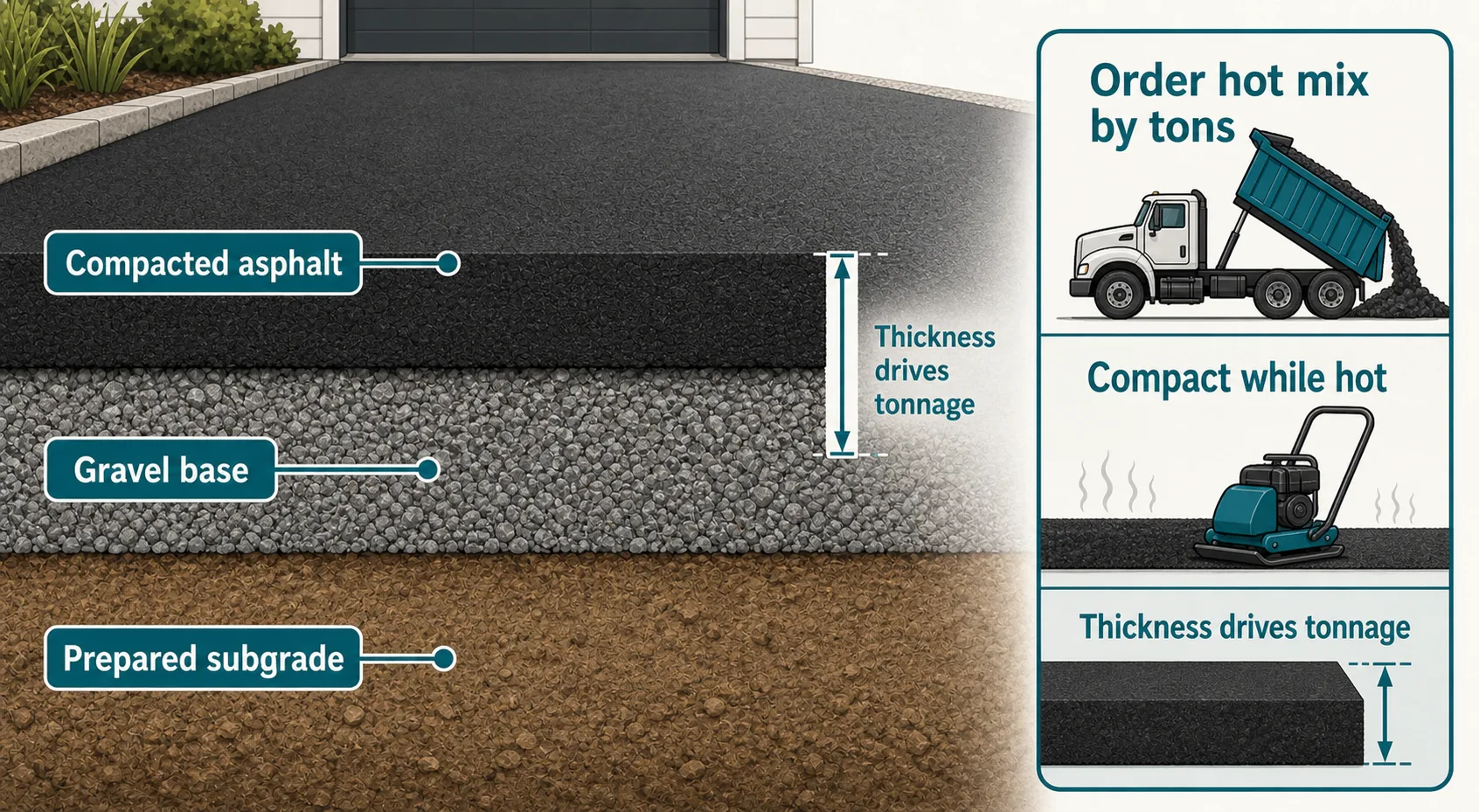
Laydown and rolling
Getting asphalt down before it goes cold
Hot mix has one workable window and it closes on its own schedule. These are the things worth settling with the crew before the first truck backs in.
Order every lift for the same day. A mat that is left overnight has to be tack coated again before the next course goes on, and the joint between them is the first thing to open up.
Tack coat between lifts, and against every vertical edge you are paving up to. Two lifts without tack behave like two separate slabs sliding on each other.
Roll the mat while it is still hot, starting at the low edge and working uphill. Once the surface has stiffened, more rolling only polishes it, it no longer closes the voids.
Get the base in first. Our crusher run calculator sizes the compacted gravel layer that the asphalt depth above is designed to sit on.
Keep the pave day above 50 degrees F with the temperature rising, not falling. Cold ground pulls heat out of the bottom of the mat before the roller reaches it.
Sealer goes on 6 to 12 months after paving, once the mix has cured, then every 2 to 3 years after that. Sealing too early traps the oils that are still leaving the surface.
Still choosing a surface? Our asphalt vs concrete calculator puts the two side by side over the life of a driveway.
Pricing the concrete version too? Our concrete driveway cost calculator breaks out material, labour and finishing.
Edges hold a mat together. Our concrete curb calculator estimates a poured border or mow strip along the paving.
Sealer schedule for new asphalt
Quantities only
- First coat, after paving
- 6 to 12 months
- Then reseal every
- 2 to 3 years
- Coverage, one coat
- 1 gal per 80 sq ft
- Your 480 sq ft, one coat
- 6 gal
Worked tonnage
Asphalt tonnage for four jobs, from resurfacing to a parking pad
Standard hot mix in every one, with the same 10% allowance this calculator applies by default, so the only things changing are area and depth.
Resurfacing · 40 × 12 ft at 2 in
6.38 tons
1 lift · 1 load · $1,598–$3,357 installed
Overlay on old asphalt that is still sound underneath. The fussiest lift of the four: a 2 in mat loses heat fast, so it is a morning job.
New driveway · 40 × 12 ft at 3 in
9.57 tons
1 lift · 1 load · $1,917–$3,836 installed
The usual single-car build over a compacted gravel base. Still one course, because 3 in is exactly the roller's reach.
Double width · 40 × 20 ft at 3 in
15.95 tons
1 lift · 1 load · $3,195–$6,393 installed
Two cars side by side. Twice the tonnage of the single build and still inside one truck, which is why width is the cheapest thing to add here.
Parking pad · 60 × 40 ft at 4 in
63.8 tons
2 lifts · 4 loads · $11,180–$21,570 installed
Eight to ten spaces. Two courses at 2 in each, and the load count is what decides whether it is a one-day pave.
Before you order
What homeowners ask before paving an asphalt driveway
The questions that come up between the first quote and the pave date, answered against the same densities and rates this calculator runs on.
How many tons of asphalt per square foot?
About 0.0125 tons (25 lbs) per sq ft at 2 inches thick. A 480 sq ft driveway needs about 6 tons.
How thick should an asphalt driveway be?
2 to 3 inches for resurfacing. 3 to 4 inches over gravel base for new residential driveways. 6+ inches for commercial parking lots.
Why is a 6 inch driveway paved in two lifts?
A roller can only compact about 3 inches of hot mix at a time. Any deeper and the bottom of the mat stays loose, so the depth is split into two courses and each one is rolled before the next goes down.
How much does asphalt cost per ton?
$100 to $150 per ton for standard hot mix delivered. Polymer modified costs $130 to $200. Recycled asphalt (RAP) is cheapest at $40 to $80.
How much does an asphalt driveway cost?
$3 to $7 per sq ft installed. A 12x40 (480 sq ft) driveway costs $1,440 to $3,360 total including labor.
How long does asphalt last?
15 to 20 years with proper maintenance (sealcoating every 2 to 3 years). Without sealcoat, expect 10 to 12 years.
When should I sealcoat new asphalt?
Wait 6 to 12 months after installation for the asphalt to cure fully. Then sealcoat every 2 to 3 years.
Is recycled asphalt any good?
RAP works well for driveways and rural roads at 40 to 60% less cost. It is not suitable for high-traffic commercial lots or roads with heavy trucks.
What is the difference between asphalt and blacktop?
Asphalt uses a coarser aggregate mix and is stronger. Blacktop uses finer stone and more tar, making it smoother but less durable. Both are petroleum-based.
Structural depth
How thick should asphalt be, and how many lifts
Depth is set by what drives on the pavement, and the lift count follows from the depth on its own. The coverage column is worked out from the same 145 lb per cubic foot the calculator uses, before any waste allowance.
| What it carries | Compacted depth (in) | Lifts | Sq ft per ton |
|---|---|---|---|
| Overlay on sound existing asphalt | 2 | 1 | 83 |
| New residential driveway over gravel base | 3 | 1 | 55 |
| Driveway with regular truck, trailer or RV use | 4 | 2 | 41 |
| Commercial lot with delivery traffic | 6 | 2 | 28 |
Porous and recycled mixes are lighter than standard hot mix, so they cover slightly more ground per ton. Local frost depth and subgrade quality can push any of these rows deeper.
The arithmetic
How this asphalt calculator converts depth to tons
Nothing here is proprietary. Volume from your dimensions, weight from the mix density, tons from the weight, and the lift count from the depth alone.
cu ft = L × W × (t ÷ 12) × (1 + waste)lbs = cu ft × 145tons = lbs ÷ 2,000loads = ⌈tons ÷ 20⌉lifts = ⌈t ÷ 3⌉loose = compacted × 1.25sealer gal = area ÷ 80The density figure changes with the mix you pick: 145 lb per cubic foot for standard and polymer modified, 140 for recycled, 130 for porous. That figure is an in-place compacted density, which is why rolling the mat down by 20 to 25% does not change the tonnage you order. Installed cost adds placement labour at $2 to $5 per sq ft. Permits, drainage, milling, striping and difficult site access are not included.
Disclaimer
These estimates are for planning purposes only. Actual costs vary by location, material availability, and project complexity. Always get at least 3 local quotes. This calculator does not replace professional advice.
Sources