Crushed Concrete Calculator
Estimate recycled concrete aggregate for a driveway, shed, slab, or parking-pad base.
Base Dimensions
What is it under
Compacted base under asphalt, concrete, or gravel.
Fines help it lock up under compaction. Changing the grade redraws the gradation plate below.
Before you order
Confirm the grade by name, ask whether the yard sells by scale weight, and check access for a loaded truck.
Estimates only. Not professional advice.
tons to order
5.50tons
3/4" minus RCA at 6 in compacted, placed in 2 lifts. One local dump truck delivery.
- 3/4" minus RCA at $18/ton
- $99
- Overage allowance, 10%
- 0.37 yd³
- Delivery, dump fee, and spreading
- Not included
- Material per sq ft of base
- $0.49
Placement plan
- Lift 1 off the subgrade
- 3 in compacted
- Lift 2, finish grade
- 3 in compacted
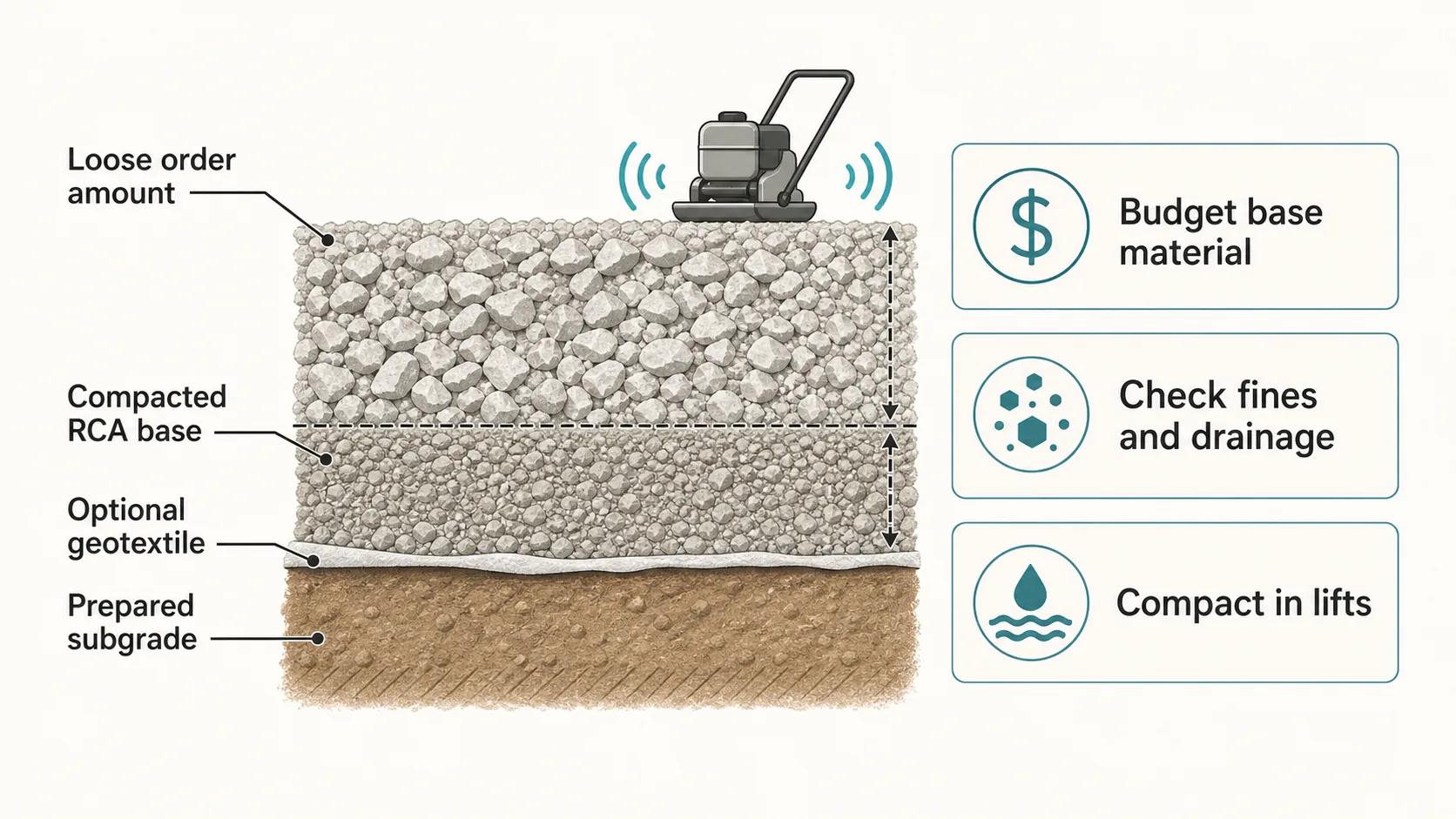
Compact each lift before the next goes down, and wet the fines first.
Last updated August 5, 2026. Reviewed against FHWA and MnDOT recycled aggregate guidance by our expert review team.
Gradation
Crushed concrete gradation, and the lift each grade belongs in
Grade is the decision this page exists for. Both figures below are drawn at one scale, so the pieces in a washed 2 to 3 in load appear beside your own lift at true size. That comparison is why clean RCA will not compact and minus RCA will.
Your grade sits in the top lift. It is the default base grade and packs tight under a plate.
Grade in the plate
- Grade
- 3/4" minus RCA
- Screened to
- 3/4 in down to dust
- Fines
- Yes, down to dust
- Belongs in
- top lift
- Planning density
- 1.35 tons/yd³
- Yard price
- $18 per ton
- Lifts at your depth
- 2 × 3 in
Loads delivered
Three crushed concrete bases, priced by the load
Every figure here runs through the same density and the same 10% overage the calculator uses, so these are the numbers you would get by typing the dimensions in. Material only, at yard prices.
Driveway base
13.2 tons
- Base
- 40 × 12 ft, 6 in compacted
- Grade
- 3/4" minus RCA
- Loose volume
- 9.78 yd³
- Material
- $238
One dump load. Compact it in two lifts and crown it before the surface goes on.
Shed or slab pad
3.52 tons
- Base
- 12 × 16 ft, 4 in compacted
- Grade
- 3/4" minus RCA
- Loose volume
- 2.61 yd³
- Material
- $63
A cheap base once something covers it. Add fabric over clay or disturbed fill.
Parking pad
16.95 tons
- Base
- 24 × 20 ft, 8 in compacted
- Grade
- 1-1/2" minus RCA
- Loose volume
- 13.04 yd³
- Material
- $254
Near a full load. Confirm truck access, and place it damp so the fines bind.
Lifts and subgrade
How to build a crushed concrete base, lift by lift
The order matters, which is why these are numbered. Everything that decides whether the base is still flat in five years happens before the surface goes on top of it.
- 01
Strip and proof-roll the subgrade
Take off sod and topsoil until you reach firm ground, then drive the loaded truck or a roller over it and watch for movement. Anything that pumps or ruts will pump under the finished base too.
- 02
Lay geotextile over soft or wet soil
A non-woven separation fabric keeps clay from working up into the RCA. Without it the bottom of your base slowly turns into mud with stones in it, and the depth you paid for stops carrying load.
- 03
Place the first lift and compact it
Spread no more than 4 in of loose material at a time. One pass over a thick pile packs the top and leaves the bottom soft, which is the single most common reason a recycled base fails.
- 04
Repeat until you reach grade
Your base needs 2 lifts at 3 in to finish at 6 in compacted. Check depth against a string line as you go, not at the end.
- 05
Crown or slope the top before you cover it
Water has to leave. Build the fall into the base rather than hoping the surface layer above it will fix the grade, because it will not.
- 06
Let it cure before heavy use if you can
Residual cement in RCA keeps hydrating, so the layer stiffens for weeks after placement. Two to four weeks of light traffic pays off in a noticeably harder base.
Yard check
Buying crushed concrete without inheriting somebody else's debris
RCA is a recycled product, so quality is a local question rather than a spec you can look up. These are the checks that separate a good yard from a demolition dump.
Ask for a sample or a photo of the stockpile before you order. Good RCA looks like crushed concrete and nothing else. Brick, wood, drywall, and sheets of old asphalt are grounds to refuse the load.
Buy by scale weight, not by the bucket. A yard loader operator is estimating; a certified scale ticket is a measurement, and it is the only way to check what you paid for against what arrived.
Have the pile dumped where you can reach it from both sides. RCA is heavy and unforgiving to move twice, and a load dropped in the wrong spot costs more in labour than the material did.
Wet the lift before you run the plate or roller. Damp fines migrate into the voids and lock the layer; dry fines just blow off the top and leave the stone loose underneath.
Keep dusty minus material out of anything meant to drain. The same fines that make a driveway base solid will silt up a French drain within a season.
If you want a quarry dense-grade base instead of a recycled one, price it with the crusher run calculator, or compare natural sizes in the crushed stone calculator.
Depth schedule
Crushed concrete depth and tonnage by base type
Tonnage below is computed at 1.35 tons/yd³, the planning density for 3/4" minus RCA, so the whole table moves when you change grade in the calculator. No overage added.
Soft spots
Why a crushed concrete base fails in its first two winters
None of these show up on delivery day. All of them are decided before the plate compactor comes out, and all of them are cheaper to avoid than to dig back up.
Clean drainage stone ordered for a base
Washed 2 to 3 in RCA has no fines, so it never locks up. It stays a loose ball-bearing layer under load.
Use a minus grade under anything you drive on. Save the clean stone for trenches and fabric-wrapped drainage.
One thick layer instead of lifts
A plate compactor influences roughly 4 in of material. Below that the base stays as loose as it was dumped.
Place 4 in at a time and compact each one. Your depth needs 2 passes.
Fines used where water has to move
Concrete dust behaves like silt. It packs into the voids of whatever it sits against and stops flow.
Keep minus RCA out of French drains and out of backfill behind retaining walls.
Contaminated load accepted at the gate
Rebar, brick, drywall, wood, and asphalt chunks all compact differently and some of them rot.
Inspect before the truck tips, and reject on the spot. Once it is spread it is yours.
Base placed straight onto soft clay
Without separation, clay migrates up and stone sinks down until the layer has no measurable depth left.
Proof-roll first, then lay non-woven geotextile before the first lift goes down.
Density math
How this calculator turns a crushed concrete base into tons
Volume is geometry and nobody argues about it. Weight is where estimates diverge, because RCA density moves with the parent concrete, the crush, and how wet the pile is.
The depth you enter is the finished compacted depth. Volume comes from your area and that depth, the overage allowance is added on top, then the grade density converts volume to weight. Cost is weight times the yard rate, and nothing else.
yd³ = L × W × (d ÷ 12) ÷ 27order = yd³ × (1 + overage)tons = yd³ × densitycost = tons × rateloads = ⌈tons ÷ 18⌉- Density in use
- 1.35 tons/yd³
- Density range
- 1.25 to 1.40 tons/yd³
- Truck assumed
- 18 tons
- Max lift
- 4 in
Yard rates are planning figures for material at the scale. Delivery, dump fees, spreading, fabric, and compaction rental are all separate, and in a small job they can cost more than the RCA does.
Supplier answers
Crushed concrete questions: strength, drainage, and cure time
The nine things people ask a yard before ordering their first load, answered against the same FHWA and state DOT guidance this calculator is built on.
Is crushed concrete good for a driveway base?
Yes, as a compacted base. Use a minus grade so the fines lock the layer together, shape it to drain, then cap it with asphalt, concrete, or a clean surface stone.
Is RCA as strong as virgin gravel?
Yes. FHWA studies confirm RCA meets AASHTO M-147 specs. Residual cement gives it self-cementing properties, increasing CBR values 10 to 15% over time.
How deep should a crushed concrete base be?
4 inches for patios and shed pads, 6 inches for a residential driveway, 8 inches or more for a parking pad. Add 2 inches over clay that drains poorly.
How much crushed concrete do I need per square foot?
At 6 inches deep, roughly 25 lbs per square foot. A 10 by 20 ft driveway base needs about 2.5 tons of 3/4 inch minus RCA.
Does crushed concrete leach anything into the soil?
RCA runs alkaline, pH 8.0 to 11.0. The EPA considers it safe for most uses, but keep it more than 50 feet from acid-loving plants.
How long does crushed concrete take to harden?
Self-cementing starts in 2 to 4 weeks. Full bonding takes 6 to 12 months, after which the layer is harder than traditional gravel.
Can crushed concrete go in a French drain?
Only the 2 to 3 inch clean grade, which holds about 40% void space. Wrap the trench in non-woven geotextile so fines do not clog it, and keep dusty minus RCA out.
What is the difference between RCA and RAP?
RCA comes from demolished concrete, is grey, and self-cements over time. RAP comes from milled asphalt, is black, softens in heat, and suits temporary surfaces.
Is crushed concrete cheaper than new gravel?
Usually. RCA runs $8 to $15 per ton against $25 to $45 for virgin limestone, which saves $100 to $300 on a typical 10 ton driveway base.
Disclaimer
These estimates are for planning purposes only. Actual costs vary by location, material availability, and project complexity. Always get at least 3 local quotes. This calculator does not replace professional advice.
Sources