Excavation Calculator
Estimate bank yards, loose yards after swell, and the truck loads you have to book.
Excavation Dimensions
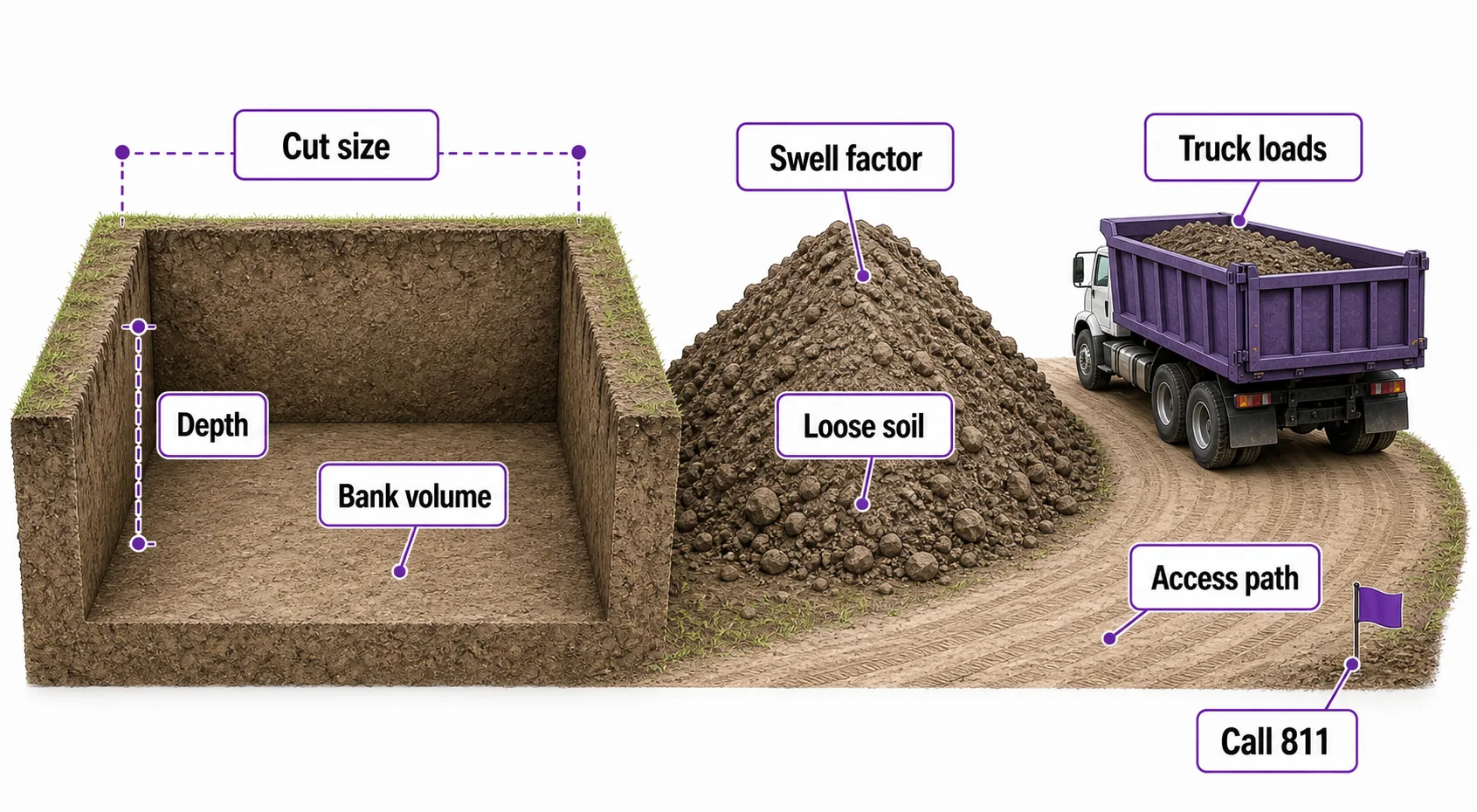
Swell factor 1.2x. The hole comes out of the ground as 1.2 times its own volume in loose spoil.
Estimates only. Not professional advice.
Loose spoil to haul away
26.7 yd³
mixed soil at easy access. Trucking, disposal and the cost range below are all sized on this loose figure, not on the hole.
- Excavation (Mixed Soil)
- $1,101
- Labor and equipment
- $661
- Hauling and disposal
- $441
- Access multiplier
- 1×
- Excavation total
- $1,733 – $2,667
600 cubic feet in the ground, which is 22.2 yd³. Loads are rounded up, because a part load still ties up a truck.
Last updated August 10, 2026. Checked against OSHA 29 CFR 1926 Subpart P by our expert review team.
Cut section
Excavation volume: bank yards in the ground, loose yards on the truck
Soil takes up more room once it is broken loose, so the pile beside the hole is always bigger than the hole. Both shapes below are drawn to scale from your own dimensions.
The windrow is the spoil cast along the full length of the cut, so it is what has to fit on site before the first truck arrives. Lay the walls back for a cut you intend to stand in and the volume rises past the figure above.
Bank
Soil still in the ground. The hole itself, and the figure a plan set dimensions.
Loose
The same soil after digging, drawn as the pile. This is what a truck bills you for.
Compacted
The same soil placed back and rolled. Smaller than bank, and not a figure this page gives.
This calculator converts bank to loose. For the compacted figure, and for buying fill rather than removing it, use the fill dirt calculator.
Excavation spec sheet
29 CFR 1926 · SUBPART P
- Protective system
- at 5 ft
- Engineered design
- over 20 ft
- Type A max slope
- 3/4:1
- Type B max slope
- 1:1
- Type C max slope
- 1.5:1
- Spoil setback
- 2 ft min
- Ladder spacing
- 25 ft
- Locate call
- 811, 2 to 3 days
Load count by soil
How soil type changes your excavation haul count
The hole never changes. Only the swell factor does, and it decides how many trips leave your driveway. Guess the soil wrong and the truck count is wrong with it.
Every row is the same 22.2 yd³ bank cut, hauled in 12 yd³ trucks at easy access. Reading mixed soil as rocky is 4.4 yd³ more material and $1,376 more at the low end, without changing the trip count at this size.
Sand and gravel
10 to 18%
Common earth, loam
20 to 30%
Heavy clay
30 to 40%
Blasted rock
40 to 65%
Published swell bands, from the Caterpillar earthwork tables and the Auburn survey of state highway practice. The factors this calculator uses sit at the bottom of each band, so a wet or heavily structured load will run higher than the figure it gives you.
Worked digs
Excavation cost by job: four digs priced end to end
Bank volume, the swell factor for the soil, loose volume, truck count and price, run through the same math the calculator above uses. Easy access on all four.
Drain trench · 60 × 1.5 × 2 ft
$520 to $800
6.7 yd³ bank, ×1.20 mixed, 8.0 yd³ loose, 1 load
One truck covers it, so trench wall stability and pipe slope decide the day, not the haul. Keep clay spoil away from the bedding stone.
Basement · 40 × 30 × 8 ft
$37,000 to $55,000
355.6 yd³ bank, ×1.30 clay, 462 yd³ loose, 39 loads
Thirty-nine round trips is a schedule, not a line item. Price this by scope with a contractor who owns the trucking, not by the yard.
Pool shell · 16 × 32 × 6 ft
$6,400 to $10,200
113.8 yd³ bank, ×1.12 sandy, 127.4 yd³ loose, 11 loads
Overdig is charged twice: hauling it out now and buying backfill later. Equipment access to the yard sets the real price here.
Patio base · 20 × 16 × 8 in
$620 to $950
7.9 yd³ bank, ×1.20 mixed, 9.5 yd³ loose, 1 load
Cut to the base design depth and stop. Every extra inch removed is stone you have to buy back to bring the patio up to grade.
Scope sheet
Excavation planning by job: trench, pad, pool shell, foundation
A trench, a patio cut, a pool shell and a foundation all run the same volume math. What changes is depth, access, where the spoil sits and what the law asks of you.
The order the decisions actually get made in. Utility marking and access come before the first bucket, because both can change what equipment shows up.
Drain trench
Narrow cut
Wall stability and pipe slope beat cubic yards. Wet or clay spoil has to go somewhere that is not on top of the bedding stone.
Patio or pad
Shallow cut
Depth control is the whole job. Cut past the base design depth and you buy stone to bring the surface back up to grade.
Pool shell
Shape control
The shape matters more than the total. Overdig is paid for twice, and equipment access to the back yard drives the price more than the volume does.
Foundation
Engineered
Setbacks, shoring, dewatering and permits. Past 20 ft OSHA wants a protective system designed by a registered professional engineer.
Dig and stage
- Bank volume
- 22.2 yd³
- Cut depth
- 3 ft
- Spoil windrow
- 14.7 ft wide
- Spoil setback
- 2 ft min
Haul off
- Loose volume
- 26.7 yd³
- Truck loads
- 3
- Round trip
- 45–90 min
- Dump fee, clean fill
- $10–30 / yd³
Backfill and finish
- Compaction lifts
- 6 in
- Passes per lift
- 3–4
- Settlement, uncompacted
- 15–25%
- Regrade window
- 1–2 yr
Haul fleet
Dump truck loads for your excavation, by truck class
Booking a bigger truck cuts trips but not always cost, because the hourly rate climbs with the box. These counts are your own loose volume divided by each class.
Counts assume the truck leaves full. A part load still ties up a driver and a round trip, which is why the readout rounds up rather than to the nearest whole load.
Method
How this excavation calculator turns a hole into truck loads
Four steps, in the order they have to happen. Each one feeds the next, which is why getting the swell factor wrong moves the truck count and the price together.
- 01
Measure the hole
cu ft = L × W × DLength by width by depth gives the bank volume, the soil as it still sits in the ground. Divide by 27 for cubic yards.
- 02
Break it loose
loose = bank × swellExcavated soil holds voids the ground did not. The factor for your soil type expands the bank figure into the volume that actually leaves.
- 03
Fill the trucks
loads = ⌈loose ÷ capacity⌉Loose volume over truck capacity, rounded up. A half-full truck is a whole round trip, so the fraction never gets dropped.
- 04
Price the loose yards
cost = loose × rate × accessContractors quote against what they move and dump, not against the hole. Access difficulty multiplies the rate by 1.25x or 1.5x.
Not included: permits, engineering, shoring, dewatering, utility repair, rock breaking beyond the rocky-soil rate, contaminated soil disposal, or imported backfill.
Overruns
Excavation mistakes that add truck loads and days
Every one of these is settled before the machine arrives, and every one of them shows up as trucks you did not book or a hole you cannot stand in.
Booking trucks against the bank volume
The hole is the smaller number. Order against it and the last load has nowhere to go.
Book against the loose figure. On mixed soil that is a fifth more material than the hole suggests, and on rocky soil two fifths.
Treating the swell factor as exact
Published bands are wide, and moisture moves a soil further than its name does.
Take the factor as a floor, not a promise. If the spoil is wet or heavily structured, price one spare load before the day starts.
No room for the spoil pile
Loose soil needs more ground than the cut it came out of, and it has to sit back from the edge.
Stage it at least 2 ft from the edge per OSHA, or book same-day trucking so nothing is ever piled on site.
Relying on the 811 marks alone
Locates cover utility-owned lines. Irrigation, drain tile, landscape lighting and pool plumbing are yours, and unmapped.
Call 811 two to three working days ahead, then hand-dig the first foot anywhere a private line could plausibly run.
Digging a wall you intend to stand in
A vertical face over 5 ft is a cave-in risk, and the volume math on this page assumes vertical walls.
Slope, bench or shore it. Laying back to Type B adds a wedge on each side that the box volume above does not count.
Backfilling loose and walking away
Uncompacted fill settles 15 to 25%, which shows up later as a sunken patio or a broken pipe slope.
Place it in 6 in lifts and make three to four passes per lift. Budget the compacted volume separately from the loose one.
Dig questions
Excavation questions: cost per yard, swell, permits, dump fees
The eight things homeowners ask before booking a machine, answered against the same rates and factors this calculator runs on.
How much does excavation cost per cubic yard?
Residential excavation runs $50 to $150 per cubic yard. Sandy loam with easy access: $50 to $80. Rocky soil in a tight backyard: $150+.
How much does dirt expand when dug up?
Sand swells 10 to 15%, mixed soil about 20%, clay 30 to 40%, and blasted rock up to 50 to 65%. Plan truck loads on the swelled volume.
How much do dump fees cost?
Clean fill: $10 to $30 per cubic yard. Contaminated soil: $50 to $150+. If you need fill instead of removing it, try our fill dirt calculator.
Rent equipment or hire a contractor?
Under 20 cu yd with easy access, renting a mini excavator ($250 to $400/day) saves 40 to 60%. Above 20 cu yd, a contractor's efficiency wins.
What soil types are hardest to excavate?
Heavy clay and caliche are the most difficult. Rocky soil requires hydraulic breakers, slowing production to 30 to 50% of normal speed.
Do I need a permit to dig?
Most areas require permits for excavations deeper than 4 feet or over 50 to 100 cu yd. OSHA requires trench protection over 5 feet deep.
How do I handle a high water table?
Options include dewatering pumps ($150 to $250/day), well points, or installing a French drain system. Discharge water must be filtered.
How many truck loads will I need?
Divide swell-adjusted volume by truck capacity. A standard dump truck holds 10 to 14 cu yd. Each round trip takes 45 to 90 minutes.
Site practice
Excavation site practice: utilities, spoil, access and topsoil
These are not in any order. They are the eight things that most often separate a dig that runs to plan from one that does not.
Quote two volumes, never one. The bank figure is the hole. The loose figure is what leaves the site, and it is the one the trucking bill is written against.
Walk the access path before you price anything. Gates, slopes, soft lawns, overhead wires and tight turns can force smaller equipment, and this calculator's Difficult access setting is a 1.5x multiplier for exactly that reason.
Call 811 before digging, then still look for private lines: irrigation, drainage, landscape lighting, pool plumbing and old conduit are on nobody's map.
Keep clean topsoil in its own pile. Mixed with clay, rock or demolition debris it stops being reusable material and starts being disposal you pay to haul.
Removing concrete first? Estimate the debris separately with the concrete weight calculator. Rubble and soil price differently and rarely share a truck.
Backfilling afterwards? Loose spoil placed back in the hole compacts down, so the fill dirt calculator is where the compacted number lives. This page stops at the loose figure.
Read OSHA trenching guidance before any cut you plan to stand in. This calculator sizes volume, not a protective system.
Digging a pool? Estimate the water separately with the pool volume calculator once the shell shape is settled.
Disclaimer
These estimates are for planning purposes only. Actual costs vary by location, material availability, and project complexity. Always get at least 3 local quotes. This calculator does not replace professional advice.
Sources
- 01OSHA 1926 Subpart P App B, Sloping and Benchingosha.gov
- 02OSHA 1926.652, Requirements for Protective Systemsosha.gov
- 03OSHA Trenching and Excavation Safetyosha.gov
- 04Caterpillar, Material Density Tables for Earthwork Volumescat.com
- 05Auburn University, Shrinkage and Swelling Factors on Highway Constructionetd.auburn.edu
- 06Call 811 Before You Digcall811.com