Cubic Feet Calculator
Convert a box or a round form to cubic feet, plus cubic yards, cubic meters and gallons.
Shape and dimensions
Solid
Common jobs
Length
Width
Height
Each field carries its own unit, so a depth in inches beside a length in feet is fine. Everything is converted before it is multiplied.
Estimates only. Not professional advice.
Box volume
48ft³
Inside volume only. Nothing here is subtracted for wall thickness, packing space, rounded corners or the material you spill.
- Box formula
- 6 ft × 4 ft × 2 ft= 48 ft³
Last updated August 6, 2026. Conversion factors checked against NIST by our expert review team.
Inscribed volume
Cubic feet for your box, and for the round form that fits inside it
A cubic foot is a shape unit, not a delivery unit, and the shape decides how much of your measurement you can actually fill. Both solids below stand at the same height and are drawn at one scale, so the difference you see is footprint and nothing else.
Hatching is footprint a round form cannot reach. Here the circle takes 52.4% of the box, and on a square footprint it is always 78.5%, because that ratio is pi over 4.
What the corners cost
pi ÷ 4 = 0.7854 ceiling- Your box
- 48 ft³
- Round form inside it
- 25.13 ft³
- Corner you cannot fill
- 22.87 ft³
- Corner in cubic yards
- 0.847 yd³
The corner is the part of a square order that a round form can never use, and it is 171.1 US gallons of whatever you were about to pour.
Why the ceiling is 78.5%
A circle of diameter d covers π d² ÷ 4, and the square around it covers d². The ratio is π ÷ 4, or 0.7854, and it does not change with size. So a round form bought as a square leaves at least a fifth of the order in the corners, and more than that the moment the footprint is not square.
Fill capacity
How many cubic feet is a fridge, a truck bed, or a moving truck?
Cubic feet only means something once you can picture it. These are the capacities people already own, so a result can be checked against something real before anyone rents a truck or buys forty bags of soil.
48 ft³ is about 2.40 full-size refrigerators of space.
Approximate interior capacity. Appliance and truck sizes vary by model, and a packed load never reaches the rated figure.
Worked solids
Cubic feet worked out for a raised bed, a tote and a post hole
Three jobs that land in three different buying units. Every figure below comes out of the calculator on this page, with the dimensions shown.
8 ft x 4 ft x 12 in
Raised garden bed, filled with soil
Over a cubic yard, so this is a bulk delivery rather than a stack of bags. Note the depth is in inches while the sides are in feet, which is the normal way a bed gets measured.
32ft³
1.19 yd³ · 0.906 m³ · 239.4 gal
24 in x 18 in x 12 in
Storage tote, packed for a move
All three sides in inches, so the product is cubic inches and has to come down by 1,728. Outside dimensions like these run about a fifth higher than the space actually inside the tote.
3ft³
0.11 yd³ · 0.085 m³ · 22.4 gal
12 in diameter x 36 in deep
Post hole, ready for concrete
The radius is 6 in, not 12. Measuring the hole as a 12 in square instead would order 3 ft³ and leave most of a bag over, since the round form only takes 78.5% of that box.
2.36ft³
0.09 yd³ · 0.067 m³ · 17.6 gal
Inside dimensions
Measuring for cubic feet: inside dimensions, inches and round forms
Three routes reach the same answer, and picking the wrong one is where the number goes wrong. This is the decision the calculator above cannot make for you: what you point the tape at, and what comes back off the reading.
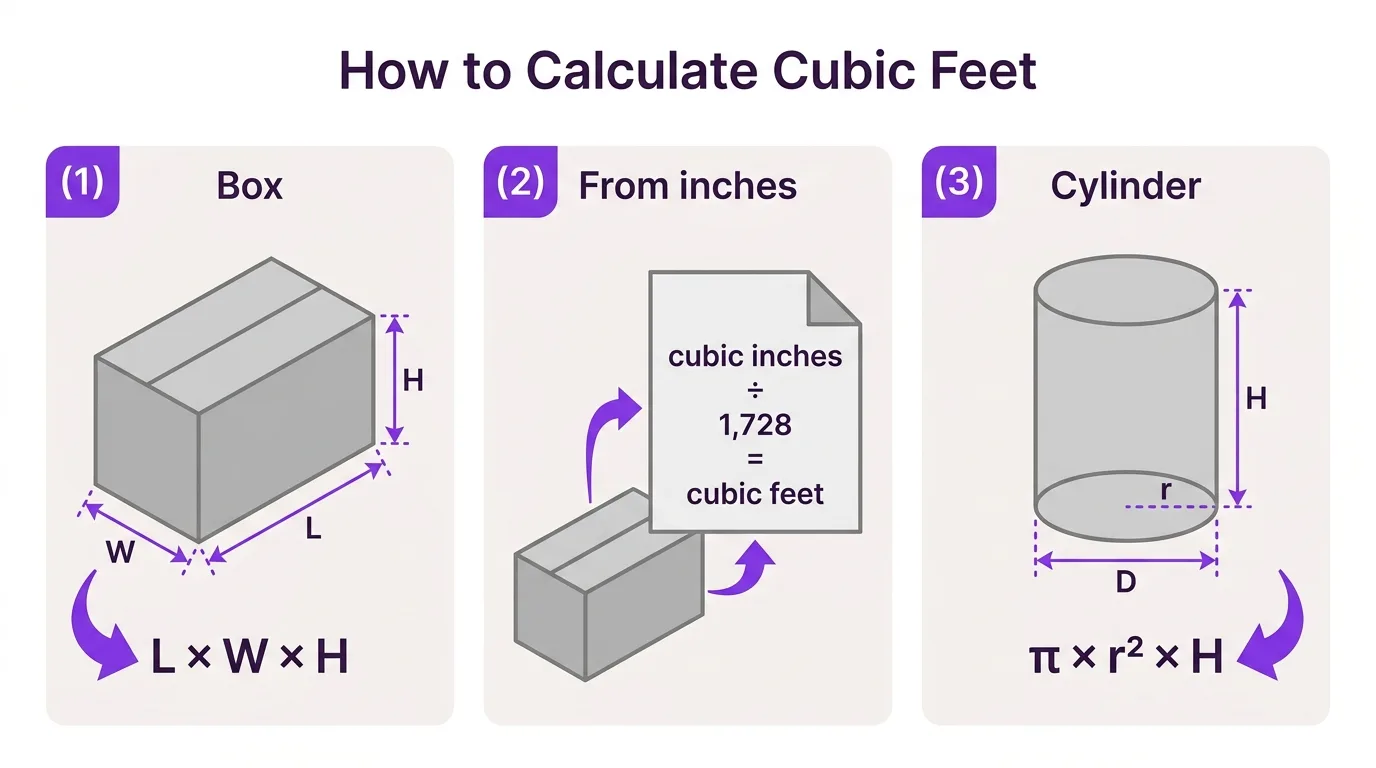
Inches are the trap in the middle panel. Multiplying three inch readings gives cubic inches, which is 1,728 times too large until it is divided down.
What to measure, and what comes back off it
Storage tote or bin
Inside length and width at the base, then depth to the lip
The wall thickness, which is close to an inch a side on a heavy tote
Raised bed or planter
Inside the frame, and the depth you actually want soil to sit at
One to two inches of freeboard so watering does not float soil over the edge
Post hole or round footing
The bore, not the auger bit: a hole cuts wider than the tool that made it
The post itself, which displaces its own volume of concrete
Room, attic or crawlspace
Floor to ceiling at the lowest point, times the floor area
Nothing, but do not add the joist bays unless you are filling those too
Truck bed or trailer
Inside the walls, up to the level of the rails
The wheel-well boxes, and anything you cannot heap above the rail line
Barrel or round tank
Inside diameter, and the height of the fill line rather than the rim
The ullage above the fill line, plus any dip tube or heater in the way
Unit slips
Cubic feet mistakes, and the wrong number each one gives you
Every slip here is one line of arithmetic, so you can check whether it is the one that produced your figure. The examples run in feet and inches, which is where these happen.
Feet multiplied straight into inches
6 × 4 × 24 = 576
24 in is 2 ft, so 6 × 4 × 2 = 48 ft³
Radius entered as the diameter
π × 1² × 2 = 6.28 ft³
A 12 in bore has a 0.5 ft radius: π × 0.5² × 2 = 1.57 ft³
Cubic inches never divided down
24 × 18 × 12 = 5,184
5,184 in³ ÷ 1,728 = 3 ft³
Square feet used as a volume
10 × 12 = 120 ft³
120 sq ft × an 8 ft ceiling = 960 ft³
Divided by 3 to reach cubic yards
48 ÷ 3 = 16 yd³
48 ÷ 27 = 1.78 yd³
Outside dimensions on a container
24 × 18 × 12 in outside = 3 ft³
Inside 22.5 × 16.5 × 11 in = 2.36 ft³
One more that has no arithmetic: cubic feet is not weight. The same 48 ft³ is about 3,000 lb of water and closer to 4,800 lb of wet gravel, so check the density before it goes in a truck bed or on a balcony.
Prism arithmetic
Cubic feet formulas for a box, a cylinder, and measurements in inches
Every dimension is converted to feet first, then multiplied. Stating it this plainly is the point: you should be able to reproduce the number on this page with a pocket calculator.
ft³ = L(ft) × W(ft) × H(ft)ft³ = π × r(ft)² × h(ft)r = diameter ÷ 2ft³ = in³ ÷ 1,728yd³ = ft³ ÷ 27m³ = ft³ × 0.0283168gal = ft³ × 7.48052One foot is 0.3048 metre exactly, so a metric entry converts without rounding error before it reaches the multiplication. Cylinders use the radius, which is half of the diameter you typed, and that single halving is the most common wrong answer on any volume calculator.
Dimensions are treated as straight inside measurements. Wall thickness, rounded corners, voids, packing space, compaction and material waste are not modelled, and volume is never converted to weight.
Conversion factors
NIST- 1 cubic yard
- 27 ft³
- 1 cubic meter
- 35.31 ft³
- 1 cubic foot
- 1,728 in³
- 1 cubic foot
- 7.48052 gal
- 1 foot
- 0.3048 m
Order notes
Turning cubic feet into something you can order
A volume is not yet an order. These are the conversions and the deductions that stand between the figure above and a supplier who wants bags, yards or gallons.
Order a round form by its bore, never by the square you measured across it. The corners are 21% of the box on a square footprint and you cannot pour concrete into them.
Bagged material is priced by the bag yield printed on the bag, so divide your cubic feet by that number. A 2 cu ft bag of soil holds 2 cubic feet, not a fraction of a yard.
Bulk soil, gravel and mulch are sold by the cubic yard. Divide by 27 first, then call the yard, or start from our cubic yard calculator instead.
Water and any other liquid: multiply cubic feet by 7.48052 for U.S. gallons. Our tank volume calculator and pool volume calculator do the shape work for you.
Leave freeboard in anything you fill by hand. One to two inches off the depth of a planter or a bin is the difference between a clean fill and soil down the side.
Cubic feet says nothing about weight. A cubic foot of water is about 62.4 lb and a cubic foot of gravel is closer to 100 lb, so check the density before you trust a truck bed with it.
Working from an area rather than a solid? Get the area first with the square footage calculator, then multiply by depth, or price the material in our gravel calculator.
Short answers
What people ask about cubic feet
The nine that come up most, answered against the same NIST factors the calculator uses.
How many cubic feet are in a cubic yard?
There are 27 cubic feet in 1 cubic yard. That comes from 3 ft x 3 ft x 3 ft.
How do you calculate cubic feet from inches?
Multiply length x width x height in inches, then divide by 1,728. A 24 x 18 x 12 inch box is 3 cubic feet.
How many gallons are in a cubic foot?
One cubic foot is about 7.48052 U.S. gallons. Use this for water volume, tanks, and pool estimates when the shape is measured in feet.
How many cubic feet does a round form hold compared with a square box?
About 79 percent of it. A cylinder that just fits inside a square footprint holds pi divided by 4, or 78.5%, of that box at the same height, so pricing a round hole as a square over-orders by roughly a fifth.
Box or cylinder mode: which should I use?
Use box mode for rectangular spaces like planters, rooms, boxes, and material bins. Use cylinder mode for round tanks, post holes, columns, barrels, and tubes.
Should I convert every dimension to feet first?
Yes. Convert each dimension to feet before multiplying, especially when one number is in inches and another is in feet.
How do I use cubic feet to estimate material cost?
Convert cubic feet to the unit your supplier prices, then multiply by that rate. Divide by 27 for cubic yards, use gallons for liquids, or divide by the bag yield for bagged material.
Is cubic feet the same as square feet?
No. Square feet measures area, while cubic feet measures volume. A floor can be 100 sq ft, but its volume depends on height or depth.
Can I use cubic feet for soil, gravel, concrete, and water?
Yes for volume, but not for weight. Soil, gravel, concrete, and water can share the same cubic feet volume while weighing very different amounts.
Disclaimer
These estimates are for planning purposes only. Actual costs vary by location, material availability, and project complexity. Always get at least 3 local quotes. This calculator does not replace professional advice.
Sources