Cubic Yard Calculator
Convert area and depth to cubic yards, cubic feet, cubic meters, and truck loads.
Area and depth
Length
Width
Depth presets
Depth
Depth is converted to feet before the volume is worked out.
Estimates only. Not professional advice.
Bulk volume to order
1.23
cubic yards, from 100 sq ft at 0.33 ft deep. This is the number a supplier prices.
- Area times depth
- 100 sq ft × 0.33 ft
- Cubic feet, then ÷ 27
- 33.33 ft³
- Standard dump-truck loads at 12 to 16 yd³
- 0.08 to 0.10
- Smallest vehicle that does it in one go
- Single-axle dump
- Weight of it as topsoil
- 2,706 lb
Weight assumes topsoil at 2,200 lb/yd³, which you can change in the options panel. The cubic-yard figure itself assumes nothing about the material.
Being billed by weight? Convert the same figure with the tons to cubic yards calculator.
Last updated August 6, 2026 by our expert review team.
Loads
Your cubic yards, dropped into three real truck beds
Cubic feet describe a shape. Cubic yards describe a delivery, and a delivery arrives in a bed with two ceilings: how much the box holds, and how much the axles are allowed to carry. On anything heavier than bark the second one binds first, which is why a half-ton looks half empty and is already illegal.
Beds are 5.3, 7, 8 ft wide, which a side section cannot show, and the depths are struck level with the rails. Where the fill line lands exactly on the dashed line, that load is already at its legal weight with the bed part empty.
Which ceiling binds
- Material assumed
- Topsoil
- Density
- 2,200 lb/yd³
- Your load weighs
- 2,706 lb
- Same weight in tons
- 1.35 tons
On topsoil the half-ton fills to 36% of its box and is then at payload. Fewer, heavier-rated trips beat a full-looking bed.
Change the material in the calculator's advanced options.
Spoil and shortfall
Where a cubic yard order goes wrong
Four of these five leave you with the wrong pile on the driveway. The fifth leaves you with the right pile and an overloaded truck.
Leaving depth in inches
Area is in square feet, so an inch figure multiplies twelve times too big.
Divide inches by 12 first. Four inches is 0.333 ft, and the depth field converts it for you whichever unit you pick.
Skipping the divide by 27
Area times depth gives cubic FEET. Ordering that number buys 27 times too much.
One cubic yard is 3 ft on every side, so divide cubic feet by 27. The worked steps in the readout show the division on its own line.
Reading cubic yards as tons
Yards are volume and tons are weight, and suppliers quote in both without saying which.
Multiply yards by the material density to get weight. Screened topsoil runs about 2,200 lb per yard, crushed stone about 2,700.
Filling the pickup bed to the rails
Payload runs out first on anything denser than bark, and an overloaded half-ton stops badly.
Work back from payload: 1,500 lb divided by the density. On topsoil that is 0.68 yd³, not the 1.91 yd³ the box holds.
Ordering the exact converter figure for a spread material
This page is material-agnostic: no waste, no compaction, no settling, no bag yield.
Use it to size the order, then add the allowance the material actually needs from its own calculator before you call the yard.
Delivery tickets
Cubic yards for a patio slab, a gravel run and a mulch bed
Three jobs at three depths, each run through this converter and then through the pickup bed above, so you can see which ones are worth a trip and which want a truck.
Small Patio Slab
10 x 10 ft at 4 in
1.23 yd³
- cubic feet
- 33.3
- half-ton trips
- 2
- of a tandem load
- 9%
Use the concrete slab calculator when reinforcement, forms, and ready-mix cost matter.
Driveway Gravel Run
20 x 12 ft at 6 in
4.44 yd³
- cubic feet
- 120
- half-ton trips
- 7
- of a tandem load
- 33%
For gravel, convert yards to tons with the material density before ordering.
Mulch Bed
300 sq ft at 3 in
2.78 yd³
- cubic feet
- 75
- half-ton trips
- 5
- of a tandem load
- 21%
Mulch often needs a waste or settling allowance, so use the mulch calculator for final ordering.
Trips and load shares assume topsoil. The cubic-yard figures come from this converter with no waste, compaction or settling added.
Tailgate math
Square feet and inches to cubic yards in three moves
Every wrong yardage order comes from skipping one of these three steps. The middle one is where inches have to become feet, and the last one is the divide by 27 that turns a big number into an orderable one.
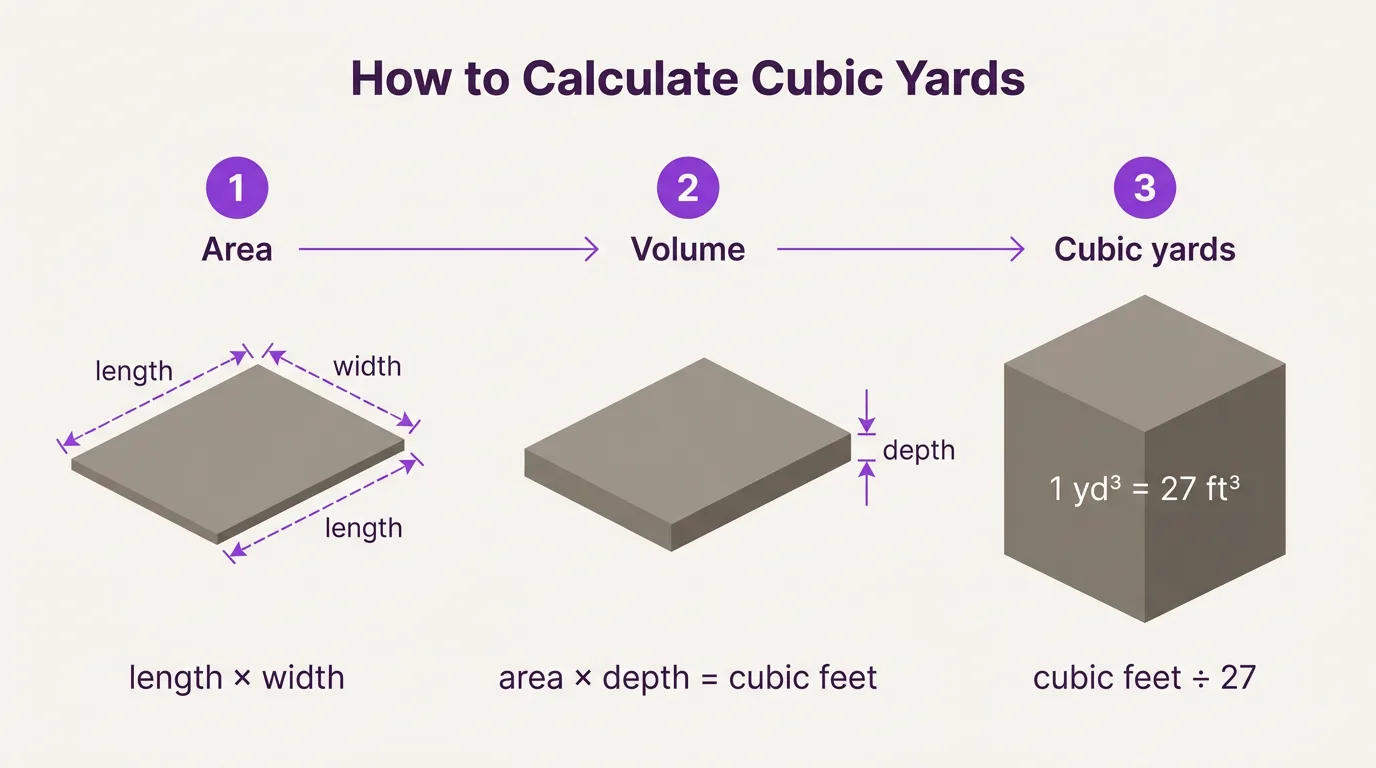
The depth box is the one to watch: it is the only step where the unit on your tape measure and the unit in the formula disagree.
Spread rates
Cubic yards per depth, and the factors behind them
One cubic yard is a fixed 27 cubic feet, so depth alone decides how far it goes. Doubling the depth halves the area it covers, which is the fastest sanity check on a quantity before you order it.
How far one yd³ spreads
| Depth | Coverage | For 100 sq ft |
|---|---|---|
| 2 in | 162 sq ft per yd³ | 0.62 yd³ |
| 3 in | 108 sq ft per yd³ | 0.93 yd³ |
| 4 in | 81 sq ft per yd³ | 1.23 yd³ |
| 6 in | 54 sq ft per yd³ | 1.85 yd³ |
Level grade, no waste, compaction or settling allowance. Every row is 27 cubic feet divided by the depth in feet.
Cubic yard conversion factors
NIST SP 365
| Conversion | Factor | Use |
|---|---|---|
| 1 cubic yard | 27 ft³ | Bulk soil and gravel |
| 1 cubic yard | 0.7646 m³ | Metric equivalent |
| 1 ft³ | 0.03704 yd³ | Cubic feet to yards |
| 1 m³ | 1.30795 yd³ | Cubic metres to yards |
The metric factor follows NIST customary-to-metric guidance. Suppliers round order quantities, so expect a ticket in whole or half yards.
Scale house
Cubic yard questions: tons, bags, concrete and depth
The questions that come up between working out a quantity and actually ordering it. Nothing here is behind a toggle.
How many cubic feet are in a cubic yard?
27. A cubic yard measures 3 ft on every side, and 3 x 3 x 3 is 27, so dividing cubic feet by 27 gives cubic yards.
How many cubic yards do I need for 100 square feet at 3 inches deep?
About 0.93 cubic yards. The math is 100 sq ft x 0.25 ft = 25 ft³, then 25 / 27 = 0.93 yd³.
How many cubic yards are in a 10x10 slab at 4 inches?
About 1.23 cubic yards before waste. Concrete projects usually add a small allowance for uneven forms and spillage.
How many cubic yards fit in a pickup truck?
A 6.5 ft half-ton box holds about 1.9 cubic yards struck level with the rails, but payload runs out long before the bed does. On a 1,500 lb payload that is roughly 0.68 yd³ of screened topsoil or 0.56 yd³ of crushed stone. Heaping only helps with mulch and bark.
How many cubic yards does a dump truck deliver?
A tandem dump truck is the usual bulk delivery and its bed holds about 13.3 cubic yards level. On a 30,000 lb payload it tops out around 11.1 yd³ of crushed stone, so a full-looking load and a full-weight load are not the same thing. A single-axle truck runs 5 to 8 yd³ and fits a normal driveway.
Should I use cubic yards or tons for gravel?
Use cubic yards for volume and tons for weight. Gravel suppliers may sell by either unit, so convert yards to tons with the material density or use the gravel calculator.
Should I order bagged material or bulk cubic yards?
Use bags for small jobs and bulk cubic yards for larger jobs. Once you are near a full cubic yard, delivery is often easier than moving many small bags.
How much does a cubic yard of concrete cost?
Ready-mix concrete is commonly ordered by the cubic yard, but delivered pricing varies by mix, location, short-load fees, and schedule. Use the cubic-yard answer as the quantity, then ask the supplier for the delivered yard price.
Why does depth need to be converted to feet?
Area is in square feet, so depth must be in feet before multiplying. Four inches is 0.333 ft, not 4 ft.
Haul vs deliver
How many cubic yards does a truck hold?
Five vehicles, their level capacity, and what they may actually carry once topsoil is in the bed. The gap between the last two columns is the whole reason a delivered load looks half empty.
| Vehicle | Level yd³ | Payload lb | May carry yd³ |
|---|---|---|---|
| Half-ton pickup, level6.5 ft box, struck level with the rails | 1.91 | 1,500 | 0.68 |
| Half-ton pickup, heapedOnly worth doing with mulch or bark | 2.90 | 1,500 | 0.68 |
| Towable dump trailerRental trailer behind a half-ton | 4.00 | 7,000 | 3.18 |
| Single-axle dump truckThe truck that fits a suburban driveway | 5.96 | 14,000 | 5.96 |
| Tandem dump truckThe default for a bulk aggregate delivery | 13.33 | 30,000 | 13.33 |
An amber figure means weight ran out before the box did. Capacities are class averages, payloads are practical rather than legal maximums, and axle rules vary by state, so confirm the load with the yard and check tailgate clearance before you haul anything heavy yourself.
Drop site
Take delivery of a cubic yard without a second trip
In the order the decisions actually get made, from the tape measure to the ticket.
- 01
Measure the bed or the pad, not the bag you already bought. Length times width times depth is the only figure a bulk supplier can price, and it wants all three in the same unit before you multiply.
- 02
Convert depth before you multiply. Four inches is 0.333 ft, so a 100 sq ft area at that depth comes out well under one cubic yard, not four of them.
- 03
Decide haul or deliver before you order. A 0.68 yd³ trip in a half-ton is fine once; six of them is a Saturday. Delivery minimums usually start around three cubic yards.
- 04
Clear the drop site and tell the driver where it goes. A tandem needs overhead clearance to raise the bed, and a pile dumped on the wrong side of the garage gets moved twice by wheelbarrow.
- 05
Order the material calculator's number, not this one, when waste matters. The gravel calculator adds compaction, the mulch calculator adds settling, and the concrete slab calculator adds spillage.
- 06
Ask for the ticket in the unit you are being billed in. If the yard sells by weight, run the number through the tons to cubic yards calculator before you agree the price.
Net yards
How this cubic yard calculator gets to 27
Three lines of arithmetic, all of them visible in the readout so you can audit the answer instead of trusting it.
Length and width become square feet, whichever of inches, feet, yards or metres you typed them in. Depth converts to feet on its own, because area is already in square feet and multiplying an inch figure by a square-foot figure is the single most common yardage error. Area times depth gives cubic feet, and cubic feet divided by 27 gives cubic yards, because a cubic yard is a 3 ft cube.
Nothing else is added. For concrete context, NRMCA CIP 31 notes that ready mixed concrete is manufactured and delivered under ASTM C94/C94M, so confirm the mix and the delivery window with the supplier rather than with a converter.
area (ft²) = L × Wft³ = area × depth (ft)yd³ = ft³ ÷ 27m³ = yd³ × 0.764554858lb = yd³ × densityloads = yd³ ÷ bed capacityWhat it leaves out
- Waste, spillage and over-excavation
- Compaction, which base gravel needs
- Settling, which mulch and soil do
- Bag yield for bagged material
- Delivery minimums and short-load fees
Each of those lives in the calculator for its own material, so this page stays a clean volume conversion.
Disclaimer
These estimates are for planning purposes only. Actual costs vary by location, material availability, and project complexity. Always get at least 3 local quotes. This calculator does not replace professional advice.
Sources
- 01NIST SP 365 Approximate Conversions from U.S. Customary Measures to Metricnist.gov
- 02NIST Handbook 44 Appendix C, General Tables of Units of Measurementnist.gov
- 03NRMCA CIP 31: Ordering Ready Mixed Concretenrmca.org
- 04Concrete Network: Ready Mix Concrete Delivery and Orderingconcretenetwork.com
- 05Soil Building Systems: Pickup Truck Capacities (bed dimensions)soilbuildingsystems.com
- 06The Upfit Insider: How Many Cubic Yards in a Dump Truck (yardage vs payload)theupfitinsider.com
Related Calculators
Sq Ft to Cubic Yards Calculator
Already know your square footage
Cubic Feet Calculator
Boxes, cylinders, gallons, and yards
Tons to Cubic Yards Calculator
Weight tickets and densities
Gravel Calculator
Yards, tons, bags, and coverage
Concrete Slab Calculator
Concrete volume and bags
Mulch Calculator
Mulch yards and bags
Soil Calculator
Topsoil and garden soil volume