Sq Ft to Cubic Yards Calculator
Convert square footage and a depth to cubic yards, cubic feet and cubic meters.
Area and depth
Area you have measured
Only have length and width? The cubic yard calculator multiplies them for you first.
Depth presets
Depth of the layer
Without this, there is no volume to convert. Depth becomes feet before anything is multiplied.
Estimates only. Not professional advice.
Volume to order
1.23
cubic yards, from 100 sq ft spread 4 in deep. Change the depth and nothing else, and this figure moves with it in a straight line.
- Area times depth
- 100 sq ft × 4 in
- Cubic feet, then ÷ 27
- 33.33 ft³
- Shortcut: sq ft × inches ÷ 324
- 1.23 yd³
- Standard dump-truck loads at 12 to 16 yd³
- 0.08 to 0.10
- Every inch of depth adds
- 0.31 yd³
Exact geometry only. No waste, compaction, settling, bag yield or delivery minimum is included, because none of those are the same for two materials.
Being quoted by weight instead? Run the same figure through the tons to cubic yards calculator.
Last updated August 13, 2026 by our expert review team.
Depth term
Your square footage at three depths, drawn to one scale
Square feet is the number you already have. Depth is the number the conversion cannot guess, and it is doing more work than most people expect: the same patch of ground below is one area and three completely different orders.
Each block is 3 ft of run through your area, in section, while the yardage under it is for the whole area. Your square footage divided by 324 gives the third figure above.
Coverage ladder
Square feet to cubic yards at every depth you are likely to use
The left table is your own area run down the depths that actually get specified. The right one is the fixed arithmetic behind it, which never changes whatever you are spreading.
100 sq ft, depth by depth
| Depth | You need | One yd³ covers |
|---|---|---|
| 2 in | 0.62 yd³ | 162 sq ft |
| 3 in | 0.93 yd³ | 108 sq ft |
| 4 inyours | 1.23 yd³ | 81 sq ft |
| 6 in | 1.85 yd³ | 54 sq ft |
| 8 in | 2.47 yd³ | 41 sq ft |
Every row is your area times that depth, divided by 27. Level grade, no waste, compaction or settling. Double a depth and the coverage column halves.
The factors that do not move
NIST SP 365
| Conversion | Factor | Use |
|---|---|---|
| 1 cubic yard | 27 ft³ | Volume held by one cubic yard |
| 1 ft³ | 0.03704 yd³ | Cubic feet to cubic yards |
| 1 cubic yard | 0.7646 m³ | Metric volume equivalent |
| Area only | no yd³ | You must add a depth to get a volume |
The metric factor follows NIST customary-to-metric guidance. The last row is the one that catches people out.
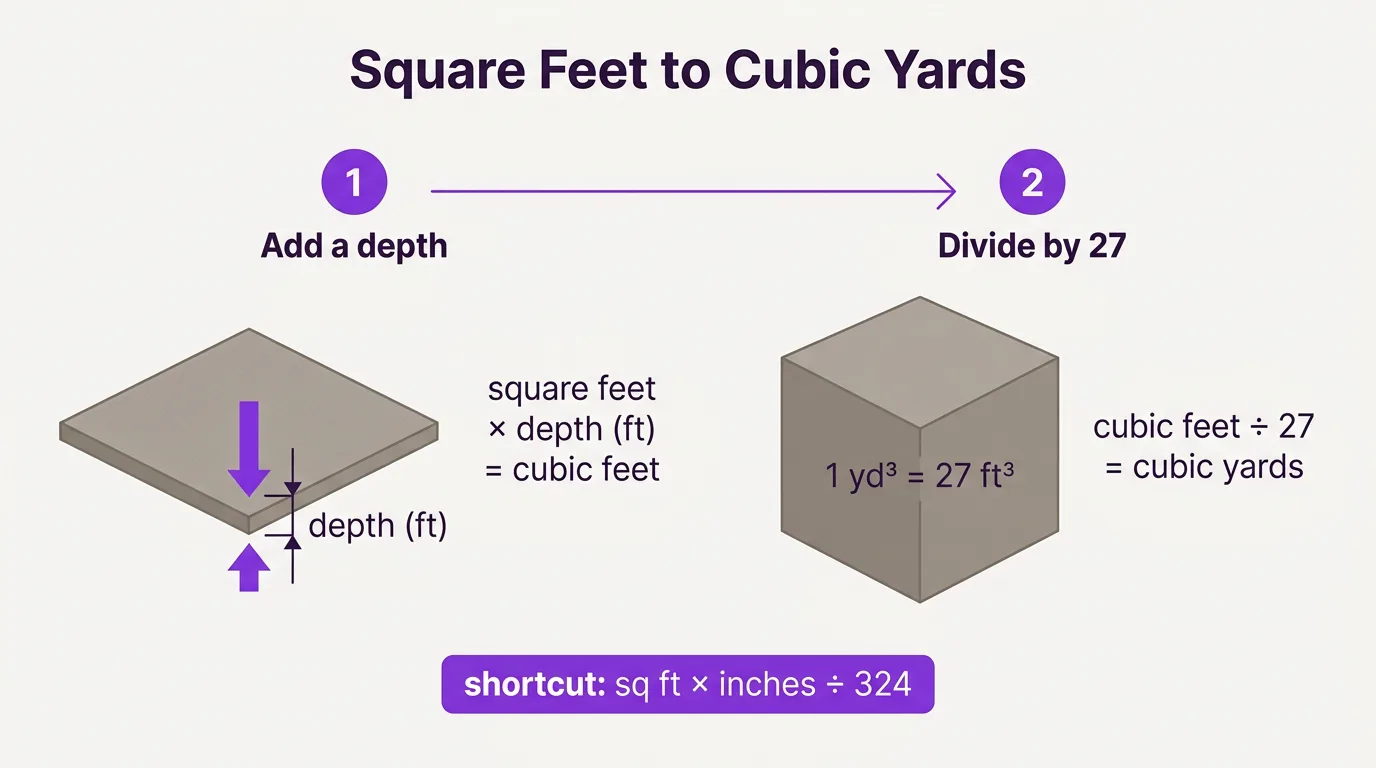
Two routes to the same answer. The lower one exists because the depth on a drawing is almost always written in inches.
Before the order
Six checks on the depth before you order the cubic yards
The area is usually measured properly and the depth is usually assumed. These are the six places that assumption costs money.
Measure the finished depth and type it in the unit you measured. The depth field takes inches, feet, yards or metres and converts before it multiplies, so hand-converting is one step you can skip and one place a factor of twelve can no longer creep in.
Sanity-check the answer with the 324 shortcut. Square feet times the depth in inches, divided by 324, is cubic yards. It folds the inch-to-foot step and the divide by 27 into one division you can do on a phone at the yard.
Price the depth, not just the area. At 100 sq ft your order moves 0.31 yd³ for every inch of depth you add, so you can see what a deeper bed costs before you commit to it rather than after the truck leaves.
If the depth changes across the area, this converter only takes one figure. Average it over the whole area, or split the job into zones, convert each zone on its own and add the yards. A dished patio and a sloping bed both need that second treatment.
Ask the yard what increment it invoices in. The conversion gives an exact volume; a supplier sells in its own steps and usually has a minimum load, so the number you actually order is this figure rounded up to whatever they will put on a ticket.
Add the allowance in the material's own calculator rather than here. The gravel calculator adds compaction, the mulch calculator adds settling, and the concrete slab calculator adds spillage. This page stays a clean geometric conversion on purpose.
Wrong by a factor
Where a square feet to cubic yards conversion goes wrong
None of these five are rounding errors. Each one is out by exactly 12, exactly 27 or exactly 324, which is why a wrong yardage is usually wrong by a lot rather than a little.
Converting square feet straight to cubic yards
An area has no third dimension, so no single factor can do it.
Add a depth first. Square feet times depth in feet gives cubic feet, and only then does the divide by 27 apply. A converter that offers you a sq ft to yd³ factor with no depth field is giving you a coverage rate, not a volume.
Multiplying square feet by a depth in inches
The area is in feet, so an inch figure comes out twelve times too big.
Convert the depth to feet, or keep the inches and divide by 324 instead of 27. The depth field converts for you whichever unit you pick, and the worked lines in the readout show which figure went into the multiplication.
Stopping at cubic feet
Area times depth gives cubic FEET. Ordering that number buys 27 times too much.
A cubic yard is 3 ft on every side, so divide cubic feet by 27. The readout keeps that division on its own line so you can see it happen instead of trusting it.
Using the 324 shortcut with a depth in feet
324 already contains the inch-to-foot step, so feet come out twelve times too small.
324 takes inches only, 27 takes feet. If the depth on your drawing is 0.5 ft, either call it 6 in and divide by 324, or leave it in feet and divide by 27.
Ordering the exact figure for something that settles
This page converts geometry. It knows nothing about compaction, settling or spillage.
Use it to size the order, then take the allowance from the calculator for the material you are actually buying before you call the yard.
Divide by 324
How this converter gets from square feet to cubic yards
Three lines of arithmetic, all of them visible in the readout, plus the one shortcut worth memorising.
Your area converts to square feet first, whether you typed square feet, square yards or square metres. The depth converts to feet on its own, because the area is already in square feet and multiplying a square-foot figure by an inch figure is the single most common yardage error there is. Area times depth gives cubic feet, and cubic feet divided by 27 gives cubic yards, because a cubic yard is a 3 ft cube.
The shortcut on the fourth chip below is the same arithmetic with the inch-to-foot step folded in: 12 times 27 is 324, so square feet times a depth in inches, divided by 324, is cubic yards in one move. It only works with inches. Give it a depth in feet and the answer comes out twelve times too small.
Nothing else is added. For concrete specifically, NRMCA CIP 31 notes that ready mixed concrete is manufactured and delivered by the cubic yard under ASTM C94/C94M, so this is the unit the supplier will quote back at you.
ft² = your measured areaft³ = ft² × depth (ft)yd³ = ft³ ÷ 27yd³ = ft² × depth (in) ÷ 324m³ = yd³ × 0.764554858yd³ per inch = ft² ÷ 324What it leaves out
- Waste, spillage and over-excavation
- Compaction, which a base course needs
- Settling, which mulch and soil do
- Bag yield for bagged material
- Delivery minimums and short-load fees
- Density, so no weight and no tons
Each of those belongs to a material, not to a conversion, so each one lives in the calculator for the material you are buying.
Bed, pad, slab
Square feet to cubic yards for a mulch bed, a gravel pad and a slab
Three real jobs at three depths. The middle row of each is the figure this page is for: what one more inch of depth would add to that particular order.
Mulch Bed
300 sq ft at 3 in
2.78 yd³
- cubic feet
- 75
- per extra inch
- 0.93 yd³
- one yd³ covers
- 108 sq ft
Mulch settles, so use the mulch calculator to add a settling allowance before ordering.
Gravel Pad
200 sq ft at 6 in
3.70 yd³
- cubic feet
- 100
- per extra inch
- 0.62 yd³
- one yd³ covers
- 54 sq ft
For gravel, convert the cubic yards to tons with the material density before ordering bulk.
Concrete Slab
120 sq ft at 4 in
1.48 yd³
- cubic feet
- 40
- per extra inch
- 0.37 yd³
- one yd³ covers
- 81 sq ft
Concrete is ordered by the cubic yard, but use the slab calculator for forms, rebar, and waste.
All three come out of this converter with nothing added. The coverage column is 27 cubic feet divided by that job's depth, which is how far a single yard of anything goes.
Finished layer
Depth in a cubic yards conversion: measure the layer, not the hole
The arithmetic is easy and the depth is not, because the depth on a drawing, the depth of the excavation and the depth of the material delivered are three different numbers.
The depth is the finished layer
Measure from the finished surface down to whatever sits underneath: subgrade, base, membrane, existing slab. An excavation is usually deeper than the layer going into it, and if you convert the excavation depth you order material to fill space that something else is meant to occupy.
A slab over a base is two conversions
Concrete over compacted stone is one area and two depths, so it is two runs of this converter added together, not one run at the combined depth. Keeping them separate matters because the two arrive on different trucks, are priced per yard on different tickets, and only one of them compacts.
Loose volume is not in-place volume
Mulch, soil and aggregate all arrive loose and finish shallower than they land, so an in-place depth converted exactly leaves you slightly short. This page deliberately does not guess by how much, because the allowance is a property of the material rather than of the geometry. Take it from that material's own calculator.
Concrete is bought in exactly this unit
Ready mixed concrete is ordered and invoiced by the cubic yard, which is why a depth error on a slab shows up directly on the bill rather than as a vague shortage. NRMCA CIP 31 covers what to have ready when you place the order, and the supplier's own minimum load is worth asking about before you settle on a thickness.
At the counter
Square feet to cubic yards questions: depth, coverage and the 27
The questions that come up between having an area and having a number the yard will accept. Nothing here is behind a toggle.
How do I convert square feet to cubic yards?
Multiply the square footage by the depth in feet to get cubic feet, then divide by 27. For example, 100 sq ft at 4 in (0.333 ft) is 33.3 cubic feet, or about 1.23 cubic yards.
Can I convert square feet to cubic yards without a depth?
No. Square feet measure area and cubic yards measure volume, so there is no direct conversion. You must add a depth (or thickness) before you can calculate a volume.
How many cubic yards is 100 square feet?
It depends entirely on depth. At 4 inches deep, 100 sq ft is about 1.23 cubic yards. Deeper layers need proportionally more material.
How many square feet does a cubic yard cover?
One cubic yard covers about 162 sq ft at 2 in, 81 sq ft at 4 in, and 54 sq ft at 6 in deep. Coverage halves as the depth doubles.
Why do I divide by 27 to get cubic yards?
A cubic yard is 3 ft on every side, so it holds 3 × 3 × 3 = 27 cubic feet. Dividing cubic feet by 27 converts the volume to cubic yards.
How many cubic yards of gravel do I need for 200 square feet?
For 200 sq ft at 6 in deep, you need about 3.70 cubic yards. Add a small allowance for compaction and order to the supplier's minimum.
Is this the same as the cubic yard calculator?
It is the area-first version. This page is for when you already know your square footage. If you only have length and width, the cubic yard calculator multiplies them for you first.
Should I add waste to this number?
This converter gives exact volume only. For materials that compact or settle (gravel, mulch, soil) or projects that waste material (concrete), use the matching material calculator to add an allowance.
Disclaimer
These estimates are for planning purposes only. Actual costs vary by location, material availability, and project complexity. Always get at least 3 local quotes. This calculator does not replace professional advice.
Sources
Related Calculators
Cubic Yard Calculator
Length and width instead of an area
Cubic Feet Calculator
Boxes, cylinders, gallons and yards
Square Footage Calculator
Work out the area first
Tons to Cubic Yards Calculator
Weight tickets and densities
Gravel Calculator
Yards, tons, bags and coverage
Concrete Slab Calculator
Concrete volume and bags
Mulch Calculator
Mulch yards and bags