Pool Volume Calculator
Calculate gallons or liters from your shallow and deep depths, plus fill time and flow.
Pool Details
Most lap and backyard pools.
Both depths redraw the floor profile below. A flat-bottom pool takes the same number twice.
Pool water volume
18,514
gallons in a rectangular pool at 5.5 ft average depth, taken from a 3 to 8 ft floor.
- Liters, for metric labels
- 70,084 L
- Weight of the water
- 154,409 lb
- Starter chlorine at 2 oz per 10,000 gal
- 3.7 oz
- Salt to reach 3,200 ppm
- 494 lb
- Water to fill it
- $93 to $185
Chemical figures are starting quantities from the defaults in the options panel. Test the water and follow the product label before anything goes in.
Estimates only. Not professional advice.
Last updated August 5, 2026 by our expert review team.
Floor profile
Pool volume comes from average depth, not the deep end
People picture a pool as its deep end. The floor slopes, so most of the length sits nearer the shallow depth, and the deep end holds a much smaller share of the water than it looks like it should. That is why the average of your two depths drives the volume, and why a pool with a 8 ft deep end needs far less water than the number in your head.
The floor is drawn as one straight slope because a plain average of your two depths describes exactly that. Real pools hold a flat shallow section and a transition into the deep end, which this estimate smooths out.
Water by quarter
gal- Quarter 1, 3 to 4.25 ft deep
- 16%3,051 gal
- Quarter 2, 4.25 to 5.5 ft deep
- 22%4,103 gal
- Quarter 3, 5.5 to 6.75 ft deep
- 28%5,154 gal
- Quarter 4, 6.75 to 8 ft deep
- 34%6,206 gal
The deep quarter holds 34% of the water. Treated as a box 8 ft deep throughout, the same footprint would take 26,929 gal, or 45% more than it holds.
Startup errors
Pool volume mistakes that throw off dosing and fill time
Every one of these lands on the same number, and that number then multiplies through the hose time, the pump flow and every bag of chemical you buy.
Taking the deep depth as the pool depth
On your 3 to 8 ft floor it claims 45% more water than the pool holds.
Average the shallow and deep readings first. Every figure on this page, volume through to salt, runs off that one average.
Measuring the wall instead of the water
The wall carries on above the water line, so a wall measurement quietly adds depth to the whole floor.
Measure down from the water line at both ends. On a pool not yet filled, measure to the tile line or the skimmer throat.
Treating a freeform pool as its rectangle
A kidney or lagoon shape does not fill the box drawn around it, so the box overstates the water and the dose.
Use the kidney option, which takes 0.75 of length times width, or split the pool into rectangles and add them.
Forgetting steps, benches and tanning ledges
Built-in features sit in the water and displace it, so the real volume comes in under a clean footprint estimate.
Treat the result as the ceiling on a pool with a lot of built-in structure, and let the water test settle the dose.
One average depth across an L-shape
A spa wing or a shallow play area at a different depth is not described by the main pool's average.
Run each section on its own depths and add the two volumes, rather than folding both into one average.
Dosing straight off the volume
Volume is a quantity, not a reading. It cannot tell you what is already in the water.
Test first, then dose to the gap between the reading and the target on the product label.
Measuring sequence
Measuring a pool for volume, in the order that works
Six steps, in sequence, because each one depends on the one above it. You cannot average depths you have not measured, and you must not dose from a number you have not tested against.
- 01
Measure to the water line, not to the top of the wall. The wall stands above the water, so measuring the wall inflates the volume and every dose that follows from it.
- 02
Take the shallow reading at the shallow wall and the deep reading at the deepest point, then let the calculator average them. One depth from the middle of a sloped pool is a guess.
- 03
Convert once: 7.48052 gallons per cubic foot, then 3.78541 liters per gallon if you work in metric. The cubic feet calculator handles odd shapes you would rather split up.
- 04
Plan the fill around the rate you actually have. The calculator starts at 500 gal per hour, which is roughly a garden hose, so change it if you are trucking water in.
- 05
Test the water before anything goes in it. Volume sets the starting quantity, the test result and the product label set the dose, and the pool salt calculator works from the same volume.
- 06
Pouring a deck at the same time? The concrete slab calculator sizes the pad, and the excavation calculator the dig.
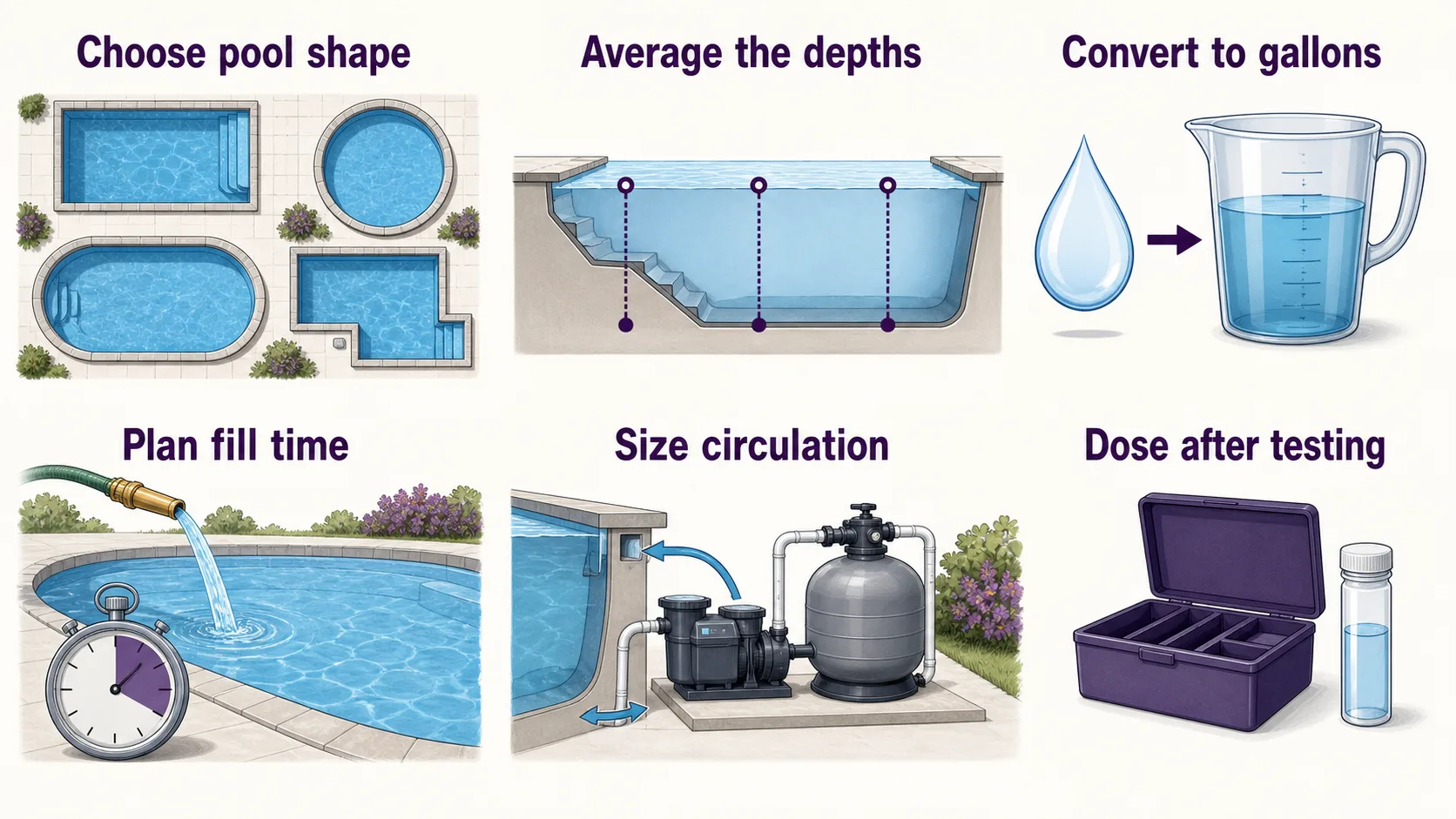
The same six steps as one path: shape, then depth, then gallons, then the hose, then circulation, and only then anything that goes in the water.
Worked pools
Pool volume for four real pools, round through freeform
Four pools worked through the same conversion this calculator uses, so the only thing changing between them is shape, footprint and how far the floor falls. Fill times sit at 500 gal per hour.
Above-ground round
5,288 gal
15 ft across · 4 ft flat
10.6 hr to fill
Flat floor, so the depth needs no averaging and every part of the circle holds the same depth of water.
Sloped rectangle
18,514 gal
30 x 15 ft · 3 to 8 ft
37 hr to fill
The common in-ground size, and the one people misread: the deep end holds a third of the water.
Large rectangle
35,906 gal
40 x 20 ft · 4 to 8 ft
71.8 hr to fill
Double the footprint of the sloped rectangle and a shallower slope, so the water almost doubles.
Kidney freeform
26,930 gal
40 x 20 ft · 4 to 8 ft
53.9 hr to fill
Same box as the large rectangle with the 0.75 factor applied, which is what keeps the chemical estimate from running high.
Gallon math
How this pool volume calculator turns shape and depth into gallons
Every shape resolves to a footprint, the footprint is multiplied by the average of your two depths, and the cubic feet are converted once. Metric entries are converted to feet before any of it runs, which is why the gallon and liter figures always agree.
Rectangular
your poollength x width x average depth
Round
pi x radius squared x average depth
Oval
pi x half length x half width x average depth
Kidney/freeform
length x width x average depth x 0.75
L-shape
(section 1 + section 2) x average depth
Then the same two conversions in every case, whichever shape produced the cubic feet:
average depth = (shallow + deep) / 2gallons = cubic feet x 7.48052liters = gallons x 3.78541pounds of water = gallons x 8.34What the options panel assumes
- Fill rate
- 500 gal/hr
- Turnover
- 8 hr
- Starter chlorine
- 2 oz / 10,000 gal
- Salt target
- 3,200 ppm
- Water rate
- $0.005 to $0.01 / gal
These five are editable starting points, not published standards. The volume above them is geometry; anything downstream of it is only as good as the number you put in its field.
Turnover, dosing and heating are all local decisions. Check your equipment documentation and your health authority rather than a default in a form.
Poolside questions
Pool volume questions: depth, dosing and fill time
The eight that come up before the hose goes in, answered against the same conversions and defaults this calculator runs on.
How do I calculate pool volume in gallons?
Work out the footprint area, multiply by the average depth to get cubic feet, then multiply by 7.48052 gallons per cubic foot. Metric inputs are converted to feet first, so the gallon and liter figures agree.
Why does average depth set pool volume instead of the deep end?
Because the floor slopes, most of the length sits nearer the shallow depth. A pool that runs 3 ft to 8 ft averages 5.5 ft, which is 31% less water than the same footprint would hold at 8 ft throughout.
How many gallons is a 15 ft round pool?
About 5,288 gallons at 4 ft deep. That is 176.7 sq ft of water surface times 4 ft of depth times 7.48052 gallons per cubic foot.
How long does it take to fill a pool?
Divide gallons by your fill rate. At the 500 gallons per hour this calculator starts with, an 18,514 gallon pool takes about 37 hours, so a large pool runs past two days.
How do I measure the shallow and deep depths?
Measure water depth at the shallow wall and again at the deepest point, not the height of the wall. A flat-bottom pool takes the same number in both fields.
Why is kidney pool volume lower than its rectangle?
A curved freeform pool does not fill the rectangle drawn around it. This calculator applies a 0.75 planning factor to length times width, so a 40 by 20 ft kidney comes out at 26,930 gallons rather than 35,906.
How much does it cost to fill a pool with water?
At the $0.005 to $0.01 per gallon this calculator starts with, an 18,514 gallon fill costs roughly $93 to $185. Municipal rates vary widely, so read your own bill and edit the rate.
Can I dose pool chemicals from volume alone?
No. Volume gives the starting quantity, then the test result and the product label decide the dose. The chlorine and salt figures here come from editable defaults, 2 oz per 10,000 gallons and a 3,200 ppm salt target.
Footprint chart
Pool volume by footprint, against the all-deep guess
Five common rectangular footprints on one axis. The solid bar is the footprint at your 5.5 ft average depth. The outline behind it is the same footprint held at 8 ft throughout, which is the figure people reach for by mistake.
Plunge 8 x 12 ft
3,950 gal
5,745 gal
Small 12 x 24 ft
11,849 gal
17,235 gal
Medium 16 x 32 ft
closest to yours21,065 gal
30,640 gal
Standard 20 x 40 ft
32,914 gal
47,875 gal
Large 20 x 44 ft
36,206 gal
52,663 gal
Rectangular footprints, water volume only. Every figure here is the footprint times a depth times 7.48052 gallons per cubic foot, the same route the calculator takes.
Disclaimer
These estimates are for planning purposes only. Actual costs vary by location, material availability, and project complexity. Always get at least 3 local quotes. This calculator does not replace professional advice.
Sources