Tank Volume Calculator
Calculate tank capacity in gallons and liters by shape, with partial-fill volume.
Tank shape and size
Shell
Diameter
The bore across the widest point. Radius is half of this.
Height
Floor to the top seam.
Estimates only. Not professional advice.
Capacity, brim full
423gal
Geometric volume of the shell. Nothing is taken off for freeboard, fittings, baffles, a dip tube or the wall thickness on a thick-walled tank.
- Volume
- π × (3 ft)² × 2 ft= 56.55 ft³
- Capacity
- 56.55 ft³ × 7.4805 gal/ft³= 423 gal
Last updated August 10, 2026. Conversion factors checked against NIST by our expert review team.
Dip and ullage
Partial tank volume: what a dip reading is actually worth
A tank standing up fills in step with its depth. A tank lying on its side does not, because the bore is widest across the middle, so the wetted cross-section is a circular segment and it is the area that scales. Most calculators stop at full capacity and leave you to guess this part.
Shaded is liquid, and the volume is that area multiplied by the run of the shell. Your tank is not a horizontal one, so this is the 2.25 ft by 5 ft shell the calculator starts with. Switch the shape to Horizontal to draw yours.
That shell at that level
circular segment- Brim full
- 149 gal
- In the shell now
- 29.1 gal
- Ullage above it
- 120 gal
- Wetted width
- 1.95 ft
Ullage is the empty part above the liquid, and it is the figure you order against. A reading taken down from the fill neck is already an ullage reading, so it does not belong in the liquid level field.
Segment area after Engineering ToolBox, volumes converted on the NIST factors in the sources below. Capsule and dished ends are not modelled.
The one depth the stick tells the truth
Halfway up the bore, and nowhere else. At half depth the segment is exactly half the circle, so a half-depth stick really is a half-full tank. Below the middle the bore is narrowing, so each step up the stick holds less than the step under it, and above the middle each step holds more. The error runs in opposite directions on either side of the centreline, which is why splitting the difference does not rescue a linear guess.
Dip chart for this shell, in 5 percent steps of the bore
Ø 2.25 ft · run 5 ftDip is the share of the bore the stick is wet to, depth the same thing as a measurement, and the percentage beside the gallons is the share of capacity. Print it and tape it inside the tank hatch.
Tape and stick
Measuring a tank for volume when there is no data plate
Half the tanks people need a figure for have no legible plate left on them, and the ones that do are often quoting a nominal size rather than the shell. Five steps, in the order they have to happen.
- 01
Strap the shell for the bore
Wrap a flexible tape all the way round the tank and divide the circumference by 3.1416. A tank that straps at 75 in is 23.9 in across. That reading is the outside, so on a thick poly tank take off twice the wall: a 0.3 in wall on a 24 in shell is about a gallon a foot of length you do not actually have.
- 02
Measure the straight run, not the ends
A horizontal tank is measured along the straight part of the shell, end seam to end seam. A vertical one is floor to top seam. Dished or hemispherical ends hold more than the cylinder formula gives them, so treat a plain cylinder figure as the floor on a capsule tank.
- 03
Dip from the bottom, not down from the top
Push a clean stick to the lowest point of the bore, pull it, and measure to the wet line. Measuring down from the fill neck gives you the ullage instead, which is the empty part, and the two are only the same number on a half-full tank.
- 04
Check the shape before you trust the number
The 275 gallon heating oil tank in half the basements in the country is obround, not round: a 27 in by 44 in section with semicircular ends, 60 in long. Worked as a 27 in cylinder it comes to about 149 gallons, and as a 27 by 44 by 60 in box to about 309. The truth is near 268, between the two.
- 05
Take the freeboard off last
Nothing is filled to the crown. Propane stops at 80 percent by rule so the liquid has somewhere to expand, and a water tank wants an inch or two under the fill neck. Geometric capacity is the ceiling, never the order.
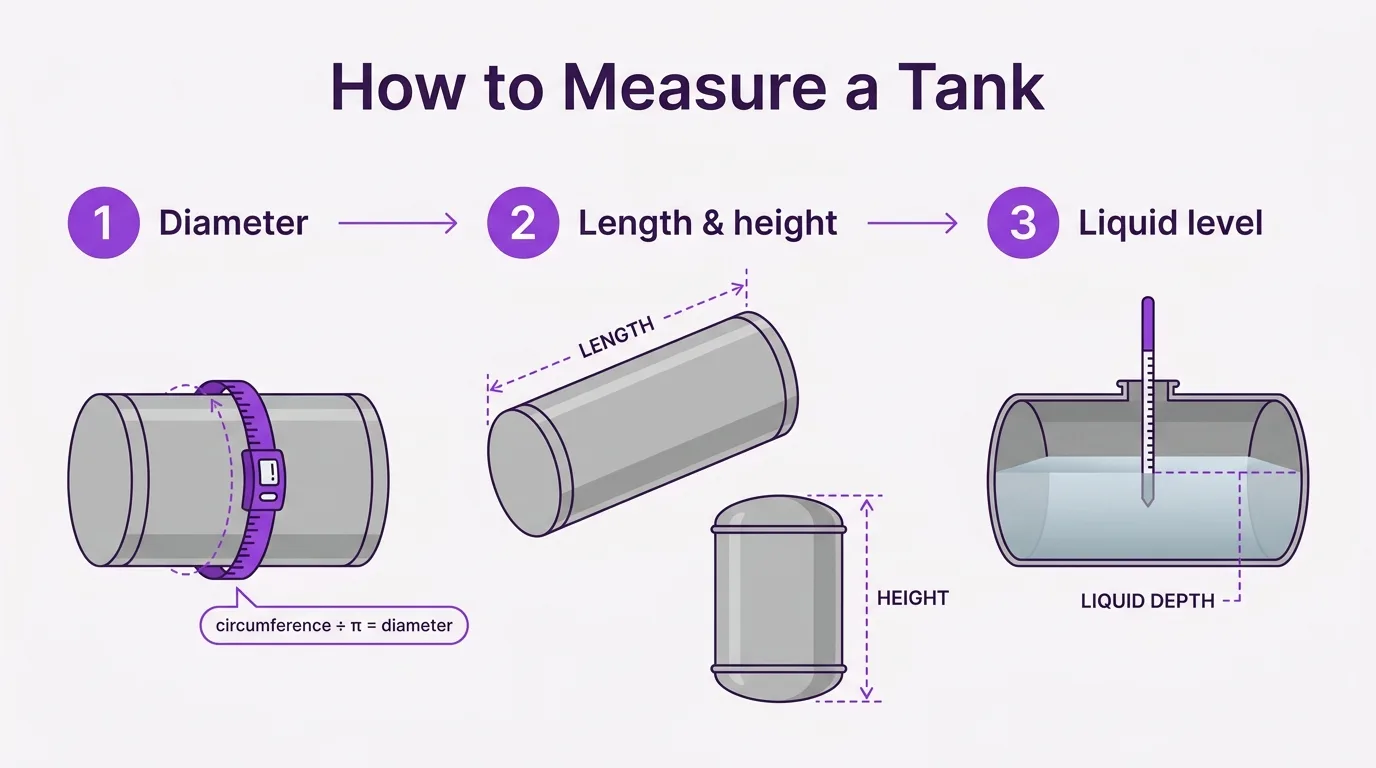
Strapping a tank you cannot reach across is the only measurement here that needs a trick. The other two are a straight tape and a clean stick.
Short measure
Where a tank volume figure goes wrong
Almost every one of these produces a number that still looks like a tank capacity. A volume out by a factor of four reads as perfectly plausible on a tank you have never measured, so none of them get caught by staring at the answer.
The radius went into the diameter field
Volume comes out at a quarter of the truth, because the radius is squared. Enter the full width across the bore and let the calculator halve it.
A dip reading read as a percentage of capacity
On a horizontal tank a quarter-depth stick is 19.6 percent of capacity, not 25. Read the depth off the dip chart above rather than off the stick.
A 275 gallon oil tank worked as a cylinder
That tank is obround. The cylinder formula gives about 149 gallons and the box formula about 309. Use the nameplate figure and keep the geometry for tanks that are really round.
Feet and inches multiplied together
Convert everything to one unit before it is multiplied. A 30 in diameter is 2.5 ft, and 30 left in the field alongside a length in feet is out by a factor of 144 on the area.
Outside dimensions used on a thick-walled tank
Steel is thin enough to ignore. A poly stock tank or a double-wall day tank is not, and the wall costs you volume on both sides of every dimension.
Geometric capacity ordered as a delivery
Order the ullage, which is capacity minus what is in there now, and then take the freeboard off that. Propane is capped at 80 percent filled and no supplier will exceed it.
A capsule tank treated as a plain cylinder
Rounded or dished ends add volume the straight shell does not have. A plain cylinder figure is the floor, so use the nameplate capacity when the ends are not flat.
Gauge questions
Tank volume questions, answered short
The eight that come up most, against the same segment formula and the same NIST conversion factors the calculator above runs on.
How do I calculate the volume of a tank in gallons?
Find the volume in cubic feet from the tank's shape, then multiply by 7.4805 gallons per cubic foot. A vertical cylinder is π × radius² × height; a rectangular tank is length × width × height.
How many gallons is my horizontal cylinder tank?
A horizontal cylindrical fuel or water tank 2 feet across and 6 feet long holds about 141 gallons. Enter your own diameter and length for an exact figure. Note that the common 275-gallon home heating-oil tank is an oval (obround) shape, so a true-cylinder estimate reads a little low for it.
How do I measure a tank's diameter if I can't reach across it?
Wrap a flexible tape around the outside to get the circumference, then divide by π (3.1416). A tank that measures 75 inches around is 75 ÷ 3.1416 ≈ 24 inches in diameter.
How do I find a partially filled tank's volume?
For vertical and rectangular tanks, the filled volume is proportional to the liquid depth. For a horizontal cylinder it is NOT linear: a half-full horizontal tank holds exactly half, but a quarter-depth holds less than a quarter. This calculator uses the circular-segment formula to get it right.
Why is a horizontal tank that's half-depth not half-full by volume except at the middle?
A horizontal cylinder is widest across the middle, so the volume per inch of depth changes as you go up. At exactly half the diameter it is half-full, but below that the cross-section narrows, so a given depth holds less than the simple percentage suggests.
What is the difference between radius and diameter when entering a tank?
Diameter is the full width across the circle; radius is half of it. This calculator asks for diameter and halves it internally. Entering the radius as the diameter will quarter the true volume.
How do I convert tank volume to liters?
Multiply cubic feet by 28.317 to get liters, or multiply US gallons by 3.785. One cubic foot is about 7.48 US gallons or 28.32 liters.
Does this work for capsule or oval tanks?
Not yet. This version covers vertical cylinders, horizontal cylinders, and rectangular tanks, which cover most home and farm tanks. Capsule (rounded-end) and oval tanks add their end caps to a cylinder body and will be added later.
Nameplate sizes
Tank capacity by type: drums, totes, propane and septic
A nominal size is a name, not a measurement, and the two only agree by accident. If your figure lands near one of these, the shell is probably that tank and the round number on the side is what to order against.
Your 423 gal shell is nearest a residential propane tank, sold as 500 gal.
Typical sizes, not a standard, and these are US nominal names, so the 275 gallon oil tank is about 1,040 liters. Manufacturers vary, and a propane tank is never filled past 80 percent of the figure printed on it.
Fill practice
Filling to a tank volume figure without overfilling
Capacity is where the arithmetic stops and the job starts. These are the deductions and the conversions that sit between the number above and something you can order, dose or carry.
Order the ullage, not the capacity. What fits is what the tank holds minus what is in it now, minus the freeboard nobody fills into. A tank reading a third full has two thirds of its capacity available on paper and rather less than that in practice.
Propane is filled to 80 percent and no further, because liquid propane expands with temperature and the vapour space above it is what keeps the relief valve shut. A 500 gallon tank takes 400 gallons on a delivery ticket, and that is not the driver short-filling you.
Dose chemicals against the water in the tank, not the number on the side. Half the depth of a stock tank is half the water, but half the depth of a tank lying on its side is also half the water, and a quarter of the depth is under a fifth. The dip chart above is the conversion.
Take the hardscape out of an aquarium before you trust the gallons. An inch and a half of substrate across a 48 by 18 in tank is 5.6 gallons of water you no longer have, and rock and wood take their own share on top of that.
Catching rainwater? An inch of rain landing on 100 square feet of roof is about 62 gallons, so a single 55 gallon barrel fills off a small shed in one shower. Size the roof first with the square footage calculator.
Water weighs about 8.34 lb a gallon, so a full 300 gallon stock tank is around 2,500 lb sitting on whatever is underneath it. Check the deck or the floor before the tank goes on it, not after.
Sizing a pool rather than a tank, or a plain box rather than a shell? The pool volume calculator handles pool shapes, and the cubic feet calculator or cubic yard calculator handle straight volume.
Three shells
Tank volume worked out for a fuel tank, a stock tank and an aquarium
One of each shape the calculator handles. Every figure below comes out of the calculator on this page, from the dimensions shown beside it.
Horizontal, 2 ft bore by 6 ft
Horizontal Fuel Tank
141gal
18.85 ft³ · 534 L
Use a stick reading as the liquid level to gauge how much fuel or water is left right now.
Vertical, 6 ft bore by 2 ft
Galvanized Stock Tank
423gal
56.55 ft³ · 1,601 L
A round stock tank doubles as a stock-tank pool. Round up for freeboard so it doesn't overflow.
Rectangular, 4 ft by 1.50 ft by 2 ft
Rectangular Aquarium
89.8gal
12 ft³ · 340 L
Glass aquariums are sized by gallons. Leave an inch of freeboard below the rim.
Segment geometry
Tank volume formulas, including the circular segment
Every number on this page comes off the nine lines below, and you should be able to reproduce any of them with a pocket calculator that has an inverse cosine on it.
r = diameter ÷ 2Vertical cylinder = π × r² × heightHorizontal cylinder = π × r² × lengthRectangular = length × width × heightSegment area A(h) = r² × acos((r − h) ÷ r) − (r − h) × √(2rh − h²)Partly filled horizontal = A(h) × lengthWetted width w = 2 × √(2rh − h²)gal = ft³ × 7.4805L = ft³ × 28.317In the segment line, h is the liquid depth measured up from the lowest point of the bore and r is the radius, both in the same unit. The inverse cosine returns radians, which is what makes the first term an area rather than a nonsense. The second term subtracts the triangle between the centre of the bore and the chord, and it flips sign on its own once h passes r, which is why the one expression covers a tank that is nearly empty and a tank that is nearly full.
Put h = r into it and acos(0) is π ÷ 2, so A = π r² ÷ 2 and the second term vanishes: exactly half the bore, which is the one depth where a linear reading is right. A vertical or rectangular tank never needs any of this, because a constant cross-section makes filled volume a straight multiple of depth.
Shell geometry only. Wall thickness, dished or hemispherical ends, internal baffles, heater coils, dip tubes, sludge and thermal expansion are not modelled, and volume is never converted to weight.
Conversion factors
NIST- 1 cubic foot
- 7.4805 gal
- 1 cubic foot
- 28.317 L
- 1 US gallon
- 3.785 L
- 1 cubic meter
- 1,000 L
- 1 foot
- 0.3048 m
US liquid gallons throughout. An imperial gallon is 4.546 L and would read about 20 percent low against these figures.
Shapes these formulas do not cover
Capsule and oval tanks carry rounded ends that hold volume a straight cylinder does not have, and the 275 gallon obround oil tank is neither a cylinder nor a box. Treat a plain cylinder figure as the floor on those, and use the nameplate capacity wherever the plate is still readable.
Disclaimer
These estimates are for planning purposes only. Actual costs vary by location, material availability, and project complexity. Always get at least 3 local quotes. This calculator does not replace professional advice.
Sources