Paver Calculator
Calculate pavers to order by area, paver size, joint gap and pattern waste.
Paver project
Quick start
Length (ft)
Longest side
Width (ft)
Shortest side
Paver face
Laying pattern
Before you call the yard
Ask for the pavers per pallet, the joint width the unit is designed around, and whether the colour run on the yard now is the one you will get. Those three answers move the order.
Estimates only. Not professional advice.
Pavers to order
520pieces
Enough 6x9 pavers to cover 192 sq ft in running bond, with the 5% pattern allowance already in it. That is 2 pallets at 360 per pallet.
- 520 pavers at $2.25 each
- $1,170
- Pallet price, if the yard quotes one
- enter it above
- Material range, $3 to $8 per sq ft
- $576 to $1,536
- Pavers per sq ft
- $6.09
Pavers only. Base stone, bedding sand, edge restraint, joint sand, delivery, saw hire and labour are all outside this figure.
Last updated August 10, 2026. Checked against CMHA and ICPI interlocking pavement guidance by our expert review team.
Border course
Where the cuts land in a paver field
Your field drawn to scale, with a soldier border and the pattern you picked laid inside it. Every shaded unit is one the border clips, which is what the pattern allowance is really paying for.
Both the field and the border come out of the same area-based count, so nothing here is an extra order line.
- Units the border clips
- 5012% of the field, every one of them a saw cut
- Whole units in the field
- 370Laid straight off the pallet with no trimming
- Border course units
- 102Standing 9 in across, at 6.13 in centres
- Joint width drawn
- 0.13 inThe gap the count already takes off the coverage
What the same field costs in each pattern
192 sq ft · 6x9 face · $2.25 each
Running bond
your pattern
5% fewest cuts
520 in 2 pallets
baseline
Basketweave
needs a 2:1 face
8% moderate cuts
535 in 2 pallets
+15 pc $34
Herringbone
needs a 2:1 face
15% most cuts
569 in 2 pallets
+49 pc $110
Herringbone costs $110 more than running bond on this field, 49 extra pavers, because a 45 degree field meets all four borders on the diagonal.
Yard and pallet
Buying pavers: the decisions that move the count
Seven habits that separate an order you can lay from one you have to top up. Most of them are settled before anybody measures anything.
Measure the paved field, not the excavation
The dig runs past the last paver so the edge restraint has something to bite. That extra margin is base and bedding, not pavers, and counting it inflates the order by a course all the way round.
Settle the border before you settle the size
A soldier course takes the odd dimension out of the field, so the interior is what gets cut and the visible outside edge stays whole. Decide it first or you buy the wrong ratio of pieces.
Buy the whole job on one delivery
Concrete pavers are coloured in batches, and two batches of the same product number rarely land on the same shade. A second load bought three weeks later shows as a patch.
Pull from three pallets at once
Even inside one delivery, shade drifts down the stack. Mixing as you lay spreads the variation across the field instead of banding it.
Keep the offcuts sorted, not swept up
A paver cut in half at one border usually fills the opposite one. Waste allowance covers breakage and the unusable end, not every cut you make.
Read the pallet count off the quote
Pallet counts move with thickness and manufacturer, so the 360 per pallet used here is a planning figure. Put the real number in and the pallet line changes with it.
Order the base and the bedding in the same call
The stone and sand under the field are a bigger delivery than the pavers. Size the base and the bedding course before you book the truck.
How your order breaks across pallets
6x9 face · 360 per pallet
- Full pallets
- 1Shipped and priced whole, and the cheapest way to buy
- On the last pallet
- 160Ask whether a part pallet is billed as a full one
- Spare after the field
- 25Cuts, breakage and the repair stock you keep back
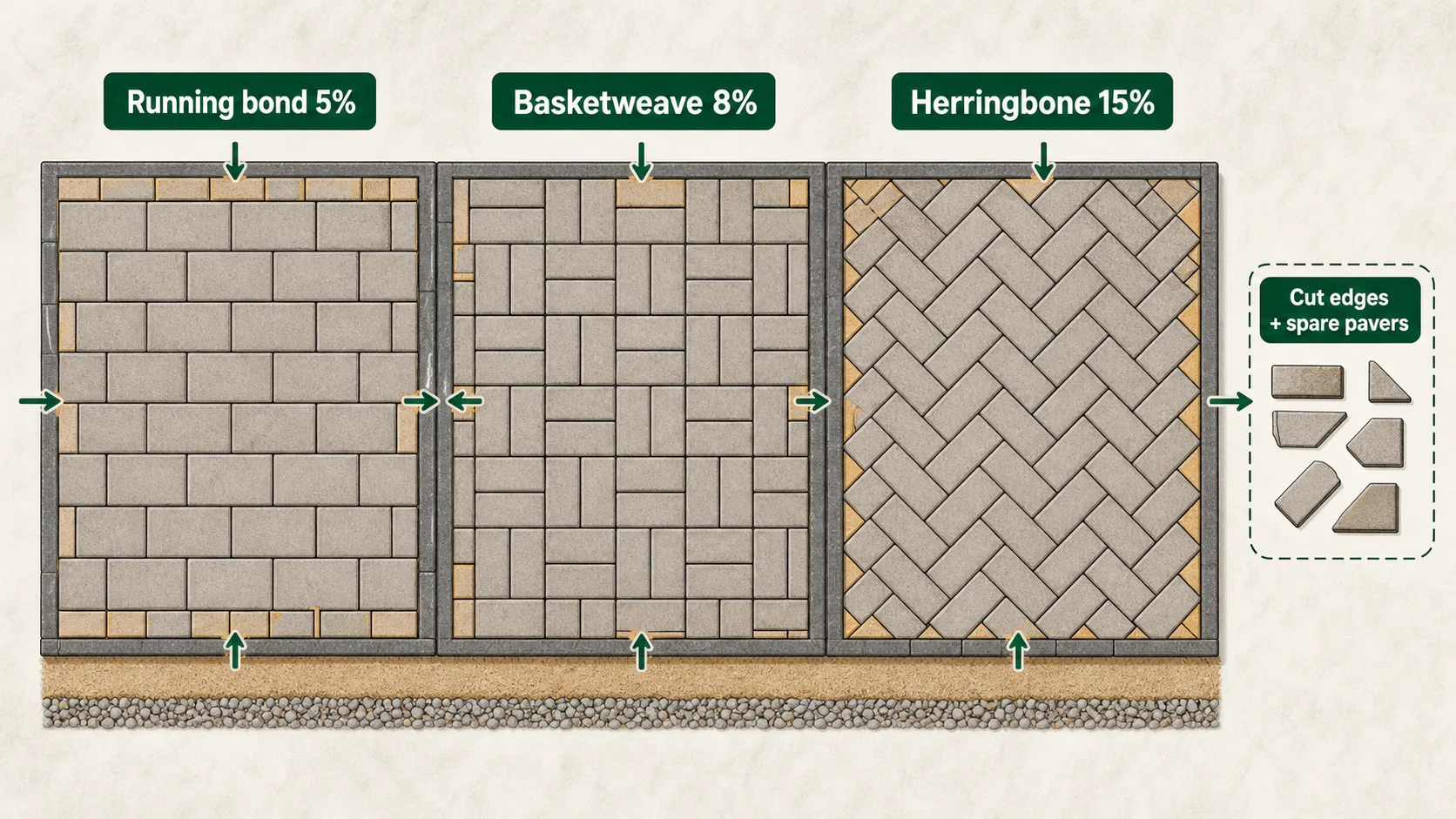
The three layouts as built fields, with the offcuts each one leaves along the edge. Running bond cuts on two sides, herringbone on four.
Joint width
Pavers per square foot, and what the joint does to it
Each bar runs from a butted joint down to a wide 3/8 in one on the same shared scale. The gap is most of a course on brick pavers and almost nothing on a large slab.
Pieces per sq ft before any pattern allowance. A butted joint is the high end of every bar, a 3/8 in tumbled joint the low end.
Which face lays which pattern
Herringbone and a true basketweave both need a face exactly twice as long as it is wide. That is one size in this list, and it is the reason 4 x 8 brick is still the default for a woven field.
- 4x8
- any pattern
- 6x6
- running bond
- 6x9
- running bond
- 12x12
- running bond
- 16x16
- running bond
A square unit still gives you a stack bond or a diagonal running bond, both of which cut like the 5% figure rather than the 15% one.
Short loads
Six ways a paver order comes up short
None of these show up while you are measuring. They show up on the day the last pallet runs out and the yard has moved to a different colour run.
Ordering the field count and nothing else
The exact count leaves no margin for a cracked corner, a bad cut, or the paver you break lifting it.
Keep the pattern allowance in, and keep the leftovers. A repair three years out needs pavers from this batch, not next year's shade.
Choosing herringbone for a paver that will not lay it
Herringbone and a true basketweave both need a face twice as long as it is wide. A 6 x 9 or a square unit cannot close the pattern.
Use a 2:1 unit for a woven or diagonal field, or lay the paver you have in running bond and put the movement in the border instead.
Ignoring the joint gap on a small paver
An eighth of an inch is nothing on a 16 in slab and it is most of a course over 200 sq ft of 4 x 8 brick.
Take the joint width off the supplier's spec sheet and enter it. The calculator drops the pieces per square foot to match.
Assuming every pallet holds the same count
A quote built on a 480 pallet and a delivery built on a 360 pallet is a whole pallet apart on a mid-sized patio.
Take the count off the quote. The pallet line here moves with the size you pick and is a planning default until you replace it.
Reading the material range as an installed price
The range on this page is pavers. Excavation, base, bedding, restraint, cuts, disposal and labour are the larger half of a real job.
Price the stack: pavers here, base and sand on the sibling pages, then add plant hire and haulage before you compare a contractor bid.
Laying the field first and the border last
A border set after the field has to absorb whatever gap is left, and it never lands on a whole unit.
Set the border course, string the field off it, and let the cuts fall against the inside edge of the border where they read as deliberate.
The first two are the same mistake twice: treating the pattern as decoration rather than as the thing that decides how many pieces get cut. The plan at the top of this page counts those cuts for you.
Order scope
What is in the paver count and what is not
The number at the top of this page is pavers, in pieces. Everything under them and around them is a separate delivery, and on most patios it is the larger one.
Field and border pavers
in the count
520 pc
2.58 per sq ft across 192 sq ft
Cut and spare pavers
in the count
25 pc
5% running bond allowance, already inside the count above
Pallets to move
in the count
2
360 per pallet, so the last one lands 44% full
Base stone, 6 in compacted
4.69 yd³
6.57 tons, priced on the paver base page
Bedding sand, 1 in screeded
17.60 ft³
0.88 tons, priced on the paver sand page
Edge restraint
56 ft
Whole perimeter, spiked through into the compacted base
Joint sand, geotextile, sealer
not counted
Coverage follows joint width and paver depth, so it comes off the product bag
Delivery, saw hire, labour
not counted
The half of a paver job that never appears on a material takeoff
The base and bedding quantities above use the same defaults as the sibling pages, 6 in of compacted aggregate and 1 in of screeded sand, so the three calculators agree on one hardscape. Paver base calculator for the stone, paver sand calculator for the bedding and joint sand. For the build sequence itself, the ICPI Tech Spec 2 order runs compacted subgrade, aggregate base, bedding sand, edge restraint, pavers, joint sand, then a final compaction pass over the finished field.
Counter answers
Paver counts, patterns and pallets, answered
Eight answers in the order they come up at the yard, from pieces per square foot to what the count deliberately leaves out.
How many 4x8 pavers are in a square foot?
About 4.5 4x8 pavers cover one square foot before waste or joint spacing. For a 100 sq ft running-bond patio, plan about 473 pavers with 5% waste.
How many pavers do I need for a 12x12 patio?
A 12x12 patio is 144 sq ft. With 6x9 pavers, 1/8 inch joints, and running-bond waste, this calculator estimates about 390 pavers, or 2 pallet at the 360-paver pallet assumption.
How much waste should I add for a herringbone paver pattern?
Use about 15% waste for herringbone. A 10x20 ft herringbone field with 4x8 pavers needs about 1035 pavers, compared with fewer pieces in a straight running-bond layout.
Running bond or herringbone: which pattern should I choose?
Running bond is easier, wastes less, and suits most patios and walkways. Herringbone has more visual movement and better interlock for traffic, but it usually needs more cut pieces along the edges.
Should I buy pavers by the piece or by the pallet?
Buy by the pallet when your count is close to a full pallet or the supplier charges less per paver that way. Keep the pavers-per-pallet number from the quote because pallet counts vary by paver thickness, size, and manufacturer.
How much does a paver patio cost?
Concrete paver material often budgets around $3 to $8 per sq ft before base, sand, edging, tools, delivery, and labor. Installed contractor prices are much higher because excavation, compaction, cuts, and site access drive the job.
Does this calculator include paver base and sand?
It estimates planning add-ons using the same default formulas as the paver-base and paver-sand calculators: 6 inches of compacted base, 1 inch of bedding sand, 10% material allowance, and 20% base compaction.
What is not included in the paver count?
The paver count does not include edge restraints, spikes, geotextile, sealer, saw blades, tool rental, delivery fees, or labor. It also does not replace a supplier takeoff for curved borders, inlays, steps, or mixed-size pattern kits.
Counted jobs
Four paver projects, counted end to end
Every figure below comes out of the calculator above at a 1/8 in joint. Type any one of them in and the numbers match to the piece.
Small Front Walk · 25 × 4 ft · 4x8
452 pavers
1 pallet · $520
100 sq ft · Running bond · 22 spare
Long narrow walks are friendly to running bond because most cuts happen at the ends and border.
Backyard Patio · 16 × 12 ft · 6x9
535 pavers
2 pallets · $1,204
192 sq ft · Basketweave · 40 spare
Basketweave adds more cuts than running bond, but it still stays manageable on a clean rectangle.
Herringbone Dining Patio · 20 × 18 ft · 4x8
1,779 pavers
4 pallets · $2,046
360 sq ft · Herringbone · 232 spare
The paver count climbs because diagonal edges create more cut pieces and spares.
Large Slab Courtyard · 24 × 20 ft · 16x16
280 pavers
4 pallets · $2,380
480 sq ft · Running bond · 14 spare
Large slabs reduce piece count, but pallet handling and base flatness matter more.
Face to pallet
The paver count, line by line
Four steps, and the joint gap enters at the first one rather than the last. Adding the joint to the face before dividing is what keeps a 1/8 in gap from quietly buying you an extra course.
- 01
Face plus joint
(6 + 0.13) × (9 + 0.13) in
The footprint one paver really occupies once the joint is allowed for
- 02
Pieces per unit area
144 ÷ that = 2.58 per sq ft
One square foot is 144 square inches, so the division is straight
- 03
Field then allowance
192 × 2.58 × 1.05 = 520
Rounded up, because the yard does not sell part pavers
- 04
Pallets to move
520 ÷ 360 = 2
Rounded up again, and worth checking against the quote
Assumptions
- Running bond allowance
- 5%
- Basketweave allowance
- 8%
- Herringbone allowance
- 15%
- 4 x 8 brick, butted
- 4.50 per sq ft
- Base under the field
- 6 in compacted
- Bedding course
- 1 in screeded
- Add-on material allowance
- 10%
- Base compaction allowance
- 20%
A waste override replaces the pattern allowance entirely, so the count follows your figure and not the layout you selected.
Disclaimer
These estimates are for planning purposes only. Actual costs vary by location, material availability, and project complexity. Always get at least 3 local quotes. This calculator does not replace professional advice.
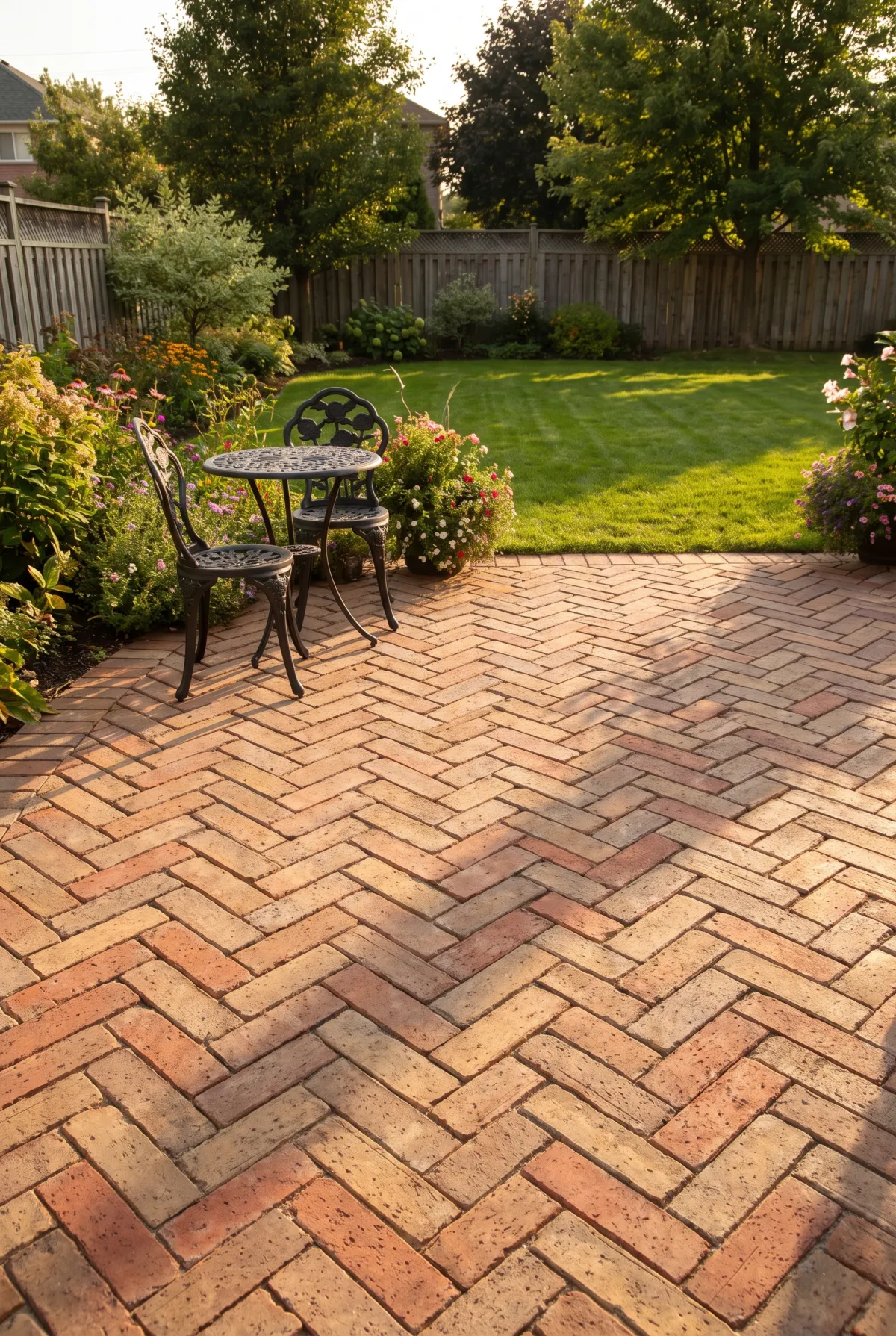 Layouts in the wild18 paver patio layouts, photographedBorders, banding and pattern changes on real patios, with the paver size noted on each.
Sources