Concrete Bags Calculator
Count 40, 60, and 80 lb bags for a slab, footing, or post hole, with weight and cost.
Project Dimensions
Project preset
Concrete Slab
4" typical
Patio or shed base. 80 lb bags keep the bag count lower.
Estimates only. Not professional advice.
Bags to buy
6280 lb bags
Concrete Slab at 4 in deep, including the 10% allowance. Past a cubic yard, price a truck against this.
- 80 lb bags at $6.50yours
- 62 bags, $403
- 60 lb bags at $5.50
- 82 bags, $451
- 50 lb bags at $5.00
- 98 bags, $490
- 40 lb bags at $4.50
- 123 bags, $554
- Mix cost per sq ft
- $4.03
62 bags is 4,960 lbs of mix to lift twice. Price a short load before you load the car.
Last updated August 10, 2026. Bag yields checked against QUIKRETE and SAKRETE product data by our expert review team.
Footprint
Your slab, drawn to scale, and the concrete bags it takes
A bag count is an abstraction until you see it as area. The plan below is your own footprint at one scale on both axes, ruled into squares that each hold exactly one bag at the depth you entered.
The ruled squares come to 56 bags of mix. Squares that run off the far edge are part bags, and the rest of your order is the waste allowance.
The bag in the drawing
- Bag
- 80 lb
- Yield on the label
- 0.6 cu ft
- Covers at this depth
- 1.8 sq ft
- Square side
- 16.1 in
- Bags in the pour
- 56
- Allowance on top
- 10%
- Bags to buy
- 62
Short load
Concrete bags or a ready-mix truck: where the two prices cross
Bagged mix costs roughly $293 per yd³ at shelf prices, well above delivered concrete. What keeps small jobs in bags is the short-load fee, and that fee is a flat charge, so it stops mattering as the pour grows. Everything below moves with your own inputs.
Cheaper option by pour size
yd³- The two prices cross at
- 0.94 yd³
- Bags at that crossover
- 43 bags, 3,440 lbs
- Short-load fee applies under
- 4 yd³
- Bagged rate at 80 lb
- $293 per yd³
Your pour, both ways
- 62 × 80 lb bags
- $403
- 1.36 yd³ delivered
- $344
- Short-load fee in that price
- $120
- Mix to lift and carry
- 4,960 lbs
At 1.36 yd³, the truck is cheaper by $59.
Bag prices are shelf averages and the delivered rate is whatever you typed in the options panel. Neither includes a mixer rental, a wheelbarrow, or the pump a back-garden pour sometimes needs.
Wasted bags
Where a bagged concrete pour goes wrong, and what it costs
None of these are visible on the day. Each one either raises the bag count you just calculated or quietly spends the strength you paid for.
Water added until the mix pours easily
Every extra litre of water past the mix design trades directly against 28-day strength.
Mix to a stiff, moldable body. Cut a trench in it with the trowel: if the walls hold their shape, the water is right. If it slumps closed, add dry mix.
Ordering to finished depth over a soft subgrade
Concrete finds every low spot before it finds the form.
Compact the subgrade and screed it flat before you count bags. Half an inch of dip under a 10 by 10 pad quietly swallows four more bags.
Mixing more bags than one crew can place
Standard mix begins stiffening 30 to 45 minutes after the water goes in.
Batch two or three bags at a time and keep one person placing while another mixes. A cold joint between batches is a permanent line in the slab.
Pouring against soil instead of forms
Unformed edges spread outward under their own weight, so the pour is thicker than planned everywhere it is not held.
Stake 2 by 4 forms every 2 to 3 ft and brace the corners. Forms are the cheapest way to make the bag count come true.
Pouring in the wrong weather
Below 50 F hydration stalls; above 90 F the surface flashes off before the body sets.
Aim for 50 to 80 F and overcast. Keep the slab damp for three days after, which matters more to final strength than the mix you bought.
Leaving out control joints
Concrete will crack; the only question is whether the crack follows a line you chose.
Cut joints every 8 to 10 ft, a quarter of the slab depth deep, while the surface is still green. The saw costs less than the patch.
Hauling
Buying and hauling concrete bags without wasting a trip
The bag count is the easy half. The rest is getting the right pallet home in one run and having it still be good mix when you open it.
Buy the whole count in one trip and from one pallet. Mixes change slightly between production runs, and a slab poured out of two runs can cure to two shades of grey.
Check the date code and squeeze the bags before loading. Bagged mix draws moisture in storage, and a bag with hard lumps in it will not gain full strength no matter how long you mix it.
Above roughly fifteen bags, rent a mixer for the day. Hand-mixing in a tub is realistic for a repair or a couple of post holes; it stops being realistic somewhere around bag number sixteen.
Dampen the base and the forms before placing, then let the surface water disappear. Dry ground and dry lumber both pull water out of the bottom of the pour, which is where you least want it gone.
Keep two or three bags back rather than returning them. Most yards take unopened bags back, but nobody delivers one bag at four in the afternoon with a half-finished slab going off.
For a stoop or a flight of steps, the volume comes from the riser and tread geometry rather than a footprint: use the concrete steps calculator. For round holes and sonotubes, the concrete cylinder calculator is the right shape.
If the pour starts with a dig, the soil coming out bulks up about a quarter once it is loose. The excavation calculator sizes the pile and the trips it takes to move it.
Counter questions
Concrete bag questions: yield, coverage, and when to stop bagging
The ten things people ask at the contractor desk, answered against published bag yields rather than rounded rules of thumb.
How many bags of concrete do I need?
Multiply length by width by depth in feet to get cubic feet, add a waste allowance, then divide by the yield printed on the bag. An 80 lb bag of standard mix yields about 0.60 cu ft.
How many 80 lb bags are in a cubic yard?
About 45 bags before waste. With a 10% allowance, order closer to 50 bags per cubic yard.
What does an 80 lb bag of concrete cover?
One 80 lb bag yields about 0.60 cu ft. At 4 inches thick that covers about 1.8 sq ft, so a 4 by 4 ft pad takes about 10 bags.
How many 60 lb bags are in a cubic yard?
About 60 bags before extra material. A 60 lb bag yields about 0.45 cu ft.
When should I stop buying bags and order ready-mix?
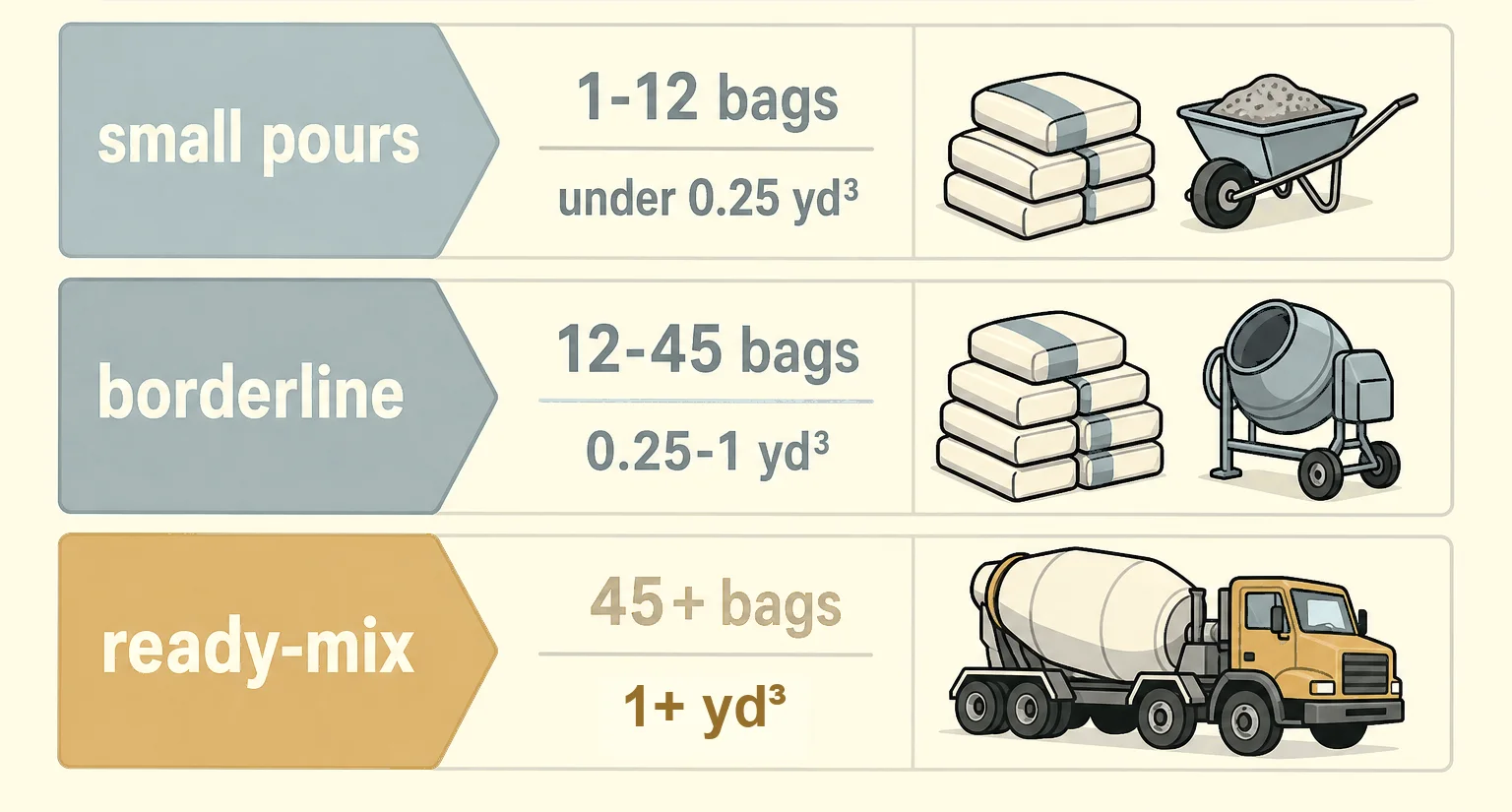
Around one cubic yard. That is roughly 45 bags of 80 lb mix, about 3,600 lb to carry and a full day of mixing for one person.
How much water does an 80 lb bag of concrete need?
About 6 pints to start, then more only as needed for a stiff, moldable mix. Extra water is the fastest way to weaken a slab.
How much waste should I add to a bag count?
Use 5% for tight forms on a compacted base, 10% for most DIY pours, and 15 to 20% for uneven ground.
How thick should concrete be?
Use 4 inches for patios and walks, 6 inches for light driveways, and 8 to 12 inches for many footings. Structural work should follow local code.
Can I use this calculator for post holes?
For square holes, yes. For round holes or sonotubes, use the concrete cylinder calculator.
Do bag yields vary by product?
Yes. Standard mixes are usually 0.30, 0.45, and 0.60 cu ft for 40, 60, and 80 lb bags. Lightweight or high-yield mixes can differ.
Mix water
Mixing concrete bags: water, batch size, and the 30-minute clock
Buying the right number of bags is arithmetic. Turning them into a slab that is still flat in ten years comes down to how much water goes in and how fast the mix leaves the tub. This is the part the bag count cannot tell you.
Start dry and add the last water by the cup
Published starting water is a floor, not a target. Add most of it, mix until the colour is even, then bring it in slowly. Aggregate that arrived damp counts toward the total, so a pallet left in the rain needs noticeably less.
Judge the mix by a trowel cut, not by how it pours
Draw the trowel through the batch. The trench should hold its walls with no free water in the bottom. Concrete that levels itself behind the blade has too much water in it and will cure soft and dusty.
Batch to the placing rate, not the mixer capacity
Standard mix starts stiffening 30 to 45 minutes after the water goes in, sooner in heat. Two or three bags per batch keeps a single person ahead of it. Anything left in the tub past that window belongs in the bin, not in the form.
Screed, then wait, then finish
Strike the surface off the forms immediately and then leave it alone. Bleed water has to rise and evaporate before floating and troweling, and working it early seals that water under the surface where it becomes scaling in the first winter.
Cure it wet for three days
Concrete does not dry, it reacts, and the reaction stops when the water is gone. Cover with plastic or keep it damp for three days. This single habit is worth more strength than any upgrade you could have made at the bag price.
Starting water per bag
Scaled from the 80 lb figure QUIKRETE prints on the bag. Fast-setting and high-strength mixes list their own water, so read the label you bought.
The clock, once the water is in
- Workable in the tub
- 30 to 45 min
- Trowel window
- 2 to 4 hr
- Walk on it
- 24 to 48 hr
- Keep it damp for
- 3 days
- Design strength
- 28 days
All of it runs faster in heat and wind, and stalls below 50 F. Plan the pour around the first row, because that is the one you cannot negotiate with.
Three pours
Concrete bags for three real pours, counted and priced
All three run through the same yield and the same 10% allowance the calculator uses, at 80 lb bags and shelf prices. Type the dimensions in and you get these numbers back.
Patio slab
62 bags
- Pour
- 10 × 10 ft at 4 in
- Volume
- 1.36 yd³
- Mix cost
- $403
Past the comfort zone for one person with a mixer. This is the size where a short-load quote starts to look reasonable.
Six post holes
12 bags
- Pour
- 10 in round, 24 in deep
- Volume
- 0.27 yd³
- Mix cost
- $78
Round holes, so the volume is π r² h rather than a footprint. A morning's work with a wheelbarrow and no delivery worth booking.
Front walk
49 bags
- Pour
- 4 × 20 ft at 4 in
- Volume
- 1.09 yd³
- Mix cost
- $319
Right on the threshold. If the short-load fee is under about $150, the truck buys back a long afternoon of mixing.
Bag yield
How many bags of concrete in a cubic yard, by bag size
Every row is computed from the same yield the calculator divides by, so this table and your answer can never disagree. The last column moves with the depth you entered.
Yields are the planning figures published for standard Sakrete and Quikrete concrete mix. Fast-setting, high-strength, and lightweight products all yield differently, and the number on the bag beats the number in this table every time.
Bag arithmetic
Turning a footprint into a concrete bag count
Three steps, and the only one with any judgement in it is the allowance. Depth is what moves the answer most: the same footprint at 6 in takes half again as many bags as at 4 in.
Footprint times depth gives the volume of the hole you are filling. The allowance is added on top, because forms leak, subgrades dip, and a wheelbarrow always keeps some. That total is then divided by the yield printed on the bag and rounded up, since half a bag is not a thing you can buy.
cu ft = L × W × (d ÷ 12)order = cu ft × (1 + allowance)bags = ⌈order ÷ yield⌉weight = bags × bag weightcost = bags × shelf price- Yield in use
- 0.6 cu ft
- Allowance
- 10%
- Bags per yd³
- 45
- Full strength at
- 28 days
Shelf prices are national planning averages and move with region and season. Rebar, mesh, forms, gravel base, and mixer rental are all outside this figure, and on a small pad they can add up to more than the concrete does.
Disclaimer
These estimates are for planning purposes only. Actual costs vary by location, material availability, and project complexity. Always get at least 3 local quotes. This calculator does not replace professional advice.
Sources