Concrete Weight Calculator
Calculate what a pour weighs in pounds, tons or kilograms, and how many loads it takes to move.
Weight Details
Total weight
5,000lb
of standard (normal weight) concrete, 1.23 yd³ at 150 lb/ft³ over 100 ft².
- Loads at 40,000 lb
- 1
- Pickup trips at 1,500 lb
- 4
- Load on what it sits on
- 50 lb/ft²
- Weight per cubic yard
- 4,050 lb
Wet weight at a nominal unit weight for the selected mix. Loads and trips round up.
Estimates only. Not professional advice.
Last updated August 5, 2026 by our expert review team.
Haul ledger
Concrete weight in loads: barrows, pickups and the delivery crossover
A weight on its own decides nothing. What it decides is how many times something has to move, and concrete runs a vehicle out of payload while the bed still looks empty. Four ways to move the same pour, counted in loads rather than pounds.
Every bar is the same pour at the same weight. The divisions are where one load ends and the next begins, so a narrow last division is a part load.
Wheelbarrow, mixed on site
300 lb
2 ft³
17last 67% full
Half-ton pickup bed
1,500 lb
10 ft³
4last 33% full
Dump truck or tandem trailer
40,000 lb
266.7 ft³
1last 13% full
Ready-mix truck to the forms
40,500 lb
270 ft³
1last 12% full
One ready-mix drum load carries what 27 pickup trips carry, and 135 barrow trips. That ratio is the whole crossover: hauling it yourself is repeating a drive that a delivery does once, so the sensible cutoff is wherever repeating it stops being worth the saving. Your pour is 4 pickup trips or 17 barrow trips.
The pickup payload and the barrow load are assumptions set in the haul options above, not ratings this page can look up for your vehicle. Read the payload off your own door jamb sticker and subtract passengers and tools. A barrow filled to its rated volume with concrete holds far more than one person can push, so the load figure here is about the pusher, not the barrow. The dump truck and drum figures are the ones this calculator already used.
Unit weight
What a cubic foot of concrete weighs, by mix
Four mixes on one axis. The gap between the lightest and the heaviest is more than double, which is why the mix design belongs in a haul plan.
Standard (Normal Weight)
your mix150 lb/ft³ · 4,050 lb per yd³
5,000 lb
Reinforced (with Rebar)
156 lb/ft³ · 4,212 lb per yd³
5,199 lb
Lightweight Aggregate
110 lb/ft³ · 2,970 lb per yd³
3,666 lb
Heavyweight (Radiation Shield)
250 lb/ft³ · 6,750 lb per yd³
8,333 lb
Unit weights are nominal and shift with aggregate, water content and curing. For a figure an engineer will sign, use the unit weight on the supplier's mix design.
Weights worth knowing
- A cubic yard, standard mix
- 4,050 lb
- One US short ton
- 2,000 lb
- One metric tonne
- 2,205 lb
- Dump truck, loaded
- 40,000 lb
- Ready-mix drum
- 10 yd³
Volume and density
Where concrete weight comes from, and what moves it
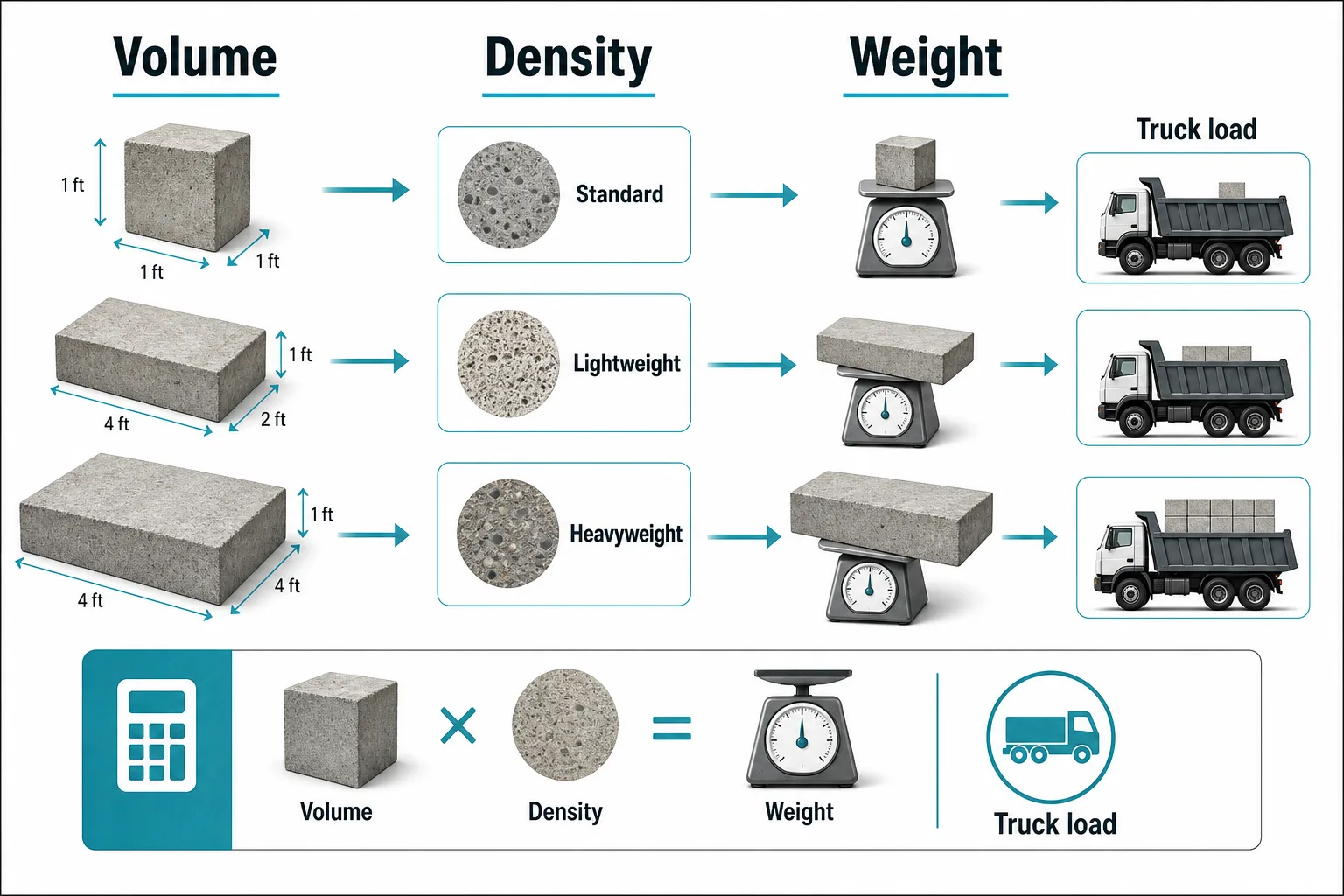
A cubic yard of standard concrete weighs about 4,050 lb, which is just over two US short tons. Every other figure on this page is that one arithmetic step, volume times density, run on a different mix or a different size.
The aggregate
Expanded shale or clay gives 110 lb/ft³. Ordinary gravel gives 150 lb/ft³. Barite or steel aggregate for shielding reaches 250 lb/ft³, which is over twice the lightweight figure for the identical volume.
The steel in it
Reinforced concrete comes out around 156 lb/ft³, a few percent over plain. Small per unit volume, and the reason a big pour needs one more load than the plain figure suggests.
The water still in it
Fresh concrete runs about 10% heavier than the same concrete cured. Transport, formwork and shoring all carry the fresh weight; the structure carries the cured one.
How thick you pour it
Thickness turns a density into a load per unit area. Density times thickness is what the deck, the joists or the subgrade underneath actually feel, and for your pour that is 50 lb/ft².
Stranded loads
Weight mistakes that leave a load stranded
Each of these is decided before anything moves, and none of them is fixable with a loaded truck sitting in the driveway.
Planning the haul off cured weight
Fresh concrete runs about 10% heavier than the same concrete once it has cured, and it is the fresh weight that rides in the truck. Size the load off wet weight and treat the cured figure as the number the finished structure carries.
Filling a pickup bed by eye instead of by weight
Concrete runs out of payload long before it runs out of bed. At 150 lb/ft³ you reach a 1,500 lb payload after roughly 10 ft³, which is a puddle in the corner of the bed and nowhere near the rails.
Assuming every mix weighs the same per unit volume
Lightweight aggregate runs 110 lb/ft³ and heavyweight shielding mix runs 250 lb/ft³. The same forms filled with the second weigh more than twice the first, so the haul plan changes with the mix design, not just the size.
Leaving rebar out of the number
Reinforced concrete is 156 lb/ft³ against 150 lb/ft³ for plain. It is only a few percent, but on a big pour it is the few percent that pushes the last load over.
Quoting tons without saying which ton
A US short ton is 2,000 lb. A metric tonne is about 2,205 lb. Both appear on the readout above for that reason, and a spec written in one and read in the other is out by roughly a tenth.
Pouring onto a deck or a floor without checking what it sits on
Density times thickness gives the load per unit area, and this page shows it for your pour. What it cannot tell you is the limit for your structure. That comes from the framing, the span and the drawings, so ask an engineer rather than a calculator.
Worked hauls
Concrete weight by pour size: four hauls worked through
Type any of these into the calculator above and you get the same numbers back. Trips use the payload you set, so the last row changes with your own truck.
Front walk
1,600
lb of concrete
0.8 US tons
- Size
- 4 × 8 ft at 4 in
- Mix
- Standard
- Volume
- 10.7 ft³
- Pickup trips
- 2
- Drum loads
- 1
Small enough that mixing it on site is a real option, and heavy enough that the mixed concrete still moves one barrow at a time.
Backyard patio
5,000
lb of concrete
2.5 US tons
- Size
- 10 × 10 ft at 4 in
- Mix
- Standard
- Volume
- 33.3 ft³
- Pickup trips
- 4
- Drum loads
- 1
The size where hauling stops being sensible. Count the trips above, then price the same pour with our concrete cost calculator.
Two-car driveway
60,000
lb of concrete
30 US tons
- Size
- 20 × 40 ft at 6 in
- Mix
- Standard
- Volume
- 400 ft³
- Pickup trips
- 40
- Drum loads
- 2
Nobody is moving this by pickup. The interesting number here is how few drum loads it is, and how many trips each one replaces.
Lightweight roof topping
11,000
lb of concrete
5.5 US tons
- Size
- 20 × 30 ft at 2 in
- Mix
- Lightweight Aggregate
- Volume
- 100 ft³
- Pickup trips
- 8
- Drum loads
- 1
Same arithmetic, lighter mix. Switch the calculator above to lightweight and the load count drops with it.
At the scale
How much does concrete weigh? The eight questions people ask
Answers in the order they tend to arrive, starting with the cubic yard figure the rest of the page is built on.
How much does a cubic yard of concrete weigh?
Standard concrete weighs about 4,050 lbs (2 tons) per cubic yard. Lightweight concrete is around 2,970 lbs per cubic yard, and heavyweight concrete used for radiation shielding can reach 6,750 lbs per cubic yard.
How much does an 80lb bag of concrete weigh when cured?
An 80lb bag of dry concrete mix weighs 80 lbs before mixing. Once cured, the finished concrete from one bag weighs roughly the same because the water that was added mostly reacts chemically rather than adding significant mass.
How much does a 10x10 slab weigh?
A 10x10 foot slab at 4 inches thick contains 33.3 cubic feet of concrete. At 150 lbs per cubic foot, it weighs about 5,000 lbs (2.5 tons).
What is the difference between wet and dry concrete weight?
Freshly poured (wet) concrete weighs about 10% more than cured concrete. Fresh concrete runs around 150 lbs per cubic foot, while fully cured concrete settles near 145 lbs. For transport and formwork load calculations, always use wet weight.
How does lightweight concrete compare to standard?
Lightweight concrete uses expanded shale, clay, or slate aggregate instead of gravel. It weighs 110 lbs per cubic foot versus 150 lbs for standard. The tradeoff is lower compressive strength, typically 3,000 to 4,000 PSI versus 4,000 to 5,000 PSI for standard.
How do I calculate dead load from concrete weight?
Dead load equals the concrete density times the thickness. For a 6-inch standard slab: 150 lbs/cu ft times 0.5 ft = 75 lbs per square foot. Building codes use this to size footings, beams, and columns.
What are the transport weight limits for concrete?
A standard dump truck carries about 40,000 lbs gross vehicle weight (roughly 20,000 lbs of payload). A concrete mixer truck holds 10 cubic yards, which weighs about 40,000 lbs. Highway weight limits vary by state but are typically 80,000 lbs total.
How much does a concrete block wall weigh?
Standard 8x8x16 inch CMU blocks weigh about 35 lbs each when filled with grout. A filled block wall weighs roughly 78 lbs per square foot of wall area. An unfilled block wall weighs about 55 lbs per square foot.
Volume to pounds
How this concrete weight calculator gets from a size to a load
One multiplication and a handful of conversions. Everything on the page, including the haul ledger and the worked hauls, comes off these lines.
volume ft³ = length × width × (thickness ÷ 12)weight lb = volume ft³ × density lb/ft³US tons = lb ÷ 2,000kg = lb × 0.4536tonnes = kg ÷ 1,000yd³ = ft³ ÷ 27truck loads = ceil(lb ÷ 40,000)load per ft² = density × thickness ftIn metric the entered size converts to feet and inches first, weighs in pounds, then converts back, so both readouts come from one calculation rather than two. Loads and trips round up, because a part load still needs the trip. The haul ledger divides the same weight by capacities you set, and it never feeds anything back into the weight.
Not included: the mixer, the tools, the pallet, the water you add on site, or any limit on what the ground or the structure under the pour can carry.
Bag counts and prices live where they belong: our concrete bags calculator counts bags, and our concrete cost calculator prices the pour.
On site
Working around concrete weight on the day
Not a sequence, so not numbered. Each one is a habit that keeps a heavy load from becoming the reason a pour goes sideways.
- Weigh the wet pour, not the cured slab.
- Transport, formwork and shoring all carry the fresh weight, which runs about 10% above the cured figure. Set the volume with our concrete slab calculator first, then weigh it here.
- Buying bagged mix means carrying the finished weight home.
- A bag weighs about what the concrete out of it weighs, so the pallet in the bed is the same load as the pour. Count the bags with our concrete bags calculator and split the run across trips.
- Check access before you check price.
- A drum truck needs room to reach the forms. Where it cannot, the concrete lands where the truck can stop and moves the rest of the way by barrow, which is a different job with a different day rate. Compare it against delivery with our concrete cost calculator.
- Spread barrow runs across two people, not two hours.
- One person pushing loaded barrows sets the pace of the whole pour, and concrete does not wait. Trips are the unit to plan around, and the ledger above counts them for the load you entered.
- Broken concrete is heavier to move than it looks.
- Demolition debris is the same weight as the slab, arriving in pieces you cannot lift. Size the skip and the haul with our concrete removal calculator.
- Weigh the spoil you dig out, too.
- Excavated soil leaves the site before concrete arrives, and it is often the bigger load of the two. Our excavation calculator sizes it.
- Match the density to the mix on the ticket.
- For a dead load figure an engineer will use, the density has to be the one the supplier is actually batching, not the round number. Ask for the unit weight on the mix design.
Disclaimer
These estimates are for planning purposes only. Actual costs vary by location, material availability, and project complexity. Always get at least 3 local quotes. This calculator does not replace professional advice.
Sources