Concrete Footing Calculator
Calculate concrete, bags and rebar for strip and pad footings, sized to the soil under them.
Footing Details
Footing type
Estimates only. Not professional advice.
Concrete to order
2.9cu yd
80 ft of trench at 16 in by 8 in, including the 10% allowance.
- Volume in the forms
- 78.22 cu ft
- Ready-mix delivered
- $362 to $435
- Truck capacity assumed
- 10 cu yd
- Ready-mix per ft of trench
- $4.98
Last updated August 12, 2026. Widths, depths and bearing values checked against the 2021 IRC Chapter 4 by our expert review team.
Bearing plane
How wide your concrete footing has to be on this soil
Two different things decide a footing, and people mix them up constantly. The frost line decides how deep the trench goes. The soil at the bottom of it decides how wide the footing has to be, because the load divided by the bearing area has to stay under what that soil can carry.
Depth into the page is the run of the trench, which the section cannot show. Nothing is exaggerated, so a shallow trench really does look that shallow.
- Footing width
- 16 in
- Thickness
- 8 in
- Depth to bearing
- 36 in
- Projection each side
- 4 in
Load over bearing area
- Load on the trench
- 2,375 lb/ft
- Soil under it
- 2,000 psf
- Pressure delivered
- 1,781 psf
- Width the soil needs
- 14 in
- Your width
- 16 in
Bearing governs here, and your 16 in clears the 14 in it needs. You are using 89% of what this soil can carry.
Three trenches
Concrete footing takeoffs for a garage, a house perimeter and deck pads
All three run through the same 10% allowance and the same 0.6 cu ft bag yield the answer above uses. Each one also carries the bearing figure, because the width in the spec is only defensible against a soil.
Garage perimeter, 1 story
2.9 cu yd
- Trench
- 80 ft at 16 in by 8 in
- Soil assumed
- 2,000 psf
- Pressure, at most
- 1,125 psf
- 80 lb bags
- 131
A single storey wall is the case where bearing never governs on ordinary ground. The 12 in floor in R403.1.1 is what sets the width, and everything past it is margin rather than code.
House perimeter, 2 stories on clay
8.6 cu yd
- Trench
- 160 ft at 19 in by 10 in
- Soil assumed
- 1,500 psf
- Pressure delivered
- 1,500 psf
- 80 lb bags
- 388
That width is the IRC's own figure for two storeys on the weakest class in the table, and it uses the full 1,500 psf. Move the same house onto 2,000 psf sand and it drops to 14 in, a quarter less concrete for an identical building.
Six deck pads
0.98 cu yd
- Pads
- 6 at 24 in square by 12 in
- Soil assumed
- 1,500 psf
- Capacity per pad
- 6,000 lb
- 80 lb bags
- 45
4 sq ft of bearing on the weakest class carries 6,000 lb, which is roughly 120 sq ft of deck per post at 50 psf of combined live and dead load. Bags are practical at this volume.
The one storey pressure is a ceiling rather than a design load: the IRC publishes the same 12 in width for that row at every soil value, so the load it multiplies back out to is the most the table can be carrying, not the load your particular wall delivers.
Presumptive values
Concrete footing width by soil class, from bedrock to soft clay
Every row carries the same building: 2 stories, basement, which works out at about 2,375 lb/ft along the wall. Only the soil changes, and the width moves in exact proportion to it until the 12 in code floor takes over.
Bearing values are IRC Table R401.4.1. The width column is that load divided by the bearing value, floored at the 12 in minimum in R403.1.1, and the last two columns price the difference at the 8 in thickness already entered and ready-mix at $125 to $150 per cubic yard. Where the IRC publishes a width for the same case these agree to within an inch, because the published table rounds. Add $50 to $100 for a short-load fee under 3 cubic yards, which is most single footing pours.
Frost heave
Where concrete footings actually fail: frost, fill and width
Almost none of these are a concrete problem. A footing fails because the trench was too shallow for the winter, too narrow for the soil, or bottomed out on something that was never going to hold still.
Bottom of the trench above the frost line
Water in the soil under the footing expands as it freezes and lifts the whole foundation, then drops it unevenly in the thaw.
Dig to the frost depth your building department publishes, not to a number off the internet. Where no frost is published, the bottom still sits at least 12 in below undisturbed grade.
Code minimum width on soil nobody looked at
The 12 in minimum is a floor, not an answer. A two-storey wall on clay wants 19 in, and pouring 12 instead puts about 2,375 psf onto soil rated for 1,500.
Identify the soil class at the bottom of the trench, not at the surface, then divide the load by its bearing value. Where the answer disagrees with the table, believe the wider of the two.
Pouring onto fill or a loosened bottom
The presumptive table describes undisturbed natural soil. Backfill and the loose spoil a bucket leaves behind compress for years under load.
Hand clean the last inch or two of the trench, and where you have over dug, bring it back with compacted crushed stone in lifts rather than the soil you took out.
A footing that projects further than it is thick
The projection is a cantilever. Once it reaches past the footing thickness it wants tension steel that a plain footing does not have, and the corner cracks off.
Keep the projection between 2 in and the footing thickness. A wider footing that needs more projection needs more thickness with it, not just more width.
Rebar laid straight on the dirt
Steel touching soil has no cover, so it rusts, swells and splits the concrete off. It also contributes nothing where it sits.
Chair the bars 3 in up from the bottom and 3 in in from each side. In Seismic Design Categories D0 to D2 the IRC requires at least two continuous number 4 bars.
Trench walls used as the form
A ragged trench overruns on volume and leaves the top of the footing out of level, which then throws the first course of the wall.
Form at least the top of the pour with staked 2x stock every 2 to 3 ft, and screed the top flat. A footing out of level is paid for again in mortar or shims.
Trench takeoff
The trench arithmetic behind a concrete footing estimate
Four lines, and the only judgement in any of them is the allowance. Width and thickness arrive in inches and have to become feet before they multiply against a run measured in feet, which is where most hand estimates go wrong by a factor of twelve.
A strip footing is one long prism: the run in feet times the width and thickness in feet. A set of pads is the volume of one pad times the count. The allowance goes on the total, because trench sides slump and forms leak, then the result is divided by 27 for cubic yards or by the yield printed on the bag. Rebar is estimated as two continuous bars along the run plus a transverse bar every 18 in, and truckloads assume a full 10 yard mixer.
strip = run × (W ÷ 12) × (T ÷ 12)pads = (L × W × T ÷ 1728) × countorder = volume × (1 + allowance)bags = ⌈order ÷ 0.6⌉- Allowance in use
- 10%
- 80 lb bag yield
- 0.6 cu ft
- Cubic feet per yard
- 27
- Bags in your order
- 131
This is a material takeoff and a code check, not a structural design. Reinforcement schedules, dowels into the wall above, drainage, and anything sitting on fill or a slope belong to your local building department and, past a certain point, to an engineer.
Below grade
Concrete footings: width, depth, rebar and soil bearing
The eight questions people ask before they dig, answered against the 2021 IRC rather than against the numbers that get repeated on forums.
How wide should a concrete footing be?
Divide the load the footing carries by the bearing value of the soil under it. A 2,375 lb per foot wall on 1,500 psf clay needs 19 inches; the same wall on 2,000 psf sand needs 14. IRC R403.1.1 sets a floor of 12 inches wide and 6 inches thick no matter what the arithmetic returns.
What soil bearing capacity should I assume?
IRC Table R401.4.1 gives presumptive values in lieu of a geotechnical evaluation: 1,500 psf for clay and silt, 2,000 psf for sand and silty or clayey gravel, 3,000 psf for sandy gravel, 4,000 psf for sedimentary rock and 12,000 psf for crystalline bedrock. They apply to undisturbed natural soil only.
How deep does a concrete footing need to be?
The bottom of an exterior footing goes below the published frost line for your jurisdiction, and in no case less than 12 inches below undisturbed ground. Frost depth runs from nothing along the Gulf to 48 inches and more across the northern tier, so it is a local number rather than a national one.
What is the frost line and why does it matter for footings?
It is the depth to which soil freezes in a normal winter. Water in freezing soil expands, so a footing above that depth is lifted every winter and dropped every spring. Frost decides how deep the trench goes; the soil under it decides how wide the footing is.
Do concrete footings need rebar?
The IRC requires at least two continuous number 4 bars in footings in Seismic Design Categories D0, D1 and D2. Elsewhere a plain concrete footing is permitted, but two continuous bars cost very little against the trench and they hold a crack together when the ground moves.
What is the difference between a strip footing and a pad footing?
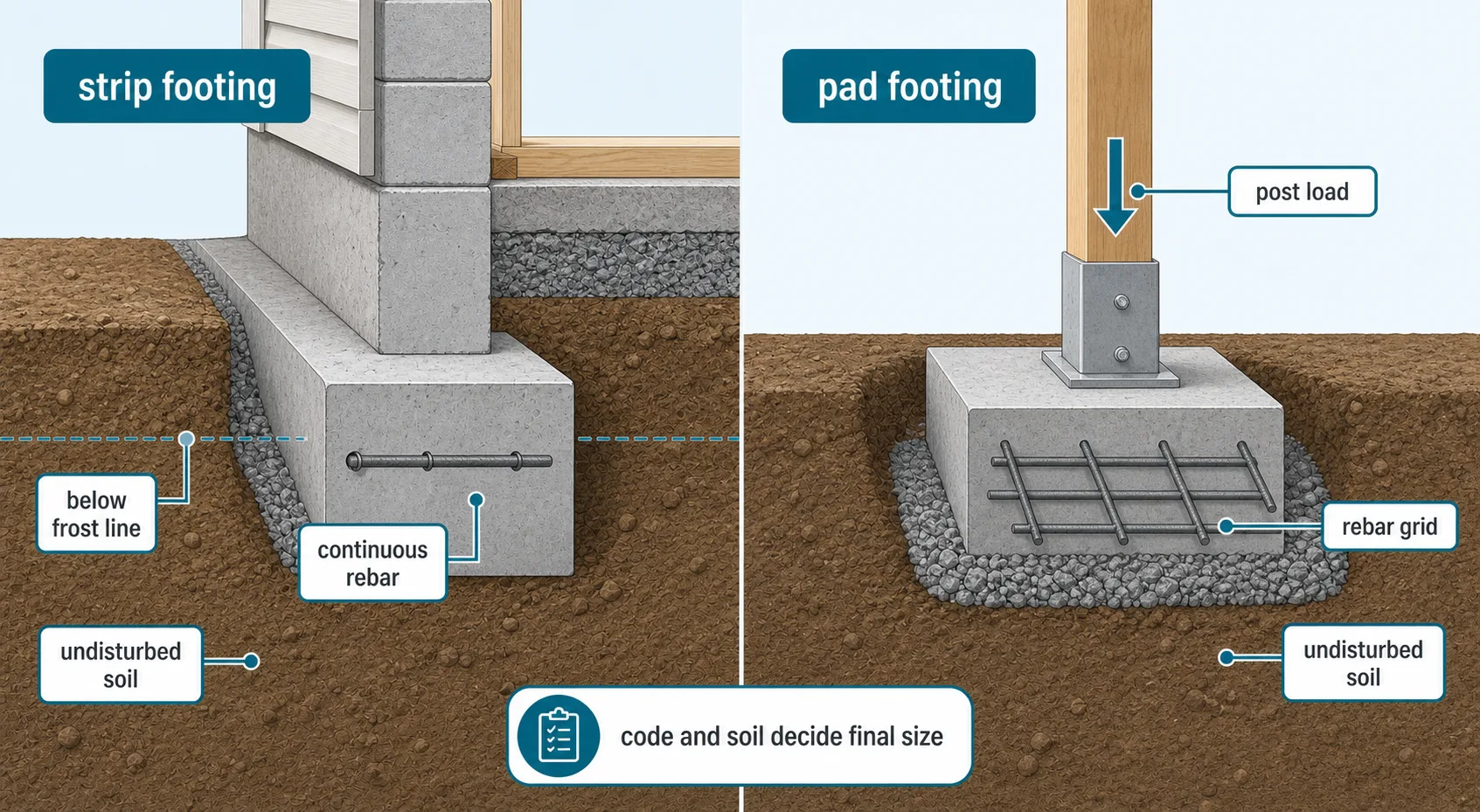
A strip footing is a continuous trench under a wall, so its load arrives as pounds per linear foot and its width is the only thing spreading that load. A pad footing sits under a single post or column, so its load is a point load and the bearing area is length times width.
How much concrete does an 80 foot garage footing take?
An 80 linear foot trench at 16 inches wide and 8 inches deep holds 71.1 cubic feet of concrete, or 2.63 cubic yards. Adding a 10 percent allowance for trench slump brings it to 2.9 cubic yards, which is 131 bags of 80 lb mix.
When do I need an engineer instead of the IRC footing table?
Whenever the trench bottoms out on fill, peat or highly plastic clay, whenever water sits at the bearing plane, whenever you want to claim a bearing value above the common classes, and whenever the load is concentrated rather than spread along a wall. The prescriptive tables only ever described light-frame walls on undisturbed soil.
Load path
Strip footing, pad footing, or a job that needs an engineer
The shape of the footing follows the shape of the load. A wall delivers pounds per foot and gets a trench; a post delivers a point load and gets a block. And there is a third case, which is the one where no table on this page applies to your site at all.
Strip footing, under a continuous wall
The load arrives as a line, so the width alone sets the bearing area and the length just repeats it. Foundation walls, block stem walls and garage perimeters all take this shape, and reinforcement is continuous bars run the length of the trench and bent around the corners.
- Bearing model
- Load ÷ width
- Priced
- By the linear foot
Pad footing, under a post or column
The load arrives at a point, so both plan dimensions count and the bearing area is length times width. Deck posts, porch columns, carport uprights and beam pockets take this shape, and the steel is a small mat running both directions rather than two straight bars.
- Bearing model
- Load ÷ area
- Priced
- By the each
Round pier, drilled or formed
A tube filled with concrete, sometimes with a belled base. Common for decks and additions where the frost depth is deep enough that a square pad would mean a lot of digging, and the bearing area is the base circle rather than a rectangle.
- Bearing model
- Load ÷ base circle
- Priced
- By the pier
Anything on fill, slope or soft ground
Not a footing type but a different job. The presumptive table stops describing the site, so the width has to come from a soil report and a design rather than from a lookup, and that is a cheap piece of engineering against the cost of a foundation that moves.
- Bearing model
- Designed
- Priced
- By an engineer
Six sites where the footing table stops being an answer
Presumptive values are a licence to skip a soil investigation on ordinary ground. On any of the six below the licence does not apply, and the honest answer is a geotechnical report and a designed footing rather than a wider guess.
Any fill under the trench
Presumptive values describe undisturbed natural soil. Engineered fill can be excellent, but it has to be placed and tested to be worth a number, and nobody can read that off a table.
Highly plastic clay
A CH clay may test at 1,500 psf and still move an inch a season with moisture. Shrink and swell is a separate problem from bearing, and it is what drives most foundation litigation.
Organic soil, peat or a high water table
Water at the bearing plane changes the soil's behaviour and can wash fines out from under the footing. Neither condition appears anywhere in the presumptive table.
A claim above 2,000 psf
The table lists 3,000, 4,000 and 12,000 psf, but a building official is entitled to ask what those are based on. Above the common classes, expect to justify the value with a report.
Sloping ground near the footing
A footing set back too little from a descending slope has soil to the side rather than under it. The IRC sets a setback for exactly this, and steep sites go past what it covers.
Concentrated loads
A beam pocket, a column line, a masonry fireplace or a post carrying more than a couple of tons is a designed pad, not a tabulated one. The prescriptive tables only ever described walls.
Rebar chairs
Digging, forming and reinforcing a concrete footing trench
The volume is the easy half. What separates a footing that still sits level in twenty years from one that does not is almost all decided before any concrete arrives.
Dig the trench narrow and true rather than wide and rough. Widening it by 2 in over an 80 ft run buys another 0.33 cu yd of concrete you pay to bury, which is why the width the soil actually needs is worth knowing before the excavator arrives.
Cut a level line inside the trench with a laser before you place any steel. Footings are the one pour where a flat top is worth more than a neat side, because the wall above inherits every dip.
Keep the last pass of the bucket shallow and clean the bottom by hand. The bearing plane is the surface the whole building sits on, and a loose two inches of spoil is the difference between the table's soil and something much weaker.
Lap continuous bars at least 40 bar diameters and bend them around the corners rather than butting them. The concrete rebar calculator works out sticks, weight and tie wire for any spacing.
Set anchor bolts or wall dowels while the concrete is still plastic, and mark them off the string line, not off the trench edge. Round pier footings are a different pour: price those with the concrete cylinder calculator.
Order by the trench, not by the drawing. Trench sides slump, so a 10% allowance is the realistic floor on a dug footing, and the excavation calculator gives the spoil volume you will need somewhere to put.
Disclaimer
These estimates are for planning purposes only. Actual costs vary by location, material availability, and project complexity. Always get at least 3 local quotes. This calculator does not replace professional advice.
Sources