Concrete Removal Calculator
Estimate demolition, hauling, debris weight and container count for taking out an existing slab.
Removal Details
Measure at an edge or a control joint. This is the input that moves the weight.
Structure type
Estimates only. Not professional advice.
Debris to get rid of
5tons
200 sq ft of patio at 4 in, broken out and hauled away.
- Breaking it out
- $400 to $800
- Getting rid of it
- $200 to $400
- Rubble once broken
- 4.12 yd³
- Removal, all in
- $600 to $1,200
Last updated August 13, 2026. Debris density, bulking factor and gate fees checked against published sources by our expert review team.
Scale ticket
What a concrete slab weighs once you break it out
Renting a breaker is cheap and it is the half everyone budgets for. The expensive half is that the slab has to leave, and it leaves by the ton. Both sections below are drawn from the thickness you entered, at one scale, because the container you hire is sold by the volume on the right and stopped by the weight on the left.
- Debris weight
- 5 tons
- In place
- 4,050 lb/yd³
- Once broken
- 2,425 lb/yd³
- Containers by weight
- 1 x 20 yard
Nothing here is exaggerated. Broken concrete pavement is quoted at a 67% swell, so the rubble genuinely stands that much deeper over the same footprint while weighing exactly the same as it did in the ground.
- Clean rubble, recycled
- $60
- Same load, mixed with rubbish
- $180
- US landfill average
- $311
$12/ton
$36/ton
$62.28/ton
Ordering that by volume is the trap. At the 20 yard box this estimate assumes an allowance of 6 tons, which is about 4.95 yd³ of rubble, so the container fills to roughly 25% of its volume before the driver has to stop loading it.
Gate fees sit outside the cost range above, which prices a hauler who includes disposal. Rates are the published clean and mixed gate at the Salt Lake Valley Landfill and the national average from EREF's 2024 survey of 351 landfills.
Breaker and blade
Concrete removal without a second container pull
Seven things worth settling before demolition day. None of them are about swinging the hammer, because that part is straightforward and it is not what the job overruns on.
Measure the thickness at an exposed edge, a control joint or a broken corner before you price anything. A slab that reads 4 in across the middle is often 6 in or more at a driveway apron or a garage edge, and thickness is the only input that moves both the weight and the container count.
Ask the container company for two numbers, not one: the yard size and the concrete ton allowance. The allowance is what you will actually hit. Published limits vary a lot, from 1 to 2 tons on a general 10 yard box up to 10 tons on a heavy-debris box of the same size, so the size alone tells you nothing.
Keep the load clean and keep it clean deliberately. Soil, sod, timber, sheet plastic and a single bag of site rubbish are what move a load from the broken-concrete rate to the mixed-trash rate, and at the Salt Lake Valley Landfill's published gate that is the difference between $12/ton and $36/ton.
Saw-cut every edge where the slab you are taking out meets concrete that stays. A cut gives the break somewhere to stop, and it is the only thing that protects a garage floor, a porch step, a neighbouring sidewalk panel or the rest of a driveway.
Cut steel as you expose it rather than trying to pull it. Wire mesh and rebar tie the whole slab together, so levering against tangled reinforcement cracks the panels you meant to keep and leaves chunks nobody can lift safely.
Price the replacement before you break anything, with the concrete slab calculator. Removal is half a project, and an open hole that sits through a wet week costs more to correct than it did to dig.
Plan the grade after the slab is gone, using the excavation calculator for the fill or cut. A removed slab usually leaves soft, low subgrade that has been protected from compaction for twenty years.
Price per square foot
Concrete removal cost per square foot by structure type
Breaking and hauling together, on one axis so the bands can be compared rather than read one at a time. What separates the bottom of this chart from the top is not the concrete, it is thickness, reinforcement and how far the debris has to travel to reach a truck.
US planning bands covering demolition labour and hauling. Rebar adds about 10% to the demolition half. Gate fees, permits, saw-cutting specialist work, subgrade repair and the replacement pour all sit outside them.
Site walk
Where a concrete tear-out goes over budget, and what stops it
Every row here is visible before the first hole is broken, and five of the six are about the debris rather than the demolition. Run this the day you book the container, not the morning the breaker arrives.
Ordering the container by volume
The yardage on the side of the box is volume, and concrete never gets there. Loose rubble runs about 2,425 lb/yd³, so weight arrives long before space does.
Order by the weight allowance and expect the box to look under-filled. At the cap this calculator assumes, a 20 yard box takes about 4.95 yd³ of rubble, roughly a quarter of its volume.
One container for concrete and everything else
A clean concrete load is a commodity a recycler wants. The same load with soil, timber or bagged rubbish in it is refuse, and it is priced as refuse.
Keep a separate skip, or a separate pile, for anything that is not concrete. The clean rate at one published gate is a third of the mixed rate for the identical tonnage.
Measuring the middle of the slab only
Aprons, thickened edges and old patches are routinely 2 in deeper than the field, and thickness scales the weight and the haul count directly.
Measure at three edges and use the deepest reading. An extra 2 in on a 240 sq ft driveway is another 3 tons, which is a whole extra container.
Breaking before locating what is under it
Downspout drains, irrigation, low-voltage lighting, pool plumbing and old conduit are frequently cast into or run directly beneath a residential slab, and none of it is on the 811 map.
Call 811, then probe the perimeter yourself. Anything you find changes the break pattern, not just the schedule.
Treating a wall like a thick slab
A foundation or retaining wall carries load, is reinforced through its length, and comes out in pieces too heavy to move by hand at any size worth breaking to.
Price a wall as demolition with equipment and staged hauling. Nothing tied into a house, a footing or a grade change should come out without structural advice first.
No plan for the hole
The slab was holding the grade. Once it is gone, the first rain finds the low spot, and wet subgrade cannot be compacted for the replacement pour.
Have the base material and the next surface scheduled before demolition day, or sheet the opening and get it graded the same week.
Tipping floor
Where broken concrete goes, and what the tipping floor charges
The EPA puts US construction and demolition debris at 600 million tons a year, more than twice the household waste stream, and concrete is the heaviest part of it. That is why a clean load is worth something to a recycler and a contaminated one is priced as refuse.
- The clean and mixed rates are the published gate at one facility, the Salt Lake Valley Landfill, which charges $12/ton for broken concrete or asphalt with no trash or green waste and $36/ton for mixed loads. The gap, not the absolute number, is the transferable part.
- Plenty of facilities do not offer a clean-concrete rate at all. Olmsted County's Kalmar Landfill charges one flat rate per ton for all construction and demolition debris, so ring ahead before you sort anything.
- The national figure is EREF's 2024 survey of 351 landfills. An earlier EREF report put the construction and demolition average below the household rate; the two have since converged in most markets.
- Reuse on site is the one free route, and the one with a real constraint: broken concrete makes acceptable bank protection or bulk fill and unacceptable structural base, so keep it away from anything that has to be compacted and away from foundations, drains and utilities.
Weight takeoff
How this concrete removal calculator turns thickness into tons and loads
Three measurements and one choice. The structure type sets the price band; the thickness does everything else, which is why it is the one number worth walking outside to check.
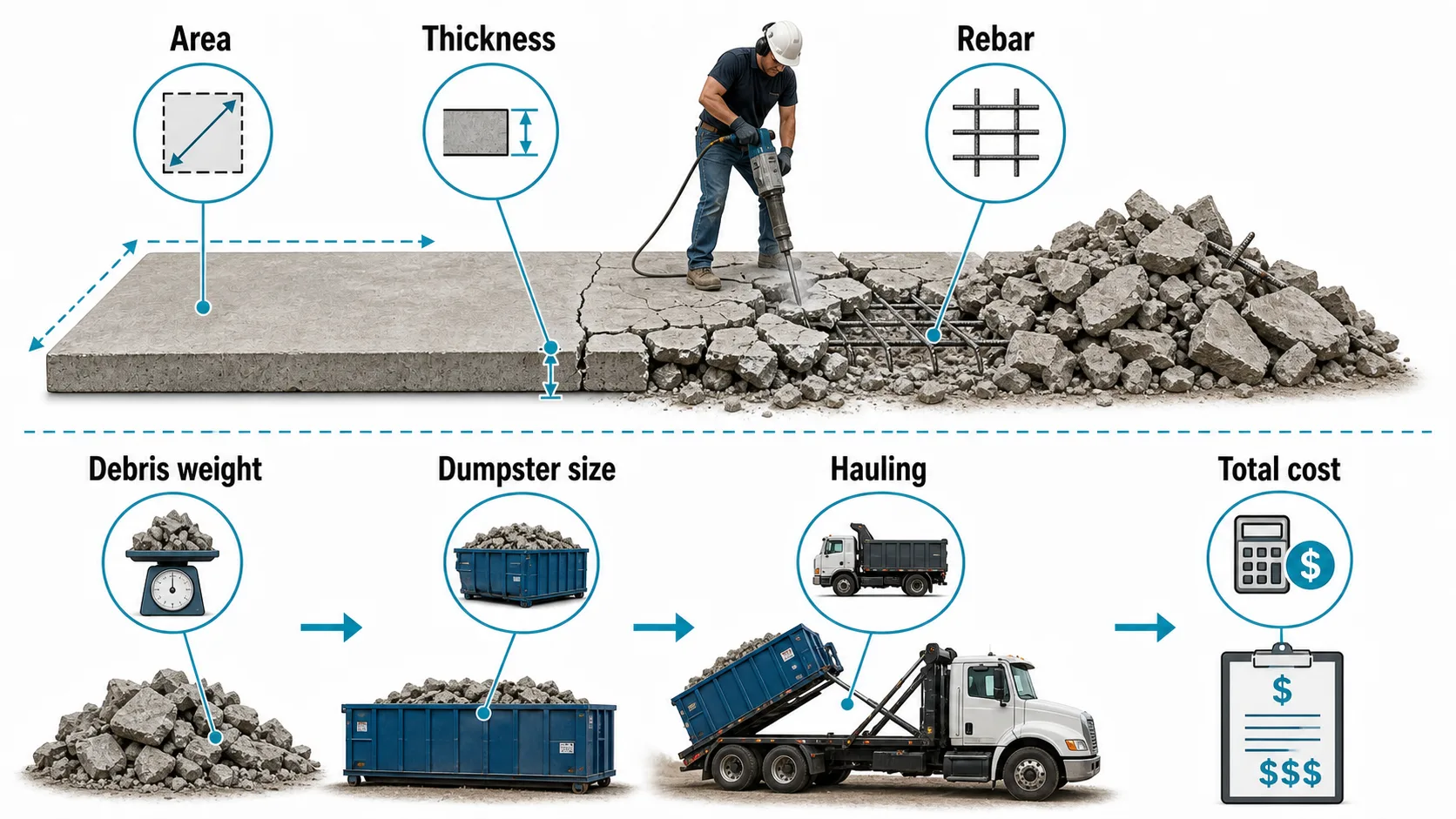
Length times width gives the area. Area times thickness over twelve gives the solid volume in cubic feet, which divided by 27 is cubic yards. That volume times 150 lb a cubic foot, over 2,000, is the debris weight in tons. Demolition and hauling are each the area times a rate band for the structure type, with the demolition half multiplied by 1.10 when there is steel in the slab. The container is then chosen by weight, not volume, and the number of loads is the weight over the container's allowance, rounded up.
What it does not do is guess at your local gate. The cost band prices a hauler who includes disposal, so if you are hauling it yourself, drop the hauling half and put your own facility's per-ton rate against the debris weight instead. That is the calculation in the first section of this page.
- Concrete density
- 150 lb per cu ft
- Bulking, once broken
- +67%
- Rebar surcharge
- +10% demolition
- Container allowances
- 3, 6, 10 tons
- 150 lb a cubic foot is the top of the 140 to 150 lb/ft³ band NRMCA gives for normalweight concrete, which is the right end to be conservative on when a hauler is billing by weight.
- The 67% bulking figure is the swell quoted for broken concrete pavement in compiled bulking tables citing FHWA and Church; stone and cinder concrete are quoted nearer 72%. The Caterpillar Performance Handbook brackets it from the other side, listing broken limestone at a 0.59 load factor and crushed stone at 0.60.
- The 3, 6 and 10 ton container allowances are this calculator's own rounding basis, and published limits vary widely: a general 10 yard box is often rated 1 to 2 tons while a heavy-debris box the same size takes up to 10. Confirm the allowance and the overage rate with your own supplier.
- This is a takeoff, not a demolition plan. On a job with employees on it, 29 CFR 1926.850(a) requires an engineering survey by a competent person before demolition starts. Permits, utility location and anything tied into a building belong to your local authority either way.
Four tear-outs
Concrete removal cost by job: a patio, a driveway and a wall
Four real slabs run through the same rate bands and the same density this calculator uses, so typing any of them in gives you these numbers back. Watch the debris column rather than the price column: it is the one that moves fastest.
Back patio
2.5 tons
- Slab
- 100 sq ft at 4 in
- Loose rubble
- 2.06 yd³
- Containers
- 1 x 10 yd
- Break and haul
- $300 to $600
The one job on this page a weekend can absorb. One container, no steel, and the barrow run is short enough that the labour is genuinely free if you do it yourself.
Driveway panel
9 tons
- Slab
- 240 sq ft at 6 in
- Loose rubble
- 7.42 yd³
- Containers
- 1 x 30 yd
- Break and haul
- $1,080 to $1,800
Half again the thickness over more than twice the area, and the debris weight goes up nearly fourfold. This is where the container stops being an afterthought.
Sidewalk run
4 tons
- Slab
- 160 sq ft at 4 in
- Loose rubble
- 3.3 yd³
- Containers
- 1 x 20 yd
- Break and haul
- $480 to $960
The same thickness as the patio and the same weight per square foot, but the pieces come out at the joints, so the breaking is the easy part and the carry is not.
Foundation wall
32 tons
- Slab
- 640 sq ft at 8 in
- Loose rubble
- 26.39 yd³
- Containers
- 4 x 30 yd
- Break and haul
- $4,480 to $8,960
Four full containers at the heaviest allowance on this page, and the reason a wall is priced as demolition rather than as a slab.
On the drive
Rebar, saw cuts and dumpster limits in a concrete tear-out
The eight questions that come up between measuring a slab and booking the container, answered against published densities, swell figures and gate rates rather than round numbers.
How much does it cost to remove concrete per square foot?
Breaking and hauling residential concrete runs about $3 to $6 per square foot for a patio or sidewalk, $4.50 to $7.50 for a driveway, $4.50 to $9 for a garage or shed slab, and $7 to $14 for a foundation wall. Rebar adds roughly 10 percent to the demolition half because the crew has to expose and cut steel.
How much does a broken concrete slab weigh?
Normalweight concrete is 140 to 150 pounds per cubic foot in place, so a cubic yard weighs about 4,050 pounds and a 4 inch slab weighs about 50 pounds per square foot. A 10 by 10 foot patio at 4 inches is about 2.5 tons of debris and a 20 by 10 foot one is about 5 tons. Breaking it does not change the weight, only the volume it takes up.
How much does broken concrete bulk up?
Broken concrete pavement swells about 67 percent out of the ground, and stone or cinder concrete is quoted nearer 72 percent. A 4 inch slab therefore becomes close to 7 inches of loose rubble over the same footprint, and loose rubble runs about 2,425 pounds per cubic yard against 4,050 in place.
What does it cost to dump concrete at a landfill?
It depends almost entirely on whether the load is clean. One published municipal gate charges $12 a ton for broken concrete with no trash or green waste in it and $36 a ton for the same load once anything else rides along. The national average landfill tipping fee was $62.28 a ton across 351 facilities in 2024.
Why does the dumpster size not match the cubic yards?
Because concrete is capped by weight, not volume. At about 1.2 tons per loose cubic yard, a 20 yard container hits a 6 ton allowance at roughly 5 cubic yards of rubble, so it is about a quarter full when the driver has to stop loading. Ask for the ton allowance and the overage rate before delivery, not the yard size.
Can broken concrete be recycled?
Clean concrete is routinely crushed into road base and recycled aggregate, and recyclers price it well below the mixed construction and demolition rate for that reason. Reusing chunks on site as fill or bank protection also works, but never under anything that needs compacted structural base, and never against foundations, drains or utilities.
Should I remove concrete myself or hire a pro?
Do it yourself on a small unreinforced slab around 4 inches thick with a container that can park close. Hire out anything with rebar or wire mesh, anything over 6 inches thick, tight access, a full driveway, or any wall or slab tied into a structure. The hauling, not the breaking, is what usually decides it.
Do I need to saw-cut before removing concrete?
Saw-cut every edge that touches concrete you intend to keep, including garage floors, porch steps, adjacent sidewalk panels, driveway aprons and foundation edges. The cut gives the break a clean stopping point so the panels you are keeping do not crack along with the ones you are removing.
Disclaimer
These estimates are for planning purposes only. Actual costs vary by location, material availability, and project complexity. Always get at least 3 local quotes. This calculator does not replace professional advice.
Sources
- 01EPA Sustainable Management of C&D Materialsepa.gov
- 02NRMCA CIP 36: normalweight concrete densitynrmca.org
- 03Bulking and swell factors for broken concretespikevm.com
- 04Caterpillar Performance Handbook: material weights and load factorsmacallister.com
- 05Salt Lake Valley Landfill published gate ratessaltlakecounty.gov
- 06EREF 2024 landfill tipping fee surveyrecyclingmonster.com
- 07CDRA: C&D recyclingcdrecycling.org
- 0829 CFR 1926.850: preparatory operations before demolitiongovinfo.gov