Concrete Cylinder Calculator
Calculate concrete, bags and cost for sonotubes, round piers and columns of any diameter.
Tube Details
Estimates only. Not professional advice.
Bags to buy
2480 lb bags
4 tubes at 12 in by 48 in, including the 10% allowance.
- Concrete in the forms
- 13.82 cu ft
- Bare form volume, one tube
- 3.14 cu ft
- Material cost range
- $64 to $77
- Material cost per tube
- $17.63
Standard (3000 PSI). Bag prices move more by store and region than ready-mix does.
Last updated August 13, 2026. Form sizes, bag yields and stripping times checked against the manufacturers' own product data by our expert review team.
Form section
Your concrete cylinder in elevation and section
A tube has two dimensions and they do not carry equal weight. Depth adds concrete in a straight line. Diameter adds it as a square, because what the depth multiplies against is the area of that circle on the right.
Both views share one scale and nothing is exaggerated, so a squat tube really does draw squat. Change the diameter above and watch the circle grow faster than the rectangle.
- Forms made
- 6 in to 36 in
- Stock length
- 12 ft
- 80 lb bag yield
- 0.6 cu ft
One tube as drawn
Bare form- Diameter
- 12 in
- Depth
- 48 in
- Area of the circle
- 0.79 sq ft
- Volume, one tube
- 3.14 cu ft
- 80 lb bags, one tube
- 6
Volume here is the bare form, which is what a supplier quotes. The order in the panel above carries your allowance on top, so the two are meant to differ.
Radius squared
How many bags of concrete a sonotube takes, by diameter
Every row is your own depth of 48 in and your own 10% allowance, changed in one respect only: the diameter of the form. The bars are scaled on the area of the circle, so doubling the diameter from 6 in to 12 in draws a bar 4 times as long, and one nominal step from 8 in to 12 in costs 2.25 times the concrete rather than half again.
Volumes are the bare form. The bag column carries your allowance and rounds up per tube, so it runs a little ahead of the order above, which rounds up once on the whole job. Your entered diameter is highlighted. Sonotube publishes its own concrete requirement table for these forms and every diameter here agrees with it. Their range runs 6 in to 36 in; these rows stop at 24 in, which is where residential work stops.
Tube selection
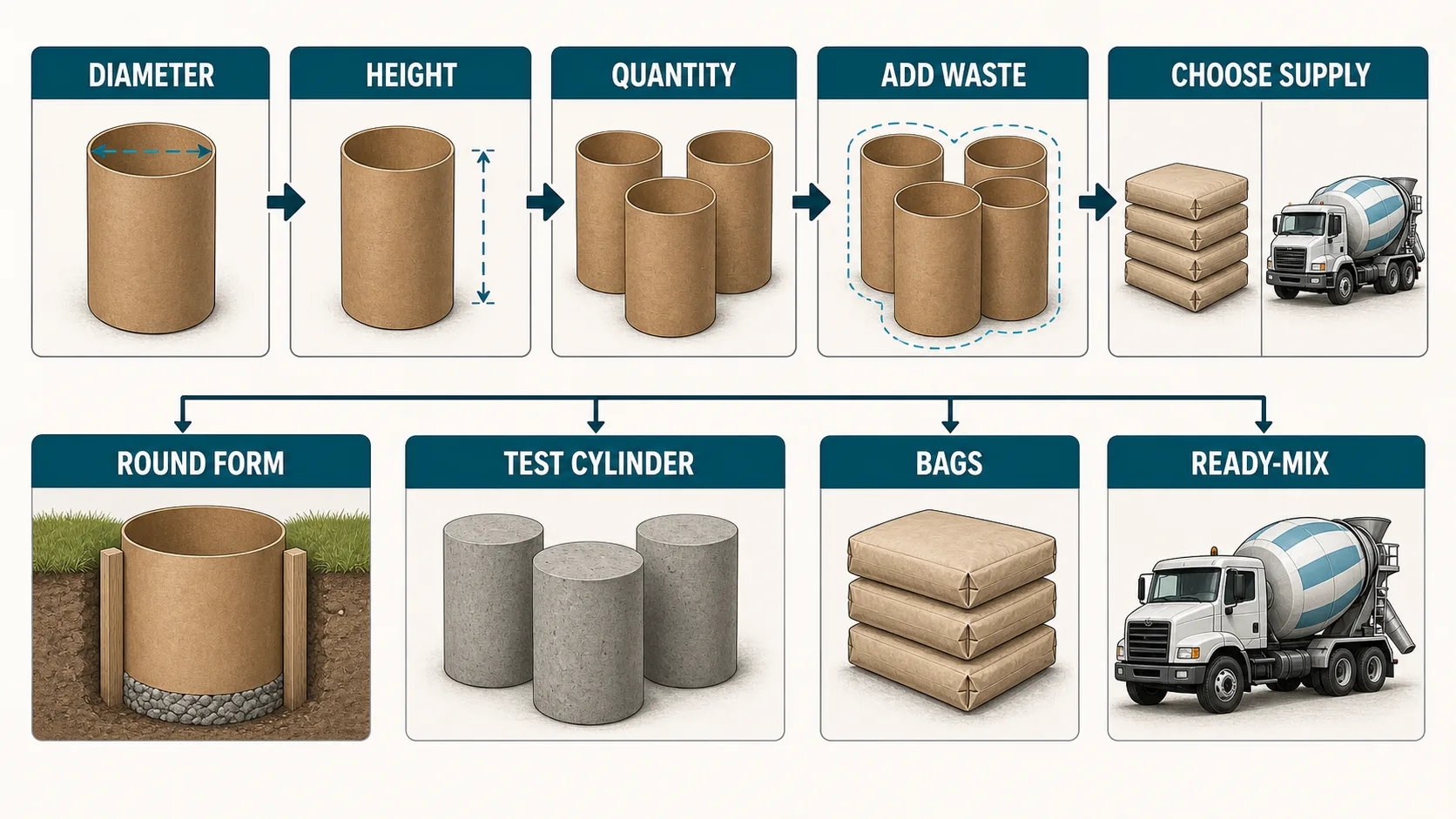
What people mean by a concrete cylinder: form, conversion or specimen
The same two words land here from three different jobs. The first two share this calculator, because a circle times a length is a circle times a length. The third is a laboratory standard and belongs somewhere else entirely.
A round form for a pier or column
The sonotube case, and what this page is for. A cardboard tube is braced plumb, filled with concrete, and cut away afterwards. Diameter and depth are the only two dimensions, and the diameter is the one that decides the bill.
- Set by
- Diameter and depth
- Priced
- By the cubic foot
A cylinder you are simply converting
A culvert, a tank pad, a core hole, a filled post sleeve. There is no form to buy and no pier to brace, but the arithmetic is identical: the circle area times the length, and the circle area is where the squaring lives.
- Set by
- Radius and length
- Priced
- By the cubic yard
A test cylinder cast from the pour
Not a thing you build at all. A specimen is filled from the same batch and cured to ASTM C31 so a lab can break it and report the strength. If you arrived here looking for specimen sizes, that is the standard rather than this calculator.
- Set by
- The standard's mould
- Priced
- By the lab
Picking the form, and what actually decides the diameter
Sonotube Round is made in diameters from 6 in to 36 in, and comes in 12 ft lengths as stock with custom lengths on request, so depth is almost never what limits a residential pier. Diameter is the decision, and it is not a habit: the bearing area of a pier is the base circle, so the size follows the load coming down the post and the soil underneath it. That arithmetic lives in the concrete footing calculator, and this page prices whatever it hands back. Depth is a separate question again, set by the frost line your jurisdiction publishes rather than by the volume you want.
Once you have a diameter and a depth, the only thing left is how the concrete arrives. One yd³ is 45 bags of 80 lb mix, so the bag count is the honest test: a few small piers is a pallet, a row of large columns is a truck, and the table below prices both.
Set and strip
Concrete cylinder pour scope: forms, bag yields, stripping and cure
Every figure here is either a manufacturer's published number or arithmetic on one. The two bag yields are the same divisors the answer above uses, so nothing on this page can drift from the result you were given.
Stripping and curing are two different clocks. The form can come off once the concrete carries its own shape; the concrete keeps gaining strength for days after the cardboard is in the skip. Delivered prices exclude a short load fee, which most single pier pours will attract.
Pier and post
Sonotube and concrete cylinder questions, from bag counts to test specimens
The eight things people ask before they order, answered against the form maker's and the mix maker's own product data.
How much concrete does a 12 inch sonotube take?
A 12 inch tube 48 inches deep holds 3.14 cubic feet of concrete, which is 0.12 cubic yards or 6 bags of 80 lb mix at the 0.60 cu ft each bag yields. Add your own allowance on top of that, because concrete stays behind on the cardboard and some is always lost placing it.
How many bags of concrete do I need for a sonotube?
Divide the volume of the tube by the bag yield and round up. QUIKRETE Concrete Mix yields 0.60 cu ft from an 80 lb bag and 0.45 cu ft from a 60 lb bag, so a 12 inch tube 4 feet deep takes 6 of the 80 lb bags or 7 of the 60 lb. The table on this page runs the same arithmetic across every tube diameter.
Why does a wider sonotube take so much more concrete?
Because volume follows the radius squared. Going from an 8 inch tube to a 12 inch tube at the same depth is 2.25 times the concrete, and going from 12 inches to 24 inches is four times. Two sizes that sit one step apart on a shelf are nothing like one step apart in cubic feet.
What sizes do sonotubes come in?
Sonotube Round forms are made in diameters from 6 inches to 36 inches, with a standard length of 12 feet and custom lengths on request. Diameters larger than 36 inches are a separate commercial product in the same family, so a residential footing is almost always inside the standard range.
How deep should a round pier footing go?
Below the frost line where your jurisdiction publishes one, which is a local figure rather than a national one. Depth is a frost question and diameter is a bearing question, and they are decided separately. Neither one substitutes for the other.
Do I need rebar in a sonotube pier?
A structural pier or column is reinforced, while a plain deck footing often carries a post anchor set into the wet concrete instead. Bar size, count and cover are a design matter for your building department, and a volume estimate does not settle any of them.
Is a concrete cylinder the same thing as a test cylinder?
No, although the phrase covers both. A formed cylinder is the pier or column you are pouring. A test cylinder is a specimen filled from that same batch and cured under ASTM C31 so a lab can break it and report the strength. This page sizes the pour, not the specimen.
Should I use bags or ready mix for round footings?
Count the bags first. At 0.60 cu ft each, one cubic yard is 45 bags of 80 lb mix, so a handful of small piers is a bag job and a row of large columns is not. Ready mix also carries a short load fee on small deliveries, so the crossover is about mixing effort more than price alone.
Three pours
Concrete cylinder volume for deck footings, fence posts and porch columns
All three run through the same 0.6 cu ft bag yield and a flat 10% allowance. Read them across rather than down: the tube counts barely move and the concrete does.
Deck footings
12.57 cu ft
- Forms
- 4 tubes, 12 in by 48 in
- With 10% allowance
- 13.82 cu ft
- In yd³
- 0.51 yd³
- 80 lb bags
- 24
The common residential deck pier. One 24 in tube at the same depth holds all four of these on its own, which is the clearest thing the squaring does to an order.
Fence posts
8.38 cu ft
- Forms
- 8 tubes, 8 in by 36 in
- With 10% allowance
- 9.22 cu ft
- In yd³
- 0.34 yd³
- 80 lb bags
- 16
Twice the holes and two thirds the concrete of the deck above, because an 8 in circle is under half the area of a 12 in one.
Porch columns
27.93 cu ft
- Forms
- 4 tubes, 16 in by 60 in
- With 10% allowance
- 30.72 cu ft
- In yd³
- 1.14 yd³
- 80 lb bags
- 52
Four holes again, and more than twice the deck footing volume. Past this point the bag count is the argument for a truck rather than a pallet.
Volumes are bare form first, then with the allowance, because the two get quoted interchangeably and they are not the same number. A whole deck material list, posts and beams included, is the deck calculator.
Bracing and lifts
Bracing, filling and stripping a sonotube without wasting concrete
The volume is the easy half. What decides whether a pier ends up plumb, solid and the right size is almost all settled before the first bag is opened.
Price the diameter before you buy the tube, not after. One 16 in form holds 1.78 times what a 12 in form holds at any depth you like, and the two sit side by side on the same rack for a couple of dollars' difference.
Brace plumb on two perpendicular faces before any concrete goes in, and check again after the first lift. A tube that is leaning has to be emptied, not adjusted.
Cut the form long and trim the top after bracing. Sonotube stocks 12 ft lengths, so a deep footing almost never needs a splice, and a form cut short is a form you cannot raise.
Count the bags before you decide how to mix. One yd³ is 45 bags of 80 lb mix, and our concrete bags calculator is built for the bag-by-bag end of that.
Work out the bearing separately from the volume. The concrete footing calculator takes the load and the soil and gives back the area a footing needs, which is what should be setting your diameter.
Do not forget the spoil. Every tube leaves a hole's worth of dirt somewhere, and the excavation calculator gives the volume you will need to move. Flat pours are a different job again: those go through the concrete slab calculator.
Short on the last tube
Where a concrete cylinder estimate goes wrong
Almost every one of these is the same mistake wearing a different hat: treating a diameter as if it behaved like a length. It does not, and the tube that runs dry is always the last one.
Ordering by the tube count instead of the volume
Four tubes and four tubes read identically on a shopping list, and one order can be double the other. The count says nothing about the concrete.
Price every order in cubic feet first, then convert to bags or yards. The count only tells you how many holes to dig.
Treating one size up as a small change
A step from 12 in to 14 in is 36% more concrete at the same depth, and 8 in to 12 in is 2.25 times as much. One nominal size is not a rounding error.
Re-run the number whenever the diameter changes, even by one nominal size. Depth scales straight, diameter squares.
Digging deeper to compensate for a narrow tube
Depth buys volume in a straight line, so matching a wider tube by going deeper means going a very long way down, and depth is a frost and bearing decision rather than a volume one.
Set the depth from your frost line and the diameter from what the footing has to carry. Neither one is a lever for the other.
No allowance for what stays behind
Concrete clings to cardboard, spills at the collar, and never comes out of the wheelbarrow completely. On the last tube of a run that shortfall is the whole tube.
Carry an allowance on the total, not per tube, and buy the spare bag. A bag you did not open is cheaper than a second trip.
Filling in one drop instead of lifts
A tall tube filled in one go traps air against the wall and bridges over voids you cannot see until the form comes off.
Fill in lifts and rod each one. A void at the top of a pier is cosmetic. A void where the post bears is not.
Stripping the form the same afternoon
The cardboard is carrying the concrete's own pressure while it stiffens. Cut it away early and a green pier can slump or spall along the seam.
Sonotube gives 24 to 48 hours as the fastest stripping, and curing continues for days after that. The form comes off on the concrete's schedule.
Tube takeoff
The arithmetic behind a concrete cylinder estimate
Four lines, and the only judgement anywhere in them is the allowance. Diameter and depth arrive in inches and have to reach feet before they multiply, which is where a hand estimate usually goes wrong by a factor of twelve or a factor of 144.
Halving the diameter gives the radius, dividing by twelve puts it in feet, and squaring it gives the area of the circle. That is the whole trick: the diameter passes through a square on its way into the answer and the depth does not. The allowance goes on the total rather than each tube, then the result is divided by 27 for yards or by the yield printed on the bag. Bags are rounded up once, on the order.
area = π × (d ÷ 24)²tube = area × (h ÷ 12)order = tube × count × (1 + allowance)bags = ⌈order ÷ 0.6⌉- Allowance in use
- 10%
- 80 lb bag yield
- 0.6 cu ft
- Cubic feet per yard
- 27
- Bags in your order
- 24
This is a material takeoff, not a structural design. Pier diameter for a given load, reinforcement, embedment and anything sitting on fill or a slope belong to your building department and, past a point, to an engineer.
Disclaimer
These estimates are for planning purposes only. Actual costs vary by location, material availability, and project complexity. Always get at least 3 local quotes. This calculator does not replace professional advice.
Sources