Stair Calculator
Calculate riser height, tread depth, stringer length and materials with IRC code checks.
Stair dimensions
Estimates only. Not professional advice.
Flight layout
14 risers
7.71 in each, over 13 treads at 10.5 in deep. Four or more risers, so a graspable handrail is required.
136.5 in
Total run
174.1 in
Stringer
38.4°
Slope
4
2x12 at 16 ft
Against IRC R311.7
Riser height
4 in to 7.75 in
7.71 inok
Tread depth
10 in min
10.5 inok
Comfort rule 2R + T
24 in to 25 in
25.9 inover
Slope, rise over run
30 to 37 deg
38.4 degover
Headroom, plumb from nosing
80 in min
96 inok
Throat left after notching
3.5 in min
3.54 inok
Materials at your prices
Stringers, 4 x 2x12 at 16 ft
$176
Treads, 13 x 1x12
$156
Risers, 14 x 1x8
$112
Railing: 4 posts, 26 balusters, 2 rails
$266
Fasteners, hangers and hardware
$35
DIY materials
Installed by a carpenter, $1,863
$745
Last updated August 5, 2026. Checked against IRC R311.7 by our expert review team.
Flight in section
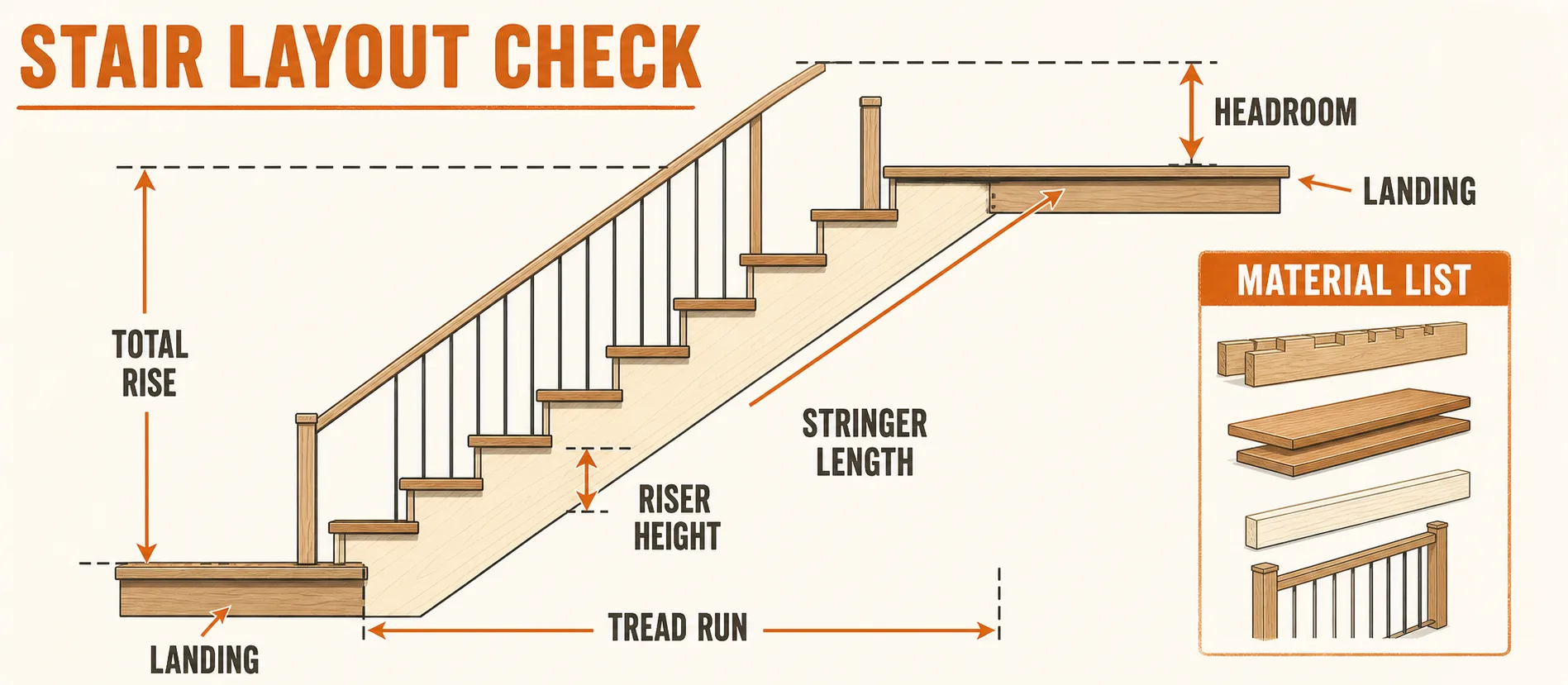
Your stair flight in section, at one scale on both axes
A stair is the one carpentry job where a number on its own tells you almost nothing. Below is your flight cut through the middle: the step you would climb, the board it is cut from, and the clear space you need above it.
Nosing at 7x
The clearance line runs parallel to the nosings rather than to the floor, so the tight spot is wherever the framing above crosses it. Both axes share one scale, so the drawn slope is the slope in the readout.
The nosing is extra walking surface, not extra run: the run is measured nosing to nosing, so an overhang buys you foot room without lengthening the flight.
Failed at inspection
Where a stair layout goes wrong, and what it costs
Six failures in the order they happen, from the tape measure to the landing. Every one of them produces a stair that looks right on paper.
The first stringer never got dropped
Cut the notches and set the stringer straight on the floor and the bottom riser finishes one tread thickness taller than every other one.
Trim the bottom of the stringer by the thickness of the tread stock before you set it, then check the first riser with a tape.
Total rise measured off the subfloor
Rise is finished floor to finished floor. Tile or 0.75 in hardwood added later shortens the top riser and lengthens the bottom one.
Add both floor finishes into the measurement first, even if they are months away from being laid.
Headroom checked at the wrong place
The clearance envelope is plumb from the nosings, so it follows the flight. The tight point is wherever the framing above crosses it, which is rarely where you are standing.
Take the smallest plumb dimension anywhere along the flight and keep it at 80 in or more before the stair well is framed.
Risers cut to a round number
Rounding the riser and cutting them all the same pushes the whole remainder into the last step. IRC allows 3/8 in between any two risers and that is the item inspectors fail most.
Work from the calculated riser, not a tape-friendly figure, and lay every notch out with stair gauges off one square setting.
Stringers spliced or over-notched
A stringer has to come out of one board. Notch a 2x12 for a tall riser and the throat left behind can drop under 3.5 in, which is where stringers flex and split.
Buy the next lumber length up rather than joining two, and switch to flush mount with tread brackets when the throat gets thin.
No landing at one end
A stair needs a landing top and bottom, each at least as deep as the stair is wide. A door that swings over the top step is the same failure.
Frame a landing at least 36 in deep at both ends, and plan a mid landing when the rise runs past 12 ft.
Layout table
Riser count and total run for every common stair rise
Total rise decides the riser count, and the riser count decides everything else. Every row below is the same arithmetic this page runs, at the 10.5 in tread currently in the calculator.
| Total rise | Risers | Riser | Run | 2R + T | Slope |
|---|---|---|---|---|---|
| 84 in | 11 | 7.64 | 105 | 25.8 | 38.7° |
| 90 in | 12 | 7.5 | 115.5 | 25.5 | 37.9° |
| 96 in | 13 | 7.38 | 126 | 25.3 | 37.3° |
| 102 in | 14 | 7.29 | 136.5 | 25.1 | 36.8° |
| 108 inyours | 14 | 7.71 | 136.5 | 25.9 | 38.4° |
| 114 in | 15 | 7.6 | 147 | 25.7 | 37.8° |
| 120 in | 16 | 7.5 | 157.5 | 25.5 | 37.3° |
| 126 in | 17 | 7.41 | 168 | 25.3 | 36.9° |
Riser, run and 2R + T are in in. Slope is total rise over total run, the same figure the readout gives. Amber marks a row outside the comfort band, which is legal but steeper than most people want to climb twice a day.
At the layout square
Stair layout habits that keep every riser equal
The arithmetic is the easy half. These are the six things that decide whether the flight you cut matches the flight you calculated.
Clamp stair gauges to a framing square at your exact riser and tread, then walk the square down the 2x12. Stepping off with a tape adds a little error at every step and the last one collects all of it.
Subtract one tread thickness from the bottom of the first stringer, the cut carpenters call dropping the stringer, so the finished first riser matches the rest.
Measure total rise at both sides and the centre of the opening, then work off the shortest reading. A floor that is out by 0.5 in turns into a riser that is out by that much on one side.
IRC R311.7.5.1 caps the riser at 7.75 in and R311.7.5.2 sets the tread at 10 in or more. Settle both before you cut, because the stringer is the one part you cannot adjust afterwards.
Handrails sit 34 in to 38 in above the nosing line per IRC R311.7.8, so they follow the same slope the drawing above shows. Guards on an open side take balusters at 4 in maximum spacing.
For exterior steps use PT 2x12 stringers with 5/4x6 composite or PT treads. Poured steps are a different job: the concrete steps calculator handles those. Building a deck? Set the deck height first so the bottom step lands on the pad.
IRC R311.7
Stair code limits, and the comfort numbers inside them
The code sets a box you have to stay inside. The comfort numbers sit well within that box, which is why a legal stair and a pleasant stair are not the same stair.
Maximum riser height
R311.7.5.1
7.75 in
Measured on the tallest riser in the flight, not the average.
Minimum riser height
R311.7.5.1
4 in
Shallow risers read as a trip hazard rather than a step.
Minimum tread depth
R311.7.5.2
10 in
Nosing to nosing, which is the run this calculator uses.
Minimum stair width
R311.7
36 in
Above the handrail height, and it sets the landing depth too.
Variation between risers
R311.7
3/8 in
Between any two risers in the flight, including the last one.
Minimum headroom
R311.7.2
80 in
Plumb from the nosing line, along the whole flight.
Handrail required at
R311.7.8
4 risers
Graspable, 34 in to 38 in above the nosings.
Baluster spacing
R312.1.3
4 in max
Measured between balusters on any open side of the flight.
The arithmetic
How this stair calculator lays out a flight
Three steps, in the order a carpenter works: split the rise into equal risers, check the result against the code box, then size the stock you have to buy.
risers = round(total rise / 7.5)riser = total rise / risersrun = (risers - 1) x treadstringer = sqrt(rise2 + run2)slope = atan(rise / run)stringers = max(3, ceil(width / 16) + 1)throat = 11.25 - risercomfort = 2 x riser + tread- 01
Split the rise into equal risers
Total rise divided by the 7.5 in target, rounded to a whole number of risers, then divided back out to get the height each one has to be. There is one tread fewer than there are risers, because the upper floor is the last tread, so the run is (risers - 1) x tread depth.
- 02
Check the flight against the code box
Riser between 4 in and 7.75 in, tread at 10 in or more, 2R + T inside 24 in to 25 in, slope inside 30 to 37 degrees, and headroom at 80 in plumb from the nosing line. A handrail is required from four risers up.
- 03
Size the stock, then round up to what the yard sells
Stringer length is the diagonal on the rise and the run, and it rounds up to the next stock length because you cannot splice a stringer. Stringer count is one per 16 in of width with a minimum of three. Notching a 2x12 leaves 11.25 in minus the riser as throat, and under 3.5 in of that the board is too weak to use.
Costs use the board prices in the options panel, plus a fixed fastener allowance, and exterior stock is carried at 40 per cent over interior. Labour is estimated at one and a half times materials.
Three flights
Stair layouts for three flights people actually build
A basement run, a set of deck steps and a main stair, each run through the same arithmetic. Note how little the riser height moves and how much the run does.
106 in rise · 10 in tread
14 risers
7.57 in each · 39.2°
Basement stair, 8 ft ceiling
An 8 ft ceiling plus a 10 in floor structure measures about 106 in finished floor to finished floor. The narrowest legal tread keeps the run out of the doorway at the bottom.
- Total run
- 130 in
- Stringer
- 167.7 in
- Buy 2x12 at
- 14 ft
- 2R + T
- 25.1 in
45 in rise · 11 in tread
6 risers
7.5 in each · 39.3°
Deck steps down to a 45 in pad
Measured from the deck boards to the top of the landing pad, not to the dirt. Pressure treated 2x12 stringers, and the run is short enough for 8 ft boards.
- Total run
- 55 in
- Stringer
- 71.1 in
- Buy 2x12 at
- 8 ft
- 2R + T
- 26 in
118 in rise · 10.5 in tread
16 risers
7.38 in each · 36.8°
Main stair, 9 ft ceiling
The tall one. Over 13 ft of run means the stair well has to be framed for it before anything else lands, and the stringers come out of 16 ft stock.
- Total run
- 157.5 in
- Stringer
- 196.8 in
- Buy 2x12 at
- 20 ft
- 2R + T
- 25.3 in
Each flight is the calculator's own layout arithmetic at that rise and tread, so nothing here can drift from the readout above. Enter your own rise for the material list and the cost.
Before the permit
Stair dimensions, handrails and landings
The eight things people ask between measuring the opening and cutting the first stringer.
What are the standard stair dimensions?
IRC max riser: 7-3/4". Min tread: 10". Min width: 36". Min headroom: 80". Most carpenters aim for 7" risers and 11" treads.
How many stairs for a specific height?
Divide total rise (inches) by 7.5". Round to the nearest whole number. A 9-foot ceiling gives about 118" total rise, or roughly 16 risers.
How do I calculate stringer length?
Square root of (total rise squared + total run squared). Always buy the next standard lumber length up from your calculated result.
What is the 7-11 rule?
7" risers and 11" treads, the most comfortable proportions. The comfort formula 2R + T should equal 24 to 25 inches.
When are handrails required?
IRC requires a graspable handrail on at least one side for four or more risers. Height: 34" to 38" above the nosing line.
How much do stairs cost to build?
DIY materials for a standard interior staircase: $150 to $400. Professional installation: $1,000 to $3,000 for a straight run. For concrete stairs, see our concrete steps calculator.
What riser height variation is allowed?
IRC limits variation between any two risers to 3/8". This is the most-failed stair inspection item. Verify each riser with a tape measure.
Do I need a landing?
Yes, at top and bottom. Each landing must be at least as deep as the stair is wide (36" min). Tall rises over 12 feet may need a mid-landing.
Disclaimer
These estimates are for planning purposes only. Actual costs vary by location, material availability, and project complexity. Always get at least 3 local quotes. This calculator does not replace professional advice.