Asphalt vs Concrete Driveway Cost
Compare both driveways over 30 years and find the year the cheaper one flips.
Driveway and local rates
How long will you own it?
Climate
Enter installed rates
Both rate fields want the finished price per sq ft including base prep and labour, not the material alone. That is the number a paving quote gives you.
Estimates only. Not professional advice.
Concrete costs less over 20 years
$7,440
That is $960 under the other material on a 600 sq ft driveway, counting install, sealing, patching and resurfacing.
| Cost line | Asphalt | Concrete |
|---|---|---|
| Install | $4,800 | $6,000 |
| Sealing and patching | $1,200 | $1,440 |
| Resurfacing | $2,400 | $0 |
| 20-year total | $8,400 | $7,440 |
Both materials suitable for moderate climates. Rates are yours; intervals are the model's, and the 30-year timeline below shows every one of them.
Last updated August 4, 2026 by our expert review team.
Cumulative spend
The year asphalt stops being cheaper than concrete
Asphalt is the cheaper driveway on day one and the more expensive one to keep. Plot both running totals and they cross. That year is the real answer, and it moves with your driveway size, your two local rates and your climate.
What the three steps cost
- Year 15 asphalt overlay
- $2,400
- Year 25 asphalt rebuild
- $5,700
- Year 25 concrete overlay
- $3,000
Assumptions, all of them the calculator's own rather than a published standard: seal on a 3-year cycle at $0.20/sq ft for asphalt and $0.30/sq ft for concrete, patching at 5% of the asphalt install and 3% of the concrete install per decade, which is the slope between events. Nothing here is discounted for inflation, so read it in today's money.
The answer
Year 15
Asphalt is the cheaper driveway for the first 14 years. In year 15 its running total passes concrete, and on these rates it never comes back.
- Asphalt, 30 years
- $14,820
- Concrete, 30 years
- $11,340
- Concrete ahead by
- $3,480
Priced jobs
Asphalt vs concrete driveway cost on three real jobs
Three households, three climates, three answers. Every figure below comes out of this calculator, so you can type the inputs in and land on the same number.
Minnesota · 600 sq ft · cold
Asphalt by $816
Crossover: year 25
Asphalt at $7 and concrete at $10 over 20 years. The freeze-thaw penalty on concrete is what keeps asphalt ahead here, and the year 15 overlay is not enough to flip it. Asphalt $7,740, concrete $8,556.
Texas · 900 sq ft · hot
Concrete by $4,041
Crossover: year 15
Asphalt at $6 and concrete at $11 over 30 years. Asphalt starts $4,500 cheaper, then buys an overlay and a full rebuild while the heat multiplier adds a fifth to everything. Asphalt $22,032, concrete $17,991.
Ohio · 450 sq ft · moderate
Asphalt by $1,944
Crossover: year 25
Asphalt at $5 and concrete at $9 over 10 years, because this owner plans to sell. Nothing expensive happens to asphalt inside a decade. Asphalt $2,633, concrete $4,577.
Trade-offs
Choosing asphalt or concrete: the seven things that decide it
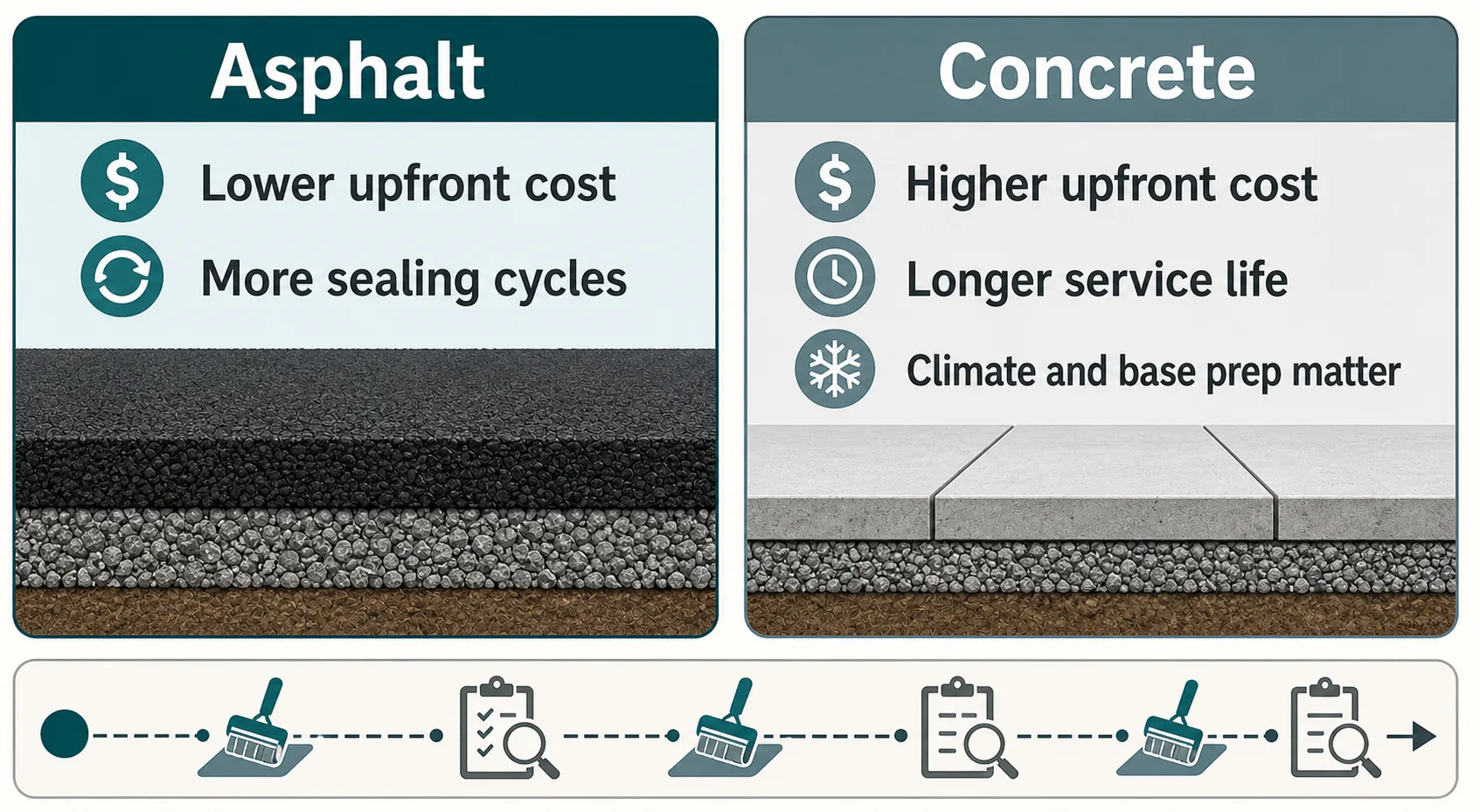
Money is only one column. These are the factors that make one material obviously right in a given driveway, whatever the crossover year says.
Installed rate
$3 to $7 per sq ft
$6 to $12 per sq ft
Service life
15 to 20 years before an overlay
30 to 40 years before replacement
Freeze-thaw
Flexes with the ground, so heaving rarely cracks it
Needs joints every 8 to 10 ft and spalls under road salt
Heat
Softens above 120°F and ruts under parked tyres
Unaffected, and stays cooler underfoot
Maintenance you cannot skip
Sealcoat every 3 years plus annual crack filling
Keep the joints sealed, reseal the surface every 5 to 7 years
Repairs
Patches blend in and a whole overlay is affordable
Patches always show, and cracks are permanent
Time before you can park on it
2 to 3 days
7 days, and 28 for full strength
Early failures
Why asphalt and concrete driveways fail before the crossover year
Every timeline on this page assumes the driveway was built properly. These six calls are what make a 20-year surface last eight, and none of them can be fixed later.
Comparing the two install prices and stopping there
Asphalt is 40 to 50% cheaper to lay and the gap closes every single year after that.
Read the crossover year above against how long you actually plan to own the house, then decide.
Paving straight onto graded dirt
Both surfaces settle unevenly and crack within three to five winters. It is the single biggest predictor of driveway life.
Insist on 6 to 8 inches of compacted aggregate, placed in lifts and compacted between each one.
Choosing asphalt where pavement hits 130°F
Petroleum binder softens above 120°F, so parked tyres press permanent ruts into the surface.
In the Southwest and the deep South, concrete or pavers are the local standard for a reason.
Skipping a sealcoat cycle to save a few hundred
Oxidation runs unchecked and the surface loses five to seven years, which pulls the expensive overlay forward.
Budget the 3-year cycle as part of the driveway, not as optional upkeep. The chart above shows what one skipped cycle costs.
Leaving drainage until after the paving
Trapped water under asphalt becomes potholes and under concrete becomes frost heave.
Grade and drain first. It is a few hundred dollars against thousands, and it happens before either material arrives.
Salting new concrete through its first winter
Rock salt scales concrete under a year old, and the pitting never heals.
Sand or CMA for the first winter, calcium chloride after, never sodium chloride.
Cost model
What goes into the asphalt and concrete totals
Seven lines of arithmetic, stated plainly so you can audit the number rather than trust it. Everything here runs on the two rates you typed in.
Area is length times width. In metric mode both rate fields are read as dollars per square metre and every maintenance rate switches with them, so nothing gets multiplied by a square-foot price against a square-metre area.
Seal cycles are whole cycles only, so a 10-year horizon buys three of them and not three and a third. Patching accrues continuously instead of landing as an event, which is why both lines on the chart climb between the dots.
The climate setting is the last step. Cold adds 15% to the concrete total for freeze-thaw damage, hot adds 20% to the asphalt total for softening, and moderate adds nothing to either.
Line by line
install = area × $/sq ftseals = floor(years ÷ 3)sealing = seals × area × seal ratepatching = install × rate × (years ÷ 10)overlay at yr 15 and yr 25asphalt rebuild at yr 25total = sum × climate factorNot counted: permits, excavation, drainage work, tearing out an old surface, decorative finishes and snow clearing. Nothing is inflation adjusted.
Decision order
Asphalt or concrete: seven calls, in the order they get made
These are numbered because the sequence is real. Answering them out of order is how people end up paying for a surface their climate or their timeline was always going to punish.
- 01
How long you stay
Under the crossover year, asphalt wins on money almost every time. Past it, concrete does. Everything else on this list is a tiebreaker.
- 02
What your winters do
Ground that heaves favours asphalt, because it flexes instead of cracking. Road salt and 100°F pavement both favour concrete.
- 03
The base, before the surface
Ask every bidder to price the same compacted depth. A cheap quote is usually a thin base, and that decides the driveway's life more than the material does. Our excavation calculator prices the digging.
- 04
Get three quotes on identical scope
Same thickness, same base, same drainage, same square footage. Then the numbers are comparable and you can drop them straight into the two rate fields above.
- 05
Book the season
Asphalt wants May through October with air temperatures over 50°F for proper compaction. Concrete wants 50 to 80°F so it neither flash sets nor freezes.
- 06
Commit to the upkeep before you sign
If you will not sealcoat asphalt on schedule, price it as a shorter-lived driveway and move the overlay year forward. Concrete's equivalent is keeping the joints sealed.
- 07
Then, and only then, resale
Concrete reads as an upgrade where it is the neighbourhood norm. In northern asphalt markets, condition matters more than material. For a concrete-only budget use our concrete driveway cost calculator, and for asphalt tonnage the asphalt calculator.
Service intervals
Asphalt and concrete driveway maintenance schedule and rates
The whole crossover argument sits in this table. The right-hand column prices each line against the driveway currently in the calculator.
| Job | When | Rate | Times in 30 yr | On your sq ft |
|---|---|---|---|---|
| Asphalt | ||||
| Sealcoat | every 3 years | $0.20/sq ft | 10 | $1,200 |
| Crack filling and patching | continuous | 5% of install per decade | ongoing | $720 |
| Overlay, a new wearing course | once, year 15 | $4.00/sq ft | 1 | $2,400 |
| Rebuild, base and all | once, year 25 | $9.50/sq ft | 1 | $5,700 |
| Concrete | ||||
| Surface seal | every 3 years | $0.30/sq ft | 10 | $1,800 |
| Joint and crack repair | continuous | 3% of install per decade | ongoing | $540 |
| Overlay or resurfacing | once, year 25 | $5.00/sq ft | 1 | $3,000 |
| Full replacement | not inside 30 years | n/a | 0 | $0 |
Published trade ranges are wider than the single rates this model uses: sealcoating is quoted at $0.15 to $0.25 per sq ft and an asphalt overlay at $3 to $5 per sq ft. Override the two install rates above with your own quotes; the maintenance rates are fixed.
At the quote
Asphalt vs concrete driveway questions homeowners ask
Nine answers, each one consistent with the model above rather than with a brochure.
How long does an asphalt driveway last compared to concrete?
Asphalt runs 15 to 20 years before it needs a new wearing course; concrete runs 30 to 40 before replacement. Asphalt is not written off at 20, though. An overlay at $4 per sq ft buys another 8 to 12 years, which is exactly the year 15 step on the chart.
How much cheaper is asphalt than concrete to install?
Roughly 40 to 50% less. Asphalt is $3 to $7 per sq ft against $6 to $12 for concrete, so on a 600 sq ft driveway the day-one gap is $1,800 to $3,000. That gap is the entire head start asphalt gets.
Is asphalt or concrete cheaper in the long run?
It depends on one number, and this page computes it: the crossover year. On the default 600 sq ft driveway in a moderate climate it lands at year 15, when the asphalt overlay is paid for. Own the house longer than that and concrete is cheaper. Sell before it and asphalt is.
Can you resurface asphalt instead of replacing it?
Yes, and it is the reason asphalt stays competitive. An overlay costs $3 to $5 per sq ft against $6 to $9 for a full tear-out and rebuild. The existing base has to be sound, with no deep structural failures or alligator cracking.
Which driveway material is better for freeze-thaw climates?
Asphalt. It flexes with ground movement instead of cracking, which is why the cold setting adds 15% to the concrete total rather than the asphalt one. Concrete in these regions wants joints every 8 to 10 feet and still spalls under road salt.
Why does asphalt soften in hot weather?
The binder is petroleum based, so it goes pliable above about 120°F surface temperature. Dark asphalt in direct summer sun reaches 140 to 160°F, and parked vehicles press ruts that never come out. That is what the hot climate multiplier is paying for.
How often does each driveway need maintenance?
Asphalt wants a sealcoat every 2 to 3 years plus annual crack filling. Concrete wants its joints kept sealed and the surface resealed every 5 to 7 years. The schedule table above prices both against your own driveway.
Does driveway material change what a house sells for?
Concrete reads as a 5 to 10% curb-appeal upgrade in markets where concrete is the neighbourhood standard. In northern regions where almost everything is asphalt, buyers notice condition and cracks, not material.
What sub-base do asphalt and concrete driveways need?
Both want 6 to 8 inches of compacted aggregate, placed and compacted in lifts. Crushed concrete and crusher run are both fine under either surface and cost far less than either one.
Disclaimer
These estimates are for planning purposes only. Actual costs vary by location, material availability, and project complexity. Always get at least 3 local quotes. This calculator does not replace professional advice.
Sources