Concrete Driveway Cost Calculator
Estimate cost, concrete volume, and your control joint layout in one pass.
Driveway Details
Common sizes
6 in is standard trade practice for RVs, boats, and occasional heavy trucks. Override the thickness under advanced options.
Quote check
Match thickness, base prep, reinforcement, joint layout, finish, removal scope and site access before you compare two bids.
Estimates only. Not professional advice.
Estimated installed cost
$3,845–$6,092
Includes concrete, labour, broom finish and wire mesh (6x6). Removal is not included.
- Concrete
- $1,493 – $1,820
- Labour
- $1,920 – $3,840
- Broom Finish
- $240
- Wire Mesh (6x6)
- $192
- Installed per sq ft
- $8.01 – $12.69
Last updated July 31, 2026. Reviewed against ACI 332 and NRMCA CIP 6 by our expert review team.
Plate 1 · control joints
Concrete driveway control joint spacing
Concrete cracks. Joints decide where. This plan is cut to the NRMCA spacing rule for your slab thickness, so the cracks land in the saw lines instead of across the middle of your driveway.
Cut 2 joints across the width, giving 3 panels at 13.3 × 12 ft. Saw within 4 to 12 hours of finishing.
Driveway spec sheet
ACI 332 · NRMCA CIP 6 · IRC R506
- Slab thickness
- 4 · 5 · 6 in
- Concrete strength
- 4,000 psi
- Air content
- 6.5% ±1.5%
- Joint spacing
- 24–36 × t
- Spacing ceiling
- 15 ft
- Centerline joint
- over 12 ft
- Gravel base
- 4 in min
- Slope
- 1/8 in / ft
Plate 2 · scope
What a concrete driveway quote leaves out
A driveway bid is rarely just concrete. Excavation depth, spoil haul-off, base tonnage, truck count and tear-out weight all move the price, and most quotes bury them. These are the figures that let you compare two bids line for line.
Dig and base
- Excavation depth
- 10 in
- Soil removed
- 14.8 yd³
- Hauled, 25% swell
- 18.5 yd³
- Gravel base
- 8.3 tons
Pour day
- Ready-mix trucks
- 1
- Fall over the run
- 5 in
- Saw cutting
- 24 ft
- Cut depth
- 1.5 in
After the pour
- Walk on it
- 24–48 hr
- Drive on it
- 7 days
- First sealer
- 30 days
- Reseal
- 2–5 yr
Plate 3 · finish pricing
Concrete driveway cost per square foot by finish
Every range sits on one shared scale, so you can see how far a decorative finish moves the number instead of reading five separate figures.
Includes material, placement labour, a 6 in slab and wire mesh. Excludes old slab removal, which runs $2 to $4 per sq ft.
Reading these
Broom finish is highlighted because it is your current selection. Broom costs almost nothing over plain and gives the traction a driveway needs.
Stamped roughly doubles the installed rate. On your 480 sq ft that is about $4,800 more, before the resealing it wants every two to three years.
Cutaway · where the money goes
What drives concrete driveway cost
Thickness, compacted base, reinforcement, joint layout, finish and removal scope all move the number. This is where a cheaper quote usually turns out to be a thinner slab.
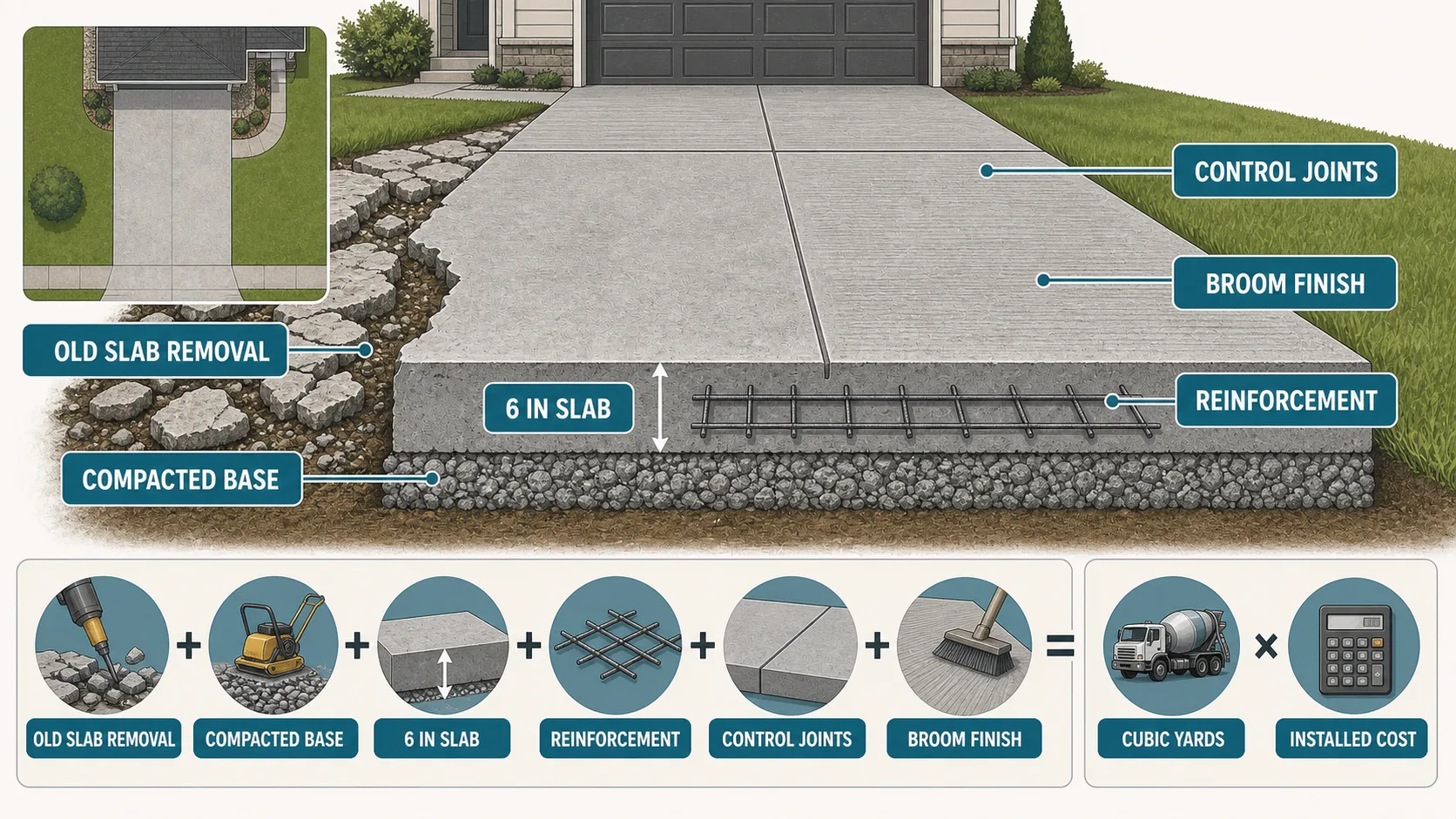
Verify slab thickness, base prep, reinforcement, joint layout and removal scope before you compare final prices.
Plate 4 · preparation
Concrete driveway prep and pour tips
The things that decide whether the slab is still flat in ten years. Every one of them is settled before the truck arrives, not after.
- 01
Use our concrete slab calculator to figure out exact cubic yards before requesting quotes. Knowing your volume keeps contractors honest on pricing.
- 02
Use 6 inches as a durable quote basis for most new driveways. Four inches may be a local minimum for light passenger cars, but thicker slabs hold up better with trucks, RVs, weak subgrade, or freeze-thaw cycles.
- 03
Broom finish is the best value for driveways. It adds almost nothing to cost, provides excellent tire traction, and hides minor surface imperfections over time.
- 04
Compare concrete to asphalt before committing. Our asphalt vs concrete calculator shows the 20-year total cost of ownership for both materials.
- 05
Wire mesh is the most cost-effective reinforcement for residential driveways. Rebar is overkill unless you park heavy trucks or RVs on the slab.
- 06
Need curbing along your driveway? Our concrete curb calculator estimates borders and mow strips.
- 07
Schedule your pour in spring or fall when temperatures stay between 50 and 80 degrees F. Summer heat cures concrete too fast, and winter cold risks freeze damage before it sets.
Method
How we calculate concrete driveway volume and joints
Volume is area times thickness, converted to cubic yards, then increased by your waste allowance. Joint spacing comes from slab thickness, not from driveway size.
yd³ = L × W × t ÷ 27order = yd³ × (1 + waste)spacing = 30 × tcut depth = t ÷ 4cost = yd³ × $160 to $195Installed cost adds labour, finish, reinforcement and removal. Permits, drainage work, pumping and difficult site access are not included.
Plate 5 · questions
Concrete driveway questions: thickness, cracking, permits
The twelve questions homeowners actually ask a contractor, answered against the same standards this calculator uses.
How much does a concrete driveway cost?
A typical 480 sq ft (40x12) broom-finish driveway at 6 inches costs about $3,800 to $6,100 installed before old slab removal. Decorative finishes can push the total much higher.
How thick should a concrete driveway be?
Four inches is often a minimum for light cars. Use 5 to 6 inches for a longer-lasting residential driveway, and ask an engineer or local contractor about heavier trucks, RVs, poor soil, or steep grades.
Does a concrete driveway need reinforcement?
Yes. Wire mesh is standard and adds about $0.40/sq ft. It holds cracked sections together and prevents shifting. Rebar at $1.50/sq ft is better for heavy loads.
How much does it cost to remove an old driveway?
Old concrete driveway removal runs $2 to $4 per sq ft, averaging around $3/sq ft. A 480 sq ft driveway costs about $1,440 to remove and haul away.
Do I need a permit for a concrete driveway?
Most municipalities require a permit for driveway work. Expect $50 to $300 depending on your city. Some areas also require an approach permit for the street connection.
How long does a concrete driveway last?
A properly installed concrete driveway lasts 25 to 50 years. Sealing every 2 to 3 years and keeping expansion joints clean extends life toward the high end.
Is stamped concrete worth it for a driveway?
Stamped adds $10/sq ft but mimics stone or brick at 40 to 60% less than real pavers. It does need resealing every 2 to 3 years at $0.50/sq ft.
Concrete vs asphalt driveway: which is cheaper?
Asphalt usually costs less up front. Concrete costs more to install, but it can last longer when the base, joints, thickness, and drainage are done correctly.
How far apart should driveway control joints be?
Cut them at 24 to 36 times the slab thickness, capped at 15 feet. A 6-inch slab gets joints roughly every 15 feet; a 4-inch slab every 10. Anything wider than 12 feet also needs a lengthwise centerline joint.
How long before I can drive on a new concrete driveway?
Walk on it after 24 to 48 hours and drive a passenger car on it after 7 days. Keep heavy trucks and RVs off for 28 days, which is when the mix reaches its design strength.
Can I pour a concrete driveway myself?
Small slabs are doable, but a driveway is a hard first job. Ready-mix arrives on the truck's schedule, you get one window to screed and finish it, and mistakes set permanently. Most people hire out anything over about 200 square feet.
Should I seal a new concrete driveway?
Yes, but wait 30 days for the first coat, then reseal every 2 to 5 years. Sealer is the cheapest thing that slows freeze-thaw scaling and keeps de-icing salt out of the surface.
Plate 6 · worked jobs
Concrete driveway cost by size: four worked examples
Same 6-inch slab and wire mesh in each one, so the only thing changing is size and finish. Removal is excluded.
Single · 20 × 10 ft
$1,602 to $2,536
200 sq ft broom finish over wire mesh. Concrete $622 to $756, labour $800 to $1,600. One car with room to walk past it.
Double · 30 × 20 ft
$4,807 to $7,615
600 sq ft. At 20 ft wide it needs a lengthwise centerline joint, which the plan above adds automatically.
Long run · 60 × 12 ft
$5,768 to $9,138
720 sq ft and two ready-mix loads. Common for houses set back 50 ft or more from the road.
Stamped · 40 × 12 ft
$8,933 to $11,180
480 sq ft where the finish outweighs the concrete: $4,800 of stamping against $1,493 to $1,820 of mix.
Plate 7 · failure modes
Concrete driveway mistakes that cause early cracking
Every one of these is decided before the pour, and every one of them shows up as a crack within the first two winters.
Comparing a 4-inch bid against a 6-inch bid
A thinner slab looks cheaper on paper and gives up most of the service life.
Ask every bidder to price the same thickness, base depth, reinforcement and joint spacing, then compare.
Skipping reinforcement
An unreinforced slab opens its cracks wide, water gets under it and erodes the base.
Wire mesh runs about $0.40 per sq ft. It is the cheapest insurance on the whole job.
No saw cuts, or cutting them too late
Concrete shrinks as it cures and will crack somewhere. Joints choose where.
Cut them 4 to 12 hours after finishing. Any later and the slab has already picked its own line.
Pouring straight onto dirt
Without a compacted base the slab settles unevenly and cracks within a season.
Lay 4 to 6 inches of gravel and compact it in lifts, not as one deep layer.
Assuming no permit is needed
The apron sits in the public right of way, so most cities require one for work near the street.
Budget $50 to $300, and expect the city rather than a national standard to set the apron thickness.
Disclaimer
These estimates are for planning purposes only. Actual costs vary by location, material availability, and project complexity. Always get at least 3 local quotes. This calculator does not replace professional advice.
Sources