Concrete Steps Calculator
Estimate concrete, bags and cost for poured steps, solid on grade or open on a waist slab.
Step Dimensions
Stair type
Common forms
Estimates only. Not professional advice.
Concrete to order
0.87cu yd
4 solid steps, including the 10% allowance.
- Concrete in the steps
- 0.79 cu yd
- Landing slab
- Not included
- 80 lb bags at $6.50
- 40 bags, $260
- Mix cost per step
- $65.00
Last updated August 11, 2026. Riser and tread limits checked against IRC R311.7 and bag yield against QUIKRETE product data by our expert review team.
Step profile
How much concrete each step in the flight actually holds
The section below is your own flight, redrawn every time you change a number, at one scale on both axes. It is the fastest way to see why the back steps cost so much more concrete than the front ones.
Hover a step to see what that one step holds on its own.
Depth into the page is the 48 in stair width, which the section cannot show. Nothing here is exaggerated, so a shallow tread really does look that shallow.
Your flight against IRC R311.7
- Riser height7.75 in max
- 7 in
- Tread depth10 in min
- 11 in
- Stair width36 in min
- 48 in
- Landing depth36 in min
- Not used
Planning references only. Adopted codes and local amendments control the built stair.
Trip hazard
Concrete step failures that show up in the first winter
A flight of steps is the one pour that has to be safe as well as flat. Every row below either raises the volume you just calculated or turns up months later, when the fix costs more than the whole original order.
Ordering off flat-slab math
A flight is not a pad. The top tread sits on as many riser-height layers as there are steps.
Count the stack: width times tread times riser times 1+2+...+N. Four steps hold two and a half times what the same footprint holds at one riser deep.
Risers that finish unequal
The bottom riser absorbs every error in the base, and the IRC allows only 3/8 in between the tallest and shortest in a flight.
Measure the total rise from the finished landing to the finished walk, not from dirt, then divide. Set the bottom form last, once the base is screeded.
No footing under the bottom riser
Steps poured on fill lift away from the house the first winter the ground freezes under them.
Carry the footing below the local frost line, commonly 36 to 48 in, and dowel the flight to the foundation rather than butting it against the wall.
Forms that bow at the bottom
Wet concrete pushes hardest at the deepest point, and the bottom step carries the whole head of the pour above it.
Brace and stake the riser boards every 16 in and kick the bottom form back to a stake in the ground. A bowed riser board is permanent.
A steel-trowelled tread
A hard trowel finish outdoors is a skating rink the first morning there is frost on it.
Float, then broom across the tread, and tool the nose. Slope each tread about 1/8 in per foot toward the front so water leaves rather than sits.
Deicing salt on the first winter
New concrete has not carbonated, and salt drives scaling that takes the top few millimetres off every tread.
Use sand for grip through the first winter, and specify air-entrained mix if the flight will ever see salt at all.
Riser and tread
Concrete for 2 to 6 steps at your own riser and tread
Every row uses the 48 in width, 11 in tread and 7 in riser you entered, at a 10% allowance and the same 0.6 cu ft bag yield the answer above divides by. Steps only, no landing.
Notice the shape of the column: six solid steps hold seven times what two do, not three times, because the stack grows with 1+2+...+N.
Formwork
Forming and pouring concrete steps that hold their edge
The volume is the easy half. What separates a flight that still looks square in ten years from one that does not is almost all decided at the forms.
Set the total rise before anything else. Measure from the finished landing down to the finished walk, then divide by a whole number of risers until you land under 7.75 in. Everything else on this page follows from that one number.
Form the risers with a slight back tilt, about a degree, and bevel the bottom edge of each riser board. The tilt buys toe room on the tread below and the bevel lets you trowel the inside corner without fighting the form.
Pour bottom step first and work up, screeding each tread off its riser board before the next batch goes in. Steps are the one pour where a cold joint runs across a walking surface, so keep the batches moving.
Order the landing separately in your head even though the calculator adds it to the same total. It is a plain slab of width by depth by thickness, and the concrete slab calculator prices it on its own if you want to split the job.
Above roughly forty 80 lb bags, rent a mixer or price a short load. The concrete bags calculator compares bag sizes for the same volume, and the stair calculator lays out the riser and tread first if the flight is not settled yet.
Keep the forms on for two days and the surface damp for three. Steps have far more exposed area per unit of concrete than a slab, so they lose water faster and they lose strength for it.
Waist slab
Poured solid, open on a waist slab, or precast concrete steps
How the flight is supported decides how much concrete it holds, and the gap between the first two routes is roughly half. Pick the matching stair type in the calculator before you trust any number on this page.
Poured solid on grade
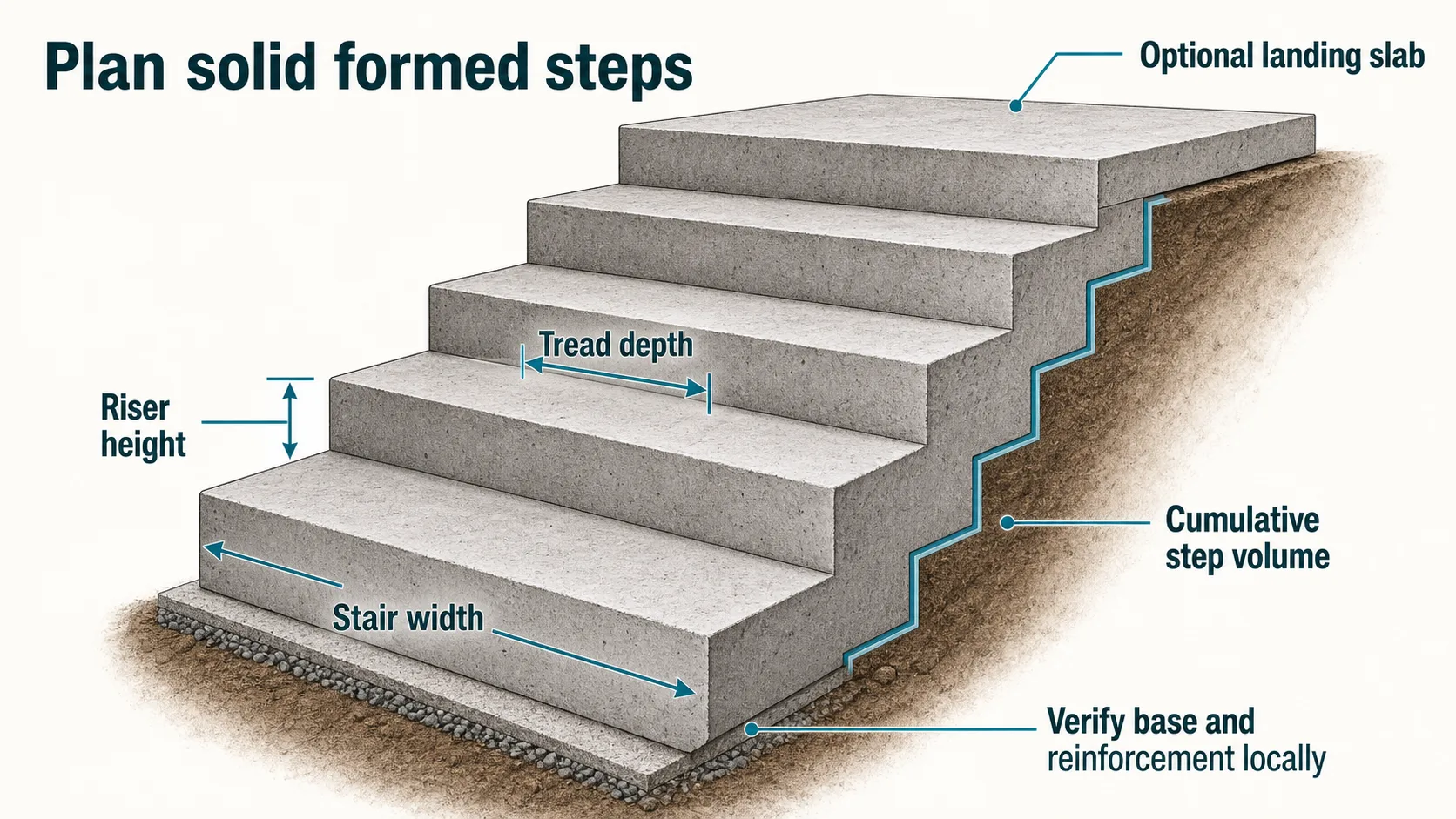
The whole flight is one mass on compacted ground, which is what most stoops, porches and entry steps are. Volume is the stacked prism sum, so it climbs steeply with step count.
- Volume model
- Stacked prisms
- Typical cost
- $60 to $120 per step in mix
Open, on a waist slab
Triangular treads sit on a sloped structural slab and the space underneath stays hollow. Normal for elevated entries and between-floor flights, and the waist thickness is an engineer's number, not a preference.
- Volume model
- Wedges plus slab
- Typical cost
- $35 to $70 per step in mix
Precast units, dropped in
Factory-made in stock widths and rises, set on a compacted base or a small footing pad. Fastest route and no forming, but the sizes are fixed, so an odd total rise usually rules it out.
- Volume model
- Not poured
- Typical cost
- $100 to $350 per step installed
Cantilever or floating
Each tread anchors into a wall or a steel spine with nothing below it. These are designed tread by tread against the load, and no bulk volume estimate applies to them.
- Volume model
- Out of scope
- Typical cost
- Engineered per tread
Cost bands are 2025 to 2026 US planning averages. Railings, tread coatings and demolition of an old flight all sit outside them, and together they can run to more than the concrete.
Stacked layers
The stacked-layer arithmetic behind a concrete steps estimate
Four lines, and only the allowance carries any judgement. The step count is what moves the answer hardest, because it enters the sum twice.
A solid flight is a set of prisms stacked against the house. The first tread fills one riser height, the second fills two, and the top tread in a 4 step flight fills 4. Adding those layers gives 1+2+...+N, which is N(N+1)/2 riser heights of concrete. An open flight replaces the stack with one wedge per step plus a sloped waist slab, which is why it lands so much lower. The landing is added afterwards as a plain slab, the allowance goes on the total, and the result is divided by the yield on the bag and rounded up.
layers = N(N+1) ÷ 2steps = W × T × R × layersorder = (steps + landing) × (1 + allowance)bags = ⌈order ÷ 0.6⌉- Stacked layers
- 10
- Bag yield in use
- 0.6 cu ft
- Allowance
- 10%
- Bags in your order
- 40
This is a material takeoff, not a structural design. Footing depth, reinforcement, dowels into the foundation, drainage and handrail anchorage are all outside it and all belong to your local code and site conditions.
Three stoops
Concrete for a 3-step stoop, a 4-step entry and an open flight
All three run through the same yield and the same 10% allowance the calculator uses, at shelf prices for 80 lb bags. Type the dimensions in and these are the numbers that come back.
Front stoop
24 bags
- Flight
- 3 solid steps, 48 in wide
- Rise and tread
- 7 in / 11 in
- Concrete
- 0.52 cu yd
- Mix cost
- $156
Small enough to mix in a tub over a morning. Two people, one mixing and one placing, keeps every batch inside its working time.
Entry with landing
47 bags
- Flight
- 4 solid steps plus a landing
- Landing
- 48 in by 36 in at 4 in
- Concrete
- 1.03 cu yd
- Mix cost
- $306
Past a cubic yard, so this is where a short-load truck starts to beat a pallet of bags on effort even when it loses on price.
Open waist-slab flight
27 bags
- Flight
- 5 steps on a 5 in waist
- Same flight solid
- 1.31 cu yd
- Concrete
- 0.59 cu yd
- Mix cost
- $176
Hollow underneath, which takes 55% off the same five steps poured solid. The waist slab is engineered, not estimated.
Doorstep questions
Concrete steps: cost, curing, footings and code
The ten things people ask before forming a flight, answered against the published bag yield and the IRC stairway section rather than rounded rules of thumb.
How much concrete do I need for 4 steps?
A 4 step flight 48 in wide with 11 in treads and 7 in risers takes about 0.87 cubic yards, which is 40 bags of 80 lb mix once a 10 percent allowance is added. The volume climbs faster than the step count because each tread sits on one more layer than the one below it.
Why do concrete steps take more concrete than a slab of the same area?
Solid steps stack. The top tread sits on as many riser height layers as there are steps, so the total is width times tread times riser times 1+2+...+N rather than one footprint times one thickness.
How much does each concrete step cost?
Bagged mix for a 48 in step runs roughly $60 to $120. Precast units land at $100 to $350 each installed, and a contractor pouring in place charges $200 to $500 per step. The concrete cost calculator breaks the same job down by material and labour.
Is precast or poured in place better for concrete steps?
Precast is faster and usually cheaper, but it only comes in stock widths and rises. Poured in place matches any dimension and ties to the foundation, and it is the only option once the total rise falls outside the standard sizes.
What riser and tread do the codes allow?
The IRC caps risers at 7.75 in and sets treads at 10 in minimum, with no more than 3/8 in variation between the tallest and shortest riser in a flight. Four or more risers bring in a handrail. Adopted codes and local amendments still control the built stair.
Do concrete steps need a footing?
Yes in any climate that freezes. The footing has to reach below the local frost line, commonly 36 to 48 in, or the flight lifts away from the house every winter and settles back unevenly.
How long before I can walk on new concrete steps?
Light foot traffic after 24 to 48 hours, no heavy loads for 7 days, and full design strength at 28 days. Keep the surface damp for the first three days, which matters more to the finished tread than the mix you bought.
Can I pour new concrete over existing steps?
Only over sound concrete with no heaving and no working cracks. Clean it back to solid material, use a bonding agent, and keep the new layer at least 2 in thick or it will delaminate under foot traffic.
How do I fix crumbling concrete step edges?
Chisel back to solid concrete, brush on bonding adhesive, and rebuild the nose with polymer modified repair mortar. Anything deeper than about an inch wants a form board and a fresh pour rather than a patch.
Does this calculator include the landing?
Only when you switch the landing slab on in advanced options. It is counted as its own slab of width times depth times thickness, so it stays visible separately from the steps themselves.
Disclaimer
These estimates are for planning purposes only. Actual costs vary by location, material availability, and project complexity. Always get at least 3 local quotes. This calculator does not replace professional advice.
Sources