Concrete Curb Calculator
Estimate concrete, bags and cost for a poured curb from its cross-section and run length.
Curb Details
Curb type
Estimates only. Not professional advice.
Concrete to order
1.02yd³
100 ft of 6 in by 6 in straight/vertical curb, including the 10% allowance.
- Concrete in the run
- 27.5 cu ft
- 80 lb bags, rounded up
- 46 bags
- Installed cost, contractor
- $800 to $1,500
- Installed, per LF
- $8 to $15 /LF
Last updated August 12, 2026. Section geometry, bag yield and concrete density checked by our expert review team.
Section and area
Curb yardage comes from the cross-section, not the run
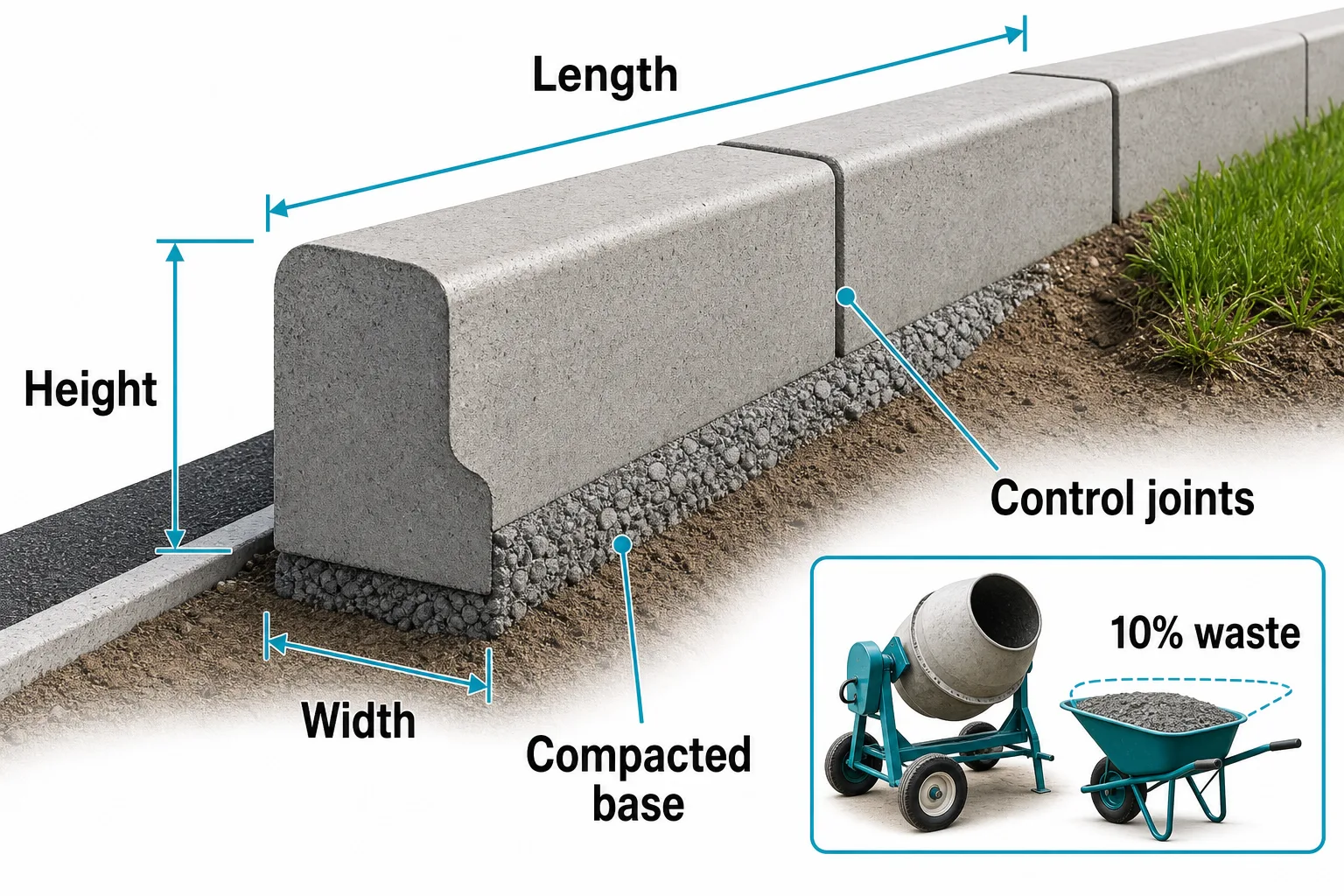
A curb is one shape repeated for a very long way, so the concrete you order is that shape times the distance. Get the distance wrong by a few feet and the order moves a few percent. Get the section wrong and it moves by a third. All three profiles below are drawn from the height and width you entered, at one scale, against the rectangle this calculator orders.
Rolled is drawn with a full-height radius on the face and battered with a 45 degree face, both idealised. Nothing is exaggerated, so a narrow curb really does lose that much of its section once the face is rolled or sloped.
Which mistake costs more
- 7 in by 7 in sectionone inch out on both
- +36%
- 110 ft runten feet longer than measured
- +10%
Both figures are the change to the same order, computed from what is currently in the calculator. The section wins because it is an area and the run is only a length.
Four runs priced
Concrete curb by run length: a mow strip, a border and a lot
Four jobs at the sections they are actually poured in, run through the same 0.6 cu ft bag yield and the same 10% allowance this calculator defaults to. Type any of them in and these are the numbers that come back.
Garden mow strip
0.36 yd³
- Run
- 80 ft
- Section
- 4 in tall by 4 in wide
- Bags
- 17 at 80 lb
- Installed
- $480 to $960
The smallest section on the page, and the cheapest to get wrong twice. A weekend of hand forming, or one afternoon behind a rented extruder.
Driveway border
0.51 yd³
- Run
- 50 ft
- Section
- 6 in tall by 6 in wide
- Bags
- 23 at 80 lb
- Installed
- $400 to $750
Short enough that forms win outright: the rental day costs more than the labour it saves over fifty feet.
Property line curb
2.04 yd³
- Run
- 200 ft
- Section
- 6 in tall by 6 in wide
- Bags
- 92 at 80 lb
- Installed
- $1,200 to $2,400
The length where the extruder starts to pay. Same section as the driveway border, four times the run, four times the concrete.
Parking lot barrier
9.05 yd³
- Run
- 500 ft
- Section
- 8 in tall by 8 in wide
- Bags
- 408 at 80 lb
- Installed
- $6,000 to $11,000
Nearly eight cubic yards, so this is a ready-mix delivery rather than a pallet of bags, and it wants rebar through the run.
Form stock and stakes
Pouring a concrete curb, in the order the work happens
These are not parallel suggestions. Each step closes off the one before it, and the two that get skipped most, compacting the base and leaving the forms on, are the two you cannot go back and do later.
- 01
Pull the line first. String a taut line at finished top-of-curb height and dry-run it with a level, because a curb reads as crooked from thirty feet away in a way a slab never does.
- 02
Dig the trench wider than the curb by a hand's width each side, and deeper by the base thickness. The excavation calculator sizes the spoil pile if the run is long enough to need a skip.
- 03
Compact 4 in of gravel in 2 in lifts with a plate compactor. Two thin lifts hold; one thick lift does not, and a curb poured on loose stone settles in the first wet season.
- 04
Set and brace the forms, or tune the extruder mix. Stake every 16 in on a straight run and every 8 in through a radius, because wet concrete pushes hardest exactly where the form wants to bow.
- 05
Run a single #4 bar through the middle of anything over 50 ft, and through every run that crosses a drive. Short garden borders do not need it.
- 06
Pour, rod off the top, then float and tool the face. Do not steel-trowel it: a curb takes weather on three sides and a hard-trowelled face scales first.
- 07
Tool or saw a joint every 10 ft and at every tie-in to a drive, walk or structure. Concrete cracks at 10 ft whether or not you gave it a joint to crack in.
- 08
Strip the forms after 24 hours, no sooner. Green edges crumble as the boards come off and there is no repair that hides it.
- 09
Keep it wet 5 to 7 days. A curb has far more surface per cubic foot than a slab, so it dries out and crazes long before a slab of the same age would.
- 10
Backfill both sides once it is hard. An unbacked curb has nothing holding the toe, and a wheel over the edge will lever it.
Back of curb
What ruins a concrete curb, and what it costs to fix later
A curb has three exposed faces and no width to spare, so it punishes everything a slab forgives. Each row below either changes the volume you just calculated or turns up a season later as a section you have to break out and repour.
Guessing the section, measuring the run
People pace out the length to the foot and then eyeball the profile. The run is linear; the section is an area, so an error there is squared.
Measure height and width with a tape before you order. On a 6 by 6 in curb, an inch out on both dimensions moves the order 36%, which no length error on a normal run gets close to.
A curb thinner than 4 in
There is no width left to resist lateral load, so the first wheel that clips it snaps a section clean off.
Keep residential curb at 6 in wide. Reserve 4 in for a mow strip that nothing will ever drive on, and even then set it flush.
No joints in a long run
A curb is the longest, thinnest thing on the site, so it moves most with temperature and it has no width to spread that movement into.
Tool or saw a joint every 10 ft, and isolate the curb wherever it meets a slab, apron or wall so the two are free to move apart.
Poured straight onto soil
The subgrade under a curb is usually the trench you just dug, which is the softest ground on the job.
Compact 4 in of gravel in 2 in lifts under the whole run, and carry the base past the toe on the drive side where the load arrives.
Forms pulled the same day
Concrete at six hours has enough set to look finished and nothing like enough to hold an arris.
Leave the forms 24 hours, longer in cold weather, and pull the stakes before the boards so nothing levers against the fresh face.
Renting the machine for a short run
An extruder carries a full day rate and half a day of setup before the first foot leaves the hopper, and it will not do a tight radius or a formed vertical face at all.
Price both paths at your own run length in the break-even below. Under the crossover, forms and a mixer win, and they win by more the shorter the job gets.
Slipform or hand form
How concrete curb gets placed, and where renting a machine wins
The concrete is the same on every route, so it cancels out of the comparison below and is deliberately left out. What changes is setup and labour. Forms need lumber and hours; an extruder needs a day rate and then almost no hours at all.
Hand-built forms
2x4 form stock on dee stakes, poured from a mixer or bags. Any profile, any radius, any tie-in, and no rental clock running. It is slow: setting, pouring and stripping is where the hours go.
- Best at
- Under the crossover length
- Profiles it can do
- Every profile
Rented curb extruder
A slipform machine that forms and places in one pass at roughly a fifth of the labour per foot. It carries a day rate and a setup, and it only extrudes rolled and mountable sections.
- Best at
- Long, straight, rolled runs
- Profiles it can do
- Rolled and mountable
Contractor slipform crew
The same machine with a crew who tune the mix for a living, priced by the linear foot with the concrete included. This is the cost band in the table further down.
- Best at
- Street-facing and commercial work
- Profiles it can do
- Every profile
Your run, both ways
Solved from the rates in the strip below, at the wage and day rate in the calculator's advanced options, using the run length already typed in. Change either number up there and everything here moves.
Rent-wins length
49 ft
From this run length up, the machine path is cheaper and stays cheaper. Shorter than that, build forms.
Over 100 ft, the machine path saves about $365 in setup and labour. Concrete, base gravel and rebar cost the same either way.
Hand-built forms
$950
- Setup before the first foot
- $75
- Then, per LF
- $8.75/LF
0.25 crew-hours/LF of setting, pouring and stripping, plus $1.25/LF of form stock
Rented curb machinecheaper here
$585
- Setup before the first foot
- $420
- Then, per LF
- $1.65/LF
1 rental day at $300 plus 4 hours of pickup, mix tuning and wash-out
- Crew wage, your input
- $30/hour
- Machine rental, your input
- $300/day
- Hand-forming labour
- 0.25 crew-hours/LF
- Extruding labour
- 0.055 crew-hours/LF
- Form stock and stakes
- $1.25/LF plus $75 setup
- Machine output
- 300 LF/day
- The $30/hour wage default sits just above the BLS national mean for cement masons and concrete finishers of $27.60 an hour, which is roughly what a loaded do-it-yourself hour is worth.
- The $300 day rate is the top of the $200 to $400 landscape-extruder band and the bottom of the $300 to $600 per day quoted for larger machines. Swap in your own quote.
- 300 LF a day is the conservative end for an operator and a helper, and the crew-hour figures come from that same pair: 16 crew-hours over 300 LF extruded, against roughly 100 LF in two days of setting and stripping forms.
- A machine only extrudes rolled and mountable sections. Tight radii, drive tie-ins and formed vertical faces are hand work regardless, so a mostly-curved job can clear the crossover and still belong in forms.
Curb line
Concrete curb rebar, permits, machine hire and cure time
The eight things people ask between measuring a run and ordering the concrete, answered against published cost bands and the same section arithmetic used above.
How much does a concrete curb cost per foot?
Concrete curbs cost $6 to $22 per linear foot depending on the style. Rolled/extruded curbs run $6 to $12. Straight vertical curbs run $8 to $15. Barrier curbs for commercial parking cost $12 to $22 per foot.
How deep should a concrete curb be?
Residential curbs are typically 6 inches tall and 6 inches wide. The footing below grade should extend at least 4 inches into compacted gravel. Barrier curbs for commercial use are 8 to 12 inches tall.
Do concrete curbs need reinforcement?
Short residential curbs under 50 feet usually do not need rebar. For longer runs, place a single #4 rebar horizontally through the center. Barrier curbs and commercial curbs should have rebar on 24-inch centers.
Do I need a permit to pour a curb?
Most cities require a permit for curbs along public streets or that affect drainage. Curbs entirely on your property (garden borders, mow strips) typically do not require permits. Check with your local building department.
How much does it cost to rent a curb machine?
Curb extrusion machines rent for $200 to $400 per day. They work best for rolled and extruded profiles on runs over 100 feet. For short runs or straight curbs, manual forms are cheaper.
What is the difference between a curb and edging?
Curbs are structural concrete borders typically 6 inches or taller that define roadways, driveways, and parking areas. Edging is thinner (2 to 4 inches), often decorative, and used to separate landscaping beds from lawn.
Are concrete mow strips the same as curbs?
Mow strips are a type of low-profile curb, usually 4 inches wide and flush with the ground or slightly raised. They create a clean edge for mowing between lawn and garden beds without trimming.
How long does a concrete curb take to cure?
Concrete curbs can handle foot traffic after 24 to 48 hours. Wait 7 days before driving over mountable curbs. Full cure takes 28 days. Keep the surface moist with a curing compound or plastic sheeting for at least 5 days.
Price per foot
Concrete curb cost per linear foot by profile
Installed prices, materials and labour together, from a contractor with a crew and a machine. Doing it yourself puts material at roughly 30 to 40% of these figures and moves the rest onto your own weekend.
Bands are 2025 to 2026 US planning averages. Excavation, removal of an existing curb, drainage tie-ins and permits sit outside them, and on a street-facing job those can outweigh the curb. At 100 ft, your selected profile lands between $800 and $1,500 installed.
Takeoff arithmetic
How this concrete curb calculator turns a section into cubic yards
Four steps, and only the allowance carries any judgement. The one thing worth knowing is which section it uses, because that is where this differs from what the drawing above shows.
Height times width gives the cross-section in square inches, which divided by 144 becomes square feet. Multiplied by the run in feet that is the raw volume in cubic feet; the allowance goes on top; dividing by 27 gives cubic yards and dividing by 0.6 gives 80 lb bags, rounded up to whole bags. Weight comes from 150 lb a cubic foot for normal-weight concrete.
The section it uses is the full rectangle, height by width, for every profile. That is exactly right for a vertical face and deliberately generous for a rolled or battered one, where the true section is smaller by the amounts drawn at the top of this page. Ordering the rectangle on a rolled curb leaves you the spare that goes into the toe, the tie-ins and the barrow, and on a job this thin that is the right way to be wrong. The curb type you pick changes the installed cost band, not the volume.
- Section in use
- 36 sq in
- Bag yield
- 0.6 cu ft
- Allowance
- 10%
- Concrete density
- 150 lb per cu ft
This is a material takeoff, not a design. Reinforcement, drainage, frost depth under the base and anything that ties a curb into a public street belong to your local code and to whoever signs the permit.
Disclaimer
These estimates are for planning purposes only. Actual costs vary by location, material availability, and project complexity. Always get at least 3 local quotes. This calculator does not replace professional advice.
Sources