Sod Calculator
Estimate sod square footage, pallets, rolls, delivery, and cost for a new lawn.
Lawn Details
Lawn preset
Typical backyard
Tall fescue
Cool-season, moderate shade, common lawns
Length (ft)
Width (ft)
Grass type
10% for simple lawns, 15% for curves and beds
Estimates only. Not professional advice.
Sod to order
1,650
sq ft of Tall fescue, which is the lawn plus 10% for cuts. Pallets and rolls are rounded up, because farms do not split them.
- Tall fescue sod
- $578 - $1,073
- Delivery, 4 pallets
- $600
- Weight arriving
- 8,000 lb
- Sod plus delivery
- $1,178 - $1,673
Confirm pallet coverage with your supplier before ordering. Weight arriving uses the pallet weight in the advanced options, which is an assumption, not a quoted figure.
Last updated May 29, 2026 by our expert review team.
Before the truck
Sod ordering: six things to settle before you book a pallet
An area figure is the easy half. The rest of the order is a pallet size you have to ask for, a date, and enough people to get a living product into the ground on it. Not a sequence, so not numbered.
The grower's pallet size, not a website's
Everything downstream hangs off one number. The calculator starts at 450 sq ft because that is the common residential planning value, and farms sell 400, 500, 600 and 700 sq ft pallets as well. Change it in the advanced options and the pallet count, the delivery bill and the schedule all move with it.
A date, and enough hands for it
Sod is the only material on this site that is alive when it arrives. Virginia Cooperative Extension puts installation within eight hours of harvest where possible, so the labor is part of the order, not a separate problem for later.
The grade and the topsoil, finished first
Sod will sit happily on a bad grade for a season and then tell you about it. Bring the levels up with fill dirt, finish with the planting layer from the soil calculator, and have it firm before delivery day.
Sod against seed, settled before either is priced
Sod buys a lawn today at roughly ten times the material cost of seed and a fraction of the wait. If that trade is still open, price the other side with the grass seed calculator before you book a truck.
The lawn measured as shapes
A rectangle around an L-shaped lawn over-orders a product that cannot be returned. Break it into pieces, or use the square footage calculator for curves and separated zones, then bring the total back here.
Waste ordered with the sod, never after
Five to ten percent covers cuts on a simple rectangle, twelve to fifteen covers curves, trees and beds. A second small delivery to make up a shortfall costs a full delivery charge and arrives a day late.
Your order
- Lawn measured
- 50 × 30 ft
- Waste added
- 10%
- Sod to order
- 1,650 sq ft
- Pallets
- 4 at 450 sq ft
- Rolls
- 165
- Grass
- Tall fescue
- Sod plus delivery
- $1,178 - $1,673
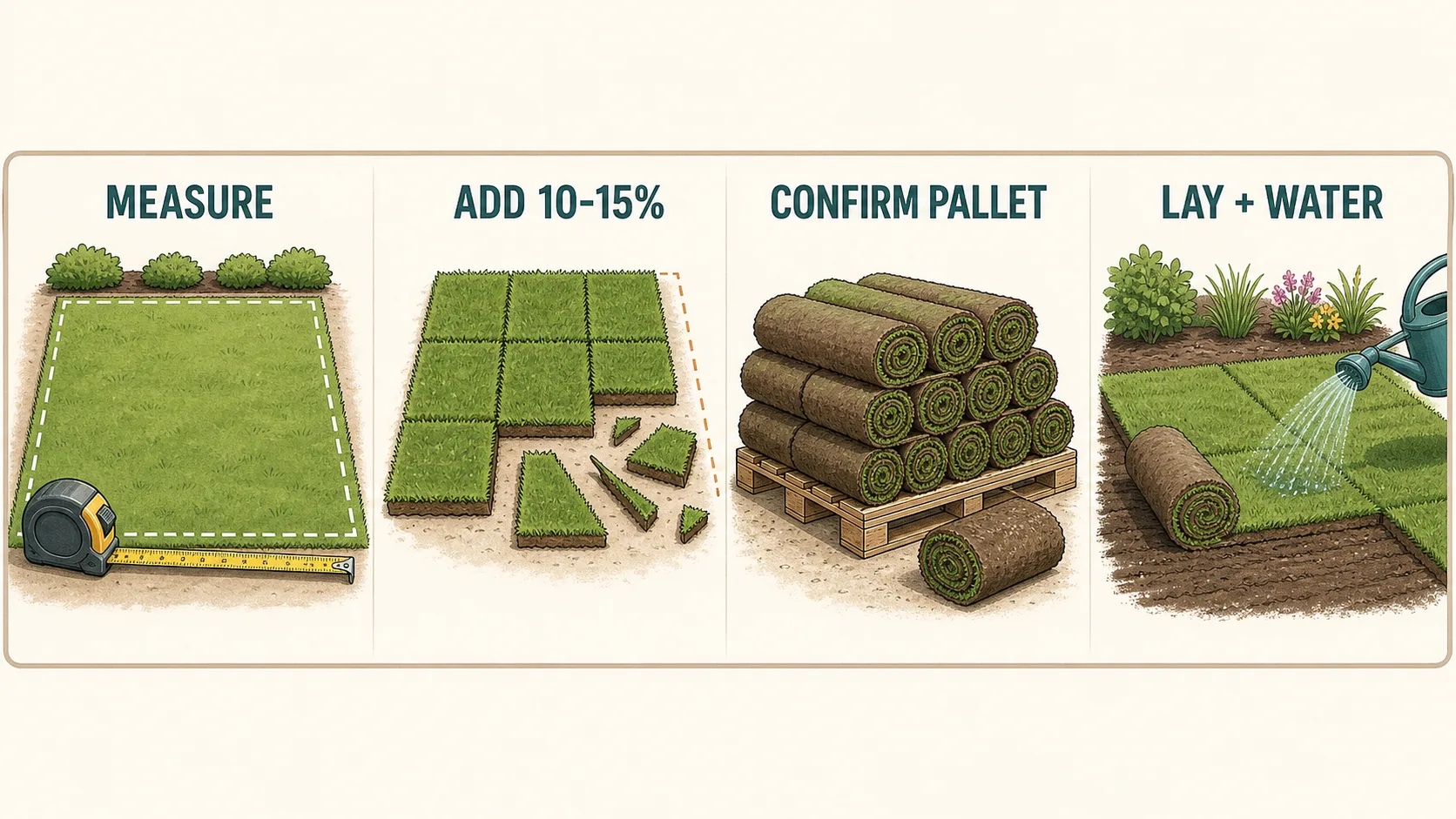
The five decisions above, drawn out in the order they happen. Soil prep and watering are both jobs the calculator cannot do for you.
Harvest clock
Can your sod delivery be laid before it spoils?
Gravel waits a fortnight on a driveway. Sod does not wait at all. It is cut, stacked on a pallet where the middle of the stack heats up, and it starts dying. Virginia Cooperative Extension puts installation within 8 hours of harvest where possible, so the order below is a delivery timetable rather than a quantity.
One delivery
4 pallets is about 5.5 hours of laying for 2 people, so one drop fits inside the window.
At 150 sq ft per person-hour, 2 people can place about 2,400 sq ft inside the window, which is 5 whole pallets at your 450 sq ft pallet size.
| Drop | Pallets | sq ft laid | lb to move | Person-hours | Hours with 2 |
|---|---|---|---|---|---|
| 01 | 4 | 1,650 | 8,000 | 11 | 5.5 |
The laying rate, the crew size and the pallet weight above are assumptions we picked so the schedule has a starting point. They are not measured figures and they are not anybody's published standard. All three are editable in the calculator's advanced options, and the schedule redraws as you change them.
The 8 hour window is Virginia Cooperative Extension's guidance, and it is still a guide. How long sod really keeps depends on the weather on the day and on how the grower cut and stacked it, neither of which this page can look up. Ask the farm. If the answer makes you nervous, the grass seed calculator prices the option with no clock on it at all.
Four lawns, priced
Sod cost and delivery plan for four lawn sizes
The four presets in the calculator, run through the same estimator at your pallet size and your laying plan. Change either and these change with them.
Repair patch
10 × 8 ft, Bermuda grass
- Sod to order
- 88 sq ft
- Waste in that
- 10%
- Pallets
- 1
- Rolls
- 9
- Sod
- $26 - $57
- Plus delivery
- $176 - $207
- Hours with 2
- 0.3
Small front yard
20 × 15 ft, Bermuda grass
- Sod to order
- 330 sq ft
- Waste in that
- 10%
- Pallets
- 1
- Rolls
- 33
- Sod
- $99 - $215
- Plus delivery
- $249 - $365
- Hours with 2
- 1.1
Typical backyard
50 × 30 ft, Tall fescue
- Sod to order
- 1,650 sq ft
- Waste in that
- 10%
- Pallets
- 4
- Rolls
- 165
- Sod
- $578 - $1,073
- Plus delivery
- $1,178 - $1,673
- Hours with 2
- 5.5
Large lawn
80 × 50 ft, Kentucky bluegrass
- Sod to order
- 4,400 sq ft
- Waste in that
- 10%
- Pallets
- 10
- Rolls
- 440
- Sod
- $1,540 - $3,300
- Plus delivery
- $3,040 - $4,800
- Hours with 2
- 15
Every figure here comes out of the same estimator the calculator uses, so none of it can drift from the readout. The hours column carries the laying-rate assumption with it.
Grass by the foot
Sod price per square foot by grass type
Material only, no delivery and no waste. The spread inside each bar is the range the calculator prices against, and it is wider than the gap between most of the grasses. Prices follow whichever unit the calculator is set to.
At your 450 sq ft pallet size, one pallet of Tall fescue is $158 to $293 of sod, before the $150 delivery charge and before waste. Cool-season, moderate shade, common lawns.
On the ground
Laying sod: what the second pallet teaches you
Seven of these, and most of them are decided before delivery day rather than on it.
Get the grade right before the truck is booked. Use fill dirt for the low spots and the soil calculator for the topsoil layer, because neither can be fixed once sod is on top of it.
Deciding between sod and seed is a different question from how much sod to buy. The grass seed calculator prices the other side of it.
An L-shaped lawn measured as one rectangle over-orders a perishable product. The square footage calculator handles curves, circles and separated zones.
Confirm pallet coverage with the grower before ordering. Many residential pallets are 400, 450, or 500 sq ft, and some farms sell larger rolls.
Book the labor before the delivery, not after. A pallet that arrives with nobody to carry it is the one that heats up in the middle of the stack.
Lay seams like brickwork and keep pieces tight without stretching them. A small gap becomes visible once the sod shrinks.
Water as you go, not at the end of the day. New sod needs moisture at the sod and soil interface right away.
Under the readout
How this sod calculator turns a lawn into pallets
Five lines of arithmetic, then a rounding rule that matters more than any of them, because a farm will not sell you two thirds of a pallet.
- Sod area
- Length × Width × (1 + waste %)
- 1,500 × (1 + 10%) = 1,650 sq ft
- Pallets
- Sod area ÷ pallet coverage, rounded up
- 1,650 ÷ 450 = 4
- Rolls
- Sod area ÷ roll coverage, rounded up
- 1,650 ÷ 10 = 165
- Sod cost
- Sod area × the grass price range
- $578 to $1,073
- Delivery
- Pallets × delivery charge per pallet
- 4 × $150 = $600
The order of a sod day, which is a real sequence
Five steps, and the numbers are load bearing: each one closes a door on the one before it. Nothing here can be reordered once the pallets are on the drive.
- 01Prep and firm the soilTill, grade, smooth. The last chance to touch the ground under the lawn.
- 02Confirm the drop, then orderPallet size, date, and whether it is one delivery or the staged plan above.
- 03Lay tight seams, brickwork fashionButt the pieces without stretching them. Start on a straight edge.
- 04Roll for soil contactRoots knit to soil, not to air. A gap under a piece is a dead piece.
- 05Water as you goNot at the end of the day. Moisture at the sod and soil interface, immediately.
Off the pallet
Where a sod order goes wrong, and what it costs
Five of these, in the order they tend to bite. Three of them are about time rather than quantity, which is what makes sod different from every other material on this site.
Ordering the sod before booking the hands
Every other material in a landscaping project waits. Sod does not: it is harvested, stacked, and the middle of the pallet starts heating the same day. Fix the crew and the date first, then order to fit them.
Ordering without confirming pallet size
A pallet may cover 400, 450, 500, or more square feet. Your supplier's number is the one that matters, and it changes the pallet count, the delivery bill, and the weight arriving at 450 sq ft a time.
Taking one big drop because the delivery fee is per pallet
Saving one delivery charge is a false economy if the last pallets sit until tomorrow. Price the staged drops against the sod you would be replacing.
Skipping soil prep
Sod hides poor soil at first, then fails later. Till, grade, smooth, and firm before delivery, because none of it can be done once the sod is down.
Under-ordering the curves
Edges around trees and beds create scrap. Add 12 to 15% for irregular lawns, and remember the offcuts are perishable too, so they are not next weekend's patch material.
Asked at the farm gate
Sod questions people ask before the pallets arrive
Nine answers, starting with the measuring and ending with the part everyone gets wrong, which is how soon you can use the lawn you just paid for.
How much sod do I need?
Multiply lawn length by width, then add waste for cuts. The calculator converts that total into pallets, rolls, slabs, and cost.
How many square feet are on a pallet of sod?
A 450 sq ft pallet is a common planning value, but suppliers may sell 400, 500, 600, or 700 sq ft pallets. Confirm before ordering.
How many rolls are on a pallet?
If each roll covers 10 sq ft, a 450 sq ft pallet is about 45 rolls. Smaller slabs or mini rolls can change the count.
How much extra sod should I order?
Use 5 to 10% for simple rectangles and 12 to 15% for curves, trees, beds, and diagonal cuts.
Can I lay sod over existing grass?
No. Remove old grass and debris so the new roots touch prepared soil.
How should I prepare soil for sod?
Till, grade, smooth, firm, and amend the upper 4 to 6 inches if a soil test calls for it.
How fast should sod be installed?
Same day is best. Virginia Cooperative Extension says sod should be installed within eight hours of harvest when possible.
How long does it take to lay a pallet of sod?
That depends on your crew, the shape of the lawn, and how far the pallet sits from the ground you are covering, so this page treats the laying rate as an input rather than a figure to publish. The delivery schedule uses 150 sq ft per person-hour as a placeholder you can change in the advanced options.
How long before I can walk on sod?
Avoid routine foot traffic until roots knit into the soil. Check by gently lifting a corner after a couple of weeks.
Disclaimer
These estimates are for planning purposes only. Actual costs vary by location, material availability, and project complexity. Always get at least 3 local quotes. This calculator does not replace professional advice.
Sources