Grass Seed Calculator
Calculate grass seed by lawn area, species, and new lawn against overseed, in lb or kg.
Lawn and seed
Typical lawns
Cool-season, germinates 7–14 days. Drought- and traffic-tolerant, the most common cool-season pick.
Estimates only. Not professional advice.
Seed for a new lawn
14lb
Tall Fescue at 7 lb / 1,000 ft² over 2,000 ft², the rate for bare soil.
- New-lawn rate, Tall Fescue
- 7 lb / 1,000 ft²
- Overseed rate, about half of it
- 3.50 lb / 1,000 ft²
- Bags at 25 lb
- 1 bag
- Seed price
- Add it under advanced options
- One 25 lb bag covers
- 3,571 sq ft
Seed only. Starter fertilizer, straw and soil amendments are not in the total, and the bag label always wins over a generic rate.
Last updated August 13, 2026. Rates checked against Oregon State, Penn State and Purdue extension guidance by our expert review team.
Seed to soil
Where grass seed has to land: thatch, soil and the cover over it
Every figure on this page assumes the seed reaches soil. This is the half inch where that is decided, drawn at your own thatch and cover depths. Both are set in the calculator's options panel.
The seed is where it needs to be
Raked to 1/4 in under 1/4 in of cover, sitting 1/2 in below the finished surface and in contact with soil. Keep the top 1/2 to 1 in damp until it comes up and the rate on this page will do what it says.
Both axes share one scale, so this is a real slice of ground 2.1 inches wide rather than a schematic. Only the seed grains are drawn larger than life, because at true size they would be smaller than the linework.
- Rake the seed to
- 1/4 inA light rake and an empty roller. Deeper does not help and cannot be undone.
- Cover it with at most
- 1/4 inThin enough that about 50% of the soil still shows through it
- Thatch it can seed into
- 1/2 inPast that, open the mat first. Past twice that, dethatch to visible soil.
What the thatch under your lawn does to the seed
THRESHOLDS FROM PENN STATE EXTENSION
None to 1/2 in
your lawn
Seed straight into it
A thin mat insulates the crown and holds moisture. Rake hard enough to open the surface and the seed still finds soil.
1/2 to 1 in
Open it first
Core aerate or run a slicer through it before seeding. Seed dropped on this depth germinates in the mat and dries out in the first hot week.
Over 1 in
Dethatch, then seed
Machine dethatch down to visible soil and rake the debris off. Seeding over it wastes the whole bag, whichever rate you used.
Full rate or half
New lawn or overseed: the same lawn, two grass seed rates
This is the decision the quantity hangs on, and it is not a preference. A new lawn is seeded for full ground cover on bare soil. An overseed drops seed into turf that already has cover, so it runs at roughly half the rate. Get it the wrong way round and half the bag lands on leaf blades.
Tall Fescue over 2,000 ft²
SET IN THE CALCULATOR ABOVE
New lawn, bare soil
14 lb
what you picked
1 bag at 7 lb / 1,000 ft². One bag finishes 3,571 sq ft.
Overseed, existing turf
7 lb
1 bag at 3.50 lb / 1,000 ft². The same bag now finishes 7,143 sq ft.
What the wrong one costs
7 lb
50% of a new-lawn order, or 0 extra bags, spread over grass that had no room for it.
Halving is a working rule, not a law: ryegrass and the warm-season grasses drop by less than half because their seed is already sparse per pound. Clemson HGIC frames the same idea from the other end, telling you to cut the planting rate in proportion to the turf already there. If half the lawn is bare, you are somewhere between these two columns.
Why the rate is quoted per 1,000 square feet
Seed is sold by weight and spread by area, so a bag needs a rate that works at any lawn size. A thousand square feet is the unit every US extension service and every bag label settled on: big enough that the number is not a decimal, small enough that a front yard is a handful of them. It is a denominator, not a lawn size, which is why a 1,000 sq ft figure never appears anywhere on your property.
Divide your lawn by 1,000 and you have the multiplier the label is asking for. Everything else on this page is that one multiplication.
- Your lawn, in label units
- 2.00 × 1,000 ft²Multiply the label rate by 2.00 and you have your order.
- One bag, new lawn
- 3,571 sq ftA 25 lb bag at the tall fescue new-lawn rate.
- One bag, overseeding
- 7,143 sq ftSame bag, same lawn, roughly twice the ground. That gap is the whole decision.
Species and rate
Choosing grass seed: rate, germination and where each species belongs
Rates differ by more than four times across this table, and none of it is about lawn quality. It is seed size and how the plant spreads: a pound of bluegrass holds an enormous number of tiny seeds, a pound of tall fescue far fewer and much larger ones.
Tall Fescue
your pick
7 lb
3.50 lb
7–14 days
6 to 12 lb
Cool-season. You want one durable, drought- and traffic-tolerant lawn with low fuss.
Kentucky Bluegrass
2.50 lb
1.25 lb
14–21 days
1.5 to 4 lb
Cool-season. You want the finest, self-repairing lawn and can wait through slow germination.
Perennial Ryegrass
8 lb
4.50 lb
5–10 days
4 to 10 lb
Cool-season. You need fast cover, are overseeding, or want quick erosion control.
Fine Fescue
4.50 lb
2.50 lb
7–14 days
4 to 10 lb
Cool-season. The yard is shady or you want the lowest water and fertilizer needs.
Bermuda (seeded)
1.50 lb
1 lb
10–21 days
1 to 2 lb
Warm-season. You're in a hot, full-sun climate with heavy foot traffic.
Zoysia
1.50 lb
1 lb
14–21 days
1 to 2 lb
Warm-season. You want a dense, wear-tolerant warm-season lawn and can wait for it to fill in.
The published range is the window the extension services actually print, and this page picks one workable figure inside it: Oregon State gives tall fescue 8 to 12 and Kentucky bluegrass 2 to 4, Penn State gives 6 to 8 and 2 to 3, and Purdue AY-3-W gives 6 to 9 and 1.5 to 2. Bagged blends carry their own rate on the label, and the label wins.
Germination window
What decides whether grass seed actually comes up
Quantity is the easy half. Every item below outranks it, and all of them are settled in the two hours before the spreader comes out and the fortnight after.
Open the surface before you open the bag
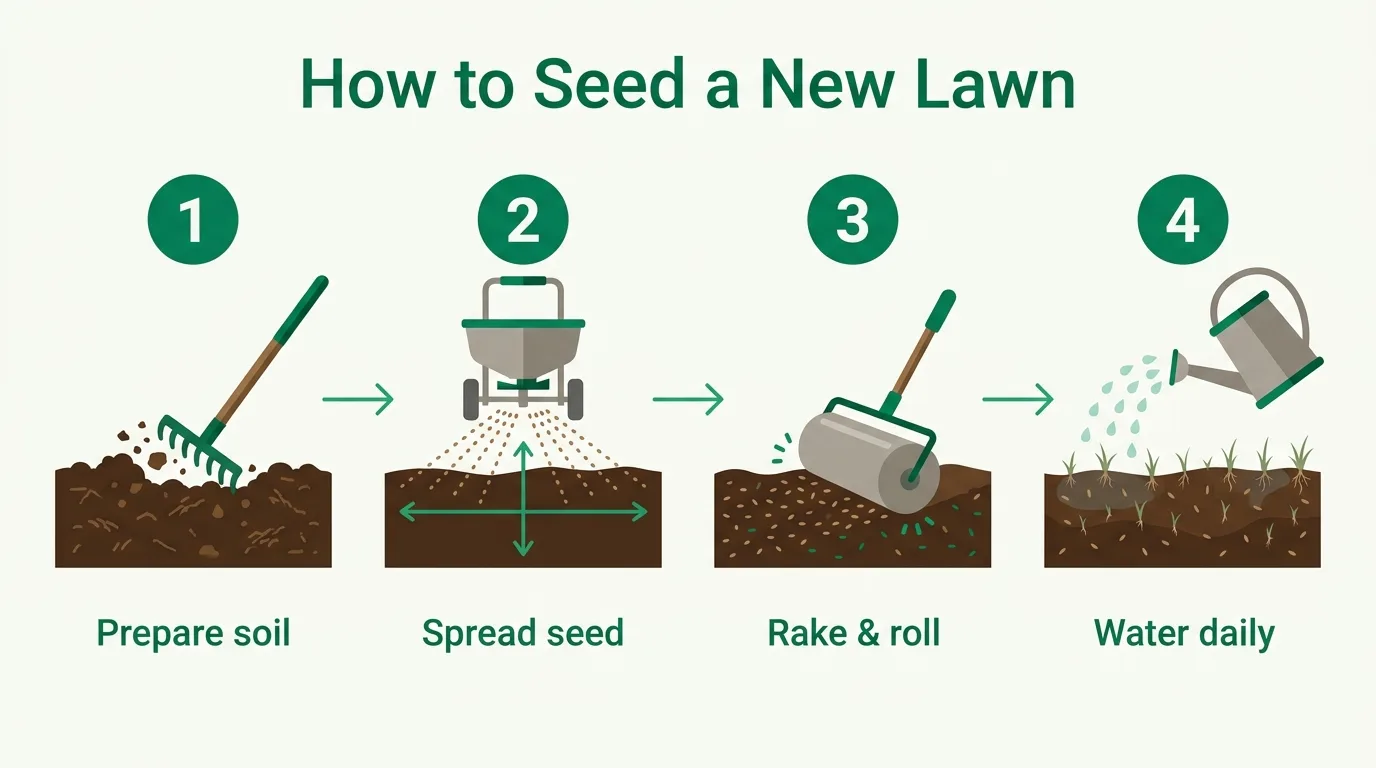
Seed needs to touch soil, not sit on it. On bare ground rake to a fine, firm finish; on an existing lawn core aerate or run a slicer so there are open lanes for the seed to fall into. Oregon State EC 1550 puts it plainly: go over the area until it looks like bare soil.
Spread half the bag each way
Split the quantity in two and make two passes at right angles. A single pass leaves spreader stripes that show as green bands for the whole first season, and it is the reason a correctly sized order can still look short.
Rake it in to about 1/4 in, no deeper
A light rake and a pass with an empty roller is the whole job. Past 1/2 in the seedling runs out of reserve before it reaches light, so heavier raking does not help and cannot be undone.
Cover it thinly, or not at all
Straw or topdressing is for erosion and moisture, not for burying seed. Purdue AY-3-W asks for a covering light enough that roughly 50% of the soil still shows through, which is about one bale of clean straw per 1,000 sq ft.
Keep the top half inch to inch damp, not soaked
Two to four short waterings a day until germination beats one long soak. The seedbed drying out for a single afternoon in week one kills more seed than any rounding error in the quantity.
Buy the season, not just the bag
Cool-season grasses go down in late summer to early fall, warm-season in late spring once soil is reliably warm. The right rate in the wrong month still produces a thin stand, and a thin stand is what gets blamed on the seed.
Check the label against the rate on this page
Bag rates are quoted per 1,000 sq ft and vary between blends, so read the label before you set the spreader. If the label disagrees with this page, follow the label: it knows what is actually in the bag.
Seeded and bagged
Grass seed by lawn size: three lawns, both ways round
Three real jobs through the same function the calculator runs, each shown at its own purpose and then at the other one. Type any of them in and the figures match to the decimal.
Tall Fescue · 5,000 ft² · Overseed
18 lb
1 bag · 3.50 lb / 1,000 ft²
New lawn instead: 35 lb
Overseed in early fall for cool-season grass so seedlings establish before winter.
Kentucky Bluegrass · 2,500 ft² · New lawn
6.3 lb
1 bag · 2.50 lb / 1,000 ft²
Overseed instead: 3.1 lb
Kentucky bluegrass is slow to germinate, so keep the seedbed moist for up to 3 weeks.
Bermuda (seeded) · 4,000 ft² · New lawn
6 lb
1 bag · 1.50 lb / 1,000 ft²
Overseed instead: 4 lb
Sow bermuda in late spring once soil is reliably above 65 to 70 degrees Fahrenheit.
Lawn size to bags
Grass seed quantity by lawn size, new lawn against overseed
Five common lawns at the tall fescue rate, with the bag count at your own bag size. Change the species or the bag in the calculator and every row here moves with it.
1,000 ft²
7 lb
3.5 lb
1
1
2,500 ft²
18 lb
8.8 lb
1
1
5,000 ft²
35 lb
18 lb
2
1
7,500 ft²
53 lb
26 lb
3
2
10,000 ft²
70 lb
35 lb
3
2
Seeding answers
Grass seed questions: rates, timing, bags and depth
Ten answers in the order they come up, from working out the area to standing in the aisle deciding how many bags to carry out.
How much grass seed do I need per square foot?
It depends on the grass type. Most cool-season seed is rated in pounds per 1,000 sq ft: tall fescue is about 7 lb for a new lawn, Kentucky bluegrass about 2.5 lb, and perennial ryegrass about 8 lb. Overseeding uses roughly half the new-lawn rate.
What is the difference between new lawn and overseeding rates?
A new (bare-soil) lawn needs the full seeding rate for complete coverage. Overseeding adds seed to an existing lawn to thicken it, so it uses about half the new-lawn rate.
How many pounds of seed for a 2,500 sq ft Kentucky bluegrass lawn?
About 6.3 lb for a new lawn at 2.5 lb per 1,000 sq ft. Buy a little extra for bare patches and edges.
Can I use too much grass seed?
Yes. Overseeding too heavily makes seedlings compete for water, light, and nutrients, which weakens the stand and invites disease. Stick to the recommended rate rather than doubling it.
When should I plant grass seed?
Plant cool-season grasses (fescue, bluegrass, ryegrass) in early fall or early spring. Plant warm-season grasses (bermuda, zoysia) in late spring once the soil is consistently warm.
How long does grass seed take to germinate?
It varies by species: perennial ryegrass sprouts in about 5 to 10 days, tall and fine fescue in 7 to 14 days, and Kentucky bluegrass, bermuda, and zoysia can take 14 to 21 days. Keep the seedbed consistently moist the whole time.
How do I get good seed-to-soil contact?
Loosen the top quarter-inch of soil, spread seed with a broadcast or drop spreader in two perpendicular passes for even coverage, then rake lightly and roll or tamp so the seed settles into the soil rather than sitting on top.
Do I need starter fertilizer when seeding?
A phosphorus-containing starter fertilizer helps new roots establish, but check local rules — many areas restrict phosphorus unless a soil test shows a deficiency. It is optional, not part of the seed quantity.
How much does grass seed cost?
Seed runs roughly $3 to $10 per pound depending on type and quality, with premium bluegrass and fine-textured blends at the top of the range. Enter your price per pound to estimate the cost.
Should I use seed or sod?
Seed is far cheaper and offers more grass-type choices, but takes weeks to establish. Sod gives an instant lawn at higher cost. For an instant lawn, use the sod calculator instead.
Area to poundage
From lawn area to pounds of grass seed
Five steps, each one run against the numbers you entered. Only one of them involves a judgement, and it is the purpose switch rather than any of the arithmetic.
Lawn area
2,000 ft²
50 ft by 40 ft, as entered
Label units of ground
2.00
Area divided by 1,000, the denominator every label uses
Rate for the species
7 lb / 1,000 ft²
Tall Fescue, new lawn. Overseeding runs at about half the new-lawn figure.
Seed by weight
14 lb
Label units multiplied by the rate
Bags to buy
1 bag
Pounds divided by your 25 lb bag, rounded up. A part bag is still a bag.
What the grass seed calculator assumes, and where it stops
One figure inside a published window
Extension rates are ranges, not points. This page carries one workable figure per species and prints the published window beside it, so you can see how much room there is either side.
Overseeding at about half
Halving is the working rule for turf that still has cover. It is not exact and it is not uniform across species, which is why the two columns higher up the page are shown side by side rather than folded into one number.
Rounding, at the end
Weights round to two decimals and bags round up to whole bags. Buy the rounded-up bag: bare edges and thin patches always want a little more than the rectangle you measured.
What it does not price
Starter fertilizer, straw, topsoil, soil tests and equipment rental are all outside this number. Seed is usually the smallest line on a lawn renovation.
Three weeks later
Where a grass seeding goes wrong before anything germinates
None of these are visible on seeding day. Every one of them is decided by a choice made with the bag still closed.
Overseeding at the new-lawn rate
The full rate is sized for bare ground. Poured into a lawn that already has cover, roughly half of it lands on leaf blades and never reaches soil, so it is money spread on grass.
Switch the calculator to Overseed. On this lawn that is the difference between the two figures higher up the page, and it comes off the order, not off the result.
Doubling the rate to be safe
Crowded seedlings compete for the same water and light, thin out under the first heat, and invite damping-off disease. A double-rate stand looks best at week three and worst at week twelve.
Order the labelled rate and spend the difference on the seedbed. Prep decides germination far more than quantity does.
Seeding straight into thatch
Seed lands in a dead mat with no moisture behind it. It germinates, roots into thatch instead of soil, and burns off in the first hot week.
Measure the mat. Past 1/2 in open it up, past 1 in dethatch to visible soil first. The section at the top of this page draws your own depth.
Burying it under topdressing
A generous layer of compost over new seed feels like care. At more than 1/2 in it is a lid, and the seed exhausts itself underneath it.
Keep the cover at 1/4 in or less, thin enough to see the soil through it. If you cannot see soil, it is too much.
Reading a warm-season rate off a cool-season chart
Bermuda and zoysia are sold at a fraction of a fescue rate because the seed is far smaller and the plants spread sideways. Use a fescue number for bermuda and you buy four times what the lawn can use.
Pick the species in the calculator first. The rate follows the species, not the lawn size.
Letting the seedbed dry out once
Germination is not a checkpoint you pass. A seed that has swollen and then dried is dead, and no amount of watering in week two brings it back.
Water lightly and often for the first two weeks, then less often and more deeply. Nothing on this page matters if that slips.
The first four are one mistake in four costumes: treating seed as a quantity you buy rather than a thing that has to reach soil at the right depth. The section at the top of this page separates the two.
Disclaimer
These estimates are for planning purposes only. Actual costs vary by location, material availability, and project complexity. Always get at least 3 local quotes. This calculator does not replace professional advice.
Sources