Paint Cost Calculator
Price a paint job in full: paint, primer, supplies, and what a pro would charge for the same walls.
Room and budget
Estimates only. Not professional advice.
Estimated project cost
$80
materials only
320 sq ft to cover in 2 coats of standard paint at 400 sq ft/gal, which is 2.0 gallons.
- Paint, 2.0 gal at $40/gal
- $80
- Materials total
- $80
- Materials per unit
- $0.25/sq ft
Gallons include the 10% order buffer and are rounded up to whole cans, the same way the paint calculator counts them.
Last updated June 11, 2026 by our expert review team
Budgeting the job
Seven habits that keep paint costs where you put them
Almost nothing on a paint budget is decided at the till. It is decided by the tier you pick, the prep you plan for, and whether you priced the work or only the paint.
Price the finish, not the can. Benjamin Moore Regal Select is best budgeted around $55/gal to $65/gal. Premium paint costs more up front, but stronger hide and better washability cut the risk of a third coat in a room that gets touched.
Take three quotes, not one. Professional interior work runs about $2.00/sq ft to $4.00/sq ft in the Midwest and $4.00/sq ft to $7.00/sq ft in coastal cities. Rates vary by 40% inside a single metro, so one quote tells you almost nothing.
Prep is the bill. Prep is 60 to 80% of a pro painter's hours, and $0.50/sq ft to $1.50/sq ft of the price for patching, sanding, caulking and taping. It is also the line that peels within a year or two when somebody cuts it.
Know your crossover point. A 12 by 12 ft room is $80 to $150 in materials or $400 to $800 hired out. Under two rooms, doing it yourself almost always wins; past three, a crew's speed starts paying for itself. The split above puts your own numbers on that.
Mid-range beats cheap. Behr Ultra at $35/gal is the best value in the middle of the shelf. Consumer Reports rates it level with paints costing $20 more a can, which is a real saving across a whole order.
Box the order. Buy all the paint at once and have the counter shake it into one 5-gallon bucket. Boxing costs nothing and removes the colour step between gallons that shows up on a long wall.
Count the trim separately. Baseboard and casing are priced by length, not by wall area. The baseboard calculator gives you the length, and the trim toggle here prices it at $0.30/ft in material plus $1.20/ft in pro labor.
Materials against labor
What your paint job costs you, and what it costs to hire out
Paint is the small half of a professional bill. That is why two quotes for one room differ far more than two paint prices do, and why doing it yourself buys back hours rather than a discount on materials. Both rates below are yours to set, in the calculator's advanced options.
Your 320 sq ft, 2 coats
- Paint at your price, 2.0 gal
- $80
- Materials, either way
- $80
- Labor in the pro bill, 93% of it
- $1,040
Labor here is what is left of an all-in rate once the same materials are paid for, which is how the labor tiers in this calculator were set. The materials are the same either way, so that labor line is exactly what painting it yourself keeps. Supplies count only what you ticked; the full set of five is $60.
Paint and primer are 7% of that bill. This is about a room or two of wall, and at that size doing it yourself usually wins.
Break-even on your time
$208
an hour, for your own hours
Painting it yourself saves $1,040 across about 5 hours, so it pays you roughly $208 an hour. Hiring out is the better deal any time your own hour is worth more than that.
- Hours of work
- 5
- Rolling speed
- 120 sq ft/hr
- Wall to cover
- 320 sq ft
- Coats
- 2
- Pro rate you set
- $3.50/sq ft
- Paint price you set
- $40/gal
The rolling speed is an assumption, not a published rate, which is why it is a slider you can move. It counts rolling only, and prep is 60 to 80% of a professional's hours, so read the figure as the best case for doing it yourself. Everything else here comes from your own inputs.
Line by line
Every line item in a paint job cost, and the rate behind it
Twelve lines can appear on the estimate above. These are the rates each one uses, so you can see exactly which figure moved when your total did.
| Line | Rate | What it covers |
|---|---|---|
| Economy paint | $28/gal · 350 sq ft/gal | Lowest shelf price. A real colour change can want a third coat. |
| Standard paint | $40/gal · 400 sq ft/gal | The default here, and the tier the worked jobs below use. |
| Premium paint | $55/gal · 450 sq ft/gal | Costs more per can, covers more, usually needs fewer coats. |
| Primer | $28/gal · 300 sq ft/gal | One coat over the buffered area, on new drywall or a big colour change. |
| Supplies | $60 the set | Brushes $15, rollers $20, tape $8, drop cloths $12, tray $5. |
| Order buffer | 10% on area | Cut-in overlap and the paint that stays in the tray and the roller. |
| Basic pro repaint | $1.00/sq ft | Labor only. Open walls, light prep, simple access. |
| Standard pro room | $1.75/sq ft | Labor only. Typical prep, corners, trim masking, furniture moved. |
| Detailed pro work | $2.75/sq ft | Labor only. High ceilings, heavy prep, cabinets, complex masking. |
| Regional adjustment | ×0.85 to ×1.3 | Applied to labor only. Materials barely move between markets. |
| Trim and doors | $0.30/ft + $1.20/ft | Material plus pro labor per running foot of baseboard and casing. |
| Openings deducted | 20 sq ft · 15 sq ft | Taken out per average interior door and per average window. |
Labor tiers are labor only. Add materials at roughly $0.40/sq ft and they land inside the $2.00/sq ft to $4.00/sq ft all-in range painters usually quote.
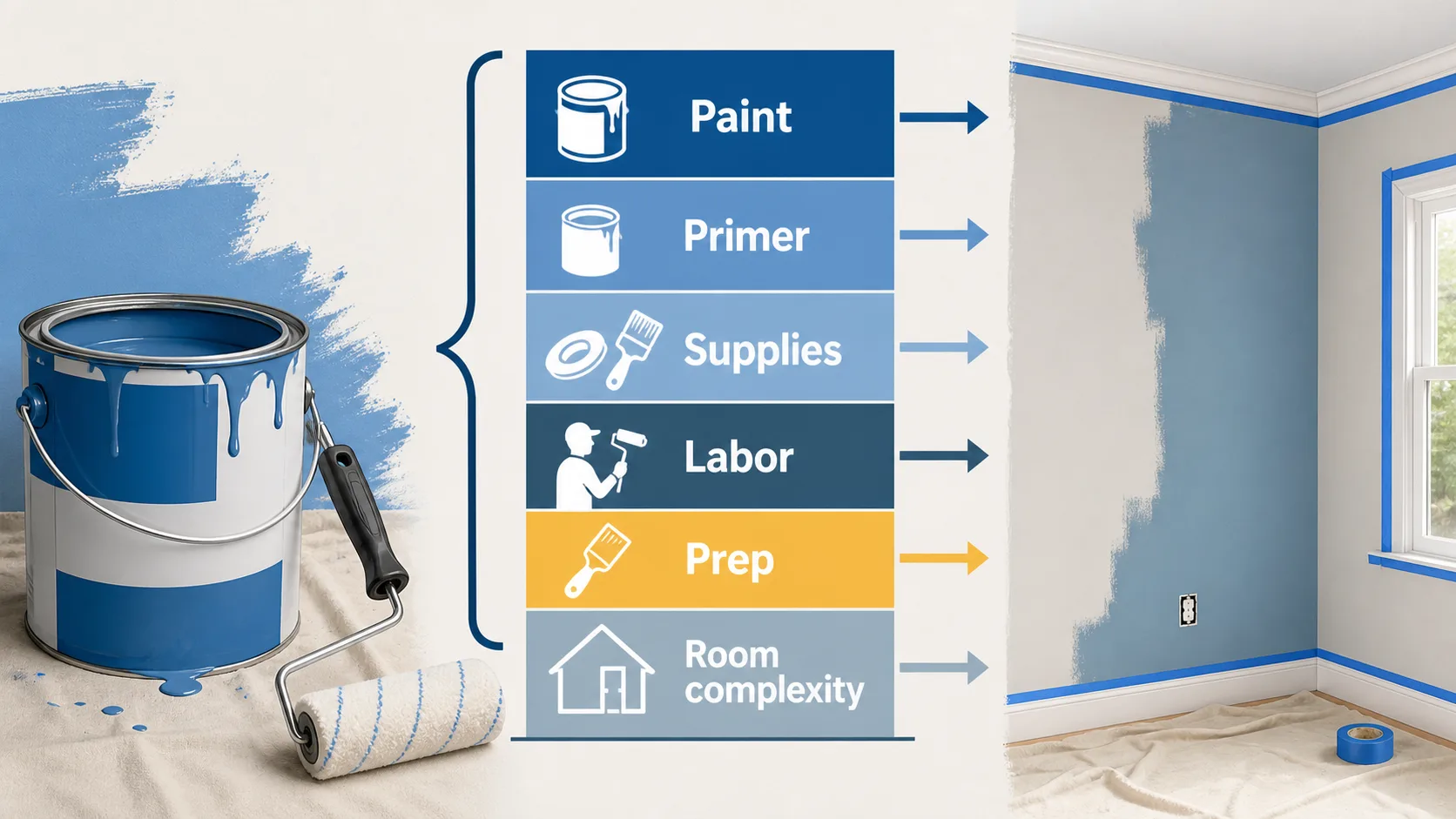
The lines stack in that order on a real quote, and the two at the bottom, prep and complexity, are the ones no material list shows you.
Behind the arithmetic
How this paint cost calculator builds your total
Height times perimeter, less the openings, buffered, divided by the tier spread rate, then priced. Labor is a separate multiplication against the same area.
paintable area = height × perimeter − doors × 20 sq ft − windows × 15 sq ftgallons = ⌈paintable area × 1.10 × coats ÷ spread rate⌉primer = ⌈paintable area × 1.10 ÷ 300 sq ft/gal⌉materials = paint + primer + supplieslabor = paintable area × tier rate × regional multipliertotal = materials + labor + trimIn the total
- Wall area, with 20 sq ft out per door and 15 sq ft per window.
- Ceiling area when you turn it on, approximated as a square room from the perimeter.
- A 10% buffer, then rounding up to whole cans of paint and of primer.
- Labor at the tier rate you pick, multiplied by your area's cost level.
- Trim and doors by the running foot, material always, labor only if a pro is doing it.
Not in the total
- Prep materials: spackle, caulk, sandpaper and cleaner, a real line on every job.
- Texture and porosity, which can drink a quarter more than smooth drywall.
- Sprayer overspray and masking beyond the tape in the supplies list.
- Delivery, permits, furniture storage and anything the crew charges as an extra.
Gallon counts and can rounding are the paint calculator's job; new drywall to be painted starts at the drywall calculator.
Three jobs priced
Paint cost by job: a bedroom, a whole interior, a kitchen
Three sets of dimensions through the same arithmetic as the calculator. The middle one is the only one with a crew on it, and it is the one where labor takes over.
Bedroom, done yourself
$180
430 sq ft · 3.0 gal
Master bedroom, 14 by 16 ft, 8 ft ceilings
- Materials
- $180
- Labor
- none, yours
- Paint used
- standard paint
A weekend. The 10% buffer matches the quantity calculator, so the touch-up paint left over is from the same batch.
Whole interior, hired out
$6,075
3,000 sq ft · 15.0 gal
1,800 sq ft home, standard pro repaint
- Materials
- $825
- Labor
- $5,250
- Paint used
- premium paint
Labor is the largest line by a wide margin. Two coats of premium on the walls, no full prime, standard complexity.
Cabinets, done yourself
$126
180 sq ft · 1.0 gal
Kitchen cabinet repaint, 30 running ft
- Materials
- $126
- Labor
- none, yours
- Paint used
- premium cabinet paint + 1.0 gal primer
Small area, enormous hours. A pro bid on cabinets is driven by door count and finish quality, not by square footage.
Every figure is the calculator's own output for those inputs. Work out your own paintable area with the square footage calculator if the plan is not a simple rectangle.
Bids and budgets
What people ask about paint cost before they book anyone
Eight answers, all against the same tier prices and spread rates the estimate above divides by.
How much does it cost to paint a 12x12 room?
DIY materials are usually about $80-180 before tools you already own. A professional repaint commonly lands around $400-800 depending on prep, trim, ceiling height, and local labor.
Do I really need primer?
Yes for new drywall, dramatic color changes, and stain-blocking. A primer like Zinsser Bulls Eye 1-2-3 ($28/gal) saves you from needing a third coat.
Is premium paint worth the extra cost?
Usually yes in kitchens, baths, halls, and kids' rooms. Benjamin Moore Regal Select is best budgeted around $55-65/gal and can reduce repaint risk because it hides and washes better than economy paint.
How much does it cost to hire a painter?
Professional interior painting often prices around $2-5.50 per sq ft for wall work before unusually heavy prep. A single 12x12 room costs about $400-800; whole-house interiors vary widely.
What's the best paint sheen for each room?
Flat for ceilings, eggshell for living rooms, satin for hallways and kids' rooms, semi-gloss for kitchens, bathrooms, and trim.
How long should I wait between coats?
Latex often needs 2 to 4 hours near 77°F and 50% RH. Below 50°F or above 85% RH, wait longer and check the can before recoating.
Should I use a brush or roller?
Use a 9" roller with 3/8" nap for smooth walls and a 2.5" angled brush for edges. For textured walls, use a 3/4" nap roller.
How do I estimate prep work costs?
Basic prep adds $0.50/sq ft. Moderate prep (patching, caulking, priming) adds $1.00-1.50/sq ft. Heavy prep adds $2.00-4.00/sq ft.
Scaling up
Cost to paint a room, and a whole interior, by size
Two tables, one for a single room and one for a whole house. The room table is walls only at the standard tier; the house table is an all-in professional repaint.
One room, 8 ft walls, two coats
| Room | Wall area | You paint it | A pro paints it |
|---|---|---|---|
| 10 × 10 ft | 320 sq ft | $140 | $690 |
| 10 × 12 ft | 352 sq ft | $140 | $760 |
| 12 × 12 ft | 384 sq ft | $140 | $830 |
| 12 × 16 ft | 448 sq ft | $180 | $960 |
| 14 × 16 ft | 480 sq ft | $180 | $1,030 |
Your own column is 400 sq ft/gal paint at $40/gal plus the $60 supplies set; the pro column is $2.15/sq ft of wall. Ceilings and trim add roughly a third.
A whole interior, priced on floor area
| Home size | Budget | Average | Premium |
|---|---|---|---|
| 1,000 sq ft | $2,500 | $3,750 | $6,000 |
| 1,500 sq ft | $3,750 | $5,625 | $9,000 |
| 2,000 sq ft | $5,000 | $7,500 | $12,000 |
| 2,500 sq ft | $6,250 | $9,375 | $15,000 |
| 3,000 sq ft | $7,500 | $11,250 | $18,000 |
$2.50/sq ft to $6.00/sq ft of floor area, walls and ceilings, labor included. Exterior and trim-heavy work sits above the top column.
Where budgets slip
Six budget mistakes that quietly add to a paint job
Five of these cost money on the day. The last one costs it twice, because the wall has to be painted again.
Dropping primer to save a gallon
On new drywall you buy the saving back in a third coat. One $28/gal gallon of primer is cheaper than the extra paint, and it stops stains bleeding through.
Buying on shelf price alone
Economy paint at $28/gal covers 350 sq ft/gal; premium at $55/gal covers 450 sq ft/gal. In a room that gets wiped and scuffed, the dear can is the cheap one.
Ignoring texture and porosity
Orange peel, knockdown and bare wood drink 20 to 30% more than smooth drywall. Raise the estimate by about a quarter before you order.
Painting in the wrong weather
Recoat times assume roughly 77°F and 50% humidity. Below 50°F or above 85% humidity, dry time stretches and adhesion suffers, and a repaint costs the whole budget again.
Leaving prep out of the budget
Spackle, caulk, sandpaper and cleaner run $50 to $100 a room and appear on no material list. Skipping them is what peels inside a year.
Measuring the room as a rectangle
Closets, bump-outs and odd angles add 4 ft or more of perimeter to a 12 by 14 ft room. Measure wall by wall, or use the square footage calculator to total an irregular plan.
Prep is the line that decides all six. It is also the line a quote is most likely to leave vague, so ask what is included before you compare two numbers.
Disclaimer
These estimates are for planning purposes only. Actual costs vary by location, material availability, and project complexity. Always get at least 3 local quotes. This calculator does not replace professional advice.
Sources