Stain Calculator
How much wood stain do you need? Calculate the exact gallons for your deck, fence, siding, or furniture based on stain type, wood porosity, and number of coats.
Surface Dimensions
Estimates only. Not professional advice.
Stain to buy
2.0 gal
semi-transparent on pressure-treated wood, 2 coats over 240 sq ft.
- Draw rate on this wood
- 250 sq ft/gal
- Per coat
- 1.0 gal
- Price assumed
- $40 / gal
- Material, this surface
- $80
Estimates only. Not professional advice.
Last updated August 5, 2026 by our expert review team.
Prep to cure
Wood stain mistakes that end in peeling, blotching and a re-sand
Six failures in the order they bite, from the day the lumber lands to the two days after you finish. None of them are about how much stain you bought, and every one of them wastes the lot.
Staining new pressure-treated lumber the week it is delivered
New PT wood arrives at 40 to 60% moisture. Stain cannot get into a pore that is already full of water.
Wait until a pin meter reads under 15%, which takes 3 to 6 months. A $25 meter pays for itself on one deck.
Staining over a degraded finish without cleaning it off
Fresh stain will not bond to dirt, mill glaze or an oxidised old coat, so it lifts in sheets the first wet spring.
Deck cleaner and a stiff brush first to break the oxidation layer, then pressure wash, then 48 to 72 hours to dry.
Putting oil-based stain over water-based, or the reverse
The two do not adhere to each other, and the failure shows up as peeling rather than as a colour problem.
Test with denatured alcohol on a rag. If colour lifts, the old finish is water-based. If nothing lifts, it is oil.
Working in direct sun on a hot afternoon
Above 90°F surface temperature the carrier flashes off before the pigment has penetrated, and the film peels in weeks.
Follow the shade around the deck, or start at first light. 60 to 75°F with low humidity is the window.
Flooding the boards to make the colour deeper
Wood takes what it takes. Everything past that sits on top and cures sticky or flaky.
Thin coats, and back-brush the excess within 15 to 20 minutes so the surplus is worked in rather than left standing.
Ignoring the forecast for the two days after you finish
Rain inside the cure window washes pigment out of the film and leaves blotches that only sanding will fix.
Oil-based needs 24 to 48 hours, water-based 4 to 6. Read the whole window, not just the afternoon you are staining.
Draw rate
How much stain your wood drinks, before you buy any
Paint sits on a surface, so its coverage is close to a constant. Stain goes into the wood, so the same amount covers whatever the boards let it. Below is your own surface priced out across every species and texture this calculator carries, so the spread is something you can see rather than something we assert.
Softwood
15-20% more absorption
×1.15
2.5 gal
3.0 gal
217 sq ft/gal
Hardwood
Lower absorption
×0.90
2.0 gal
2.5 gal
278 sq ft/gal
Pressure-Treated Woodyour wood
Standard absorption
×1.00
2.0 gal
3.0 gal
250 sq ft/gal
Composite/Engineered
Minimal absorption
×0.75
1.5 gal
2.0 gal
333 sq ft/gal
Same semi-transparent stain, same 240 sq ft, same 2 coats: the order runs from 1.5 gal to 3.0 gal depending only on what it is soaking into. Texture on its own, holding your species fixed, moves it by 1.0 gal.
Coat one against coat two
Where the order actually goes, coat by coat
Bare wood takes the most. By the second coat some pores are already sealed, so the same brush covers more ground.
coat 1, bare wood
1.0 gal
Full draw at 250 sq ft/gal. This is the thirsty one, and it is the coat people under-buy.
coat 2, partly sealed
1.0 gal
Budgeted at the same rate. In practice a second coat spreads 20 to 25% farther, so it takes nearer 0.8 gal.
what this page orders
2.0 gal
Full-coat math, rounded up to the half gallon. The page never assumes the second coat goes farther, so the margin stays on your side.
Species figures come from the absorption factors this calculator already uses. The rough or weathered column assumes those boards take 35% more, the midpoint of the 30 to 40% range quoted in the tips below. That is an assumption, not a measurement: a badly grey cedar fence can beat it and a lightly textured pine will not reach it.
Back-brushing
Stain tips that get the finish into the grain, not onto it
A stain that has not penetrated is a film, and a film peels. These six are the habits that decide whether what you bought ends up inside the wood.
Back-brush after rolling or spraying. Stain has to be worked into the grain to penetrate evenly, and the window for that is 10 to 15 minutes.
Check moisture with a pin meter before you open the stain. Pressure-treated lumber needs to be under 15% MC, which takes 3 to 6 months from delivery.
Ready Seal needs no back-brushing and works at any temperature, which makes it forgiving for a first deck. Coverage drops to about 150 sq ft/gal on thirsty softwood.
TWP 1500 Series oil penetrates dense tropical hardwoods like ipe and mahogany best. Plan for 200 to 250 sq ft/gal there, not the label's 300 sq ft/gal.
Give the boards 48 to 72 hours after pressure washing. Flick water at the surface: if it beads instead of soaking in within 10 seconds, the wood is not ready.
Olympic Elite semi-transparent covers about 250 sq ft/gal smooth and 150 to 175 sq ft/gal on rough-sawn cedar. Order from the texture in front of you, not from the label.
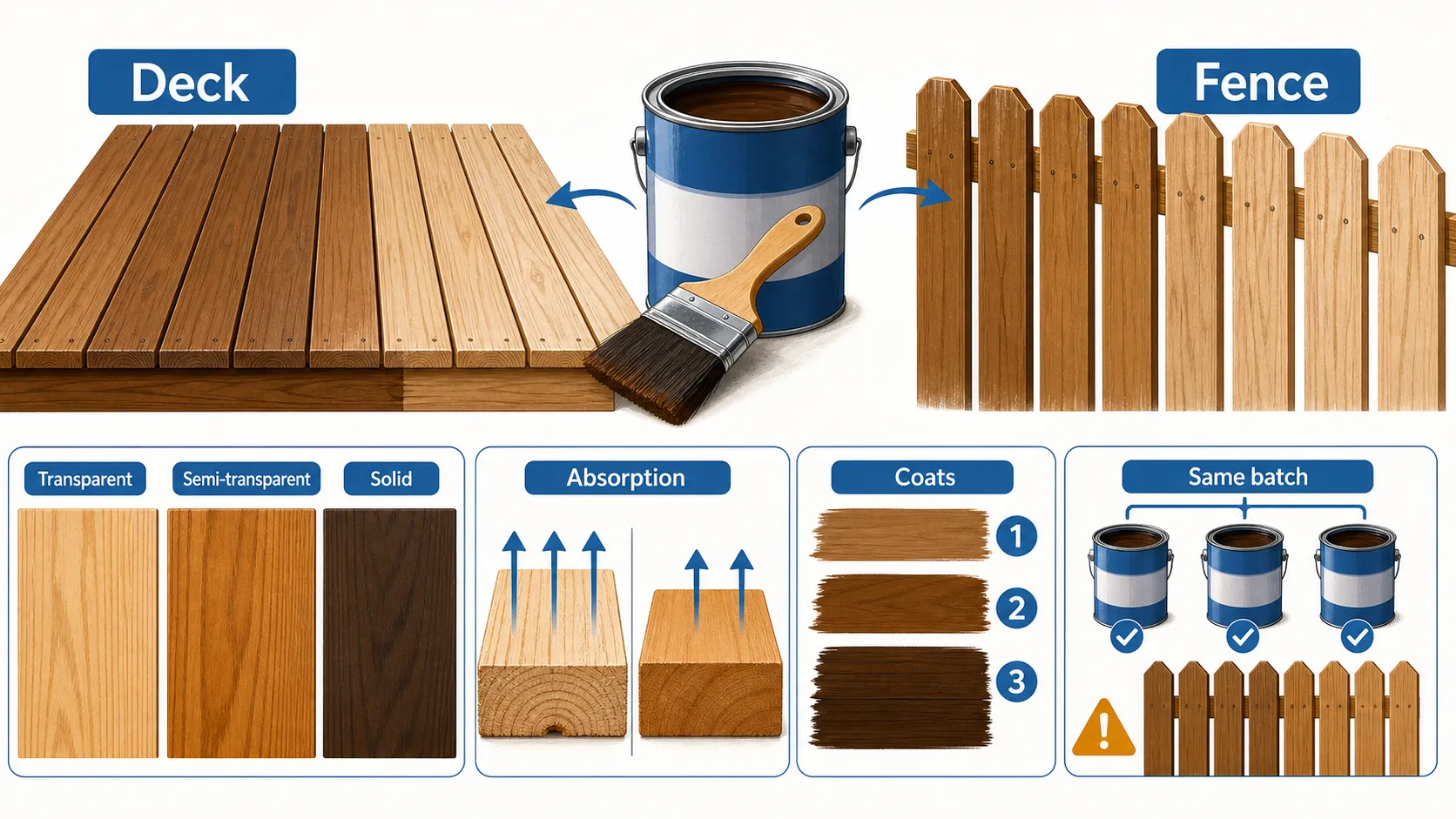
By the boards
Which stain suits a deck, a fence, a pergola or siding
Opacity is a durability decision dressed up as a looks decision. The coat counts below are the ones this calculator fills in when you pick a surface, and the last column is the reason for each.
Deckyours
2
Semi-transparent or semi-solid
Horizontal boards hold standing water and take every footstep, so two thin coats beat one heavy one.
Fence
1
Semi-transparent or solid
Vertical boards shed water and wear slowly, but rough-sawn cedar drinks fast enough to double the order.
Siding/Exterior Walls
2
Solid
Wall height means scaffolding, so the finish that lasts longest wins even if the can costs more.
Furniture/Small Projects
2
Semi-solid
Hands, glasses and sleeves wear a finish, and end grain on legs and stretchers drinks hardest.
Pergola/Arbor
1
Transparent
Decorative and rarely touched, so grain is the point. Post tops are the part that actually fails.
Coat counts are the defaults this calculator applies per surface. Raise them for bare or weathered boards and for anything that has gone grey.
From the deck rail
Wood stain questions: restain intervals, prep, oil against water
The eight things people ask once the boards are clean and the stain is in the truck.
Is deck stain different from fence stain?
Yes. Deck stains have more resin and UV blockers for foot traffic and standing water. Fence stains are thinner for vertical surfaces. You can use deck stain on a fence, but fence stain on a deck wears through in one season.
How often should I restain my deck?
Transparent stains last 1 to 2 years, semi-transparent 2 to 3 years, and solid stains 4 to 5 years. Splash water on the deck; if it soaks in within 30 seconds, it's time to restain.
Should I pressure wash before staining?
Yes, but keep the nozzle at 25-degree fan, stay 8 to 12 inches from the surface, and never exceed 1,500 PSI on softwood. Wait 48 to 72 hours before staining.
Which stain type should I choose?
Transparent shows full grain but lasts only 1 to 2 years. Semi-transparent balances grain visibility with 3-year durability. Solid hides the grain but lasts 4 to 5 years.
Can I stain pressure-treated wood right away?
No. New PT lumber has 40 to 60% moisture and needs 3 to 6 months to dry below 15%. Use a pin moisture meter to test before staining.
Do I need to sand before staining?
For new wood, light sanding with 80 to 100 grit removes mill glaze that repels stain. For previously stained wood, only sand if the old finish is flaking.
What is the best temperature for staining?
Apply between 50 and 90°F with no rain forecast for 24 to 48 hours. The ideal range is 60 to 75°F with low humidity. Avoid direct sunlight.
Oil-based vs water-based stain?
Oil-based penetrates deeper and lasts 20 to 30% longer, especially on hardwoods. Water-based dries faster (2 to 4 hours vs 24 to 48 hours) and has lower VOCs.
Staining a deck you have not built yet? Size the boards with the deck calculator and the lumber with the board foot calculator.
Three jobs
Stain quantities for three real jobs: deck, fence, pergola
The fence is the one that surprises people. It is three times the area of the deck and takes more stain on a single coat than the deck takes on two, because rough-sawn cedar drinks.
300 sq ft · 2 coats
2.5 gal
250 sq ft/gal · $100 material
12 x 20 ft pressure-treated deck
Railings have four exposed faces, so their linear run counts four times over, not once.
900 sq ft · 1 coat
5.0 gal
193 sq ft/gal · $175 material
150 ft rough-sawn cedar privacy fence
One side only. Rough-sawn cedar is why this lands well above what the label rate suggests.
192 sq ft · 1 coat
1.0 gal
200 sq ft/gal · $45 material
Pergola on 6x6 posts, rafters and slats
End grain on the post tops drinks several times what face grain does. Seal the tops first.
Imperial throughout, because these are fixed worked jobs rather than your own surface. Each one runs through the same coverage, absorption and half-gallon rounding as the readout above.
Label against reality
Stain coverage chart: square feet per gallon by opacity
The label rate is measured on smooth wood. The two columns after it are that same rate once your pressure-treated wood and its texture have had their say, which is the number your order is really built on.
| Opacity | Label rate | On your wood | Rough or weathered | Re-stain | Price |
|---|---|---|---|---|---|
| Transparent/ClearShows grain, minimal UV protection | 300 sq ft/gal | 300 sq ft/gal | 222 sq ft/gal | ~1.5 yr | $35/gal |
| Semi-Transparentyour stainPartial grain visible, good protection | 250 sq ft/gal | 250 sq ft/gal | 185 sq ft/gal | ~2.5 yr | $40/gal |
| Semi-SolidLight grain visible, better protection | 200 sq ft/gal | 200 sq ft/gal | 148 sq ft/gal | ~3.5 yr | $45/gal |
| Solid/OpaqueHides grain, maximum protection | 175 sq ft/gal | 175 sq ft/gal | 130 sq ft/gal | ~5 yr | $50/gal |
Pressure-treated is the reference species at an absorption factor of 1.00, so its column matches the label rate exactly. Pick another wood in the options panel and the two separate. Re-stain intervals are typical for a horizontal deck in full sun. A shaded vertical fence holds its finish longer, and the water test settles it: if a splash soaks in within 30 seconds, the wood is open again.
Gallons from area
How this stain calculator turns area into gallons
Two divisions and a round up. Length times width gives the area, the label rate gives the coverage, the wood's absorption factor bends that rate, and the coats multiply it.
area = length × widthdraw rate = label coverage ÷ absorption factorgallons = area ÷ draw rate × coatsorder = ⌈gallons × 2⌉ ÷ 2cost = order × price per gallonWorked at the defaults: 240 sq ft ÷ 250 sq ft/gal × 2 coats = 1.92 gal, rounded up to 2.0.
In the number
- The label coverage rate for the opacity you picked.
- The absorption factor for the species, applied before coats.
- Every coat at full draw, with no discount for the sealing the first one does.
- A round up to the half gallon, because stain is not sold by the ounce. Metric figures are converted after that round up.
Not in the number
- Surface texture, which the comparison above prices separately.
- End grain on post tops, spindles and cut ends, which drinks hardest of all.
- Railings, where four faces per board multiply the area you measured.
- Cleaner, brightener, brushes and the cost of a day in the sun.
Coating a wall rather than bare timber? That is a film on a surface, so use the paint calculator instead.
Disclaimer
These estimates are for planning purposes only. Actual costs vary by location, material availability, and project complexity. Always get at least 3 local quotes. This calculator does not replace professional advice.
Sources
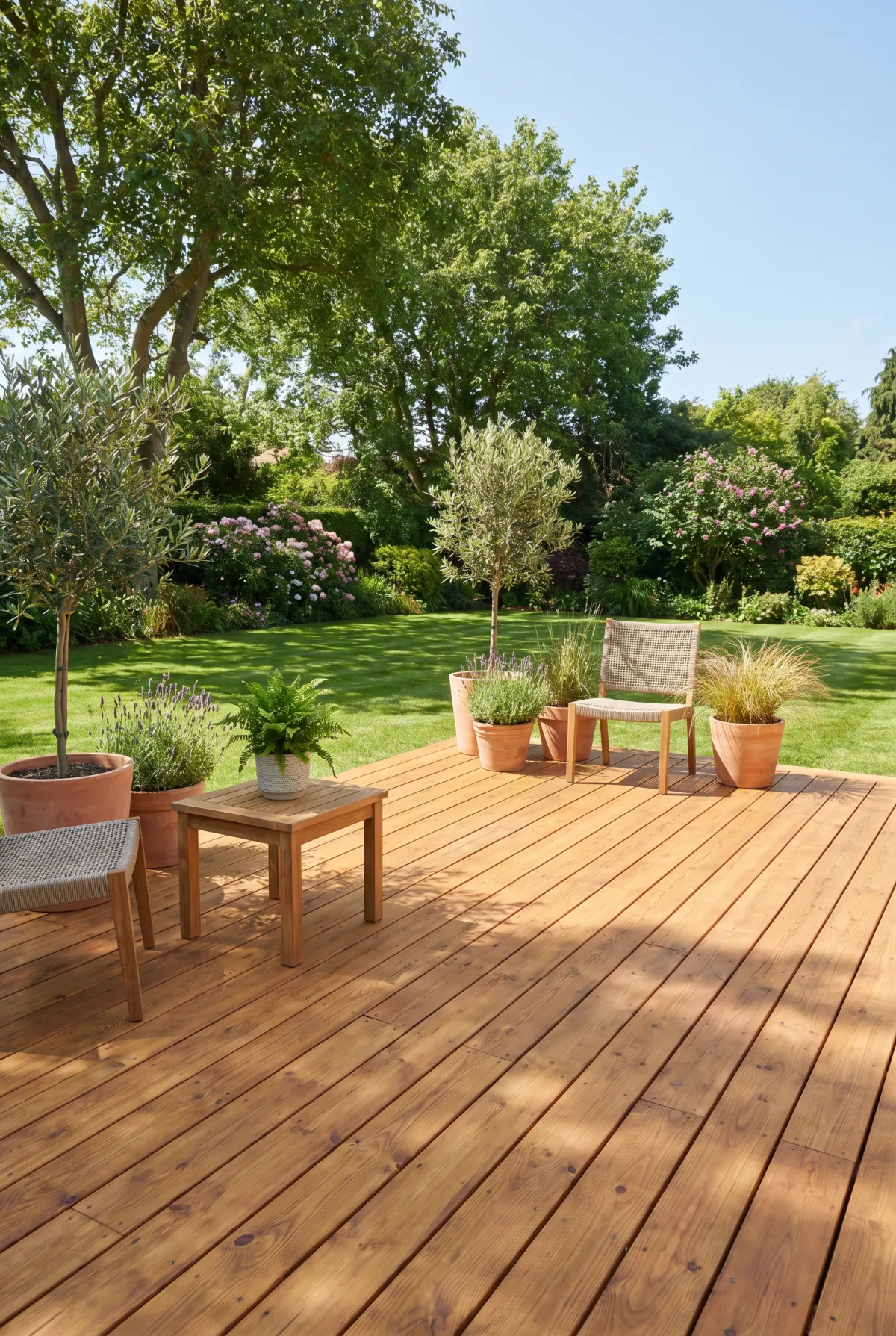
See 12 deck stain color ideas
Browse the looks, then price yours here.