Drywall Calculator
Estimate drywall sheets, mud, tape and screws, then see where the seams land.
Room Details
Estimates only. Not professional advice.
Board to order
17sheets
Regular 1/2 in at 4 x 8 ft, covering 525 sq ft with the 10% allowance already in it.
- Wall surface
- 384 sq ft
- Ceiling surface
- 144 sq ft
- Openings deducted
- 51 sq ft
- Drywall screws
- 8.5 lb
- Board, mud and screws
- $350 to $444
Materials only. Labour, a panel lift, corner bead, texture, primer and disposal are all separate. The tape figure is a per-sheet allowance; the seam ledger below counts the seam your own room actually makes.
Last updated August 5, 2026 by our expert review team.
Board prices
Drywall cost per sheet: four board types on one axis
The board is the cheapest decision on the job and the one people agonise over. All four types are priced here on the same axis at 4 x 8 ft, with your own sheet count applied on the right so the step from regular to rated board is a real number rather than a feeling.
Regular 1/2 in
your board$12 to $15
$204 to $255
Moisture-resistant
Bathrooms, kitchens, and laundry areas.
$14 to $18
$238 to $306
Type X fire-rated
Garages and rated assemblies where required.
$15 to $20
$255 to $340
Mold-resistant
Damp rooms where extra resistance is worth pricing.
$16 to $22
$272 to $374
The right-hand column is board only, before mud, tape and screws, so it moves with your sheet count and not with the finishing supplies.
- One 4 x 8 ft sheet covers
- 32 sq ft
- One 4 x 10 ft sheet covers
- 40 sq ft
- One 4 x 12 ft sheet covers
- 48 sq ft
- Door deduction, each
- 21 sq ft
- Window deduction, each
- 15 sq ft
- Allowance on top
- 10%
Seam ledger
Drywall seam ledger: where the tape and mud actually go
Sheet count follows area, so every estimator gets it roughly right. Tape and compound follow the total length of the seams, and that depends on how the boards land rather than on how much surface there is. Two rooms of the same size can need very different amounts of tape. Below, your own room counted seam by seam.
Alternate courses start half a board along, because stacking butt joints in one column is how a wall ends up with a visible ridge down it. The ceiling is in the ledger beside this drawing but is not drawn here.
Openings are not deducted from the seam totals, because the calculator carries the area of a door rather than its width. The wall to floor line is left out too, since baseboard covers it.
Same room, same hang, three board lengths. A longer board carries further between its square ends, so the butt column falls while the tapered column barely moves.
- Tapered joints
- 72 ftTwo factory edges meeting in a recess, which is the seam that finishes flat with the least fuss.
- Butt joints
- 44 ft38% of the field seam, in 11 joints. Square edges with no recess, so the compound has to be feathered out well past the tape.
- Ripped edges
- 0 ftNothing had to be cut down the long edge, so every field seam is a factory one.
- Inside corners
- 80 ft32 ft of wall to wall and 48 ft round the ceiling. Taped and mudded like any other seam.
- Total seam to tape
- 196 ftField seams plus corners, from the geometry of this room and this board length.
- The per-sheet allowance buys
- 136 ftShort of the 196 ft above. A per-sheet figure tracks the field seams; the corners scale with the room instead.
The ledger stops at a seam length on purpose. Turning that length into buckets of compound and rolls of tape needs a coverage rate per unit of seam, and this page does not carry one: the compound figure in the results panel is keyed to board area instead. Use the ledger to compare two layouts against each other, and the results panel to buy.
Hanging order
Hanging drywall: what to get right before the first sheet
Six habits that decide how much of the job is finishing work. Every one of them is settled before the board leaves the pile.
Board the ceiling first, then let the wall sheets push up tight under it. The wall panels carry the ceiling edge while you fasten it, and the corner between them ends up straight enough to tape.
Pick the sheet length for the seams, not only for the lift. A longer board removes butt joints from the middle of a wall, and the seam ledger above puts a number on that decision before you carry anything.
Hang the sheet across the framing and let the ends land on a stud or joist. A butt joint floating between two members moves as the building dries, and no amount of compound holds that flat.
Keep the waste allowance even after deducting the openings. Every cut around a door or a window leaves an offcut too small to use somewhere else, and the deduction has already taken the board away.
Prime the finished wall before the colour coat. New board and fresh compound drink paint at different rates, so work the numbers with the paint calculator once the sanding is done.
If the studs are still open, settle the cavity first with the insulation calculator. Board goes on last and comes off worst.
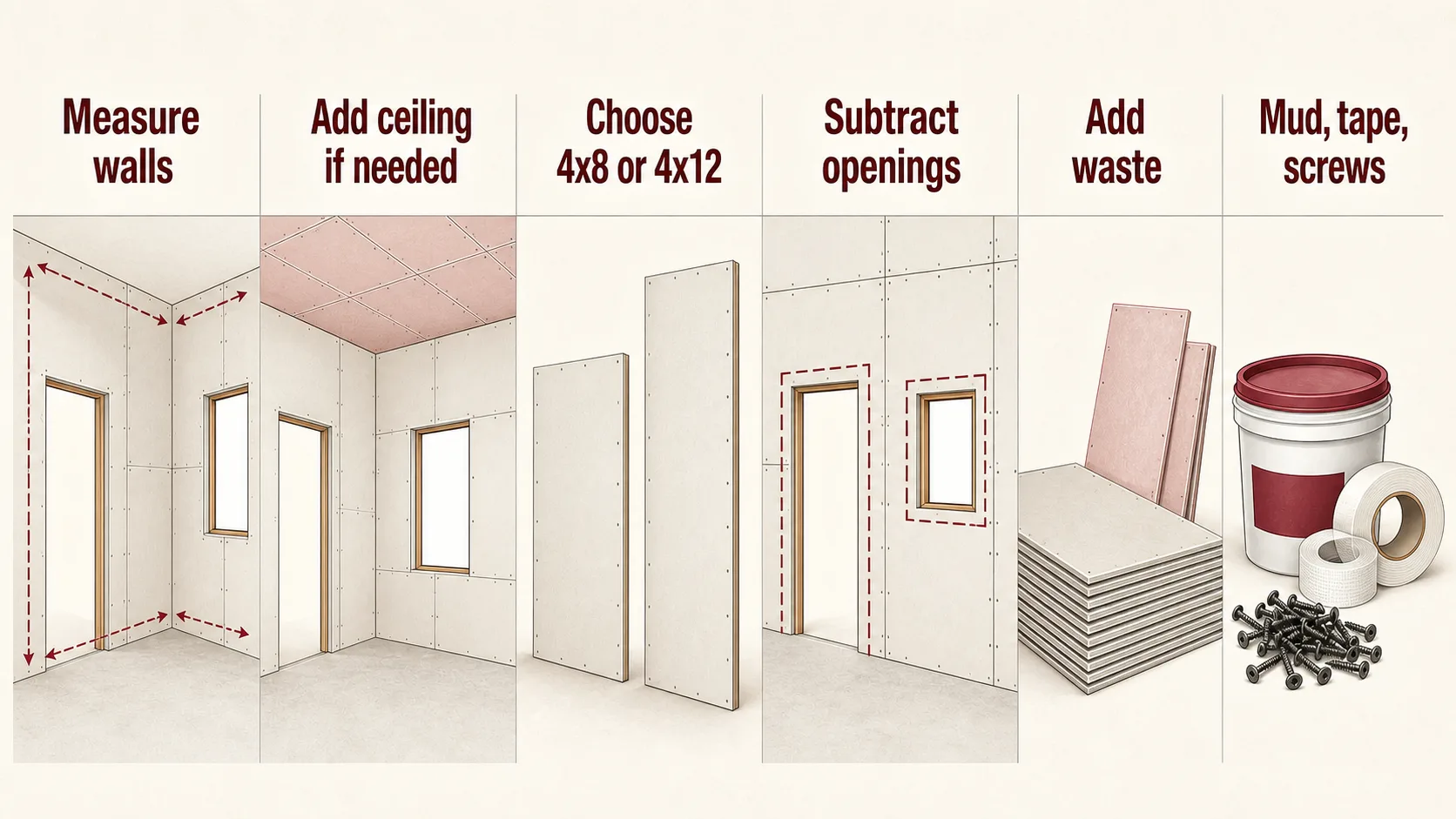
The same order of operations in one picture, from measuring up to the finishing supplies. Check the rated and wet-area assemblies against local code before any of it is bought.
Takeoff math
Drywall takeoff: the arithmetic behind every figure above
Four walls and an optional ceiling, less the openings, plus an allowance, divided into whole boards. The finishing supplies then hang off two different things, which is worth seeing written out.
wall area = 2 × (length + width) × wall heightceiling area = length × width, when includedopenings = doors × door area + windows × window areaorder area = (wall + ceiling − openings) × (1 + waste)sheets = ceil(order area ÷ sheet area)compound = order area ÷ coverage ratetape = sheets × tape per sheetscrews = sheets × pounds per sheetcost = sheets × board price + compound (gal) × $15 to $20 + screws (lb) × $8 to $10Compound scales with board area. Tape and screws scale with the sheet count. Neither of those is the same thing as the seam length in the ledger above, which is why a room chopped up by short walls can take the same board order and noticeably more finishing work. The sheet count rounds up, because nobody sells two thirds of a sheet.
Not included: corner bead, texture, primer, a panel lift, adhesive, delivery, disposal and labour. Fire-rated and wet-area assemblies are a code question, not an arithmetic one.
All three rates are editable in the advanced options, and every figure on this page moves when you change them. The tape rate is the one to question first if your room is full of corners.
Finishing failures
Drywall estimates that fall apart on site
Six failures, ordered by how early they happen. The first three are decided at the merchant and the rest with a trowel in your hand.
Starting from the floor area
Drywall is a wall and ceiling surface, not a floor plan. Four walls and a ceiling come to roughly three times the floor area of an ordinary bedroom, which is why a floor figure always underbuys.
Leaving the ceiling out by accident
The ceiling here is 144 sq ft of board on its own, and it is the hardest part of the job to hang. Decide it deliberately with the toggle rather than discovering it on delivery day.
Choosing the sheet length by what fits in the van
Shorter boards are easier to carry and leave more butt joints behind. That trade is a finishing cost, not a handling detail, and the ledger above puts a number on it.
Taping to a per-sheet allowance and forgetting the corners
A per-sheet figure tracks the field joints between boards. The inside corners scale with room shape instead, and on a small boarded room they can rival every field seam put together.
Deducting every opening down to the last cut
Openings do reduce board area, but the cuts around them produce offcuts nobody can use. Take the deduction and keep the allowance.
Ordering one board type for the whole house
Wet rooms, garages and rated assemblies each want a different board, and the price step between them is real. Confirm the assembly locally before the order goes in.
Mud and tape
Answers on drywall sheets, mud and finishing
Eight answers, opening with the sheet count people search for and working through to the fasteners.
How many sheets of drywall for a 12x12 room?
About 17 sheets of 4 x 8 board with 8 ft walls, one door, two windows, the ceiling included and a 10% allowance. Walls only, the same room comes to about 12. Both figures come straight from this calculator, so change any input above and they move.
What thickness of drywall do I need?
Half inch board for standard walls and ceilings. Five eighths, in Type X, for garage walls, furnace rooms and any fire-rated assembly your inspector requires. The thickness changes the board price and the weight you have to lift, not the seam length.
Should I use 4x8 or 4x12 drywall sheets?
Long boards on ceilings and long walls to cut out butt joints, short boards where you are working alone or turning a corner in a stairwell. A 4 x 12 sheet weighs 77 lbs against 52 lbs for a 4 x 8, and the seam ledger above shows exactly how much butt joint the swap removes from your room.
How much joint compound do I need?
About 1 gallon per 100 sq ft of board for three coats, which is the rate this calculator uses and the one you can edit in the advanced options. A 12 x 12 room with 8 ft walls and the ceiling included works out at about 5 gallons. That rate is keyed to board area rather than to seam length, so it cannot be converted into the seam length the ledger counts.
Do I need moisture-resistant drywall in bathrooms?
Yes. Green or purple board belongs in bathrooms, kitchens and laundry rooms, and behind tile in a shower you want cement board rather than any paper-faced gypsum at all.
How do I cut drywall for outlets?
Mark the box, drill the corners, then cut with a drywall saw or a rotary tool and test fit before a single screw goes in. Every one of those cuts leaves a square edge, which is why cut-outs add finishing work and not just waste.
Can I hang drywall over existing drywall?
For minor damage, yes, with 1-5/8 inch screws long enough to reach the studs through both layers. Check the ceiling framing before you double up there, because you are adding the full weight of a second layer.
How many screws per sheet of drywall?
Around 28 to 32 on a standard 4 x 8 sheet, which is about half a pound of 1-1/4 inch coarse-thread screws. That is the 0.5 lb per sheet the calculator assumes, and it is editable in the advanced options.
Board selection
Drywall board types and thicknesses, and where each belongs
The chart at the top of the page prices these four. This is the part that decides which one you are pricing, and the last row is the one people forget at the till.
Regular half inch
The default for walls and flat ceilings in a dry room. Everything else on this list is a reason to step away from it, and each step costs more per sheet.
Moisture-resistant
Bathrooms, kitchens and laundry rooms, where the air is wet but the board is not. It is not a tile backer and it is not a shower lining.
Type X fire-rated
Garage ceilings and walls, furnace rooms and any assembly your local code calls out. It is thicker and heavier, so a 4 x 12 in Type X is a two-person board.
Mold-resistant
Basements, crawl space walls and anywhere that has already grown something once. Worth pricing rather than assuming, since it sits at the top of the range.
What the order still does not include
Corner bead, texture, primer, a panel lift, delivery and disposal are all outside the figures on this page, and so is labour. If you are boarding a stairwell, work the run out with the stair calculator before you decide on a sheet length.
Room takeoffs
Drywall sheet counts for four real rooms
Run through the same arithmetic as the calculator above, with the seam ledger applied to each one at your current hang direction. The board figures move with the room; the seam figures move with how the boards land in it.
Small bedroom
14
sheets at 4 x 8 ft
$287 to $364
- Room
- 10 × 10 ft
- Wall height
- 8 ft
- Ceiling
- boarded
- Board
- Regular
- Compound
- 4.2 gal
- Butt joint
- 42 ft
- All seam
- 174 ft
Four short walls, so the boards land badly and the ceiling is a third of the order on its own.
Standard bedroom
17
sheets at 4 x 8 ft
$350 to $444
- Room
- 12 × 12 ft
- Wall height
- 8 ft
- Ceiling
- boarded
- Board
- Regular
- Compound
- 5.2 gal
- Butt joint
- 44 ft
- All seam
- 196 ft
The calculator's own default. Two courses of board reach the ceiling exactly, so nothing is ripped lengthways.
Living room, long board
19
sheets at 4 x 12 ft
$441 to $562
- Room
- 20 × 15 ft
- Wall height
- 9 ft
- Ceiling
- boarded
- Board
- Regular
- Compound
- 9.1 gal
- Butt joint
- 66 ft
- All seam
- 372 ft
These walls need a third narrow course, so a ripped strip runs along the top of each one and that seam has a cut edge on one side.
Garage walls
23
sheets at 4 x 12 ft
$599 to $791
- Room
- 24 × 24 ft
- Wall height
- 10 ft
- Ceiling
- left out
- Board
- Type X
- Compound
- 10.8 gal
- Butt joint
- 56 ft
- All seam
- 288 ft
No ceiling in the order, Type X board and a wider allowance, which is why the cost per sheet jumps.
All four use a 10% allowance except the garage, which uses 15%, and the default openings of one door at 21 sq ft and one window at 15 sq ft. Lumber for the framing behind any of this is a separate job, and the board foot calculator prices it.
Disclaimer
These estimates are for planning purposes only. Actual costs vary by location, material availability, and project complexity. Always get at least 3 local quotes. This calculator does not replace professional advice.
Sources