Fence Calculator
Calculate post count, material list, and cost for wood, vinyl, chain link, or composite fencing.
Fence Details
Wood Privacy
6ft
6ft dog-ear pickets, classic privacy fence. 15-20 years lifespan, medium maintenance.
Estimates only. Not professional advice.
Wood Privacy fence
97.00
linear ft of fence to build, gate openings already taken out, standing on 16 posts at 8.0 ft centres.
- Rails, 2x4
- 39
- Screws, estimate
- 260
- Fence materials
- $1,200
- Concrete, 32 × 50 lb
- $192
- Gate hardware
- $75
- Pro install, labour included
- $3,275
- DIY total, your labour
- $1,467
Concrete is priced at this page's flat allowance of 2 bags a post. The schedule further down works out what the hole you actually dig will take.
Last updated August 5, 2026 by our expert review team.
Three runs, priced
Fence cost by run length: three jobs end to end
Every figure below comes off the same rates and the same post rule the calculator above uses, so a price change moves these too. Gate openings come out of the fenceable length first, then each gate puts two dedicated posts back in.
Backyard privacy run
One straight run of pressure-treated wood privacy fence with a single walk gate, flat suburban lot.
- Run measured
- 150 ft
- Fence after gates
- 147 ft
- Bays at 8 ft
- 19
- Last bay
- 2.5 ft
- Posts to set
- 22
- 50 lb bags
- 44
- DIY
- $2,139
- Pro
- $4,875
Side yard with a drive gate
Galvanized chain link down a side yard with one double drive gate, wide enough to get a trailer through.
- Run measured
- 80 ft
- Fence after gates
- 68 ft
- Bays at 10 ft
- 7
- Last bay
- 8.0 ft
- Posts to set
- 10
- 50 lb bags
- 20
- DIY
- $880
- Pro
- $1,960
Whole back garden in vinyl
White vinyl panels around the full back garden with two walk gates, HOA colour approved.
- Run measured
- 300 ft
- Fence after gates
- 293 ft
- Bays at 8 ft
- 37
- Last bay
- 5.0 ft
- Posts to set
- 54
- 50 lb bags
- 108
- DIY
- $7,398
- Pro
- $13,350
Your run
- Fence after gates
- 97.00 ft
- Gates
- 1
- Post spacing
- 8.0 ft
- Bays
- 13
- Last bay
- 1.0 ft
- Posts to set
- 16
- Fence height
- 6.0 ft
Below grade
Fence post depth and concrete per hole
The part of a fence you can see is the part people estimate. The part that decides whether it is still upright in five years is underground. A picket fence is a row of levers standing in wind, and every one of them is held by a plug of concrete you have to buy, mix and carry. Change the post spacing and you change how many of these you dig.
One bay, drawn true in both directions, so the proportion is the real one. Almost everyone imagines the hole deeper and narrower than this, which is why the bag count surprises them.
- Posts to set
- 1613 bays, one closing post, two per gate
- Last bay
- 1.0 ftShort. Either cut the last bay to fit, or pull every post in to 7.46 ft and share the difference
- Buried against above grade
- 24 in under 6.0 ft25% of the post is out of sight, holding the rest of it up
- 50 lb bags a hole
- 2.0The bore less the post, over the depth above the gravel, at 0.375 ft³ a bag
- Bags for the whole run
- 331 more than the 32 the panel above prices. Buy to this number.
The 24 in depth, 10 in bore and 4 in of gravel are assumptions you can change in the calculator's options panel. They are not a code figure. Frost depth is set by your local building department and this page cannot look it up, so ask before you dig.
24 in
yours8.0 ft
0.77 ft³
2.0
33
36 in
9.0 ft
1.23 ft³
3.3
53
48 in
10.0 ft
1.69 ft³
4.5
73
Same 10 in bore and same 4 in of gravel in all three rows, so the only thing moving is depth. Going from the shallow row to the deep one roughly doubles the concrete without adding a single post.
Order of work
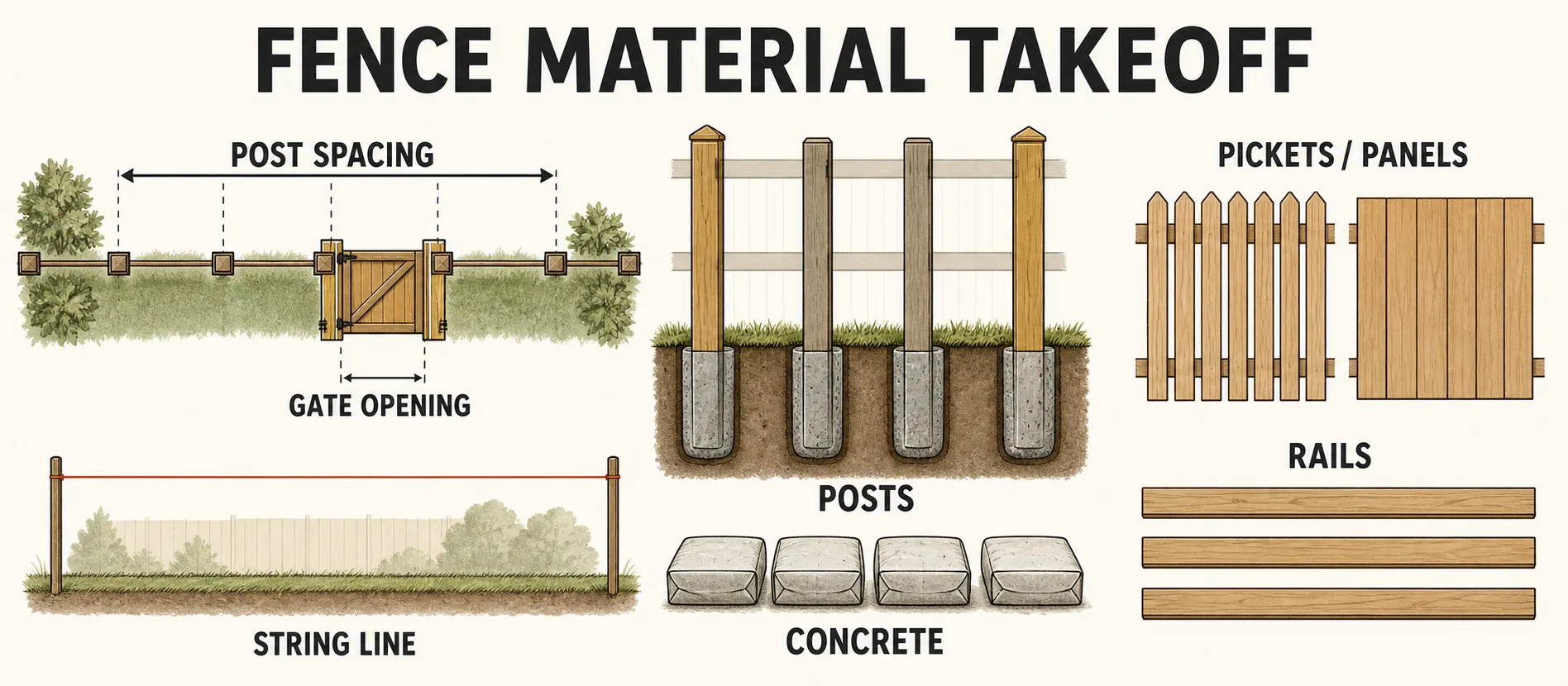
Fence material takeoff, in the order you buy it
A fence takeoff has a real sequence, because each line depends on the one above it. Get the gates out of the run before you count posts and everything downstream lands right.
- 01
Set the string line
Stakes at both ends, mason line pulled tight. Every post goes to that line, and the line is what tells you the real run length rather than the one on the survey.
- 02
Count the posts
Bays first, then add the closing post, then two dedicated posts for every gate. Gate openings come off the fenceable length before anything else is counted.
- 03
Order the concrete
This is the line most estimates miss. It scales with post count, not with fence length, so tightening the spacing raises it twice over.
- 04
Rails or panels
Wood runs three rails a bay. Vinyl and composite arrive as panels sized to the post spacing, so the spacing is fixed for you.
- 05
Pickets or fabric
Wood pickets divide the run by board width plus gap. Chain link comes off a roll and is cut to the run.
- 06
Gates and hardware
Hinges, latch, and an anti-sag kit on anything wider than a walk gate. Budget them per gate, not by the length of the run.
- 07
Fasteners last
Roughly twenty screws a bay for wood. Cheap, and the thing that sends you back to the store on a Sunday.
What leans, and why
Where a fence goes wrong, and what to do instead
Five of the six below are settled before the first post goes in the ground, and none of them is cheap to fix once the concrete has gone off.
Not calling 811 before digging
Hitting a buried line can cost $5,000 to $25,000. The 811 call is free, legally required, and takes 2 to 3 business days.
Setting posts without gravel drainage
Concrete alone traps water around the post base, accelerating rot. Add 4 to 6 inches of crushed gravel at the bottom of every hole first.
Building on or over the property line
A forced teardown costs the entire fence plus legal fees. Spend $300 to $500 on a survey, or locate your property pins with a metal detector.
Using undersized gate posts
4x4 posts are too weak for gates. Use 6x6 posts for all gate jambs in 12-inch holes with 3 to 4 bags of concrete each.
Ignoring the setback requirement
Most municipalities require 2 to 6 inches of setback from the property line. Check your zoning code before buying materials.
Skipping the string line for alignment
Drive stakes at both ends, stretch a mason line, and set every post to that line. Takes 10 minutes and prevents a wavy fence.
Five systems
Fence types compared: rate, lifespan, post spacing
Every rate here is the one the calculator charges, low being material only and high being material plus install. Post spacing matters as much as the rate, because it sets how many holes you dig.
| Fence type | Height | Rate / LF | Posts | Lifespan | Upkeep |
|---|---|---|---|---|---|
| Wood Privacyyour pick | 6 ft | $12–32 | 8 ft | 15-20 years | Medium |
| Wood Board-on-Board | 6 ft | $18–43 | 8 ft | 15-20 years | Medium |
| Chain Link | 4 ft | $7–22 | 10 ft | 20-30 years | Low |
| Vinyl Privacy | 6 ft | $22–44 | 8 ft | 25-30 years | Low |
| Composite | 6 ft | $30–55 | 8 ft | 25-50 years | Very Low |
Chain link runs its posts 10 ft apart against 8 ft for wood, so the same run needs fewer holes and less concrete before the rate is even considered.
Numbers worth keeping
- Wood privacy spacing
- 8 ft
- Chain link spacing
- 10 ft
- Vinyl panel width
- 6 ft
- Post depth, 6 ft fence
- 24 to 36 in
- Gravel under the post
- 4 to 6 in
- Hole bore, 4x4 post
- 10 in
- Hole bore, 6x6 gate post
- 12 in
- 50 lb bag yield
- 0.375 ft³
At the trade counter
Fence questions, answered plainly
Eight answers in the order they tend to come up, starting with the one that decides whether you build it yourself.
How much does a fence cost per linear foot?
Chain link: $15 to $22/LF. Wood privacy: $20 to $35/LF. Vinyl: $30 to $45/LF. Composite: $45 to $55/LF. DIY cuts labor costs by 40 to 60%.
How deep should fence posts be set?
Bury one-third of the total post length. A 6-foot fence with 8-foot posts means 24 inches in the ground. Cold climates may require 36 to 48 inches, because the footing has to sit below the local frost line.
Cedar vs pressure-treated: which is better?
PT costs 30 to 40% less but warps as it dries. Cedar stays straighter and is naturally rot-resistant, but costs $18 to $25/LF vs $12 to $18 for PT.
Do I need a permit to build a fence?
Most areas require permits for fences over 4 feet in front yards or 6 feet in backyards. Get a property survey before building to avoid teardown orders.
How long does a wood fence last?
Pressure-treated: 15 to 20 years. Cedar: 20 to 25 years with sealing every 2 to 3 years. Vinyl and composite: 25 to 50 years.
How many concrete bags per fence post?
Two 50 lb bags per 4x4 post in a 10-inch hole at 24 inches deep. Gate and corner posts (6x6) need 3 to 4 bags each. Our concrete bags calculator gives precise estimates.
What is the best post spacing?
8 feet on center is standard. Reduce to 6 feet in high-wind areas or for fences taller than 6 feet.
How do I prevent gate sag?
Install a diagonal steel anti-sag kit ($12 to $15) from top hinge corner to bottom latch corner. Required for any gate wider than 4 feet.
On site
Seven habits that decide how long a fence lasts
None of these is a sequence, so none of them is numbered. Each one is a decision made on the day that shows up years later.
Use 6-foot post spacing instead of 8-foot in high-wind areas. The shorter span dramatically reduces lever force and prevents leaning.
Budget 2 bags of fast-setting concrete (50 lb each) per 4x4 post. For 6x6 gate or corner posts, plan 3 to 4 bags per hole. Use our concrete bags calculator for exact quantities.
Place gates at the highest point of your fence run. Gates sag over time, and starting uphill gives extra clearance before dragging.
Call 811 at least 3 business days before digging. It is free and required by law. Fence height and setback come from your local zoning ordinance, not the building code, so ask the planning counter rather than looking for a national rule.
Layer 4 to 6 inches of crushed gravel at the bottom of every post hole before concrete. This prevents water from pooling around the post base.
Pre-stain or seal all six faces of every picket before installation, not after. This single step can add 5 to 7 years to a cedar fence's life.
For vertical board siding, use our board and batten calculator to estimate boards and battens for walls.
Takeoff math
What this fence calculator counts, and what it leaves out
It starts from the measured run or the yard perimeter you tick together, takes the gate openings out of the fenceable length, then puts two dedicated posts back for each gate. Everything after that follows from post spacing and the fence system you picked.
Picket counts use your own board width and gap, so a wider board or a wider gap cuts the count straight away. Panel systems ignore both, because the panel arrives already built.
Not in the number
- Corner and end posts are counted as posts, but not upsized. Gate and corner jambs usually want a 6x6 in a wider hole.
- Slope. A run on a hill is longer than its plan length and may need stepped panels.
- Permits, surveys, and setbacks. All local, all cheaper than a teardown.
- Frost depth, which decides your real hole depth and is set by your building department.
Treat the output as an ordering estimate. Confirm height limits, setbacks and post depth with your local code, and call 811 before a shovel goes in.
Disclaimer
These estimates are for planning purposes only. Actual costs vary by location, material availability, and project complexity. Always get at least 3 local quotes. This calculator does not replace professional advice.
Sources