Board Foot Calculator
Calculate board feet, cost, and weight for lumber dimensions or sawmill log measurements.
Nominal in, nominal out
Enter the size on the ticket, not the size on your tape. A 4/4 board is billed at 1 in thick after it has been planed thinner.
Estimates only. Not professional advice.
Board feet on the ticket
4.00
4 BF per board across 1 board. Order 4.60 BF to carry 15% waste.
4.60
bf with waste
576
volume in³
16.1
weight lbs
$24.00
per board
- Board feet before waste
- 4.00 BF
- Lumber at $6.00/BF
- $24.00
- Per board
- $24.00
- Order with 15% waste
- $27.60
A board foot is 144 cubic inches by definition, so the tally stays in board feet in either unit mode. Volume, weight and coverage follow the toggle.
Last updated June 9, 2026. Reviewed against the NHLA rules for measurement by our expert review team.
Off the planer
Board feet are billed on nominal size, not the wood you get
The tally above is 144 cubic inches per board foot of the size you entered. The board that arrives has been through a planer, so it is smaller than that in every direction. Here is your section drawn both ways at one scale.
1 x 6 in cross-section
Outline is the nominal size you are billed for. Solid is the surfaced board. Hatching is what the planer took.
Drawn at 74 px per inch, one scale across both drawings on this card. Length runs into the page and is not shown.
68.8%
wood in hand
0.25 in
off the thickness
0.5 in
off the width
0.50
bf per ft of length
Hardwood quarters, surfaced two sides
Hardwood thickness is quoted in quarters of an inch before surfacing. Rung height is the rough thickness; the solid part is what is left after the planer, and it is a flat 3/16 in off every rung.
Softwood and hardwood dress to different figures, which is why the two drawings disagree on a nominal inch. A 1 x 6 in the rack is 3/4 in thick. A 4/4 hardwood board out of the same yard is 13/16 in, because it started as a full rough inch.
Loss is drawn at the top of each rung. The planer actually takes half from each face.
Three orders
Board foot cost for three real lumber orders
A dining table, ten cabinet boxes and a load of sawlogs. Each one is a board foot tally first and a price second, and each one carries its waste allowance inside the figure.
8 ft x 42 in top
53 BF
$742 in lumber
Walnut dining table
44 BF of stock plus 20% waste. Top is three 8/4 walnut boards 8 in wide by 8 ft; legs are four 12/4 blanks at 12 BF. At $14/BF, with about $120 more in finishing supplies.
10 boxes
200 BF
$1,240 in lumber
Red oak kitchen cabinets
Face frames, doors and drawer fronts take about 120 BF of FAS at $7/BF. Sides and shelves take 80 BF of #1 Common at $5/BF. Cabinet carcases add roughly $180 in plywood on top.
5 logs, 16 in x 10 ft
450 BF
$1,125 in lumber
White oak sawmill logs
Doyle gives (16-4)^2 x 10 / 16 = 90 BF a log, so 450 BF at $2.50/BF. The same five logs scale 620 BF on International, about $425 more. Confirm the scale before agreeing a price.
Short on the tally
Where a board foot tally comes up short
Every one of these turns into money at the till or a second trip to the yard. None of them is an arithmetic error.
What goes wrong
Do this instead
1Measuring the planed board and pricing that
Board feet are billed on the nominal size. A 4/4 board is priced at 1 in thick even though it surfaces to 13/16 in. Measuring the finished board undercounts the tally you will be charged for.
2Ordering finished size with no milling allowance
Surfacing takes 3/16 in off the thickness and jointing takes 1/4 in off each edge, so a 6 in rough board yields about 5-1/2 in usable. Order 15 to 20% over the finished cut list.
3Comparing $/BF across two grades
FAS walnut at $14/BF yields 83% clear wood. #1 Common at $10/BF yields about 66%. Divide the price by the yield before deciding the cheaper grade is cheaper.
4Agreeing a log price without naming the scale
International 1/4 in reads 20 to 30% higher than Doyle on logs under 20 in. The same five logs can be 450 BF or 620 BF depending only on which rule the seller runs.
5Buying air-dried stock for indoor work
Air-dried lumber at 15 to 20% moisture shrinks 3 to 5% across the grain as it reaches indoor equilibrium, so an 8 in board can lose 1/4 to 3/8 in of width. Buy kiln-dried for furniture.
144 cubic inches
How this board foot calculator divides by 144
One board foot is 144 cubic inches: an inch thick, a foot wide, a foot long. Everything else on this page is that division, plus a rule for turning a round log into sawn boards.
- 01Enter the nominal sizeThickness, width and length of the board as the yard sells it, in inches or centimetres. The quarter presets fill the thickness for you. A 4/4 board goes in as 1 in even though it planes to 13/16 in.
- 02Divide the volume by 144Board feet equals thickness times width times length in inches, over 144. Length in feet is multiplied by 12 first. In log mode the volume comes from a scaling rule instead, because a log is round and tapered.
- 03Price it and add the bufferBoard feet times your price per board foot. Choosing a species fills in both the price and its weight per board foot, from pine at 2.3 lbs to hickory at 4.2 lbs. The waste slider then carries milling loss and defect cutouts.
The four rules on this page
- Sawn lumber
- BF = T x W x L / 144
- Doyle log rule
- BF = (D - 4)² x L / 16
- Scribner log rule
- BF = (0.79D² - 2D - 4) x L / 16
- International 1/4 in
- BF = (0.905D² - 1.62D - 9.19) x L / 16
T, W and L are inches, D is the small-end diameter in inches and L in the log rules is length in feet. Doyle reads 15 to 30% under International on logs below 20 in, which is why sawmills buy on one and sell on the other.
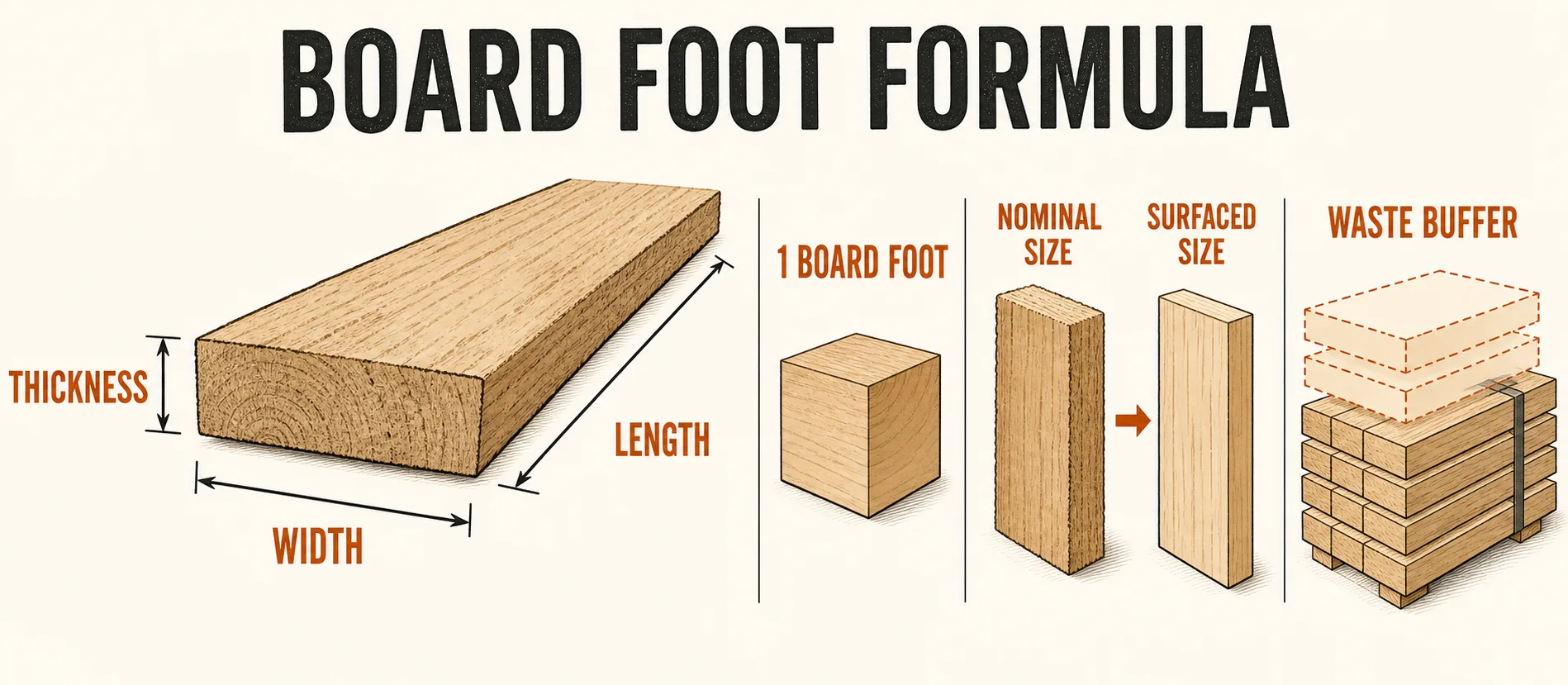
Price the nominal size, expect the surfaced board to arrive smaller, and buy over the cut list for milling and cutout loss.
Species and grade
Lumber price per board foot by species
Retail ranges for 4/4 FAS stock, on a shared axis to $20/BF. The tick on each bar is the price this calculator fills in when you pick that species, so the chart and the input can never drift apart.
Prices move with region, grade and supplier, and kiln-dried adds $1 to $3/BF. Ash has no tick because it is not in the species list. Hickory is in the list at $7/BF and 4.2 lbs/BF but has no published range here.
Before you mill
Milling allowances worth building into a board foot order
None of these change the division by 144. All of them change how much lumber you put on the order form.
Walnut runs $10 to $18/BF while poplar is $3 to $5/BF. On painted work, poplar for the hidden parts saves $7 to $13/BF across roughly 60% of the material.
S2S milling takes 3/16 in off the thickness, so 4/4 rough at 1 in finishes at 13/16 in. Buy 8/4 when the drawing calls for 1-1/2 in finished.
Order rough lumber 15 to 20% over the cut list. Milling, defect cutouts and crosscutting all take their share. Our rafter calculator gives you the board feet a roof frame needs before you add that buffer.
For walls rather than furniture, our framing calculator counts studs and plates directly instead of board feet.
Kiln-dried at 6 to 8% moisture costs $1 to $3/BF more than air-dried at 15 to 20%, and air-dried stock can shrink up to 1/4 in across an 8 in board as it settles indoors.
Weight per board foot swings hard by species: balsa is 0.7 lbs, ipe is 7.2 lbs, and the 3.5 lbs default here suits oak, maple and cherry. Decking instead? Our deck calculator prices composite and lumber side by side.
Flooring is sold by the box, not the board foot. Our hardwood flooring calculator works in boxes by species with Janka ratings.
NHLA FAS grade guarantees 83% clear on one face against 66% for #1 Common, which is hours of defect sorting you do not do. Worth the premium on furniture.
Battens and siding go by linear foot. Our board and batten calculator counts boards, battens and linear feet for a wall.
Rough to finished
Rough, S2S and surfaced: reading a lumber quote
Three words on a quote decide what turns up on the truck. Rough is straight off the saw. S2S has been planed on both faces. Surfaced dimensional stock has been dressed on all four sides and sold under a name it no longer measures.
| Sold as | Billed | Arrives | Wood | BF per ft |
|---|---|---|---|---|
| 1 x 6 | 1 x 6 | 3/4 in x 5-1/2 in | 68.8% | 0.50 |
| 2 x 4 | 2 x 4 | 1-1/2 in x 3-1/2 in | 65.6% | 0.67 |
| 2 x 6 | 2 x 6 | 1-1/2 in x 5-1/2 in | 68.8% | 1.00 |
| 4 x 4 | 4 x 4 | 3-1/2 in x 3-1/2 in | 76.6% | 1.33 |
Four sizes, because these are the four this site publishes a dressed dimension for. Ask the yard for anything else rather than assuming a 1/2 in loss, since the allowance changes with thickness. The last column is the nominal section divided by 12, the same arithmetic the calculator runs on your own length.
Hardwood quoted in quarters is a different convention again. A 4/4 board is a full rough inch and surfaces to 13/16 in, not the 3/4 in a softwood 1 x board dresses to, so the two never land on the same finished thickness.
At the lumber counter
Board foot questions asked at the lumber counter
What is a board foot?
144 cubic inches of lumber: 1" thick, 12" wide, 12" long. It is the standard pricing unit for hardwood in the US.
How do you calculate board feet?
Thickness (in) x Width (in) x Length (in) / 144. A 1" x 6" x 8ft board = 4.00 BF. At $8/BF, that board costs $32.
What is the Doyle log scale?
BF = (D-4)^2 x L / 16. Most common in the eastern US but underestimates yield on logs under 20" by 15 to 30%.
How much does a board foot cost in 2026?
Pine $2 to $4, poplar $3 to $5, red oak $5 to $8, cherry $7 to $12, walnut $10 to $18. FAS grade adds 20 to 40%.
What does 4/4 lumber mean?
Rough thickness in quarter-inches: 4/4 = 1", 8/4 = 2". Surfacing two sides takes 3/16" off the thickness, so 4/4 finishes at 13/16". See the NHLA grading rules for full standards.
Board feet vs linear feet?
Linear feet measures length only. Board feet measures volume. A 2" x 6" x 1ft board is 1 linear foot but 1 board foot. Need to convert? Try our sq ft to linear ft calculator.
Which log scale gives the highest yield?
International 1/4" scale reads 10 to 20% higher than Doyle on logs under 28". Buy on Doyle, sell on International.
How much waste for rough lumber?
Plan 15 to 20% for surfacing, edging, and defects. Complex projects may waste 25 to 30%; simple slab projects as little as 10%. Planning a deck project? Factor in extra for outdoor exposure cuts.
Disclaimer
These estimates are for planning purposes only. Actual costs vary by location, material availability, and project complexity. Always get at least 3 local quotes. This calculator does not replace professional advice.